


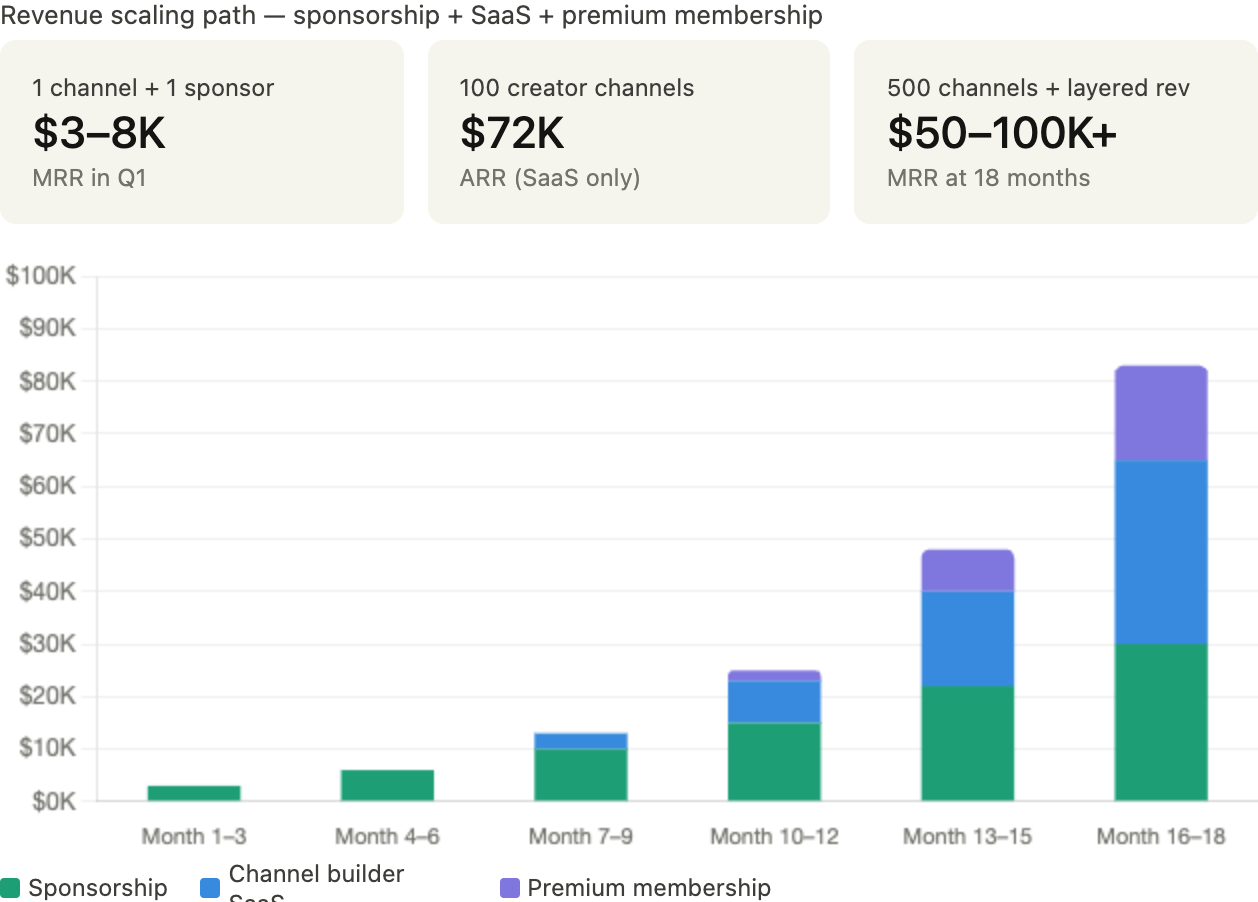
A single channel with 50,000 viewers and one sponsor can clear $3K–$8K/month in the first quarter. At 500 creator-operated channels, the path to $50K–$100K+ MRR opens within 18 months — with near-zero marginal cost per channel added.
This is a content curation startup idea at the intersection of creator tools, FAST streaming, and the growing "just put something on" behavior reshaping how people watch video.
A London developer named Steven Irby shipped a side project earlier this month called Channel Surfer. It turns YouTube into a cable-style TV guide with topic channels, scheduled programming, mid-stream tuning, and a little viewer counter so you know other people are watching with you. At launch it had 40 curated channels covering everything from AI to gardening. It pulled 10,000 views on day one. TechCrunch, Engadget, Gizmodo, Hypebeast, and Android Authority all covered it within 48 hours.
OMG this blew up overnight! I got over 10,000 views on day 1. 🤯 pic.twitter.com/fY20ZVB3Xl
— Steven Irby (@StevenIrby) March 12, 2026
The product still has no real backend. It's a static Next.js site hosted on Cloudflare, with real-time glue from PartyKit. The channels are hand-picked YouTube embeds.
That matters. Because what Irby accidentally demonstrated is how thin the product layer can be between the world's biggest video library and a dramatically better viewing experience. The value lives in packaging, sequencing, and removing the burden of choice — and there's a real SaaS business hiding inside the gap between content abundance and viewing ease.
Why This, Why Now
Three structural forces are converging, and they create a window for small teams building media automation tools and lean-back video products.
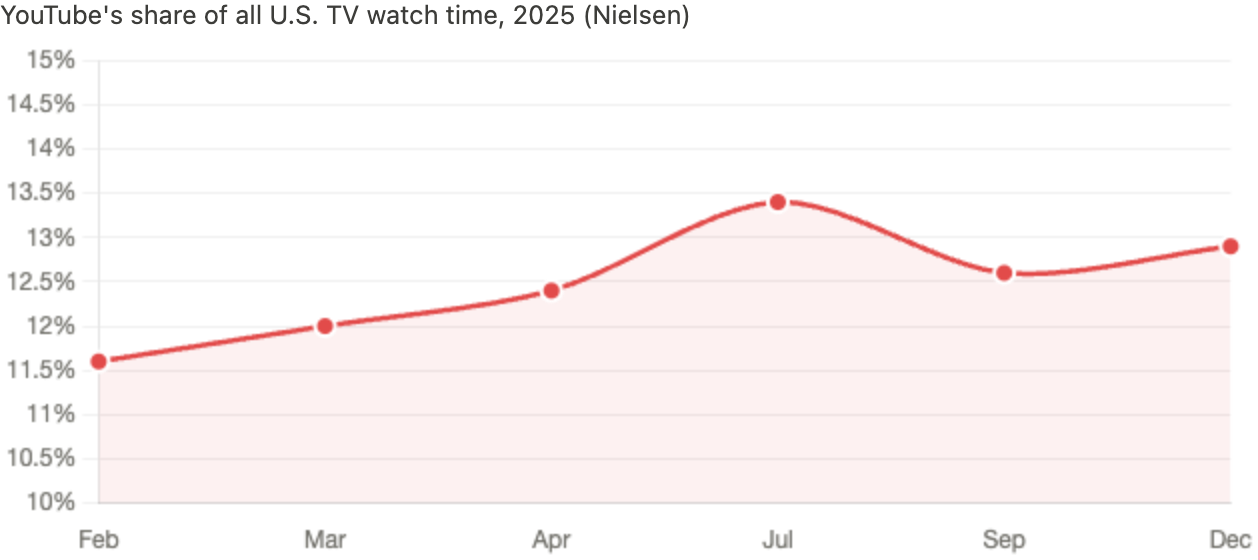
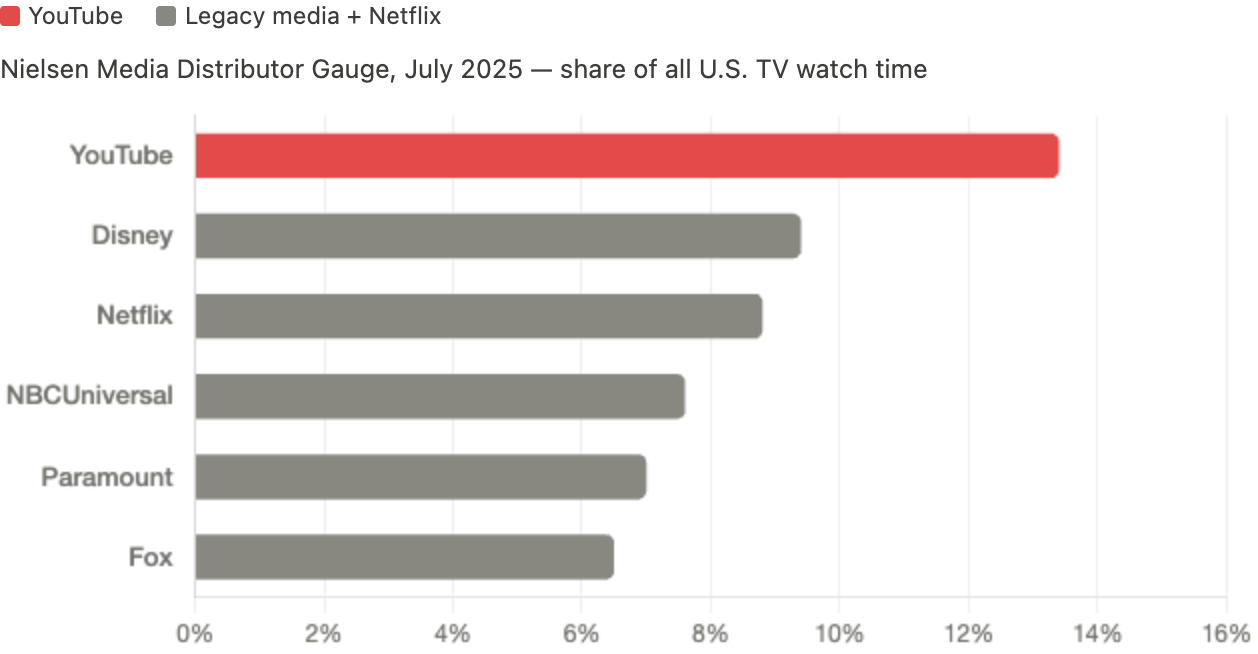
YouTube is television now. Viewers watch more than 1 billion hours of YouTube on TV screens every day. TV has surpassed mobile as the primary device for YouTube viewing in the U.S. Nielsen's April 2025 Media Distributor Gauge showed YouTube capturing 12.4% of all U.S. TV watch time — more than Disney, Paramount, NBCUniversal, or Netflix. By July 2025, that share hit 13.4%. Channels earning six figures or more from TV-screen revenue grew over 45% year over year. YouTube is preparing creators for television behavior, and that shift opens the door for new packaging layers on top.
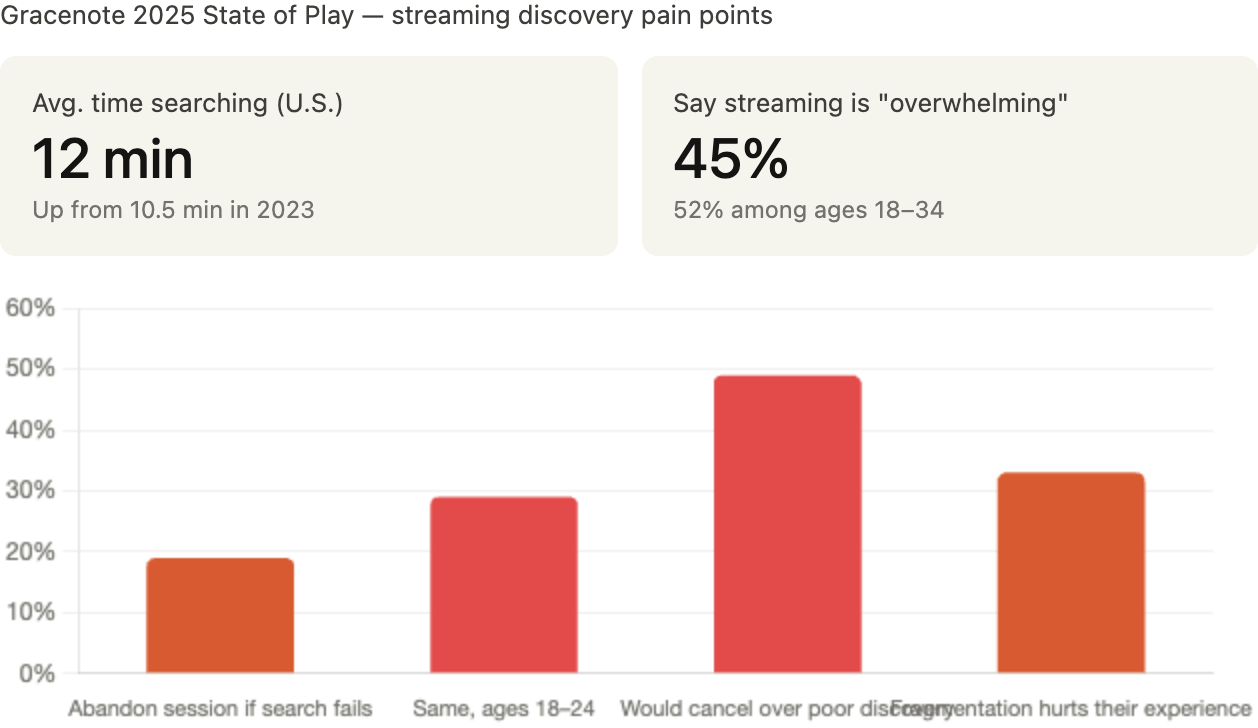
Discovery is broken. Gracenote's 2025 State of Play report found that 19% of viewers abandon a session entirely if they can't find something to watch, and that number jumps to 29% among 18-to-24-year-olds. Nearly half said they'd cancel a streaming service because finding content is too hard. American viewers now spend 12 minutes searching before they start watching, up from 10.5 in 2023. And 45% of all streaming users describe the experience as "overwhelming." Access to content stopped being the problem years ago. Navigation cost is the problem now. Choice has become friction, and a better container creates value even when the underlying content is free.
FAST proves the behavior is real. Free ad-supported streaming hours in the U.S. grew from 1.3 billion to 1.8 billion through August 2025 — a 43% year-over-year jump. Forty-five percent of U.S. internet households now regularly watch FAST. The global FAST market is projected to hit $31.8 billion by 2030 at roughly 21% CAGR. Two-thirds of viewers said they'd rather watch ads and save money than pay to avoid them. Just one in eight said they can't tolerate ads at all.
FAST proved the concept. Channel Surfer proved the packaging. The gap in between is the opportunity.
The Heist: Build the Lean-Back Layer for the Creator Internet
A retro skin on YouTube is a fun product. "Lean-back operating system for internet video" is a business.
A pure nostalgia app has weak defenses. The interface can be cloned in a weekend. The content is rented from YouTube embeds. The brand can spread fast, but it fades fast, too. If you stop at "YouTube, but like cable," you end up with a charming traffic spike, some social buzz, maybe lightweight sponsorship revenue, and then a ceiling. Channel Surfer's press coverage confirms the novelty angle is strong — but novelty-driven experiments often flatten hard after week one without deep daily context fit.
The deeper play is to treat linear packaging itself as the product.
The old streaming promise was "watch anything." The winning behavior now is "show me something good without making me work." If abundance is free, curation becomes economic infrastructure. If YouTube is now a TV surface, then whoever owns the easiest, most emotionally legible way to consume a category can carve out a durable wedge — something closer to a micro SaaS for video curation than a media company.
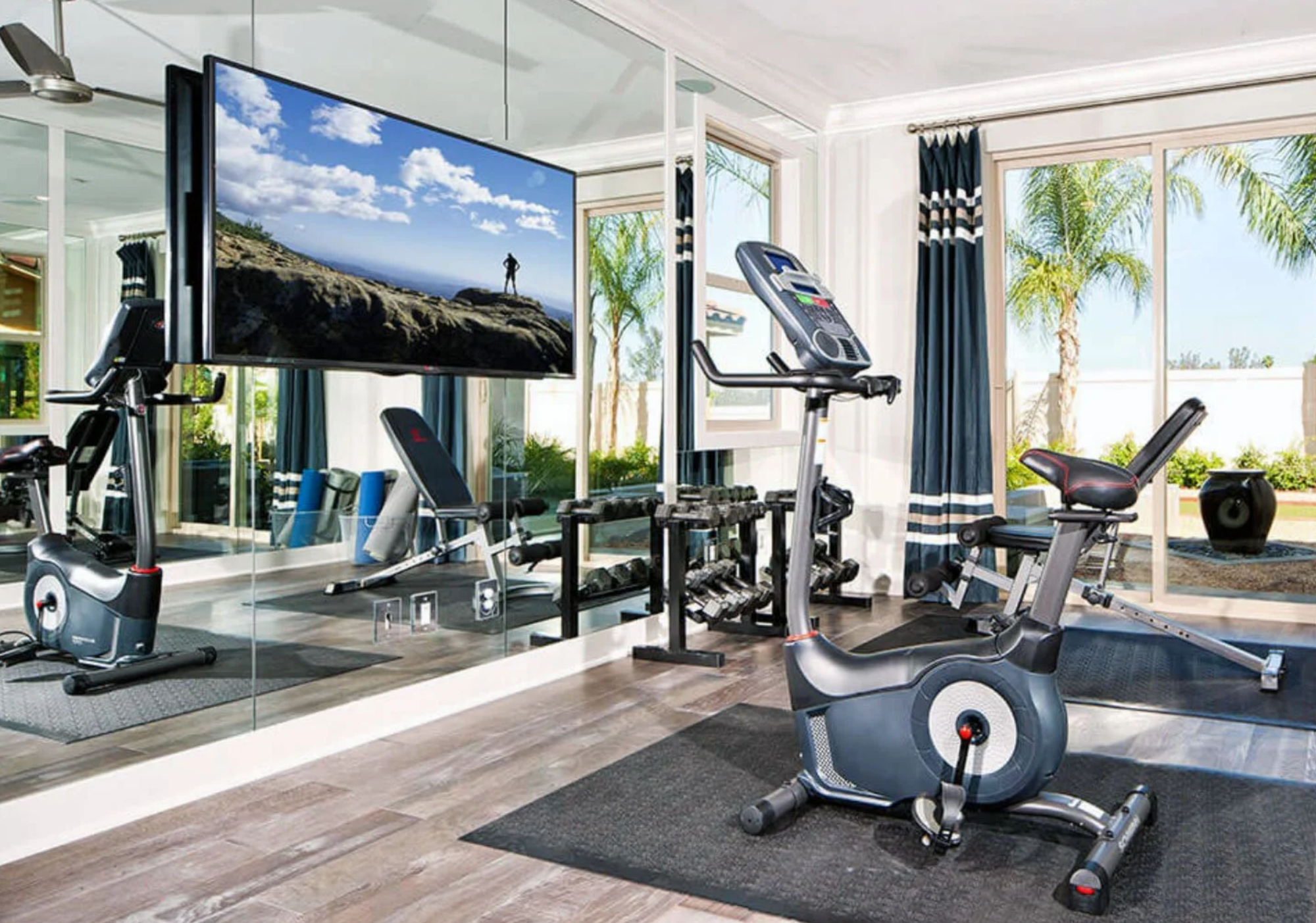
Here's the contrarian read: a lot of founders still think the media opportunity is in generating more content. The better opportunity may be in reducing the number of decisions between the user and a satisfying session.
This works as a quick heist and as a long-term company. "Cable TV for YouTube" is social catnip — nostalgic, visual, easy to demo. You can get attention with very little product. The durable version is software that linearizes the creator internet: taking on-demand archives and turning them into passive channels. Newsletters, podcasts, clips, live streams, and libraries packaged into time-based blocks. Creators acting like networks. Brands acting like channels. Viewers escaping feed fatigue.
Pick an Energy State, Not a Genre
The smartest first move is a vertical lean-back product for one audience with one clear energy state.
Energy state matters more than genre. Nobody wakes up thinking, "I want a metadata-rich rediscovery interface for user-generated video." They think, "I'm tired. I want something on while I cook." Or, "My kid needs 40 safe minutes." Or, "I want founder content in the background while I work."
Design for context, not category:
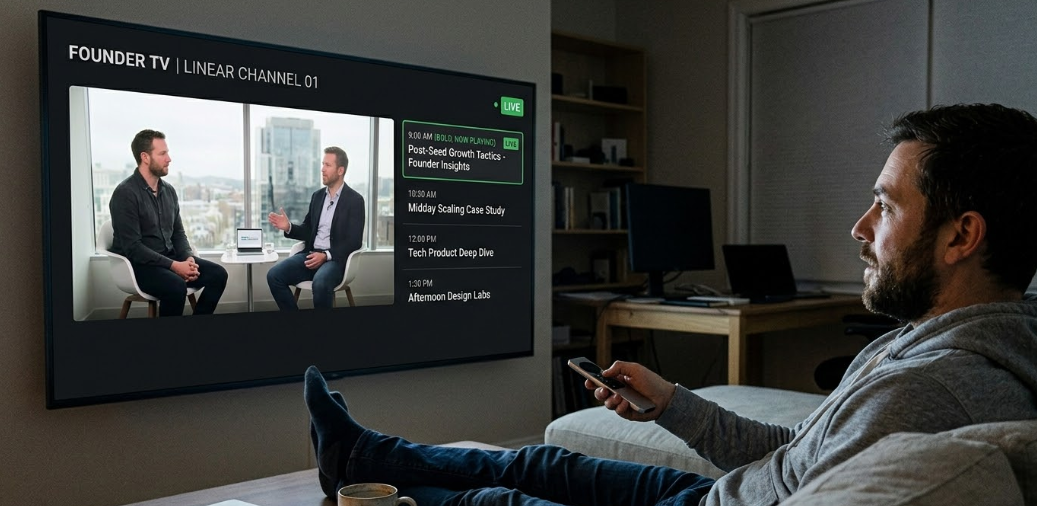
- Workday Founder TV — background business content from 8 a.m. to 6 p.m., programmed by energy arc. Morning strategy, midday interviews, afternoon deep dives.
- Safe Curiosity TV for ages 6–10 — vetted, sequenced educational content with no algorithmic rabbit holes.
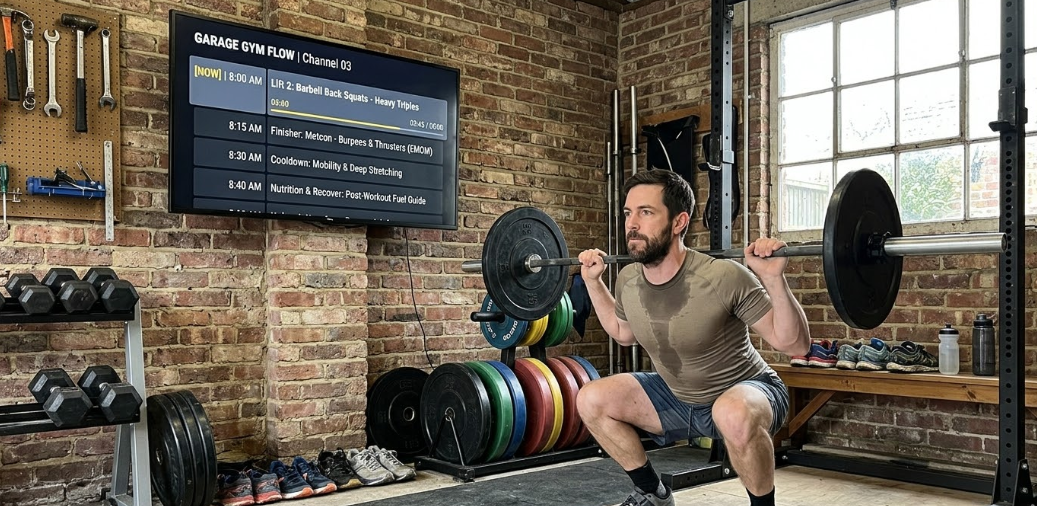
- Garage Gym Flow — warm-up, lift, finisher, cooldown, programmed as a single continuous session.
- Sunday Cook TV — recipe walkthroughs, kitchen culture, food docs, sequenced for a 3-hour cooking window.
Building around context improves everything downstream: the homepage copy, the programming logic, the sponsorship inventory, the retention loop, and the word-of-mouth story.
It also gives you a real acquisition angle. Parents share "safe kids TV." Founders share "passive startup TV." Coaches share "always-on workout TV." People don't share "interesting interface experiment" for very long.
Where the Moat Actually Is
Not content ownership. Not code. Not even the first channel lineup.
The moat develops across four layers, and they compound over time.
Sequencing data. You learn which transitions keep people in session. Not just which videos perform individually, but which order works. What should follow a 9-minute explainer? When should a high-energy clip reset attention? How much topical drift can a viewer tolerate before the session feels broken? That data becomes a genuine asset if you instrument it properly from day one. Nobody else has it because nobody else is running this experiment.
Audience trust. In a world of too much content, trust shifts from the file to the feed. The viewer stays because your channel reliably feels right. Mood consistency. Editorial pacing. An ambient promise that the next thing will also be good. That's what television networks used to own, and it's up for grabs in the internet video layer.
Creator-side tooling. Once creators and niche publishers can launch their own always-on channels on your rails, you've crossed from media product to infrastructure. The creator doesn't need to build an OTT stack or negotiate carriage. They need a schedule, a theme, a sponsor slot, and a link.
Aggregated ad inventory. A network of niche linear channels becomes sellable. One founder channel is a sponsorship. Fifty niche business channels is an ad network. One kids STEM channel is a parent-tech experiment. Twenty vetted family learning channels is media inventory. That jump — from single product to ad network — is the real platform path. And it maps to where advertisers are already heading: FAST revenue growth and the shift of major SVODs into ad tiers confirm that buyers will pay for contextual, segmentable, CTV-like inventory.
The Business Model (in Sequence)
Don't start with subscriptions alone. That's the cleanest narrative, but it's usually the weakest opening move unless the curation is unusually premium. Given that viewers already tolerate ads on FAST and prefer free access in many cases, you likely need substantial personalization, parental controls, or cross-platform perks before a consumer tier becomes compelling.
Start with three revenue paths, deployed in order.
Unlock the Vault.
Join founders who spot opportunities ahead of the crowd. Actionable insights. Zero fluff.
“Intelligent, bold, minus the pretense.”
“Like discovering the cheat codes of the startup world.”
“SH is off-Broadway for founders — weird, sharp, and ahead of the curve.”


