


The Creator Oracle: Turn a YouTube Back Catalog Into a Paid AI Assistant
The signal: Google is teaching YouTube viewers to ask questions instead of scrubbing through videos. The steal: Build the creator-owned, monetizable version of that behavior shift. Best first market: Education and problem-solving creators with deep evergreen back catalogs. Business model: Productized onboarding, a branded assistant on the creator's own site, and a revenue share on subscriptions. Scale: A credible micro-SaaS and agency hybrid with a path to $10K–$50K MRR. Platform-scale upside exists, but it should be earned rather than assumed.
The Internet Is Learning to Skip to the Answer
For years, YouTube creators optimized for one number: watch time. Sharpen the hook, stretch the session, build the playlist, turn one view into three. The logic was clean. The longer viewers stayed inside YouTube, the more ads the platform served, the more it recommended, and the more distribution it handed back to the creator.
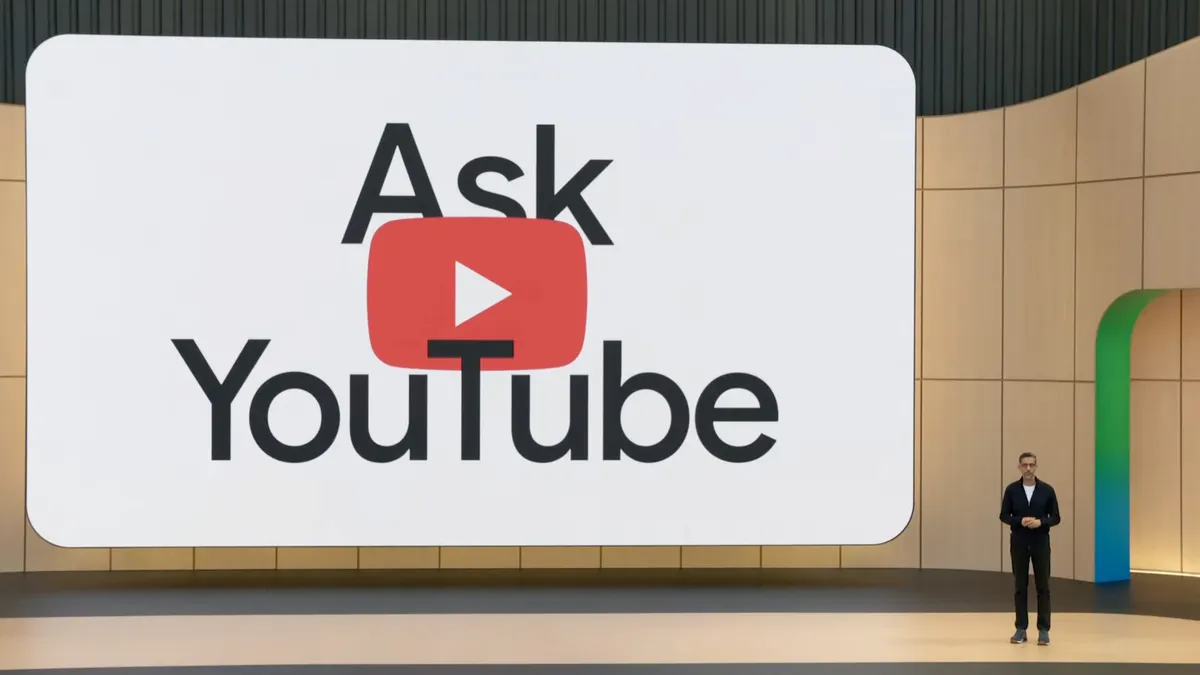
Google is now complicating that bargain. At Google I/O on May 19, 2026, YouTube announced Ask YouTube, a Gemini-powered conversational search experience. A viewer can type a complex question, refine it with follow-ups, and receive a structured answer assembled from relevant long-form videos and Shorts. The feature jumps straight to the moment in a video that answers the question, so nobody has to hunt. It's live for U.S. Premium subscribers on desktop now, with a broad U.S. rollout planned for the summer. YouTube is becoming less a library you browse and more a knowledge base you interrogate.
The defensive reaction is to complain that Google is turning your library into a commodity. The better reaction is to steal the interface. Build a sharper version for a narrower use case, host it on the creator's own turf, and put the creator back in control of the customer relationship.
Here's the opportunity:
The money: One coding creator converting 300 subscribers at $12 yields $3,600 MRR for them and roughly $689 MRR for you. Thirty accounts is about $20,700 MRR.
Inside:
• Two-stage pricing: pilot rev-share to vertical SaaS
• MVP scope built on creator authorization
• Coding-first GTM with demo wedge + outreach script
• Four moats beyond the chatbot
Ask YouTube Just Normalized a New Behavior
People won't stop watching videos. Entertainment, personality, and visual demonstration stay valuable. But a huge share of YouTube has always been consumed instrumentally. The viewer doesn't want the 28-minute tutorial. They want the one command that fixes the deployment error, the three exercises that quiet a sore shoulder, the reason a campaign stalled. Google just stripped the friction out of getting that answer, and the answer gets extracted from a creator's archive whether the creator participates or not.
Ask YouTube sits behind Premium today, so the behavior shift is still early. That timing is the gift. The expectation is forming now, before any creator owns the premium version of it.
Build a paid Creator Oracle: a branded, creator-owned AI assistant trained on a channel's YouTube archive, newsletters, course materials, PDFs, and frameworks. It lives on the creator's website. The audience asks questions. It answers in the creator's voice, cites the original videos, and links to the exact timestamps. Some answers are free. Deeper usage sits behind a subscription. The creator already spent years building the raw material. The job is turning that archive into recurring revenue.
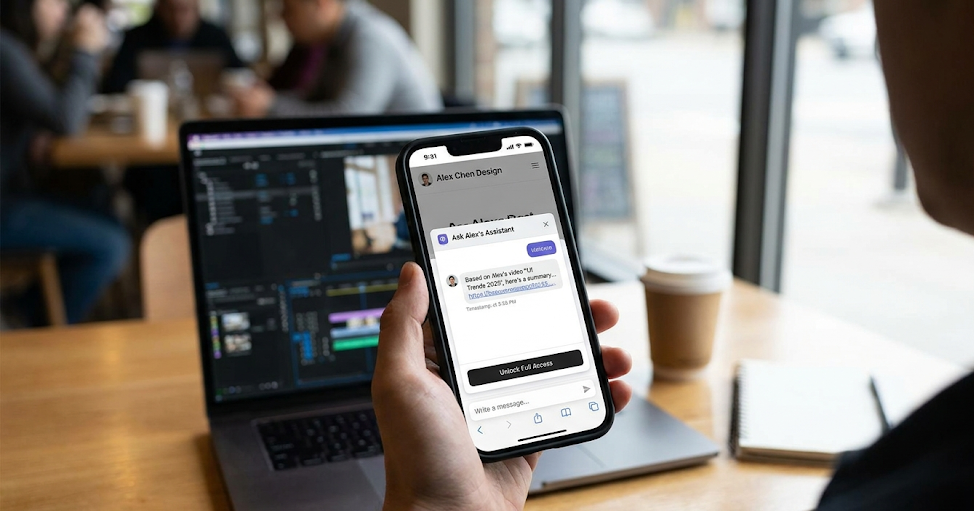
Picture a creator with 180 evergreen videos on backend development. A viewer lands on the site and types:
I'm deploying a FastAPI app to AWS. My container works locally, but the health check keeps failing. What should I inspect first?
A generic chatbot offers a generic checklist. The Oracle answers using the creator's preferred stack, terminology, and teaching style. It pulls explanations from three older videos, cites them, links to the useful timestamps, asks one clarifying question, and recommends the creator's paid DevOps course if the viewer needs the full walkthrough.
The customer isn't paying for novelty. They're paying for compression. Instead of scrubbing through a dozen videos and guessing which advice still holds, they get a useful first answer in seconds. Instead of recording another FAQ video or answering the same Discord question for the hundredth time, the creator monetizes knowledge that already exists. The promise is plain: turn years of content into a 24/7 assistant for your audience, without filming another video.
That beats "protect your AdSense." Defensive positioning rides the Ask YouTube news cycle for attention, but the durable product isn't an anti-Google protest. For the right creator, the Oracle works three jobs at once: a subscription product for superfans, a lead-generation assistant that captures questions and emails, and a customer-success layer that supports course buyers and coaching clients between human touches. That third job may be the most valuable. A $9 assistant is a nice-to-have. An assistant that lifts course completion, deflects repetitive support, and flags qualified buyers for a $499 course or a $3,000 consulting package is much harder to cancel.
This Market Already Exists, Which Is Good News
This isn't pristine white space, and that's a feature. The category already has working businesses. Delphi sells "Digital Minds" trained on an expert's documents, sites, social content, and video, with YouTube and podcast training on its $79 Builder plan and an 85% revenue share. Coachvox sells AI versions of coaches as a lead-gen tool and premium membership perk; its platform runs $99 a month and its own customers charge roughly $9 to $46 for access to the AI alone. Pickaxe is a no-code builder for embedding and monetizing AI tools behind membership paywalls on Squarespace, Webflow, Kajabi, and WordPress. ChatTube attacks the viewer's side, letting anyone chat with a single YouTube video.
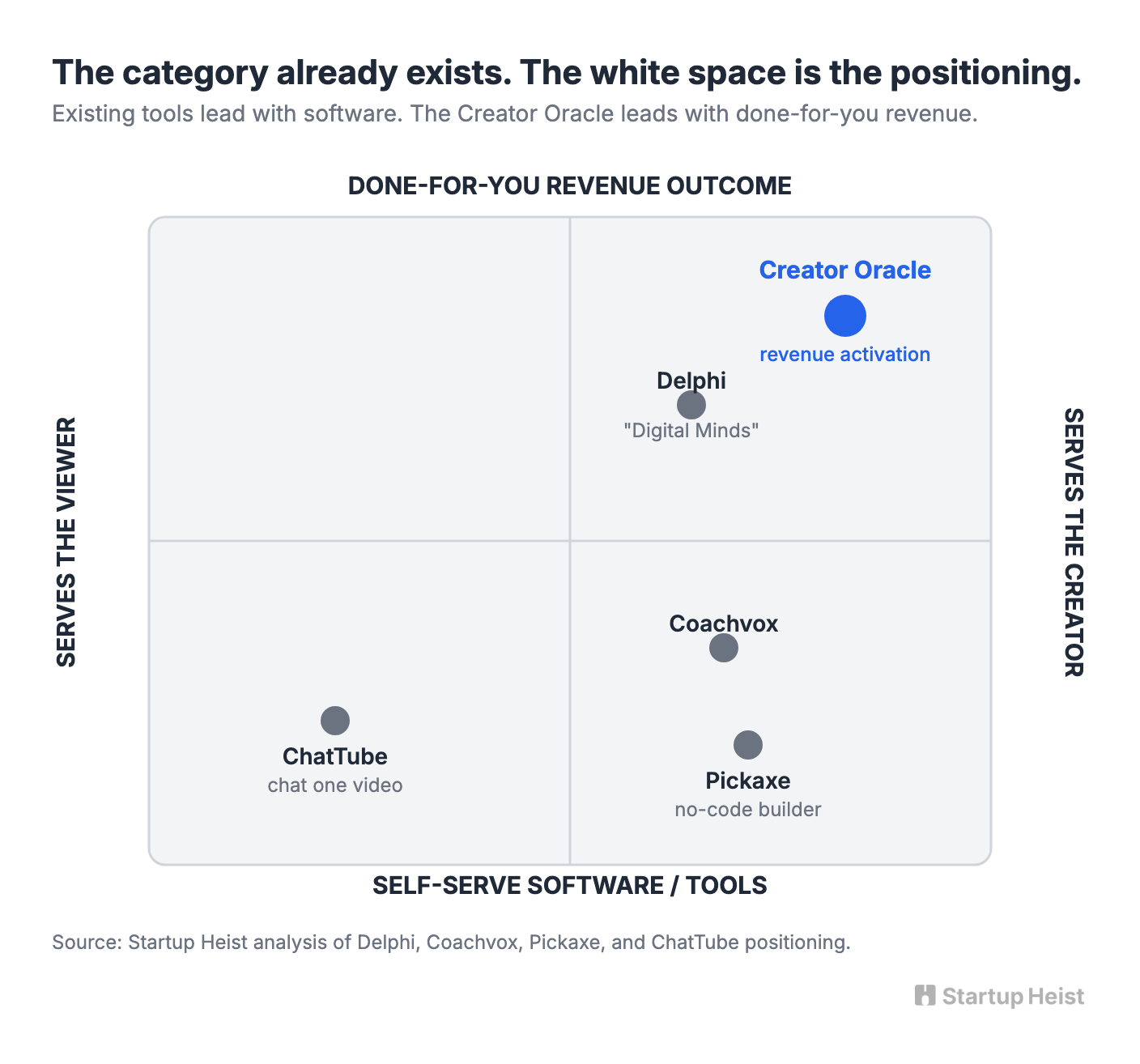
The pattern matters more than any one company. The opportunity isn't "invent an AI chatbot trained on content." That exists. The sharper move is to verticalize around the economics and workflow of serious YouTube educators. Most tools lead with software: upload your files, create your clone. The Creator Oracle leads with the business outcome: we turn your archive into a paid knowledge product, launch it on your site, and help you sell the first subscriptions. A creator doesn't want another dashboard to configure. They want a finished offer they can announce to their audience this week. The wedge isn't better embeddings. It's done-for-you revenue activation, and that's the part the generic tools refuse to do.
Do Not Sell This to "YouTubers"
The fastest way to waste six months is to pitch the Oracle as a general creator tool. Most channels are poor candidates. Comedy doesn't need a searchable paid archive. Travel content goes stale. Medical and legal channels invite liability. Finance has monetization but needs careful boundaries around personalized advice. The best first customers are creators whose audiences ask the same high-intent, outcome-oriented questions over and over.
Start with coding and DevOps education. Not because it's the biggest market, but because it's the cleanest place to learn. These creators sit on large archives of evergreen tutorials, with viewers hunting specific fixes rather than passive inspiration, existing courses and communities, and natural source citations down to the timestamp. SEO, marketing, language learning, exam prep, and fitness are reasonable second markets, but each adds friction: language needs audio and spaced repetition, fitness needs safety disclaimers, SEO goes stale fast, exam prep needs curriculum mapping. Begin where a basic retrieval assistant is immediately useful.
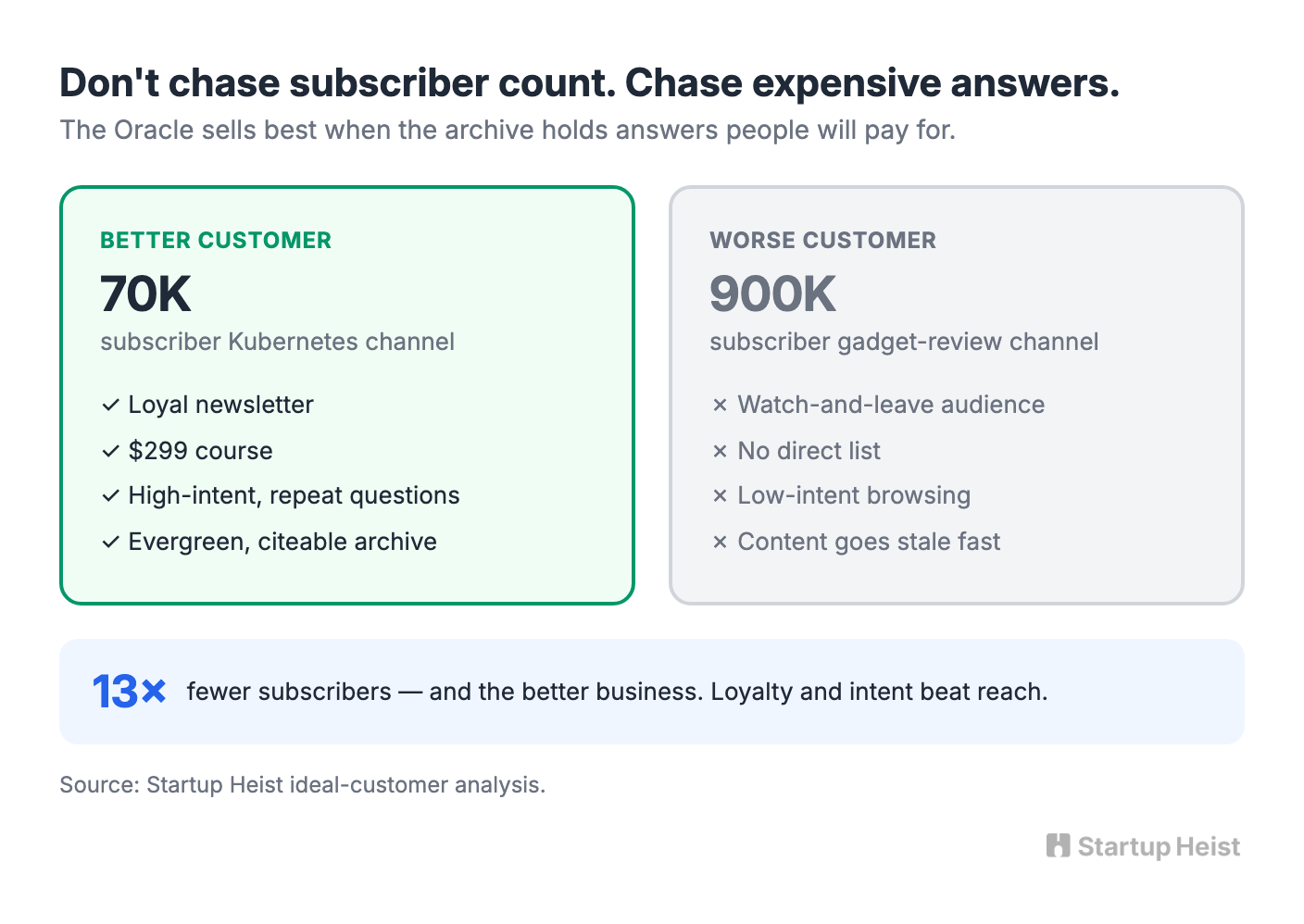
One caution on target selection: don't chase subscriber count alone. A 70,000-subscriber Kubernetes channel with a loyal newsletter and a $299 course beats a 900,000-subscriber gadget-review channel whose audience watches and leaves. The Oracle sells best when the archive holds expensive answers.
The first 20 creators should hit most of these marks.
| Signal | Target |
|---|---|
| Subscriber count | 50,000–500,000 |
| Evergreen archive | 100+ useful videos |
| Existing direct audience | Newsletter, Discord, Circle, Patreon, or course list |
| Existing monetization | Course, community, templates, coaching, or sponsorships |
| Repeated audience questions | Visible in comments, email, or community posts |
| Website ownership | Existing site or willingness to launch a simple page |
| Content type | Tutorials, frameworks, troubleshooting, implementation |
| Risk profile | Avoid personalized medical, legal, and investment advice initially |
The Business Model: Start as a Productized Service
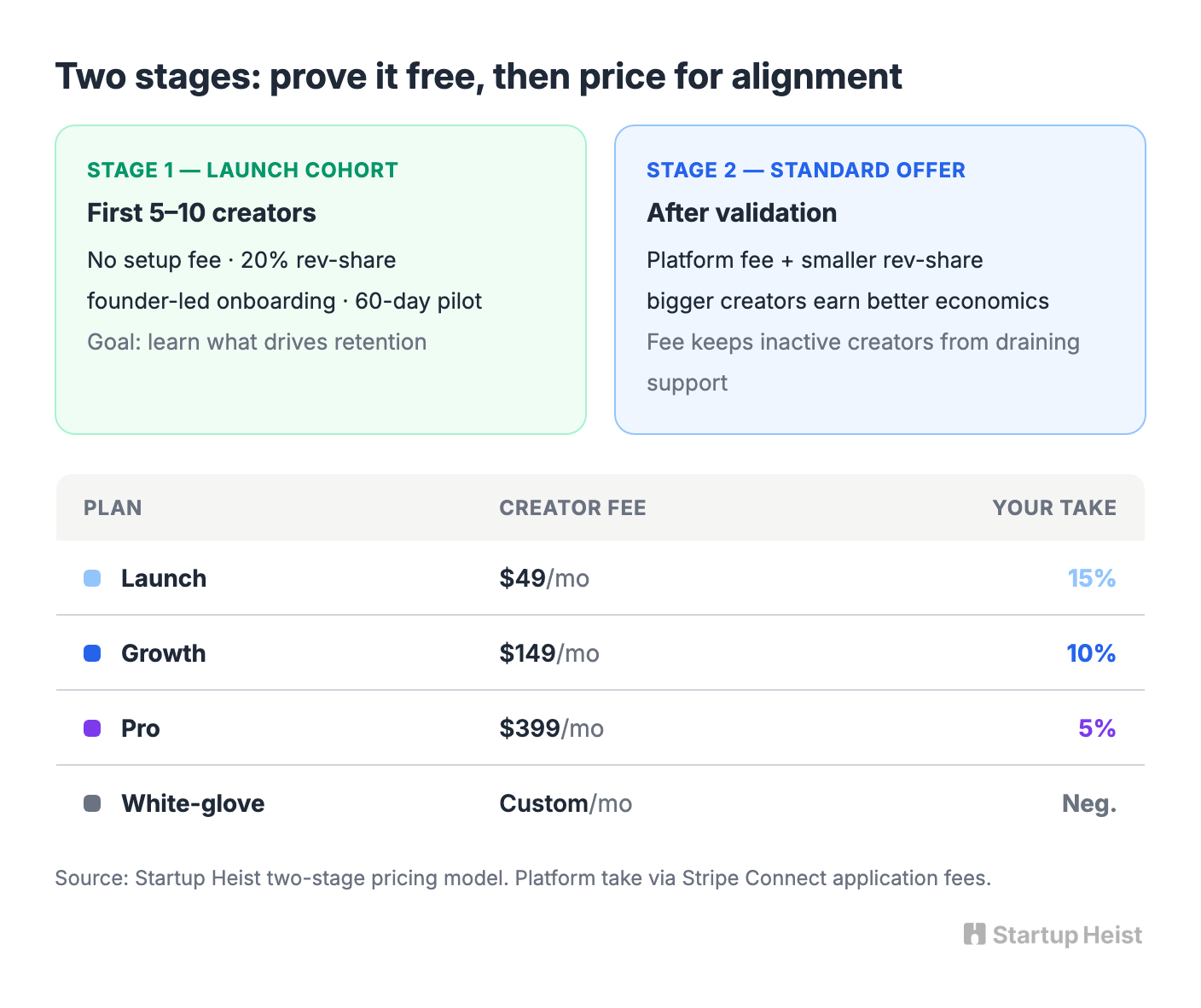
The tempting instinct is to charge creators nothing, take 15% of subscription revenue, and make the offer frictionless. That's a strong launch tactic and a bad permanent model. AI products carry variable costs. Heavy users burn real inference dollars. RevenueCat argues that hybrid monetization, subscriptions plus usage-based pricing, is becoming the default for AI products precisely because all-you-can-eat pricing disconnects revenue from cost. A $5 user who asks five simple questions is a great customer. A $5 user who treats the Oracle like an unlimited pair programmer is a liability. Use a two-stage model.
Launch-cohort offer. For the first five to ten creators: no setup fee, a 20% revenue share, founder-led onboarding, one branded assistant, up to 150 imported videos, one website embed, Stripe checkout, a monthly insight report, explicit usage caps on paid subscribers, and a 60-day pilot. The point isn't margin. The point is learning which questions drive retention, which archive formats improve answers, how many free conversations convert, and which creators actually promote.
Standard offer after validation. Once the workflow is stable, the platform fee keeps inactive creators from becoming permanent support drains, and the revenue share preserves alignment. Bigger creators earn better economics because they bring distribution.
| Plan | Creator Fee | Platform Take | Intended Customer |
|---|---|---|---|
| Launch | $49/month | 15% of Oracle revenue | Smaller creators testing demand |
| Growth | $149/month | 10% of Oracle revenue | Established education channels |
| Pro | $399/month | 5% of Oracle revenue | Course businesses, multi-source brands |
| White-glove | Custom | Negotiated | Large creators, academies, coaching |
Stripe Connect is built for exactly this. Its application-fee tools let a platform collect a cut of every transaction processed for connected accounts, so the billing plumbing is straightforward even if onboarding, tax, refunds, and payout UX still need care.
What the creator charges. Don't default to one flat $5 plan. Give the audience tiers, and build the infrastructure to assume query limits from day one even if the creator simplifies to a single paid tier at first.
| Audience Plan | Price | Usage |
|---|---|---|
| Free Preview | $0 | Five questions, email required |
| Supporter | $9/month | 40 questions per month |
| Builder | $19/month | 150 questions, deeper answers, saved history |
| Student Bundle | Included with course or membership | Controlled access for paying customers |
The free preview is non-negotiable. This product is hard to explain and easy to demonstrate. One real question with an unusually relevant answer sells it instantly.
The Math: A Small Slice Is Still Worth Stealing
Take a coding creator with 150,000 subscribers, an active newsletter, and a recognizable niche. Suppose they convert only 300 paying users at a $12 blended subscription.
- $3,600 MRR for the creator
- $540 MRR for the platform at a 15% take
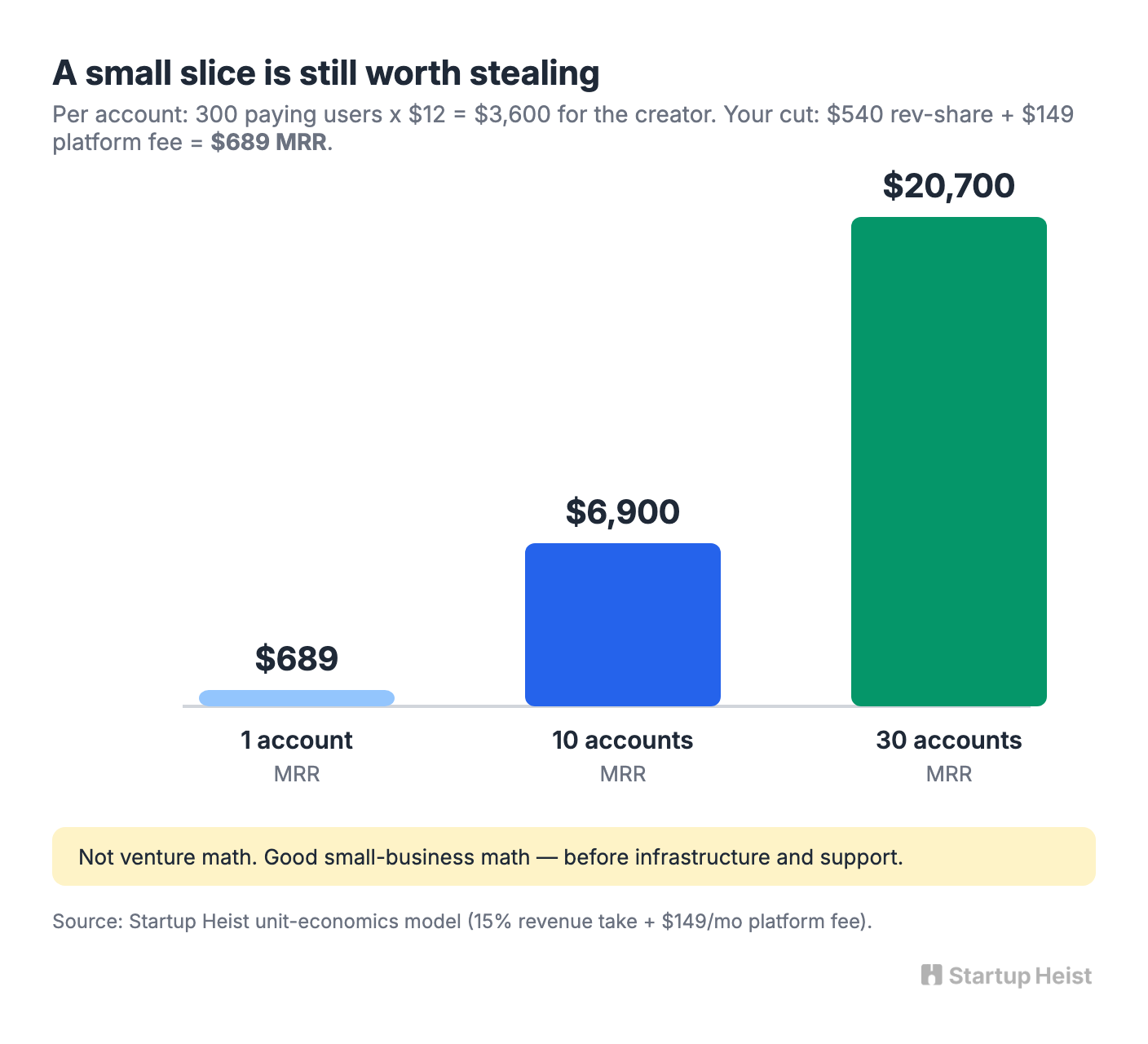
Add a $149 monthly platform fee and that single account produces $689 MRR for you before infrastructure and support. Ten accounts of similar quality is roughly $6,900 MRR. Thirty is roughly $20,700 MRR. This isn't venture math. It's good small-business math.
The upside compounds when the Oracle becomes part of the creator's larger funnel. A creator will tolerate modest standalone subscription revenue if the assistant also qualifies leads, recommends courses, and lifts retention inside an existing community. So measure more than chatbot subscriptions: free-to-paid conversion, paid retention, questions per subscriber, cost per answered question, course clicks and purchases, coaching inquiries, email captures, the most common unresolved questions, and the videos cited most often in useful answers. The Oracle is an audience-research engine. Every unanswered question is a product request. Every repeated question is a content opportunity. Every high-intent question is a lead.
The MVP: Build the Narrow Version First
The first version needs no voice cloning, no WhatsApp, no agentic workflows, no cinematic avatar. It needs to answer questions accurately, cite its sources, and collect money. Focus on:

Unlock the Vault.
Join founders who spot opportunities ahead of the crowd. Actionable insights. Zero fluff.
“Intelligent, bold, minus the pretense.”
“Like discovering the cheat codes of the startup world.”
“SH is off-Broadway for founders — weird, sharp, and ahead of the curve.”


