


The Internet Needs a "Primary Source Mode"
Google spent two decades teaching us to search by scanning links. Now it wants to answer the question before we ever leave the page.
That works fine when you need the boiling point of water. It gets complicated when you are researching a company, fact-checking a legal claim, comparing two medical studies, or trying to figure out which publication actually broke a story.

At Google I/O 2026, the shift became official. The search box is becoming a conversational engine that answers first and links second. Gemini-powered AI Mode is now the global default, already near a billion monthly users. Google is rolling out information agents that work in the background to gather answers for you, plus generative interfaces that assemble custom tables, charts, and simulations on the fly. The bet is clear: most people want fewer steps between a question and an answer.
A meaningful minority wants the opposite. They want a better audit trail. Here's the opportunity.
The money: 1,500 researchers at $12/month is $18K MRR. A solo builder can reach $10K-$30K MRR before touching enterprise.
Inside:
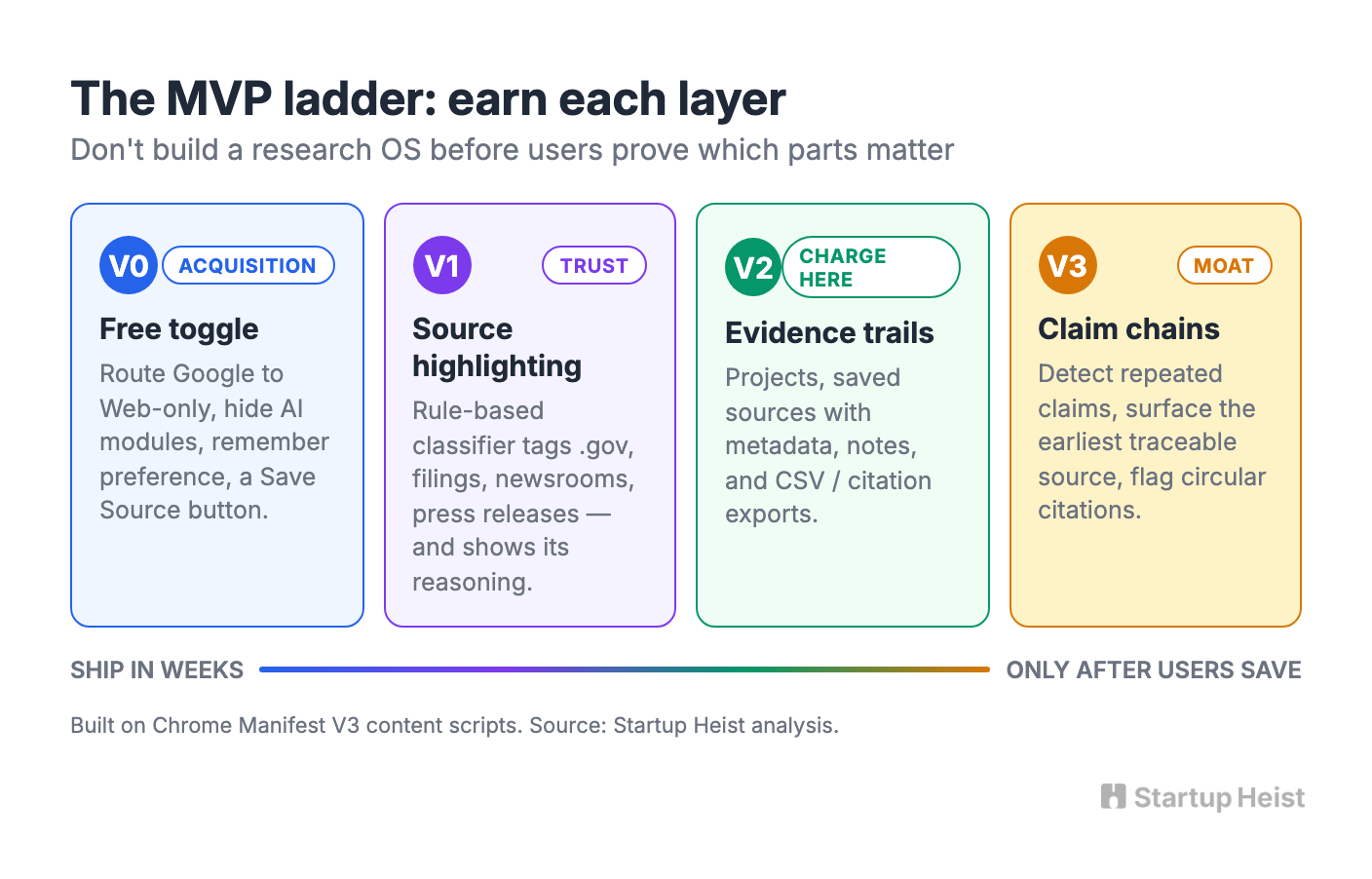
• Four-version MVP from free toggle to claim chains
• Three-tier pricing: free, Pro, Team
• Creator-first GTM with an outreach template
• The provenance dataset that becomes the moat
You can already see this minority moving. After the I/O announcements, DuckDuckGo reported a sharp install spike. U.S. app installs rose 18.1% week over week on average across six straight days in late May 2026, peaking at 30.5%. On iPhone the surge was larger, averaging 33% and peaking near 70%. Visits to DuckDuckGo's AI-free page, noai.duckduckgo.com, climbed 22.7% on average. The company's CEO put it bluntly: Google is force-feeding AI with no clean way to opt out.
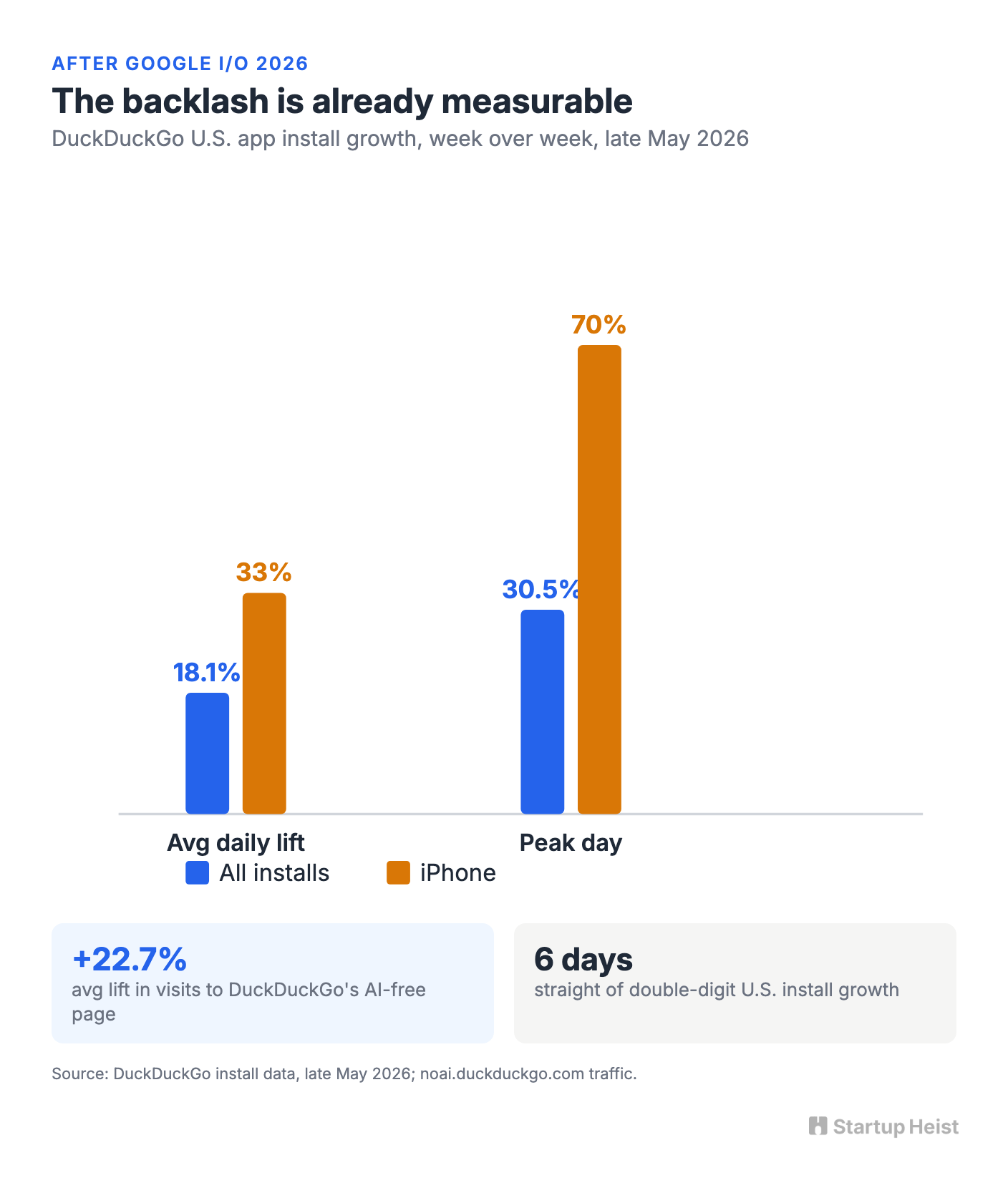
These aren't millions of people becoming anti-AI activists. It's a smaller group discovering they miss links. That group is tiny next to Google's mass market, but it's loaded with people who pay for better information workflows: journalists, newsletter writers, consultants, analysts, educators, librarians, lawyers, researchers, students, and obsessive buyers making high-consideration purchases.
The opportunity isn't to build another search engine. It's to build a Primary Source Mode for the web. A browser extension and lightweight research workspace that hides unwanted AI summaries, surfaces first-party documents, traces claims back toward their earliest discoverable source, and preserves a clean evidence trail.
Think of it as reader mode for research. The first version is a bootstrapped micro-SaaS. The long-term asset is a source graph.
Search stopped giving you doors
A traditional search engine hands you a ranked set of doors. You decide which to open. You compare sources, notice where they disagree, and develop a feel for whether a claim started with a regulator, a company announcement, a wire service, an academic paper, or a blog quoting another blog.
An AI summary moves that work upstream. Before you inspect anything, someone has already synthesized it for you. That's useful for casual queries and far less attractive when provenance is the whole point.
Google's own roadmap sharpens the tension. The 2026 overhaul goes past static AI overviews into agents that fetch and act on your behalf. Every step in that direction assumes you want distance from the raw evidence. A valuable slice of users wants the opposite: to close that distance. They aren't anti-AI. They're pro-inspection.
The escape hatch exists, and it stops too early
The basic workaround is already here. Append `&udm=14` to a Google search URL and you get a stripped-down, link-only view with the AI modules gone. It has held up since May 2024 because it routes to Google's own Web filter rather than fighting the page, and it has spread through extensions, bookmarklets, custom search engines, and sites like UDM14.com. DuckDuckGo went further with a dedicated AI-free entry point that disables its AI features and filters AI-generated images by default.
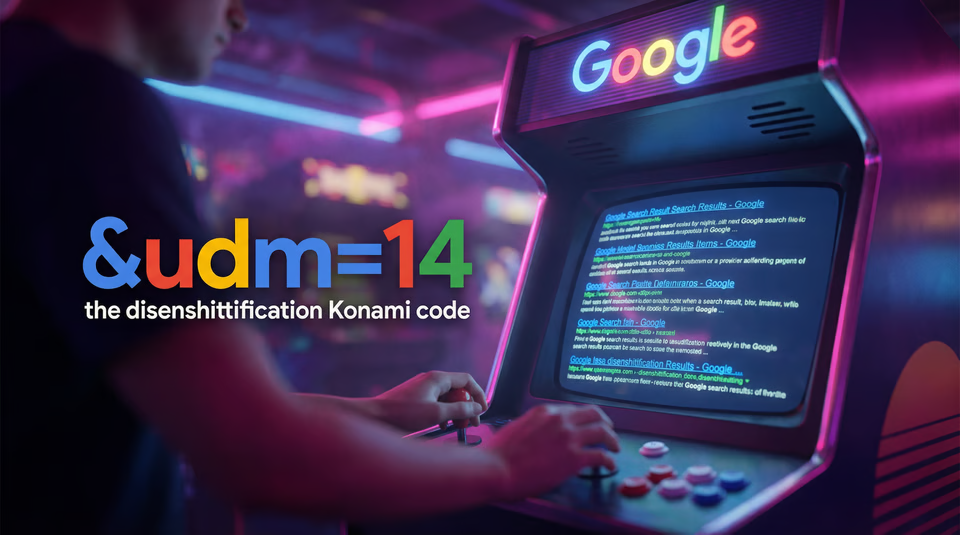
So the obvious move is a Chrome extension with a big "No AI" toggle that rides the backlash. Easy to build, hard to monetize. That layer is already commoditizing into free extensions, bookmarklets, and a search engine giving the feature away.
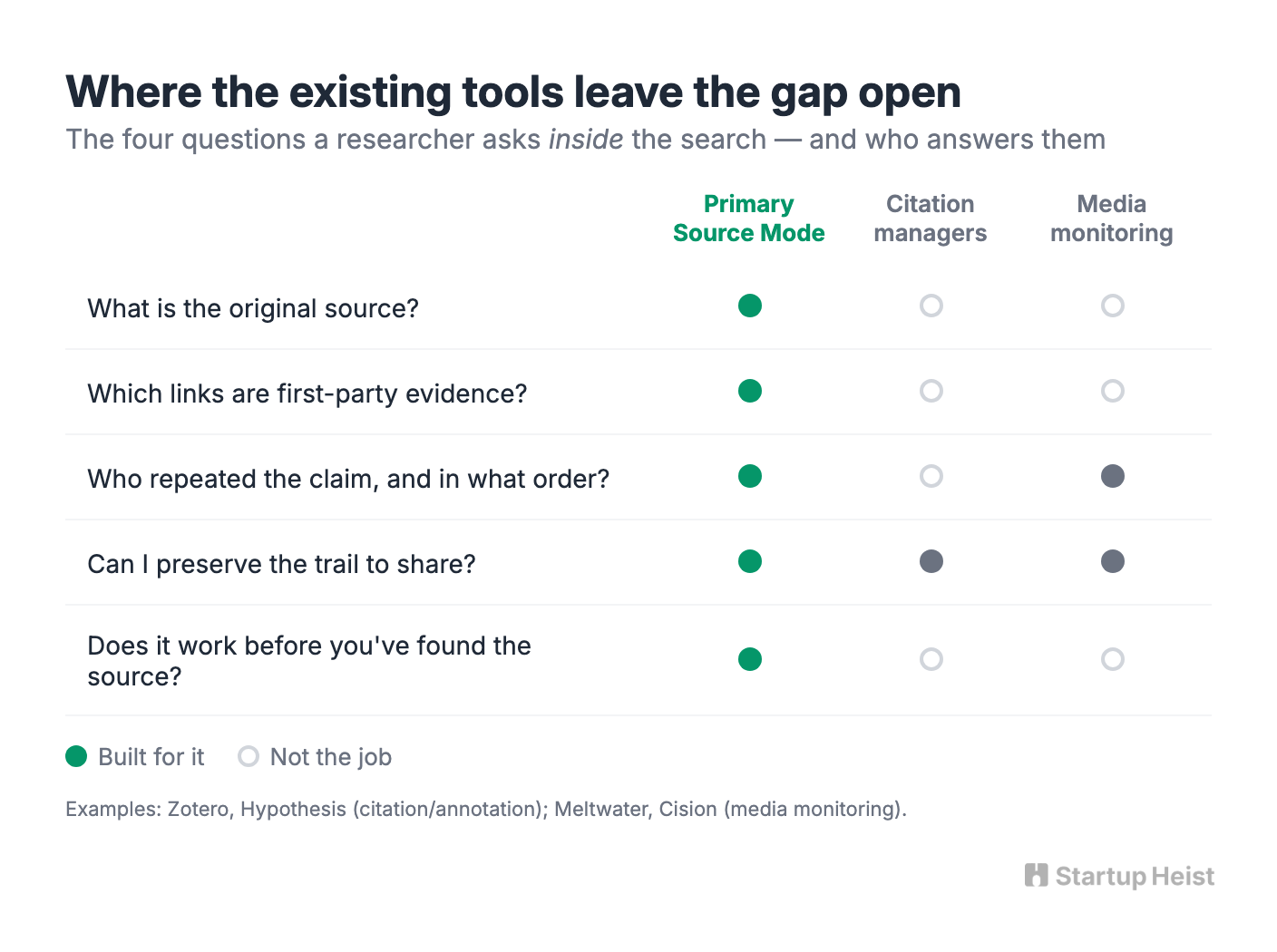
The paid opportunity sits one layer deeper. A professional researcher doesn't just want fewer summaries. They want fast answers to four questions. What is the original source? Which links are first-party evidence rather than commentary? Who repeated the claim, and in what order? Can I preserve the trail for an editor, client, or reader? That's a workflow problem, not a browser-preference problem.
What Primary Source Mode actually does
The product opens as a Chrome extension with one switch: Primary Source Mode: On. It makes a narrow promise. Not infallible fact-checking, not the definitive truth. Just this: reduce the distance between a claim and its inspectable evidence.
Say a user searches "Why did Acme Robotics lay off 18% of its staff?" A normal results page leads with an AI summary, then news, commentary, social posts, and republished coverage. Primary Source Mode bypasses the summary and tags what remains: company announcement, SEC filing, court document, government source, academic paper, original reporting, press release, syndicated copy, commentary, likely repost, PDF.
The ranking reshuffles around provenance. If five outlets cite the same company memo, the memo rises. If three quote a regulator's report, the report becomes the preferred link. If ten sites repeat a statistic that traces back to a trade-association release, the user sees the chain. And when the system can't confidently name the original, it says so. The target customer isn't shopping for another black box.
Every result carries one more action: Save to Evidence Trail. The user spins up a project, captures the URL and its metadata, adds a note, and saves a snapshot. Save several related sources and the workspace quietly builds a citation map.
A newsletter writer sees the lineage of a trend: government report, trade publication, wire story, eight secondary articles, then the LinkedIn posts and newsletters downstream. A consultant exports the originals, the secondary coverage, dates, notes, excerpts, and a clean bibliography as a shareable link or a CSV. A teacher asks students to submit the evidence behind an argument. An editor inspects the research behind a draft without opening twenty tabs. The extension is the doorway. The workspace is the business.
Why the existing tools leave the gap open
This idea lives in the seam between several mature categories, and none of them fill it.
Citation managers start too late. Zotero is an excellent, free, open-source tool with a browser connector that saves papers and pulls metadata in one click. But it assumes you already found the source. It won't restructure search around provenance, and it won't tell a writer that six stories trace to the same press release.
The play isn't to replace Zotero. It's to be the provenance layer before Zotero, then export cleanly into it. Annotation tools like Hypothesis sit one step further out, built to discuss a document you already have rather than identify which documents are worth discussing. And enterprise media-monitoring platforms like Meltwater and Cision watch coverage at scale for comms teams, but a five-person research shop or a solo analyst will never sign a six-figure annual contract just to inspect a claim faster.
Each tool solves a real problem. None of them sits where the researcher actually loses time: opening, comparing, tracing, sorting, and saving sources while still inside the search. That's the moment Primary Source Mode owns. So here is how to build it, price it, and sell it without lighting money on fire.
The MVP: keep it painfully narrow
Unlock the Vault.
Join founders who spot opportunities ahead of the crowd. Actionable insights. Zero fluff.
“Intelligent, bold, minus the pretense.”
“Like discovering the cheat codes of the startup world.”
“SH is off-Broadway for founders — weird, sharp, and ahead of the curve.”


