


The PDF Isn't Dead. It Just Needs a Front End.
A fitness creator spends three weeks building a 38-page nutrition guide. The information is genuinely good. The design is clean. A customer pays $19, downloads the file, scrolls through it once, and never opens it again.
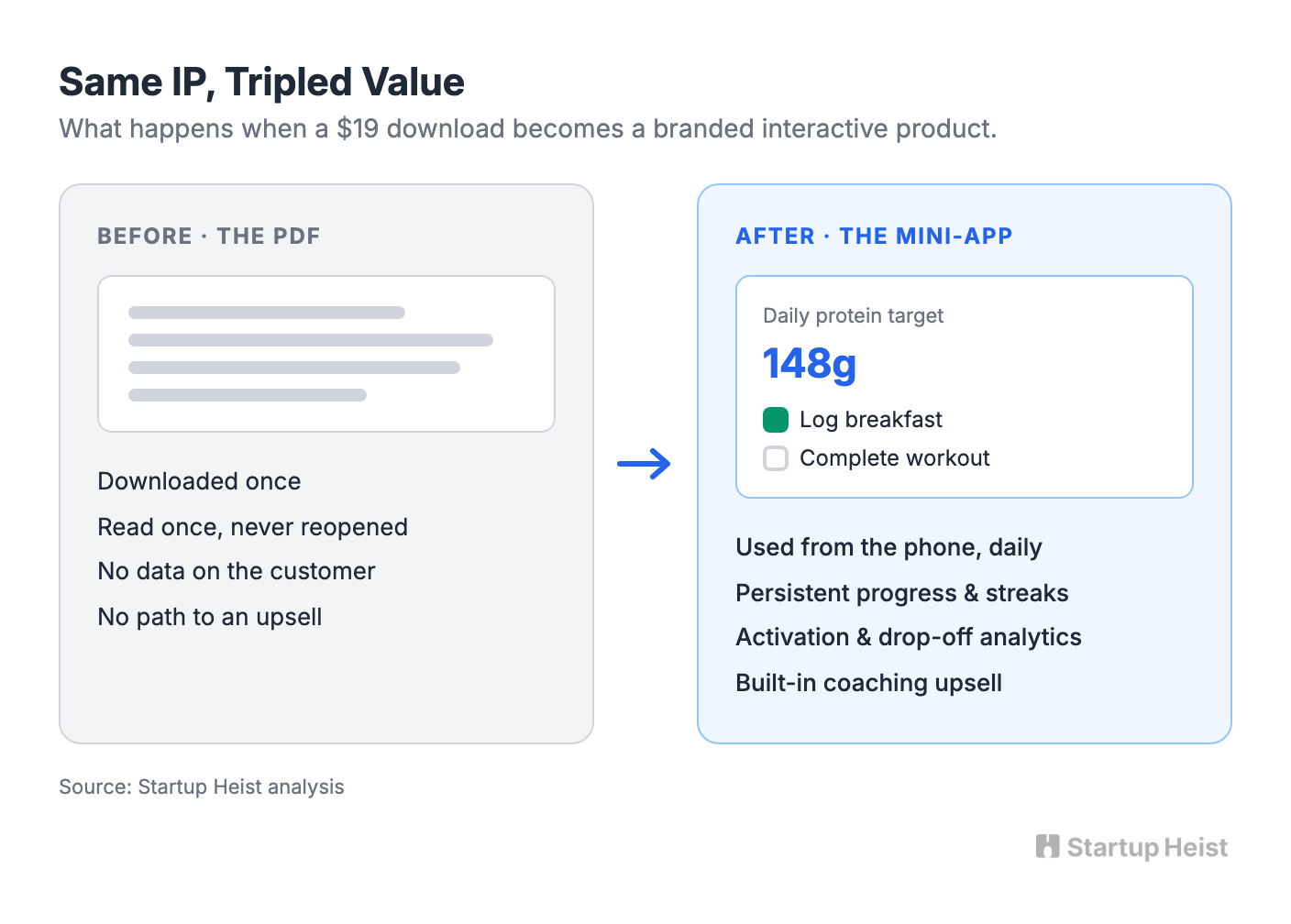
Now picture the same guide as a small branded web app. The customer enters their weight and goal. The app returns a daily protein target and a simple meal plan. Every morning, they check off habits, log progress, and get a small adjustment. The creator can see who activated the product, where people dropped off, and which customers look ready for a coaching upsell.
The intellectual property barely changed. The perceived value tripled.
Here's the opportunity: a zero-code tool that turns creators' existing PDFs, worksheets, templates, and guides into simple interactive web experiences. Not native apps, not custom software, not a general website builder. Think calculators, trackers, quizzes, checklists, guided plans, gated bonuses, and small dashboards, all generated from the digital products creators already sell.
The money: 100 creators at $49/month is roughly $5,000 MRR before setup fees; 500 at $69 is a real software company. Patreon paid podcasters $629M in 2025.
Inside:
• Full MVP scope and 10-block component library
• Three-tier pricing plus the upgrade-fee wedge
• Five compounding moats from transformation data
• Creator-first GTM with an outreach template
The lazy framing is that "the PDF is dead." It isn't. PDFs stay cheap to make, easy to deliver, and perfectly fine for plenty of products. The sharper read is that the PDF is becoming the raw material, and the product is the experience built on top of it. That single shift turns a gimmicky AI converter into a real creator-commerce business.
The Signal: Static Content Is Getting an Upgrade
The creator economy is now big enough to support narrow infrastructure companies. Grand View Research pegs the global market at $252.33 billion in 2025, on a path to $1.35 trillion by 2033. The top-line number matters less than what sits underneath it: direct-to-audience businesses are maturing. Creators have stopped living on sponsorships and ad revenue. They sell memberships, courses, coaching, communities, and digital products.
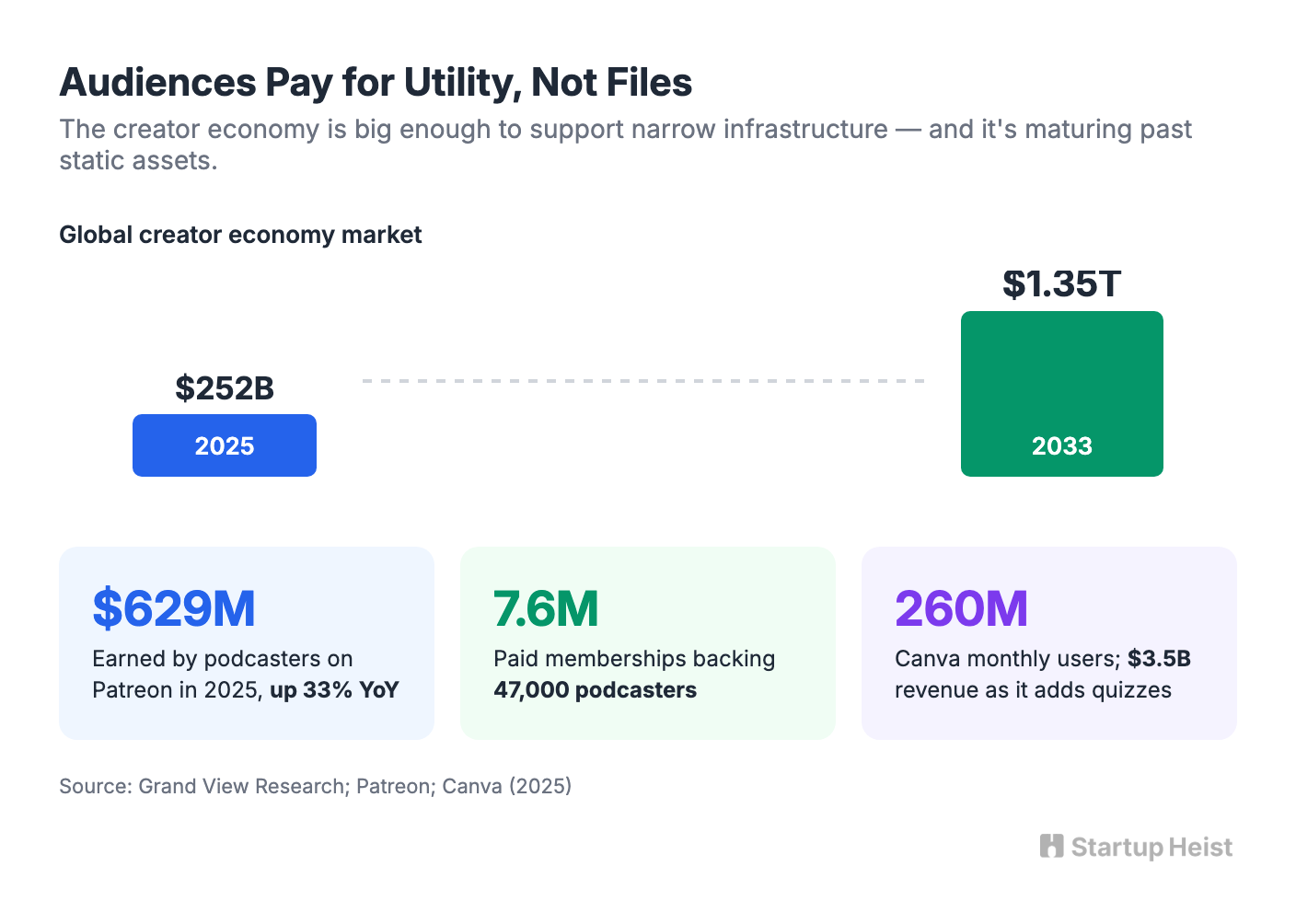
The clearest tell comes from Patreon, which said podcasters earned more than $629 million on its platform in 2025, up 33% year over year, with 47,000 podcasters backed by 7.6 million paid memberships. That's not a content statistic. It's proof that audiences pay for depth, continuity, and utility, not just files.
The platforms are training that expectation too. Canva launched Polls, Quizzes, and an AI Quiz Generator in January 2025, then closed the year at 260 million monthly users and $3.5 billion in revenue. When a general-purpose design tool starts bolting on quizzes and interactive lessons, the market has already moved past static assets. But Canva is a design platform. A creator running a 30-day fitness challenge doesn't need a prettier quiz. They need a customer-facing product with persistent progress, gated access, branding, analytics, and a built-in path to an upsell. The space between "nicer document" and "real product" is wide open.
The Product: A Mini-App Generator for Creator Businesses
Start by rejecting the obvious demo. The product should not promise to turn any random PDF into a beautiful app with one click. PDFs are messy. Half of them are posters stretched across multiple pages, stuffed with decorative layouts, screenshots, and tables that don't map to functional software. A general converter produces generic sludge: too rigid for sophisticated creators, too confusing for beginners.

The winning version starts narrower, and it starts with the business outcome rather than the canvas. Creators don't wake up wanting to assemble UI components. They want to raise a price, cut refunds, add a lead magnet, or make a membership stickier. So the product asks two questions first: what are you upgrading, a paid guide, a lead magnet, a course bonus, a coaching worksheet, a membership resource, a challenge? And what should the customer actually do, calculate a result, follow a plan, track progress, complete a checklist, test their knowledge, prep for a call? Only then does it use the uploaded document as source material, extract the structure, identify likely actions, and suggest a small set of interactive components. A calculator for personalized targets. A checklist for recurring actions. A daily or weekly tracker. A quiz or assessment. A guided lesson sequence. A gated bonus. A call-to-action for the next offer.
The creator edits the suggestions, adds colors and a logo, picks a subdomain, and publishes a mobile link. The customer downloads nothing. They open a branded experience that feels like a product, not a document. That outcome-first sequence is what keeps the company from becoming yet another no-code tool with 47 widgets and an empty screen.
Three concrete shapes make the pattern obvious:
Fitness — "The 30-Day Macro Reset." Intake form for weight, age, activity, and goal. A macro calculator with the creator's own rules. A daily habit checklist. A weekly progress log. A reflection prompt. A coaching call upsell after day seven.
Education — "SAT Writing Crash Course." A diagnostic quiz. A personalized weak-area dashboard. A daily lesson checklist. A practice-question bank. Completion tracking. An upsell into a cohort or tutoring.
Business coaching — "The Freelance Pricing Workbook." A revenue-goal calculator. Hourly and project-rate calculators. A client qualification scorecard. A proposal checklist. A weekly pipeline tracker. An upsell into group coaching.
The tool isn't replacing the creator's expertise. It's packaging that expertise into a container worth more money.
Where the Existing Platforms Stop
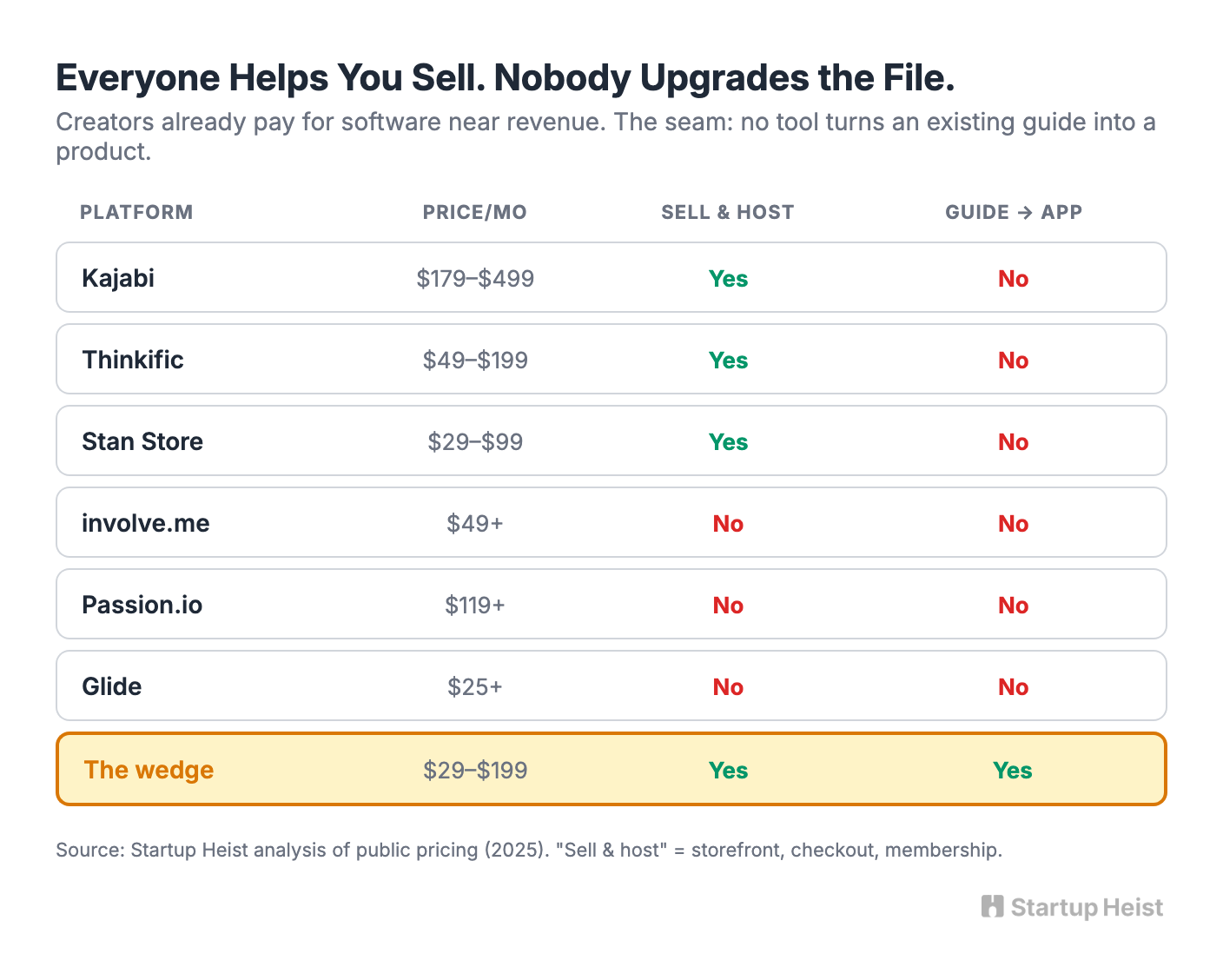
This market isn't empty, which is the good news. Creators already pay real money for software when it sits close to revenue. Stan Store runs $29 to $99 a month. Podia spans $39 to $89. Thinkific's paid plans range from $49 to $199, and Kajabi now starts at $179 a month for its Basic plan and climbs to $499. Those numbers prove the willingness to pay. But every one of those tools solves storefront, hosting, membership, and checkout. They help creators sell and deliver products. None of them make an existing worksheet feel like software.
Then there's the interactive-content crowd. Outgrow builds calculators, quizzes, and assessments for marketers. involve.me offers quizzes, forms, and AI funnels from $49 a month. Jotform ships a no-code app builder. Glide turns a spreadsheet into an app from $25. Passion.io launches branded creator apps from $119. These are real competitors, and they clarify the wedge rather than close it. Each is built for marketers, generalists, or full app-builders, and each starts from a blank canvas or a data table, not from the specific guide a creator already sells and the commercial outcome they're chasing. That's the seam. A creator-focused tool shouldn't try to out-flex Jotform's form builder or out-feature Passion.io's app platform. It should win on time-to-value: upload the guide you already sell, get a monetizable interactive upgrade before lunch. Less configurable than Jotform. Narrower than involve.me. Lighter than Passion.io. The constraint is the entire advantage.
The Best Initial Wedge
Don't launch horizontally. Pick two verticals where creators already sell transformation-oriented products and where interactivity is obviously worth more than a file.
Fitness and nutrition comes first. These creators already sell challenges, workout plans, meal guides, macro calculators, and accountability programs. The interactive components are predictable: calorie and macro calculators, workout checklists, weight and measurement logs, habit streaks, weekly check-ins, simple progress graphs, coaching upsells. A customer instantly understands why a tracker beats a PDF here. No education required.
Coaches and educators come second. Consultants, tutors, and cohort operators sell frameworks trapped inside workbooks. The components repeat just as cleanly: intake questionnaires, scorecards, self-assessments, guided action plans, lesson checklists, resource libraries, reflection prompts, booking calls-to-action. A third vertical, say personal finance, language learning, or certification prep, can follow once the component library is stable. The goal isn't to serve every creator. It's to build a reliable transformation engine for a small number of proven product archetypes.
What the MVP Actually Needs
A solo founder or a two-person team can ship a credible first version. The discipline is in refusing the seductive features.

Unlock the Vault.
Join founders who spot opportunities ahead of the crowd. Actionable insights. Zero fluff.
“Intelligent, bold, minus the pretense.”
“Like discovering the cheat codes of the startup world.”
“SH is off-Broadway for founders — weird, sharp, and ahead of the curve.”


