


The 47-Second Sales Rep
Spotify just made it effortless for listeners to share the exact moment that sold them. The business isn't another clipping tool. It's the attribution layer that tells podcasters which ideas actually produce revenue.
A listener hears something useful in a podcast.
It isn't useful enough to post publicly, or dramatic enough to go viral. But it's useful enough to send to one specific person with a single line attached: this is what I was trying to explain to you.
For years, that small act of word-of-mouth was annoyingly clumsy. You could share the whole episode, manually type out a timestamp, or hope your friend would scrub through an 82-minute conversation to find the part that mattered. Most people just gave up and described it from memory.
On May 27, 2026, Spotify killed most of that friction. It launched Spotify Podcast Clips, a mobile feature that lets Free and Premium users capture, trim, save, and share a specific moment from any podcast. You tap a scissors icon inside the Now Playing screen, drag to the segment you want, preview it, and send it through Spotify Messages or any outside app. Episodes, chapters, and timestamps are shareable from the same menu, and saved clips live in your library. Spotify's own early testing showed that podcast saving goes up when clips are turned on.
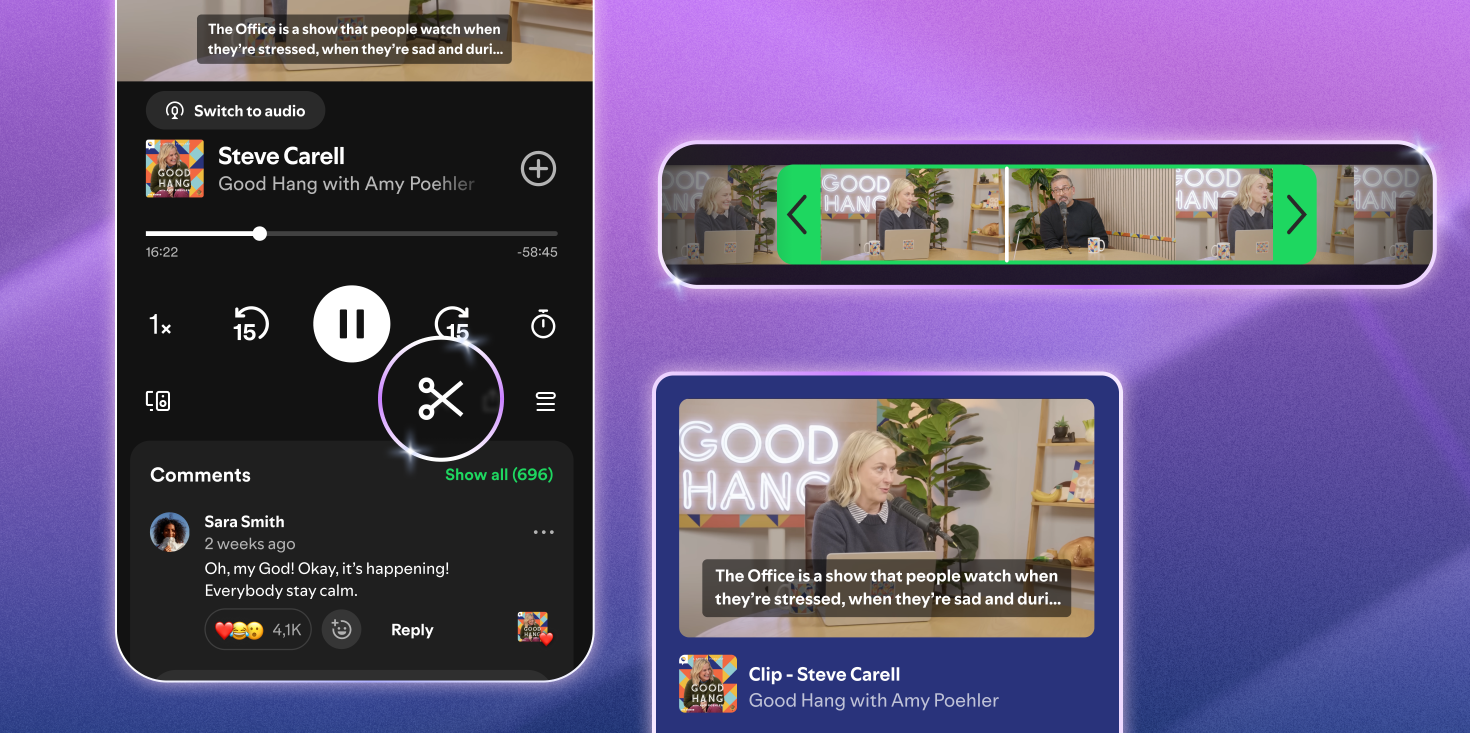
Spotify frames the feature as a way to capture the moments that "resonate most." That's accurate but incomplete. A listener-selected clip is also a high-intent referral object. It marks the exact 30 or 60 seconds of a long conversation that were persuasive, surprising, or useful enough that someone interrupted their day to forward them to a person they know.
That's a commercially interesting signal, and almost nobody is reading it correctly.
The opportunity is to build a referral and attribution layer for revenue-generating podcasts. Track which precise moments listeners share, identify which of those moments lead to signups or sales, and reward the listeners who reliably recruit customers.
Call it Margin Notes for Podcasts.
The product doesn't compete with Spotify. It sits one layer above Spotify and answers a question Spotify will never bother to answer for a niche business podcaster: which exact ideas inside my show are quietly making me money?
Here's the opportunity:
The money: A solo founder lands 50 commercial shows at $99 to $249 a month, plus a few agencies at $750+, for $10K to $30K MRR. Podcasters already pay for referral tools.
Inside:
• The six-part MVP, shippable in 4 weeks
• The V2 intelligence and clustering layer
• Pricing: $99 / $249 / $750-$1,500 tiers
• Outreach playbook plus cold email template
• The dataset moat nobody can copy
• The 30-day, build-by-hand validation test
The opportunity in one sentence
Turn podcast listeners into a measured, lightly incentivized referral network, with revenue attribution at the level of the individual clip or timestamp rather than the whole show.
This isn't a venture-scale swing on day one. It's a credible specialized SaaS business with a service-assisted wedge. A focused founder could aim for $10,000 to $30,000 in monthly recurring revenue from creators, business podcasters, and podcast agencies before deciding whether a bigger platform is hiding underneath.
The whole game is choosing the right market. Don't start with entertainment podcasts chasing download growth. Don't touch shows that monetize through programmatic ads. A million casual listeners can still be a terrible customer.
Start where one converted listener is worth $100, $1,000, or far more: the creator selling a $399 cohort course, the operator running a paid community, the consultant booking strategy calls, the SaaS founder using a podcast to generate qualified demos, the investor or executive coach building a high-value pipeline. For these people, the podcast isn't media. It's a trust engine bolted to a commercial funnel, and they're flying blind on which parts of it convert.
Why this gap exists
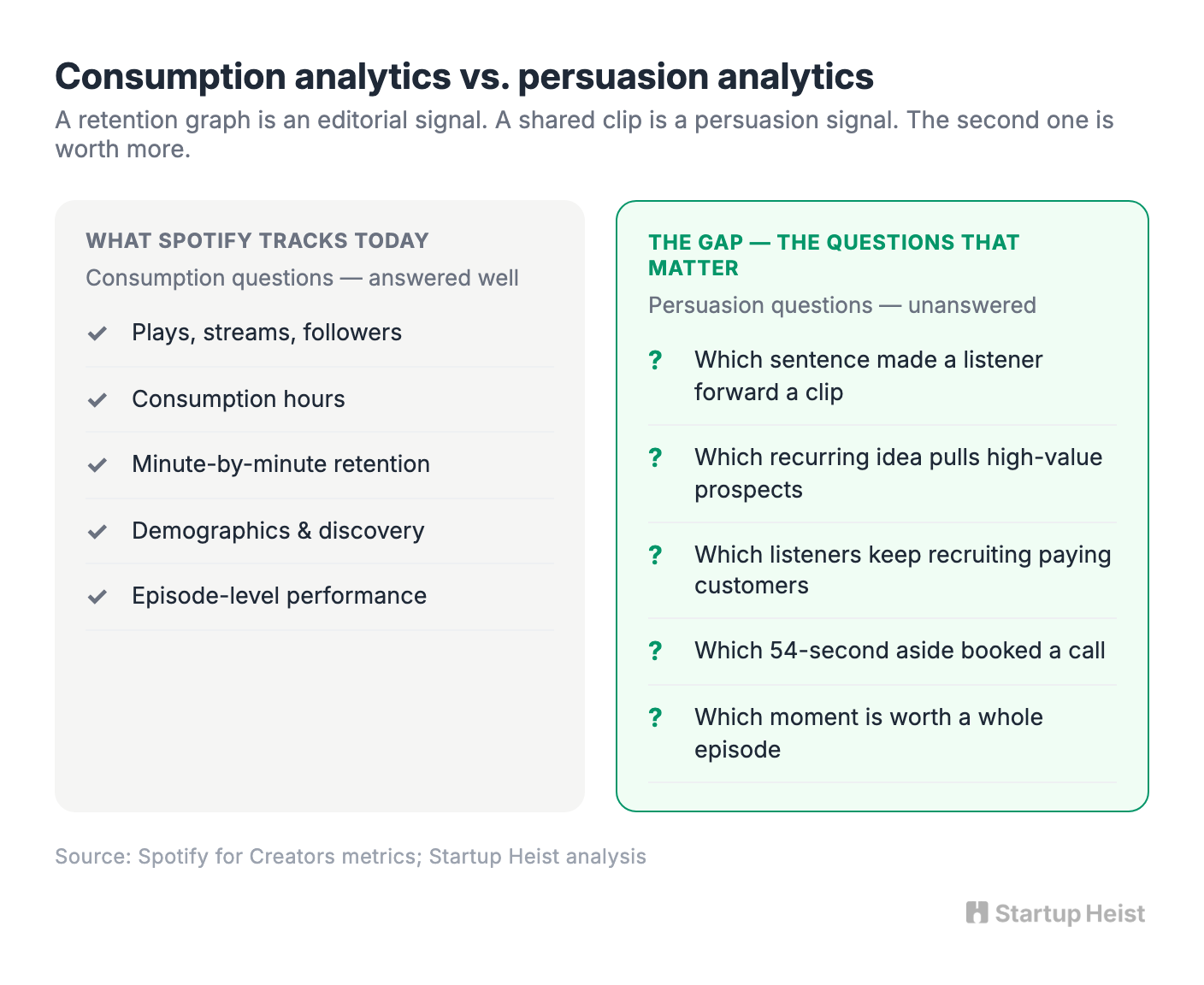
Podcast analytics have gotten good at consumption questions and stayed useless at persuasion ones.
Spotify for Creators tracks plays, followers, impressions, consumption hours, streams, demographics, discovery, and episode-level performance. Its retention chart shows what percentage of listeners are still there at each minute. All of that answers whether people started the episode, where they dropped off, and whether Spotify surfaced the show to new ears.
None of it answers the questions a commercial podcaster actually loses sleep over. Which sentence made a listener forward a clip to a colleague? Which recurring idea pulls in the highest-value prospects? Which listeners keep recruiting paying customers? Which 54-second aside quietly generated a booked call, and should it become an entire workshop?
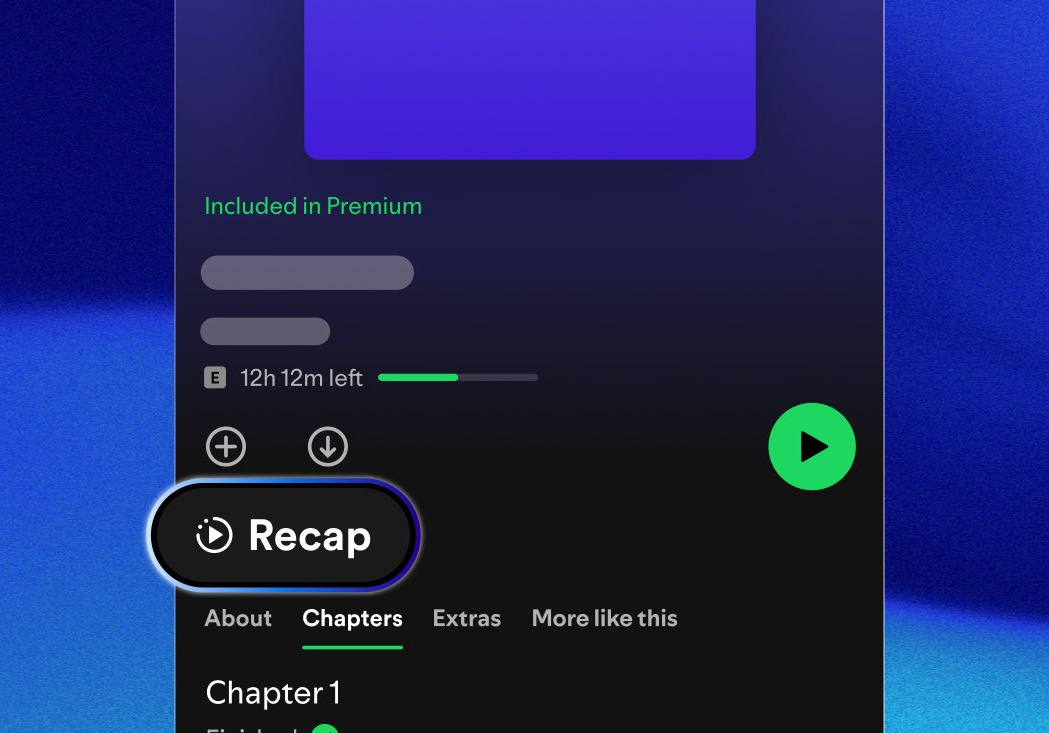
There's already proof that listeners engage with specific moments rather than whole episodes. Spotify's Chapters feature, the precursor to Clips, was saved or playlisted more than two million times a month. People weren't bookmarking shows. They were bookmarking passages. Clips just makes that instinct shareable.
A retention graph is an editorial signal. A shared clip is a persuasion signal. They aren't the same, and the second one is worth more. A popular episode isn't necessarily a productive one. A moment that gets a modest number of shares can beat a viral clip if it keeps traveling between the right people.
Spotify has already inched toward trackable sharing. Its creator help center includes link-sharing and referral data, and it has rolled out trackable episode and show links that show whether shared links led to clicks and streams inside Spotify. That's useful infrastructure, and it's also a warning: don't build a thin dashboard that just reproduces Spotify's native sharing stats. Spotify will always do that better.
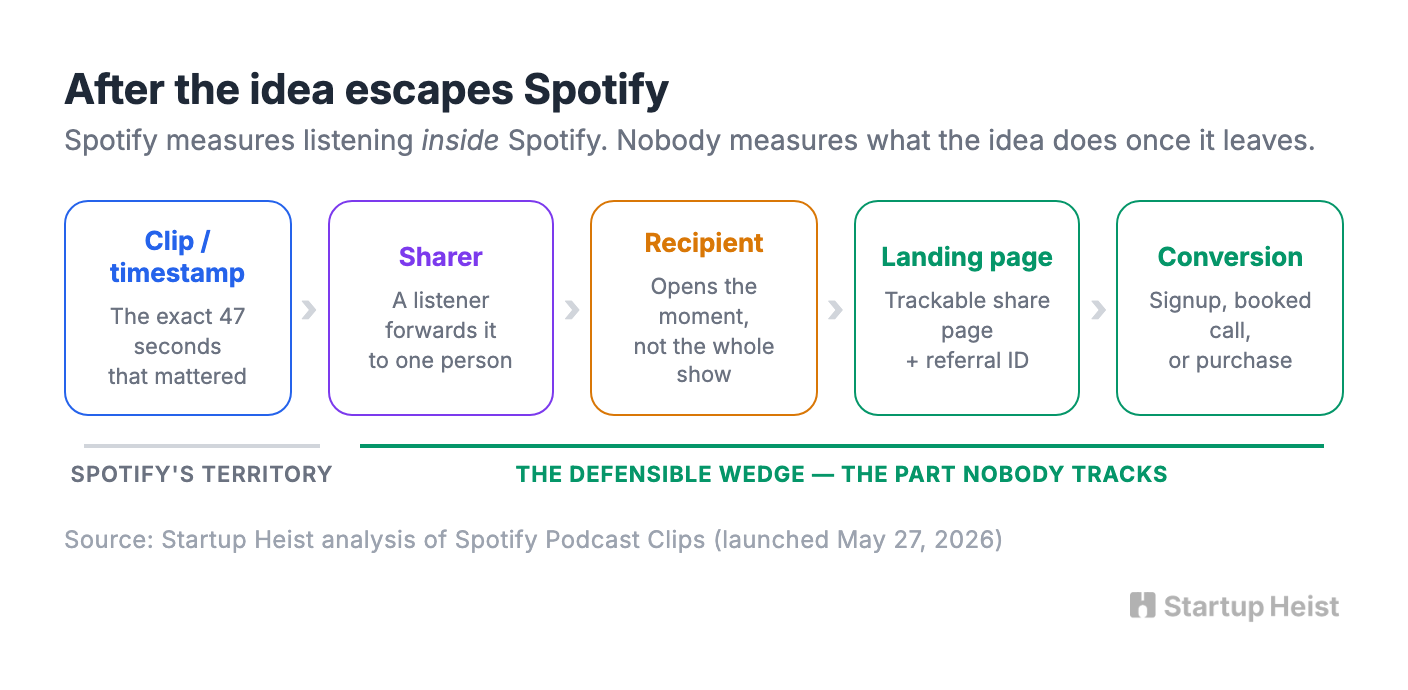
The defensible wedge is everything that happens after the idea escapes Spotify: clip or timestamp, to sharer, to recipient, to landing page, to signup, booked call, or purchase. Spotify measures listening inside Spotify. Nobody is measuring what the idea does once it leaves.
The product: moment-to-money analytics
The simplest version works like this.
A podcaster publishes an episode. The host or producer flags three to five moments worth sharing. The product spins up a lightweight share page for each one. Every page carries the episode title and artwork, a direct path to the Spotify clip or timestamp, a one-line summary of the moment, a clear call to action, a unique referral identifier, and a trackable conversion event.
The call to action bends to the show: join the newsletter, download the playbook, register for the workshop, apply for the cohort, book a call, start a trial, buy the book, grab a ticket. Listeners share a moment through text, email, WhatsApp, Slack, or LinkedIn. When a recipient clicks and converts, the product attributes the result to both the clip and the listener who sent it.
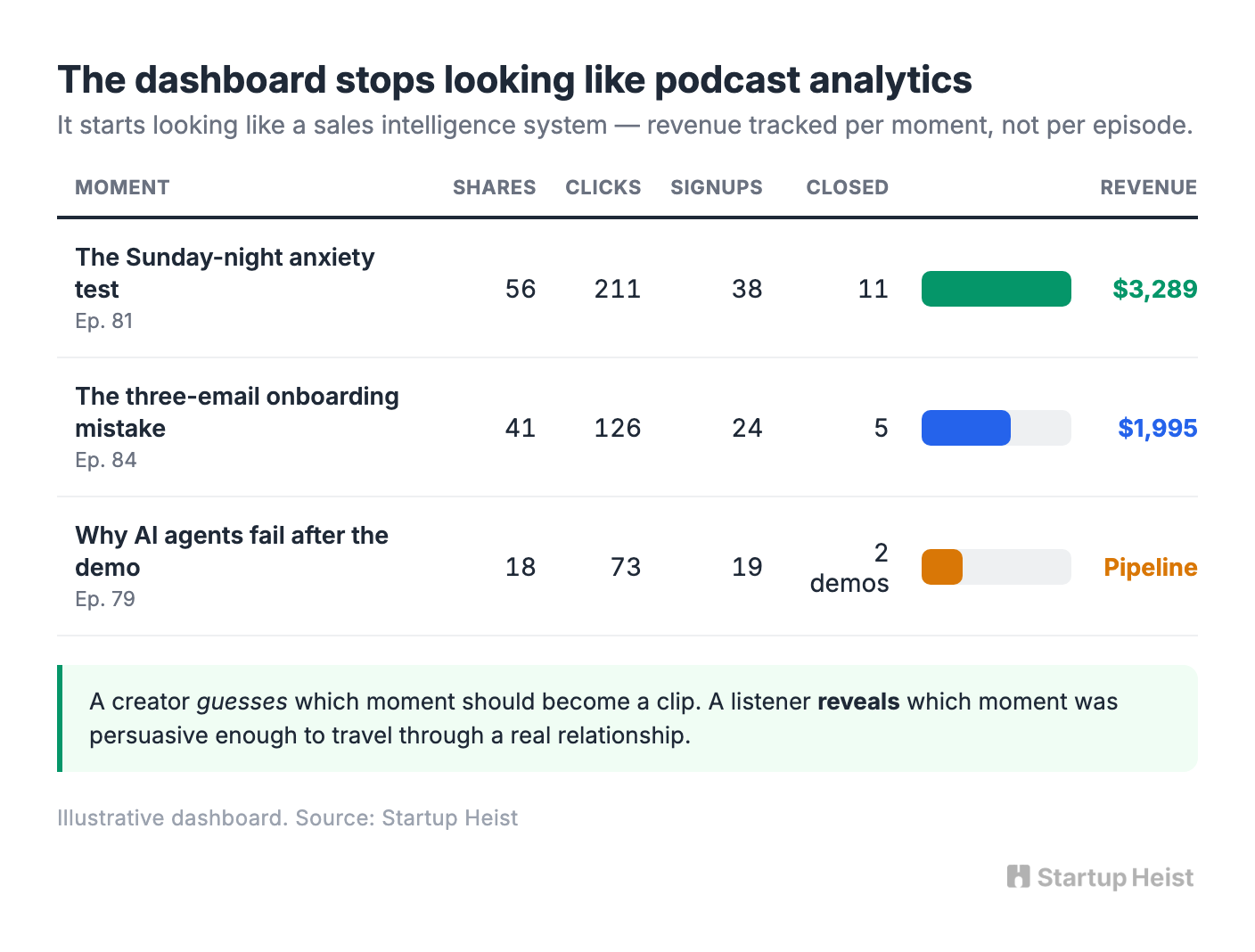
Over a few months, the host's dashboard stops looking like podcast analytics and starts looking like a sales intelligence system:
The insight underneath is simple. The listener isn't just consuming the content. The listener is annotating it with commercial intent. A creator can guess which moment should become a clip. A listener reveals which moment was persuasive enough to travel through a real relationship. That second thing is the asset.
The market is real, and it's fragmented
Podcasters already pay for referral software, which removes the scariest question for any new product: will anyone buy this.
Refer-O-Matic was built specifically for podcasts. The pitch is plain: listeners sign up, get a share link, and earn rewards as friends become listeners. It runs $20 a month with a 14-day trial, supports tiered and cash rewards, and was openly inspired by newsletter referral programs like Morning Brew's. The behavior is validated. The opening is just as clear, because Refer-O-Matic operates at the show-referral level. It helps a listener share the podcast. It isn't built around the individual idea inside the episode or the revenue attached to that idea.
The adjacent tools tell the same story from a different angle. SparkLoop (plans starting around $99 a month) runs milestone referral programs for newsletters with digital rewards, physical rewards, and exclusive-access tiers. Rewardful ($49 to $149 a month) manages affiliate and customer-referral programs for SaaS, with coupon tracking, first- or last-touch attribution, and fraud detection. These are good benchmarks, not substitutes. A sophisticated creator can already lash together referral links, landing pages, UTM tags, Stripe webhooks, and a spreadsheet, and many do. What none of that stack answers is the one editorial question that matters: what was said immediately before the customer decided to act?
Make the timestamp a first-class object. It sounds like a small distinction. It gets bigger every month the dataset grows.
The best first customer: B2B and expert-led shows
There are two plausible starting markets, and one is sharper than the other.
Unlock the Vault.
Join founders who spot opportunities ahead of the crowd. Actionable insights. Zero fluff.
“Intelligent, bold, minus the pretense.”
“Like discovering the cheat codes of the startup world.”
“SH is off-Broadway for founders — weird, sharp, and ahead of the curve.”


