


Back-Office Agents Are Coming for Offshore Work. The Heist Is to Verticalize First.
The back office is where companies hide the duct tape.
It isn't strategy. It isn't brand. It isn't product. It's the part of the business where a coordinator named Melissa is copying a policy number from a PDF into a portal, checking whether a vendor's certificate of insurance expired, chasing a contractor by email for the third time, updating a spreadsheet, and then marking a task complete in the property management system.
Every industry has this work. It lives between inboxes, PDFs, portals, spreadsheets, CRMs, calendars, support tools, claim forms, vendor systems, and old web applications nobody wants to touch. For twenty years, companies solved it with people. Internal coordinators. Offshore virtual assistants. Business process outsourcing teams. A $12/hour contractor in the Philippines trained over Loom videos and SOP docs.

Now AI agents are starting to eat that layer. On May 13, 2026, Champ AI emerged from stealth with $8.5 million in seed funding led by Redpoint Ventures, with participation from defy.vc, SV Angel, and an angel check from Instacart cofounder Max Mullen. The six-person team was founded by former Instacart engineers Jagannath Putrevu, Ted Cheng, and Peter Lin, who spent a decade scaling Instacart from Series B to IPO. Champ already has more than 10 paying customers across logistics, healthcare, and ecommerce, including Arena Club, which reported 30% faster card processing after deployment.
That's the signal. Here's the heist.
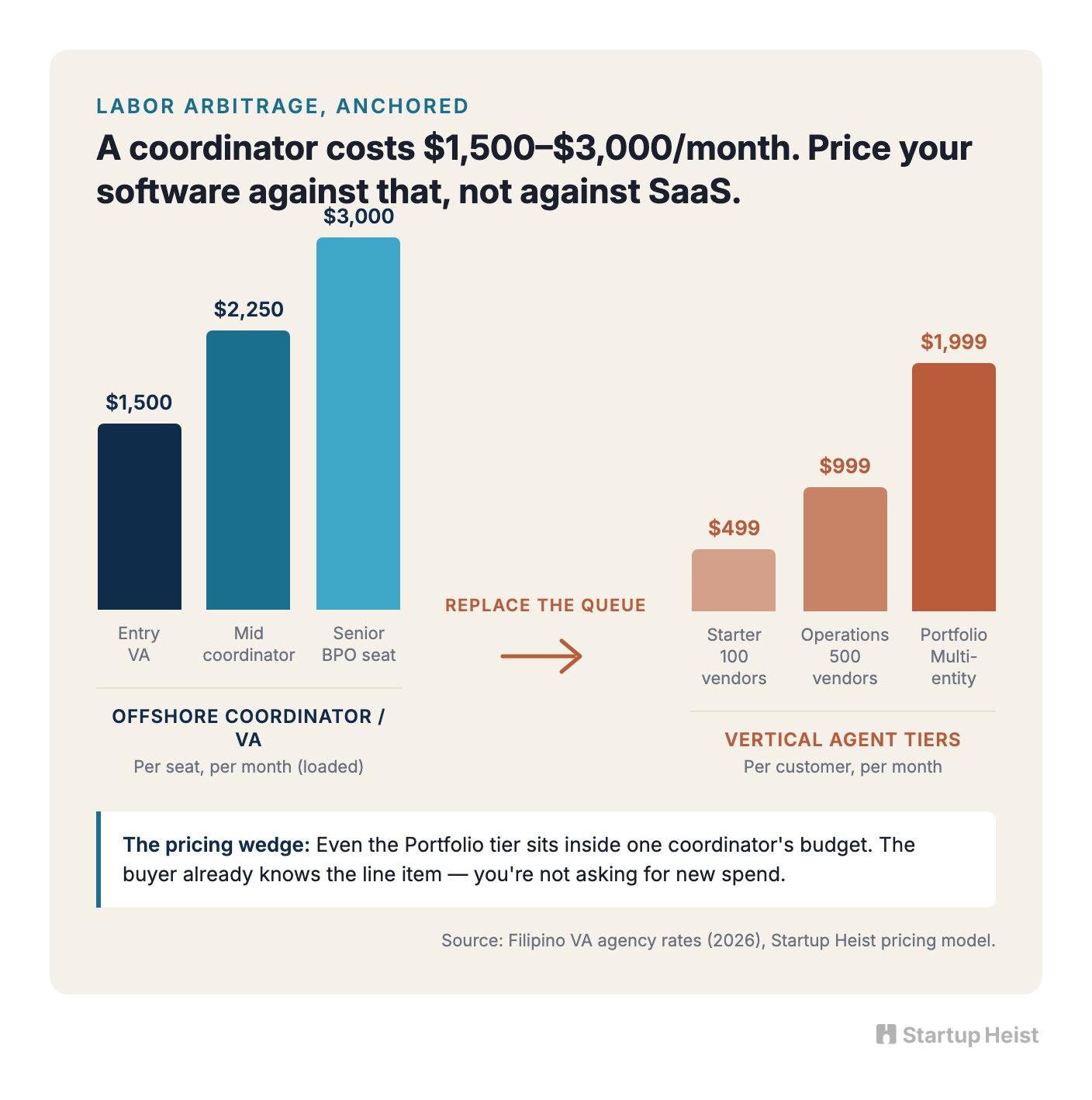
The money: 25 property managers at $999/month = $25K MRR, anchored to the $1,500–$3,000 coordinator they're already paying. Champ AI just raised $8.5M proving the category.
Inside:
• 9-step COI tracking MVP scope
• Pricing tiers anchored to coordinator cost
• Cold outbound scripts + trigger events
• Warranty triage + clinic rescheduling wedges
The Opportunity
The obvious move is to build "AI agents for back-office operations." That's the broad, VC-backed, horizontal play. It puts you against Champ, UiPath, Microsoft Power Automate, Automation Anywhere, and every AI-native RPA company with a bigger engineering team and better enterprise distribution.
The Startup Heist move is narrower. Build a vertical back-office agent that handles one annoying workflow for one industry where companies already pay offshore VAs or coordinators $1,500–$3,000 per month per person to do repetitive browser, email, and document work.
Don't replace the back office. Replace one queue.
Certificate-of-insurance tracking for property managers. Warranty claim triage for appliance repair companies. Appointment rescheduling for clinics. Refund evidence collection for ecommerce brands. Delivery exception handling for Shopify merchants.
One workflow. One dashboard. One measurable SLA. That's the wedge.
The best version of this business isn't a chatbot. It isn't a generic agent builder. It isn't a cute AI assistant that promises to "streamline operations." It's boring infrastructure with a sharp promise:
"We process your vendor insurance certificates within 24 hours, chase missing documents automatically, flag noncompliant coverage, and keep your team out of spreadsheets."
Or: "We triage appliance warranty claims, collect photos and receipts, classify the issue, validate coverage, and route repair-or-replace decisions before a human ever opens the ticket."
Or: "We handle your appointment rescheduling queue: cancellation requests, missed appointments, patient follow-ups, calendar updates, and confirmation messages."
The buyer already understands the pain because they're already paying for it. You aren't asking a company to imagine a new workflow. You're walking into an existing cost center and saying: this repetitive queue currently costs you one coordinator, one offshore VA, or one overwhelmed operations person. We can handle 70–85% of it with software, escalate the rest, and give you a cleaner audit trail.

Filipino virtual assistants in 2026 charge $3–$6/hour for entry-level admin work and $6–$10/hour for mid-level specialists. Trusted technical and executive roles climb higher. Agencies mark that up further, landing the typical SMB at $1,500–$3,000 per month per coordinator once management, EOR fees, and turnover are factored in.
The labor arbitrage is already there. But selling this as "software cheaper than labor" is the trap. The real pitch is speed, consistency, and auditability. No hiring. No training. No VA management. No timezone delays. No "she left and now we have to retrain someone." No backlog because someone forgot to check a portal.
Sell it as cheaper labor and you become a BPO vendor with software margins. Sell it as a vertical workflow system with measurable throughput and compliance, and you become software.
Why Now
Three things changed.
Agent infrastructure is finally production-ready. Browser automation used to mean brittle RPA scripts that broke whenever a button moved. That still happens. But the tooling stack is much stronger: Playwright, Puppeteer, OCR APIs, LLM-based document understanding, email parsing, workflow orchestration, and human-in-the-loop review queues. Amazon Nova Act went generally available on December 2, 2025, with AgentCore Browser providing session isolation, CloudTrail logging, session replay, and built-in human-in-the-loop escalation via SNS. The production scaffolding that took enterprise RPA vendors a decade to build is now available as a managed service.
Back-office work doesn't have a clean API. The work happens in web portals. Vendor systems. Insurance portals. Carrier dashboards. Scheduling systems. Legacy software. Inboxes. The browser is the API.
The labor replacement math is also obvious. A company paying $2,000/month for an offshore coordinator doesn't need a philosophical argument about automation. It needs fewer bottlenecks, fewer mistakes, and a faster queue.
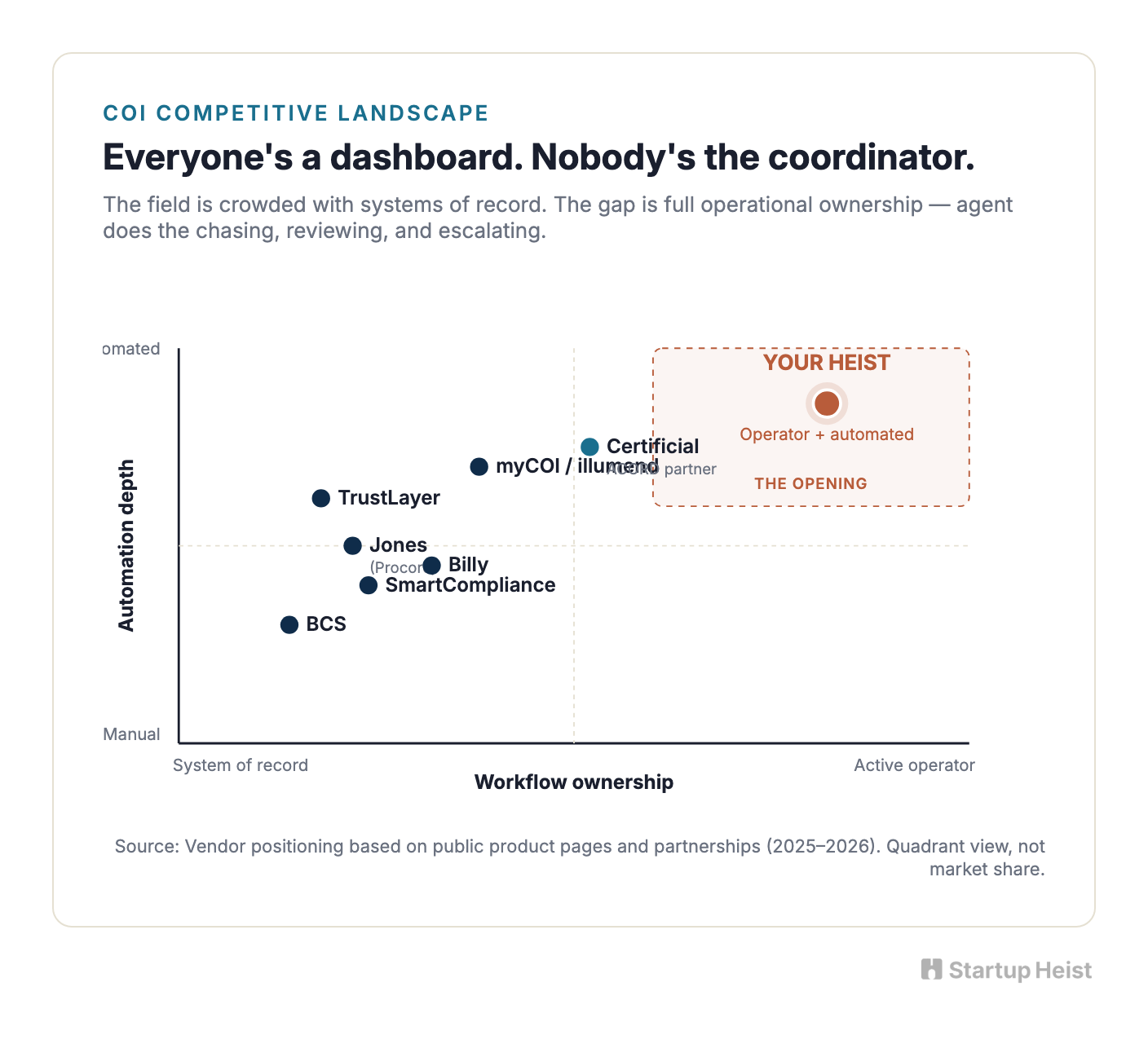
And the incumbents are still too horizontal. UiPath and Microsoft are powerful, but broad automation platforms require setup, internal ownership, and process design. They're tools. The SMB buyer doesn't want a tool. The SMB buyer wants the queue gone. Champ AI confirms the category but is already chasing logistics, healthcare, and ecommerce customers simultaneously, which is the classic horizontal trap. That leaves room beside and below the platform players. Not because they can't build your feature. Because they won't care about your first niche fast enough.
Where to Start: COI Tracking for Property Managers
The cleanest starting point is certificate-of-insurance tracking for property managers. That's your first wedge:
Unlock the Vault.
Join founders who spot opportunities ahead of the crowd. Actionable insights. Zero fluff.
“Intelligent, bold, minus the pretense.”
“Like discovering the cheat codes of the startup world.”
“SH is off-Broadway for founders — weird, sharp, and ahead of the curve.”


