


AssignmentForge: Build the Assessment Design Layer for the AI Classroom
The take-home essay didn't disappear. It just stopped meaning anything.
For a century, schools ran on a quiet bargain. Send students home with a prompt. Collect the finished artifact. Read the work product as a proxy for the thinking behind it. A polished paper meant a student who had wrestled with sources, structured an argument, and revised toward clarity. The artifact and the learning traveled together.
Generative AI severed that link. A student can now produce a clean first draft, rewrite it in a personal voice, summarize five sources, fabricate a discussion post, and polish a reflection before an instructor sees a single word. The issue isn't that every student cheats. It's that an instructor can no longer hold up most traditional assignments and say, with confidence, "This tells me what this person understands."

That broken proxy is the opening, and almost everyone is attacking the wrong side of it. The whole edtech market rushed toward AI detection: catch the machine after the work comes in. The more durable business sits one step upstream, in assessment design, helping instructors build assignments where the valuable part of the work is hard to outsource in the first place. Process, revision history, source reasoning, local context, oral defense, student-specific explanation. Call it AssignmentForge.
Here's the opportunity:
The money: 700 instructors at $149/year is roughly $9K MRR solo. A handful of $12K-$35K institutional contracts on top push past $20K MRR.
Inside:
• 8-piece MVP, no proprietary AI needed
• $19 wedge to $35K institutional ladder
• Pattern-graph moat that compounds
• Pain-harvesting GTM for the first 100
The wedge isn't "make AI-proof assignments." That promise is too brittle, and a clever student breaks it by lunch. The sharper framing: help instructors design AI-aware assessments where AI may assist but cannot replace the student's thinking. Detection asks, "Did a machine write this?" AssignmentForge asks, "How do we build the assignment so the student has to show up inside it?"
That's a better business. It's more defensible, less adversarial, and aligned with where institutions are already heading. Brookings' 2026 task force on AI in education landed on the same place: overreliance threatens foundational learning, but well-designed AI use embedded in sound pedagogy can help. No panic, no prohibition. Redesign.
Everyone Built a Smoke Detector for a House That's Already Wired Wrong
The obvious response to AI cheating was to detect it, and the incumbent moved first. Turnitin reviewed more than 200 million papers in the first year of its AI writing detector. Roughly 11% carried at least 20% AI-written content. Roughly 3% were at least 80% machine-generated. That's more than six million papers largely written by a chatbot, and the rate barely moved across the year.
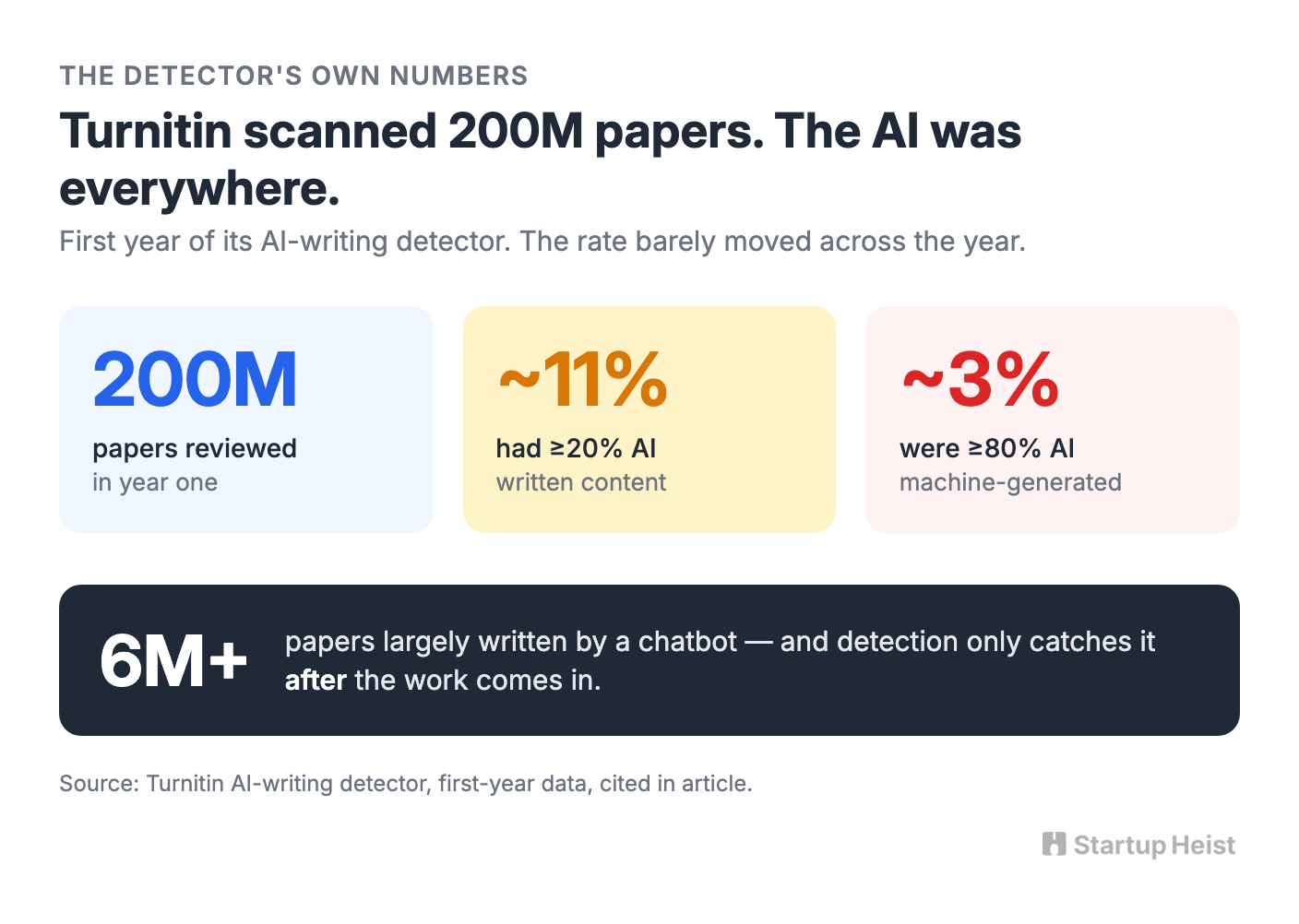
Detection has two structural weaknesses that no amount of model tuning fixes. It's reactive, arriving only after the work is submitted and the trust has already broken, which forces the instructor into an enforcement role nobody signed up for. And it's fragile: false positives, the documented penalty against multilingual writers, murky AI-use policies, and the blurred line between "assistance" and "misconduct" make detection a miserable foundation for a category.
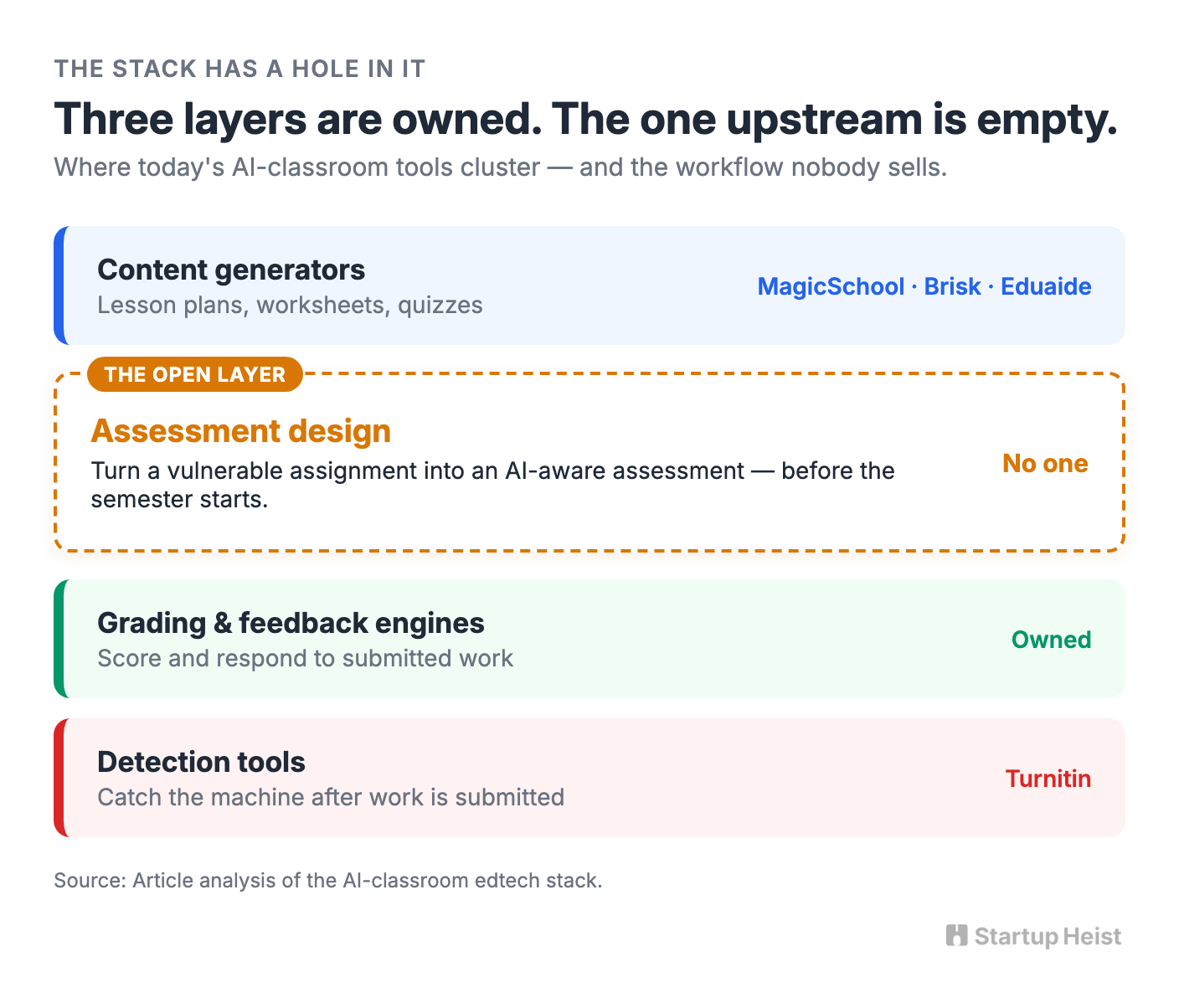
The tell is that the incumbent already knows it. Turnitin's own April 2026 integrity report calls for stronger assessment design alongside detection, the clearest signal yet that the most credible player in the space sees the upstream layer as the real ground. The current edtech stack clusters into three buckets: content generators that write lesson plans and worksheets, grading and feedback engines, and detection tools for submitted work. MagicSchool, Brisk, and Eduaide live in the first two; Turnitin owns the third. Nobody owns the layer in between, the workflow that turns a vulnerable assignment into an AI-aware assessment before the semester even starts. That layer is empty, it sits directly upstream of every dollar spent on detection, and the most credible incumbent is already circling it. The window to plant a flag is open, but it won't stay open.
Faculty Fear Just Crossed a Structural Line
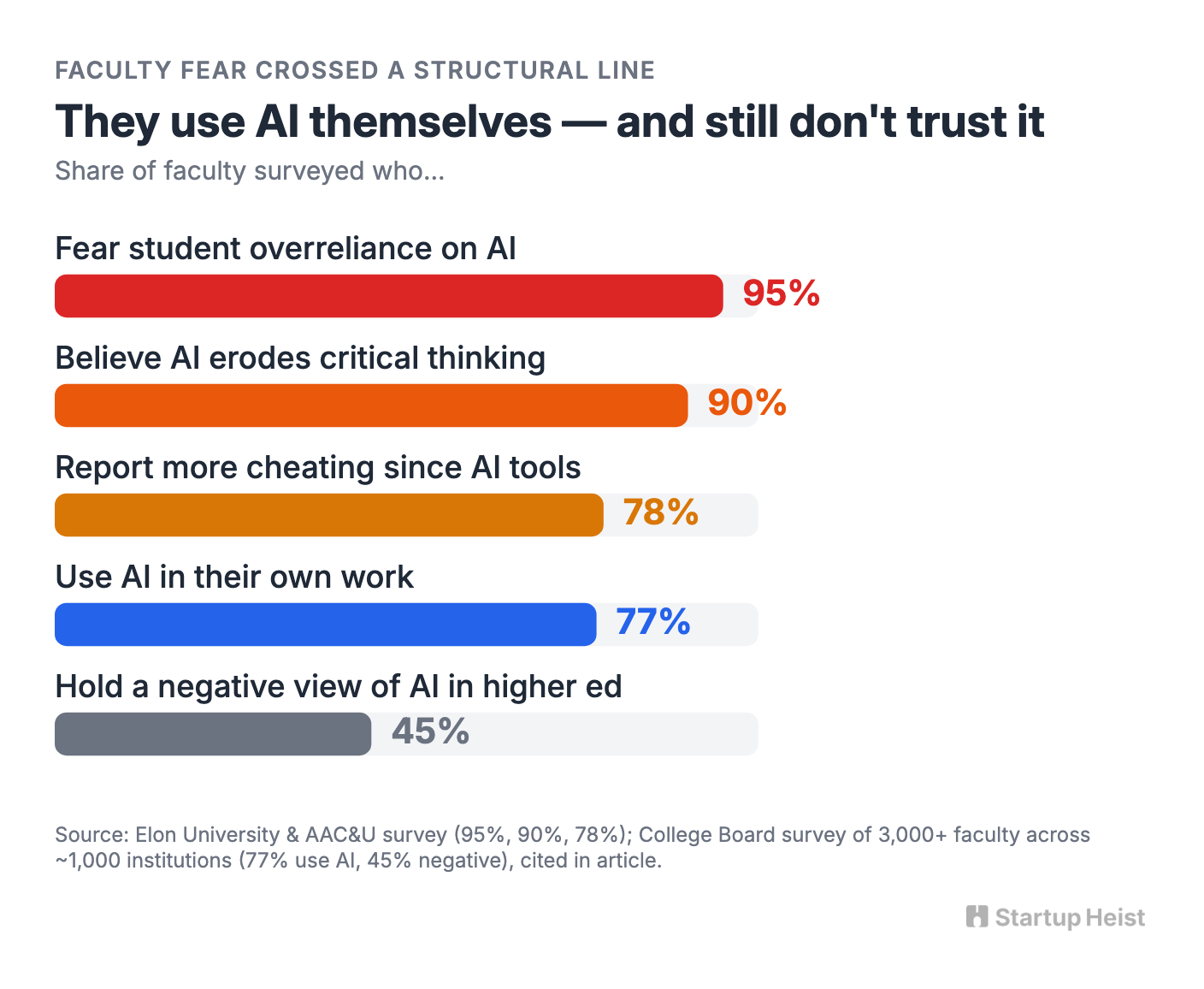
Faculty fear used to be "some students might use ChatGPT." Now it's "the assessment model itself may be broken," and the numbers are stark.
A College Board survey of more than 3,000 faculty across roughly 1,000 institutions, published in February 2026, found 45% holding a negative view of AI in higher education, with nine in ten reporting at least some concern about AI-driven dishonesty. Nearly three-quarters said students were using AI to write essays outright. A separate Elon University and AAC&U survey found 95% of faculty fearing student overreliance, 90% believing AI was eroding critical thinking, and 78% reporting more cheating since the tools went mainstream. These aren't technophobes. Most faculty use AI in their own work, and roughly three in four told the College Board they had. They use the technology and still don't trust what it does to unsupervised assessment.
The institutional response confirms the panic is structural, not seasonal. On May 11, 2026, Princeton's faculty voted with a single dissenting vote to end 133 years of unproctored exams, reintroducing proctors on July 1. The catalyst was AI-enabled cheating that students could no longer even see, let alone report. When an institution overturns an honor code that has stood since 1893, the rest of the system pays attention.
Meanwhile, six million educators have already been trained to reach for software. MagicSchool's users save a reported 7 to 10 hours a week across 80-plus tools. The behavioral groundwork is laid: educators now expect AI to handle lesson plans, rubrics, and quizzes, and assessment redesign is the next logical click. The old assignment said, "Write a paper about X." The AI-era version says: show your source trail, log your drafts, defend your argument in three minutes, apply the concept to a local case, compare your answer against the machine's, and answer follow-up questions tied to your actual submission. That's not a prompt. It's a workflow. And nobody is selling it.
The Product: A Package, Not a Prompt
AssignmentForge should launch as a focused tool for writing-heavy higher-ed courses: first-year composition, humanities, social sciences, business communication, nursing ethics, public policy, education and leadership programs.
The first user isn't the chief innovation officer. It's one instructor with a syllabus, a vulnerable assignment, and a semester bearing down. That person doesn't want a theory of AI literacy. They want to paste in their existing assignment and get back a better one. The core loop is exactly that simple: paste your current assignment, get an AI-aware assessment package.
The package is where the value lives. It isn't a rewritten prompt. It's the whole operational kit:
- A rewritten prompt that pushes weight toward context, process, and reasoning, with AI-disclosure expectations baked in.
- A process scaffold breaking the work into milestones: proposal, source map, draft checkpoint, revision memo, reflection log, final submission.
- Oral-defense prompts tied to the learning goals, runnable in class, over Zoom, or asynchronously as short recordings.
- A rubric that shifts grading weight off final polish and onto reasoning, evidence, revision quality, and AI-use transparency.
- AI-use policy language spelling out what's allowed, what must be disclosed, and what's off-limits.
- A student-facing checklist and an implementation guide with a 50-minute, one-week, and three-week version.
Most instructors already grasp process-based assessment. What they lack is time, confidence, and repeatable structure. AssignmentForge turns faculty anxiety into a usable artifact before Monday. That's the entire promise, and it's enough.
Why Writing-Heavy Higher Ed Is the Right Door
K-12 is the larger market, but it's the wrong first move: procurement-heavy, policy-sensitive, and gated behind district adoption cycles that run a year or longer.
Higher ed, specifically writing-intensive courses, is the better wedge for three reasons. The pain is acute and immediate. The buyer can often move alone, with a credit card and no committee. And the assignment types most exposed to AI in the entire curriculum, essays and reflections and discussion posts, all live here.

Community colleges deserve special attention. They run enormous volumes of writing-intensive general-education courses, lean heavily on adjunct labor, and serve students who need stronger scaffolding rather than stricter policing. Help one adjunct redesign five assignments before the semester starts and you've delivered something they'll pay for and tell their department about.
One positioning note decides everything downstream: don't launch as "AI-proof your classroom." It sounds adversarial and gimmicky, and it can't survive a faculty meeting. Launch as AI-aware assessment design for instructors who still need to know what their students actually learned. Cleaner, more professional, and far easier to defend out loud. That distinction is also what makes the next part buildable in a single quarter.
The MVP: Eight Weeks to a Paid v1
This is a genuine solo-builder opportunity because v1 needs no proprietary AI infrastructure. It needs product taste, sharp prompt engineering, a tight workflow, and enough pedagogical structure to avoid generic AI sludge. The LLM is a commodity. The packaging is the product.
Build these eight pieces:

Unlock the Vault.
Join founders who spot opportunities ahead of the crowd. Actionable insights. Zero fluff.
“Intelligent, bold, minus the pretense.”
“Like discovering the cheat codes of the startup world.”
“SH is off-Broadway for founders — weird, sharp, and ahead of the curve.”


