


TikTok Won't Let the Robot Host the Show. Put It in the Earpiece.
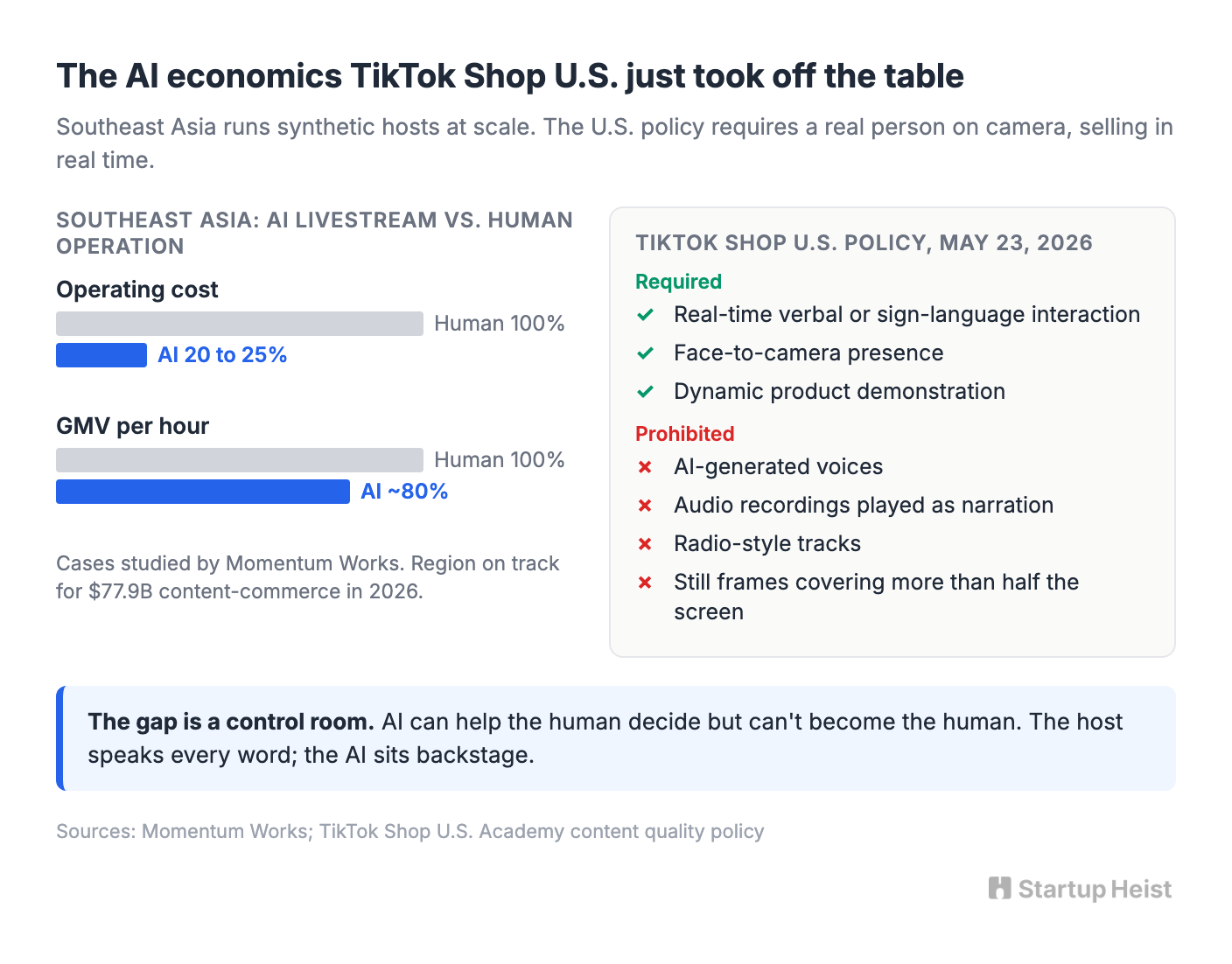
The obvious way to apply AI to livestream commerce is to replace the person on camera. Southeast Asia is already running that experiment at scale. Momentum Works puts the region's content-commerce market on track for $77.9 billion in 2026, with live, short video and affiliate-led selling now 37% of platform ecommerce GMV. In the cases the firm studied, an AI livestream operation cost 20 to 25% of a comparable human operation and generated around 80% of the human GMV per hour. If you run product livestreams eight hours a day, that math is the whole business.
In the United States, TikTok Shop has closed that door. On May 23, 2026, TikTok Shop's U.S. Academy published a content quality policy for promotional LIVEs that requires real-time verbal or sign-language interaction, face-to-camera presence and dynamic product demonstration. The prohibited list is explicit: no AI-generated voices, no audio recordings played as narration, no radio-style tracks, no still frames covering more than half the screen. Violations feed the Creator Health Rating that gates commissions, and repeat offenses escalate to content removal and account penalties.
Livestream operators want AI economics, and TikTok insists on a real person selling in real time. The business that lives in the gap between those two demands is a control room. The product is called Live Backstage: a browser or OBS sidecar for TikTok Shop agencies that loads a merchant's catalog, inventory, approved claims, FAQs, bundles and promo rules, then tells the host and moderator what deserves attention next. Three viewers are asking about sizing. The blue medium is running low. Show SKU 14. Don't use that medical claim. You already handled that objection twice, move on.
The host still decides what to say and speaks every word. The AI is a producer, catalog researcher, merchandiser and claim monitor sitting invisibly backstage, and the durable asset it builds is the institutional memory behind the show.
Here's the opportunity:
The money: Three agencies at $2,000 a month is $6K MRR, ten is $20K. Underneath it, U.S. TikTok Shop GMV hit $11.8B in H1 2026, up 103%.
Inside:
• The sell-card schema that constrains the AI
• Nine-piece MVP a two-person team can ship
• Design-partner pricing at $2,000 a month
• The 50-agency outbound list and cold email
The Rule Is the Wedge
The biggest mistake here would be treating TikTok's AI restriction as a temporary inconvenience to design around. The policy draws an unusually clean boundary, where AI can help the human decide but can't become the human, and every surface of the product should make that boundary visible. Onboarding says "Suggestions only. A human operator decides what to use and speaks or sends every response." There's no text-to-speech button, no auto-answer for chat, no unattended sales mode. Every suggestion carries a record: source, rule, suggestion, operator action.
That reads as bureaucratic until an agency has ten hosts selling thirty SKUs for three clients. A skincare brand approves "helps skin feel hydrated" and prohibits "repairs damaged skin." A clothing seller allows "fits true to size for most customers" but wants hosts to flag that one style runs small. Today those distinctions live in Slack history and a substitute host's memory. In Live Backstage they live in the product, versioned, attached to the SKU, surfaced at the moment the host needs them. At that point the tool is infrastructure, and nobody mistakes it for ChatGPT in a second window.
The Market Finally Supports Weird Software
American livestream shopping spent years being called "the next QVC," and that framing hid what changed. EMARKETER forecasts U.S. livestream retail ecommerce sales of $19.8 billion in 2026, up 35% year over year, with more than 58 million U.S. consumers buying through a livestream this year, nearly a quarter of digital buyers. TikTok Shop is growing faster than the category: EMARKETER projects $23.41 billion in U.S. sales for 2026, up 48%, a figure that would put TikTok Shop ahead of Target's U.S. online sales. Momentum Works estimated H1 2026 U.S. GMV at $11.8 billion, a 103% jump that made the U.S. TikTok Shop's largest market globally.
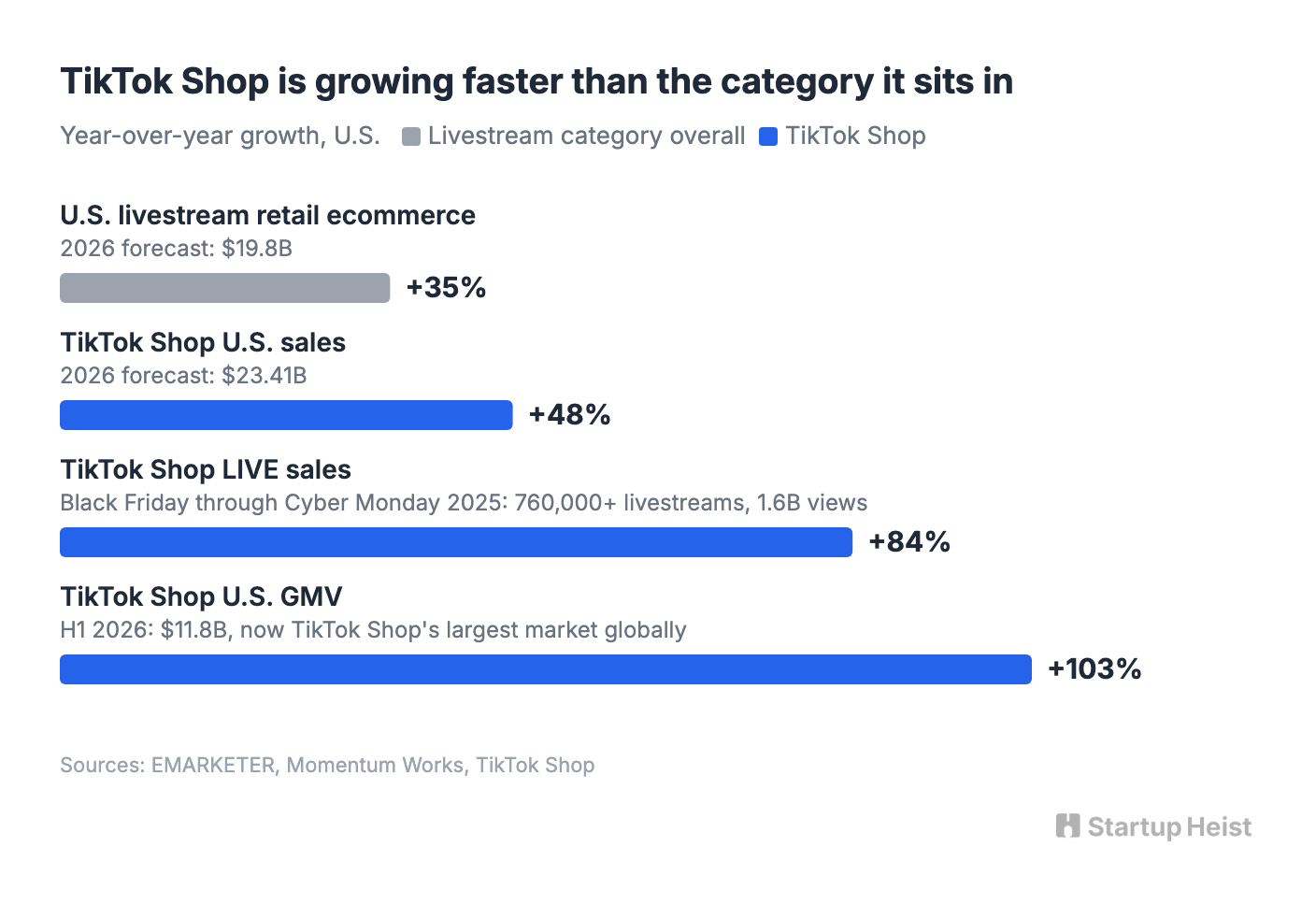
TikTok Shop LIVE is a real share of that, and the peak-season data shows what a serious operation looks like. During the 2025 Black Friday through Cyber Monday campaign, brands, sellers and creators hosted more than 760,000 livestreams that drew 1.6 billion views. Livestream sales rose 84% over the prior year's campaign, inside a four-day window where TikTok Shop cleared $500 million in U.S. sales.
None of this means every TikTok seller needs a control room, and most don't. The customer is the operator who has turned livestreaming into an industrial process: TikTok Shop agencies, brands running recurring six-hour selling blocks, merchants rotating multiple hosts through the same catalog, agencies managing five, ten or fifty merchant accounts. Their livestream is a small television production. Someone hosts, someone moderates, someone watches inventory, someone swaps products, someone answers chat, someone reminds the host which claims are approved, someone briefs the next shift. Live Backstage compresses a team that already exists, which is a much easier sale than creating a budget category.
Agencies, Not Creators
A creator wants to know whether the tool will make them a little more money. An agency director wants to know whether it can make every host on payroll more consistent, and that question produces the better SaaS company because it points at the agency's most expensive recurring problem: host rotation.
The U.S. live shopping agency layer is already formed. Shops like Go Fish Digital run live-shopping studios in cities including Boston, Raleigh and Phoenix, with hosts, moderators and strategists on staff. Agencies post dedicated Livestream Community Moderator roles whose job description is running the operational side of the show while the host stays on camera. Host pay averages around $21.60 an hour nationally, which tells you the labor is cheap per hour and expensive in aggregate, because the moderator, producer and briefing time stack on top of every one of those hours.
The best host on the roster knows a merchant's catalog by heart, and the substitute who covers a Thursday shift doesn't. So before that shift someone sends a Google Doc, twelve screenshots, a spreadsheet, three Slack messages, a promo calendar and "make sure you don't say X." Live Backstage turns that into a pre-show screen: 17 products, 4 changed since yesterday, 2 new promotions, 3 claims updated, 1 low-stock item, top 5 objections from the last show. The business case is lower onboarding cost and lower operating variance before anyone argues about GMV lift, and that case is far easier to prove.
What TikTok and the Streaming Tools Already Cover
Assume TikTok can eventually generate every prompt Live Backstage generates. The platform already ships Seller Assistant, an agentic AI in Seller Center that reasons over shop context, suggests next steps and can take actions with permission. Its AI Homepage, in beta since April 9, 2026, replaces the module dashboard with five agents that surface shop data and flag issues. And since August 2026 TikTok has been piloting a U.S. managed-services program that takes over ads, listing optimization, creator recruitment and content production for selected sellers, reportedly priced at a $10,000 flat fee plus a 10 to 20% commission. TikTok is moving deeper into merchant operations, and it understands TikTok better than you do.
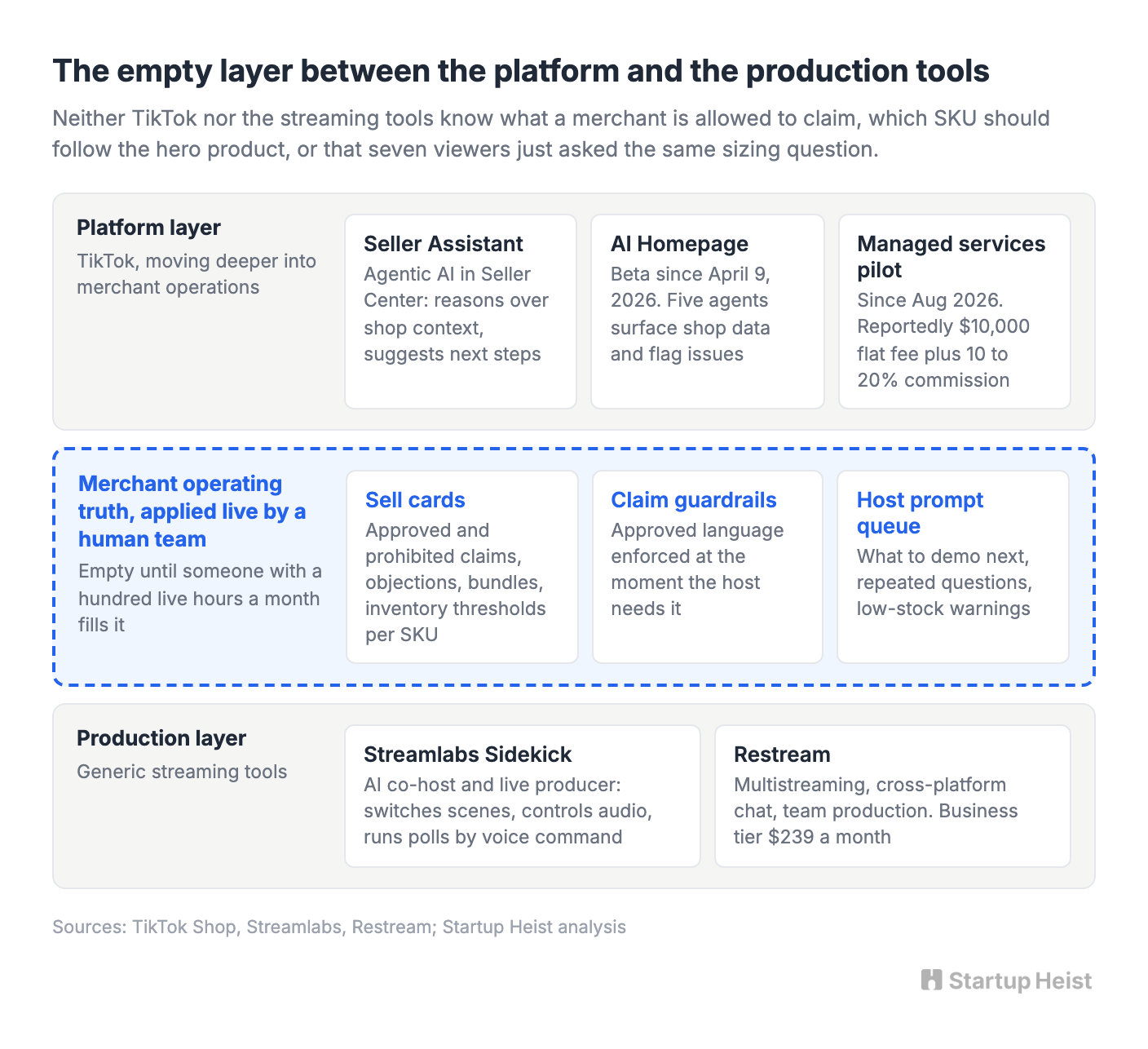
The generic streaming tools cover a different layer. Streamlabs Sidekick positions itself as an AI co-host and live producer that switches scenes, controls audio and runs polls by voice command. Restream handles multistreaming, cross-platform chat and team production at $239 a month, billed monthly, for its Business tier. Neither knows what a merchant is allowed to claim about a backpack, which SKU should follow the hero product, or that seven viewers just asked the same sizing question. That layer, the merchant's operating truth applied in real time by a human team, is empty. It stays empty only until someone with a hundred live hours a month decides to fill it.
The Sell Card Is the Core Object
Skip the general-purpose copilot. The core data object is a sell card per SKU, the canonical truth the backstage system is allowed to work from.
Unlock the Vault.
Join founders who spot opportunities ahead of the crowd. Actionable insights. Zero fluff.
“Intelligent, bold, minus the pretense.”
“Like discovering the cheat codes of the startup world.”
“SH is off-Broadway for founders — weird, sharp, and ahead of the curve.”


