


TikTok Just Turned Every Travel Video Into a Checkout Page
For years, the advice to travel businesses ran on autopilot: post more videos. Film the sunset cruise. Show the hidden alley on the food tour. Capture the customer's face when the ghost appears in the hotel basement. Add a trending sound, drop a link in the bio, and hope something catches.
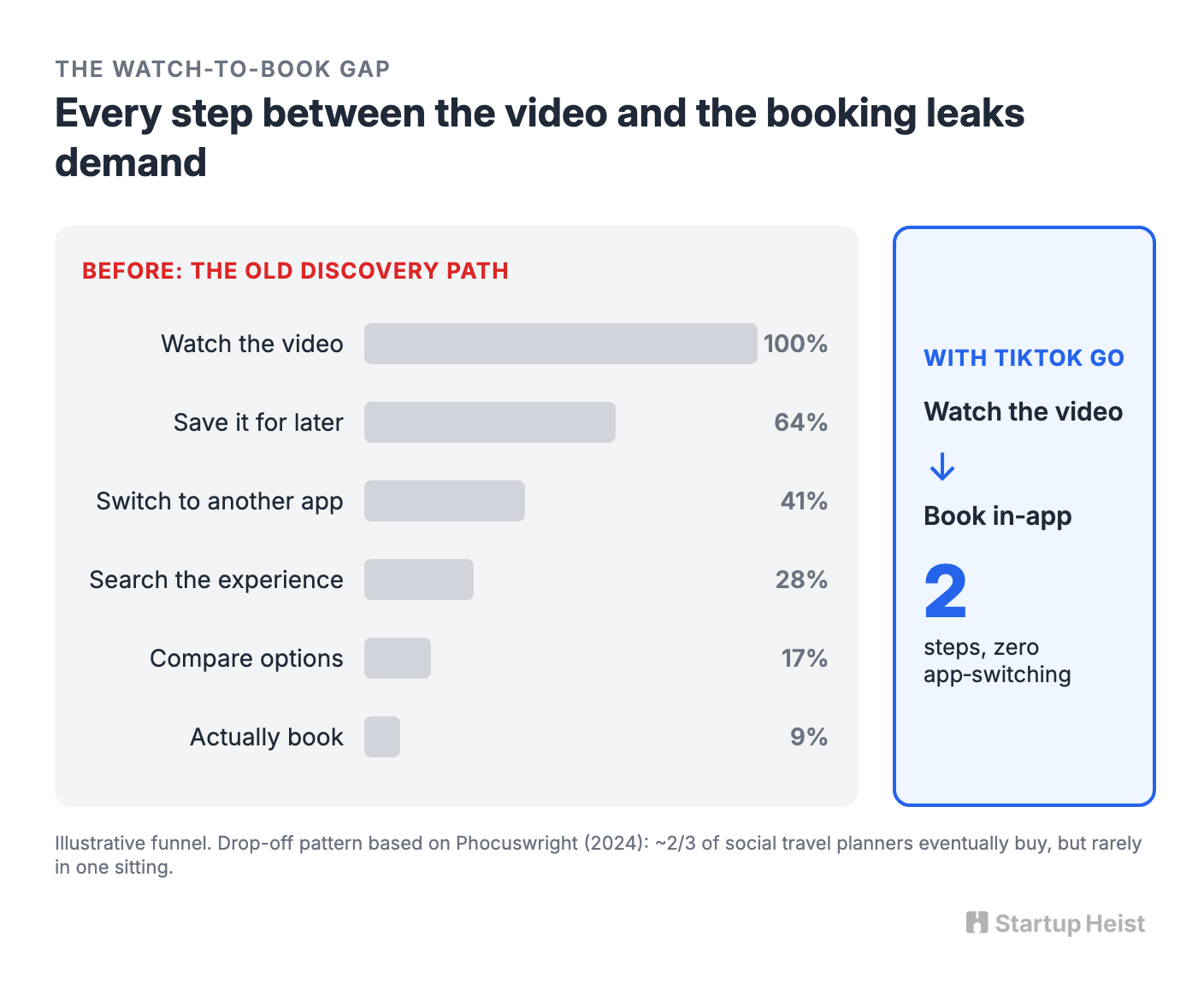
The advice wasn't wrong, just incomplete. The commercial path stayed weak. A traveler could watch a 22-second clip, feel the pull, save it for later, open another app, search for the experience, compare options, get distracted, and never book. Operators were manufacturing demand they had no way to capture.

On May 12, 2026, TikTok shortened that path. It launched TikTok GO in the United States, letting users discover and book hotels, attractions, tours, and local experiences without leaving the app. Inventory flows in through Booking.com, Expedia, Viator, GetYourGuide, Tiqets, and Trip.com. TikTok says the feature lives inside an app used by more than 200 million Americans, surfacing bookable products across videos, search, and location pages. Creators can wire their content straight to bookings and earn through commissions and creator campaigns.
Here's the opening for a founder.
The money: 20 operators at an average $550/month is $11,000 MRR; 100 is $55,000, with managed creator sprints layered on top. Operators already paying OTA commissions buy outcomes fast.
Inside:
• 90-day MVP scope, service-first then software
• Three-tier pricing: pilot, subscription, sprint
• Four launch categories that sell on video
• The data feedback loop that becomes the moat
This isn't TikTok Shop for vacations. A trip costs more than a phone case and carries more friction. Plenty of travelers will still save the video, text a friend, weigh options, and book days later. A 2024 Phocuswright study found that two-thirds of travelers who use social media to plan later made a purchase or decision tied to what they watched, but the journey rarely closes in a single sitting.
That gap between watching and booking is where the opportunity lives.
The play is a TikTok GO Revenue Kit: a lightweight SaaS product wrapped in a done-with-you service for tour and activity operators. It ingests an operator's Viator, GetYourGuide, or direct-booking pages, turns each experience into TikTok-ready briefs and offers, generates trackable links, and reports which videos, hooks, formats, and seasonal angles actually drive saves, clicks, and bookings. The simple version tells an operator what to film this week. The valuable version learns what makes people book.
Why this rail matters
TikTok didn't invent travel discovery. It formalized a habit travelers already had. People use short-form video to decide what to eat in Flushing, where to stay in Miami, which cave tour to book in Puerto Rico, and whether the "secret" jazz bar in Tokyo is worth the line. TikTok GO connects those moments to inventory anyone can book in a few taps. GetYourGuide co-founder Johannes Reck framed his side of the deal around more than 200,000 experiences across 12,000 destinations, most of them run by small local operators.
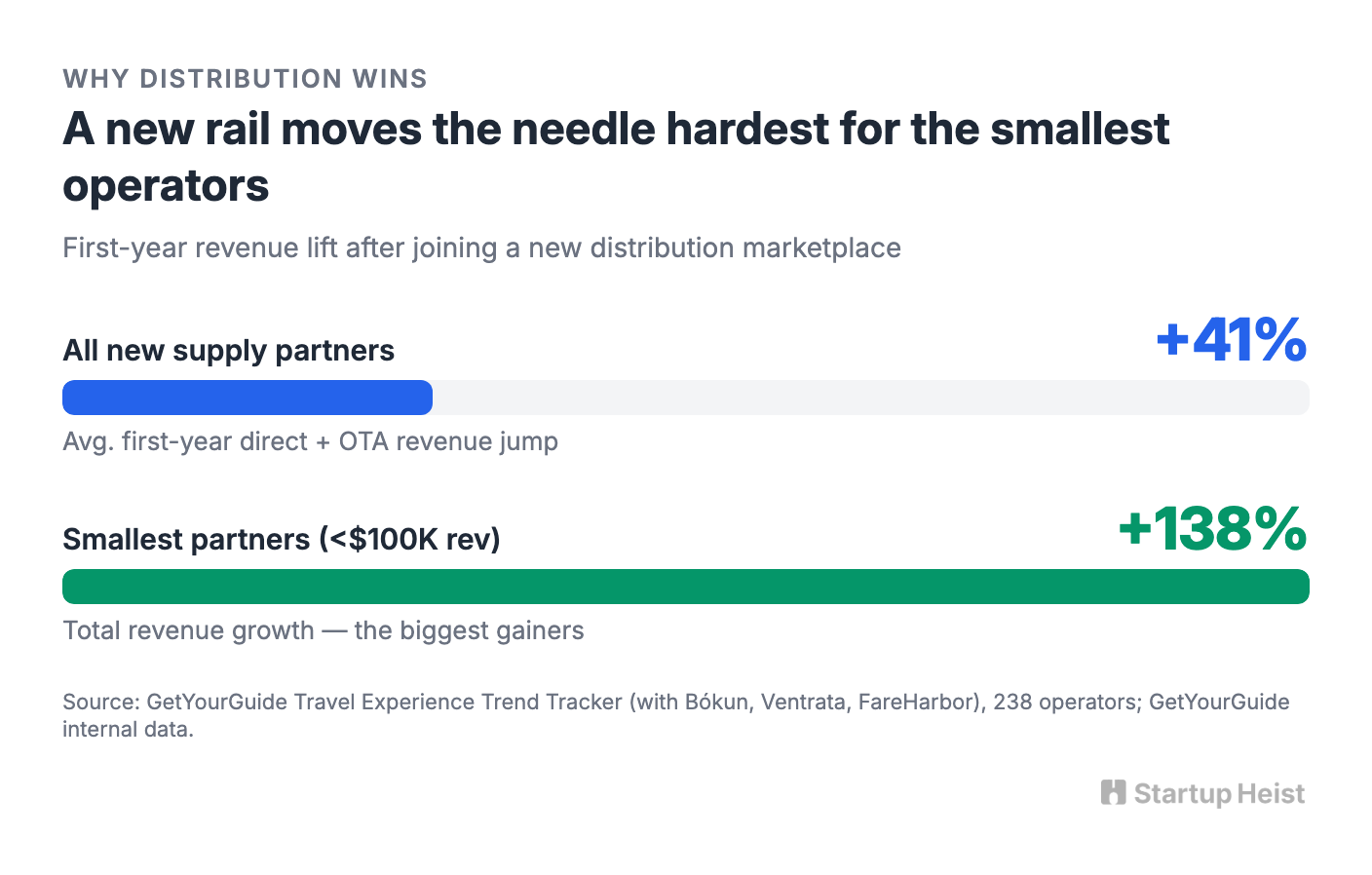
The numbers underneath are large enough to support a wave of specialized businesses. U.S. travel spending is forecast to hit $1.37 trillion in 2026, with domestic travel at 87% of the total, or $1.20 trillion. More telling for a founder: distribution changes move the needle hardest for the smallest operators. GetYourGuide's Travel Experience Trend Tracker, a study it ran with Bókun, Ventrata, and FareHarbor across 238 operators, found that new supply partners saw an average 41% jump in combined direct and OTA revenue in their first year on the marketplace. By GetYourGuide's own internal data, its smallest partners, those under $100,000 in revenue, posted the biggest gains, with 138% total revenue growth.
The lesson here isn't that every operator should hand their fate to a marketplace. It's that presentation and distribution decide outcomes for small businesses with thin marketing budgets. TikTok GO is a new distribution rail, and the playbook for it doesn't exist yet.
The operator's problem isn't a lack of ideas
Picture a food-tour company with six products: a daytime Chinatown dumpling tour, an evening street-food walk, a private corporate tasting, a vegetarian variation, a weekend market experience, and a seasonal holiday tour.
The owner has booking pages. The tours already live on Viator or GetYourGuide. The team has hundreds of photos and a growing pile of glowing reviews. Someone posts to TikTok now and then.
What the owner lacks is a repeatable answer to five questions:
- Which tour should we promote this week?
- What should we film?
- Which hook should we test?
- Which booking link should we attach?
- Did the video make money, or just views?
This is where the market stays primitive. Industry advice still treats TikTok as a craft project. Arival's guide for tour operators recommends putting booking links in the bio, pinning high-engagement videos, using calls to action, and treating the profile as a storefront. Sensible enough, but it leaves the operator inventing ideas, coordinating shoots, tagging products, and tracking outcomes by hand.
Small businesses don't need a 47-tab marketing dashboard. They need a short weekly list:
Film a 25-second "before the crowds arrive" walkthrough of your sunrise kayak tour. Open on empty water. Show the launch point, the guide, the first wildlife sighting. Put the price in the final frame. Use this booking link. Your last two "quiet escape" clips pulled twice the saves of your generic montages.
That's an action system tied to inventory and performance, not a content calendar.
Why this isn't just another AI content tool
It's easy to build the wrong product here. An operator can already paste a tour description into a chatbot and ask for 30 TikTok ideas. The output will be fine. It might even be useful. But it isn't a business.
The defensible version begins where generic generation ends: tied to live commercial inventory and trained on real outcomes. The useful recommendation isn't "post a behind-the-scenes video about your ghost tour." It's "your 8 p.m. ghost tour has open seats next Thursday. Your 'local legend' clips are pulling more saves than your jump-scare clips. Film a 30-second guide-led story at the cemetery gate, open with 'most locals don't know this,' and push the Thursday slot."
The difference is context. Travel content bends to weather, seasonality, daylight, local events, inventory levels, group size, family fit, price sensitivity, traveler origin, and the long gap between discovery and the travel date. Generic content software understands none of it. A travel-vertical tool should grow opinionated about exactly these variables. GetYourGuide's 2026 operator research suggests the market is ready: by the company's own survey, 19% of operators were actively using AI and another 33% were testing it, with more than half saying clearer guidance would push them to adopt. The winning pitch isn't "AI for tour operators." It's "we tell you what to film next, and why."
The competition is real, but pointed the wrong way
The experiences industry already has strong software. FareHarbor calls itself an all-in-one booking and business-management platform and says it powers more than 20,000 companies. Rezdy runs booking management, live availability, reseller distribution, and channel management. Peek Pro pitches itself as an operating system for experiences. All three help operators manage inventory, take bookings, distribute tours, and run operations. What none of them do is answer "which TikTok should I film Wednesday to fill my empty Friday kayak slots?" On the other side sit creator-marketing platforms and generic AI tools built for brand campaigns, not tour schedules, OTA listings, or the economics of a local operator.
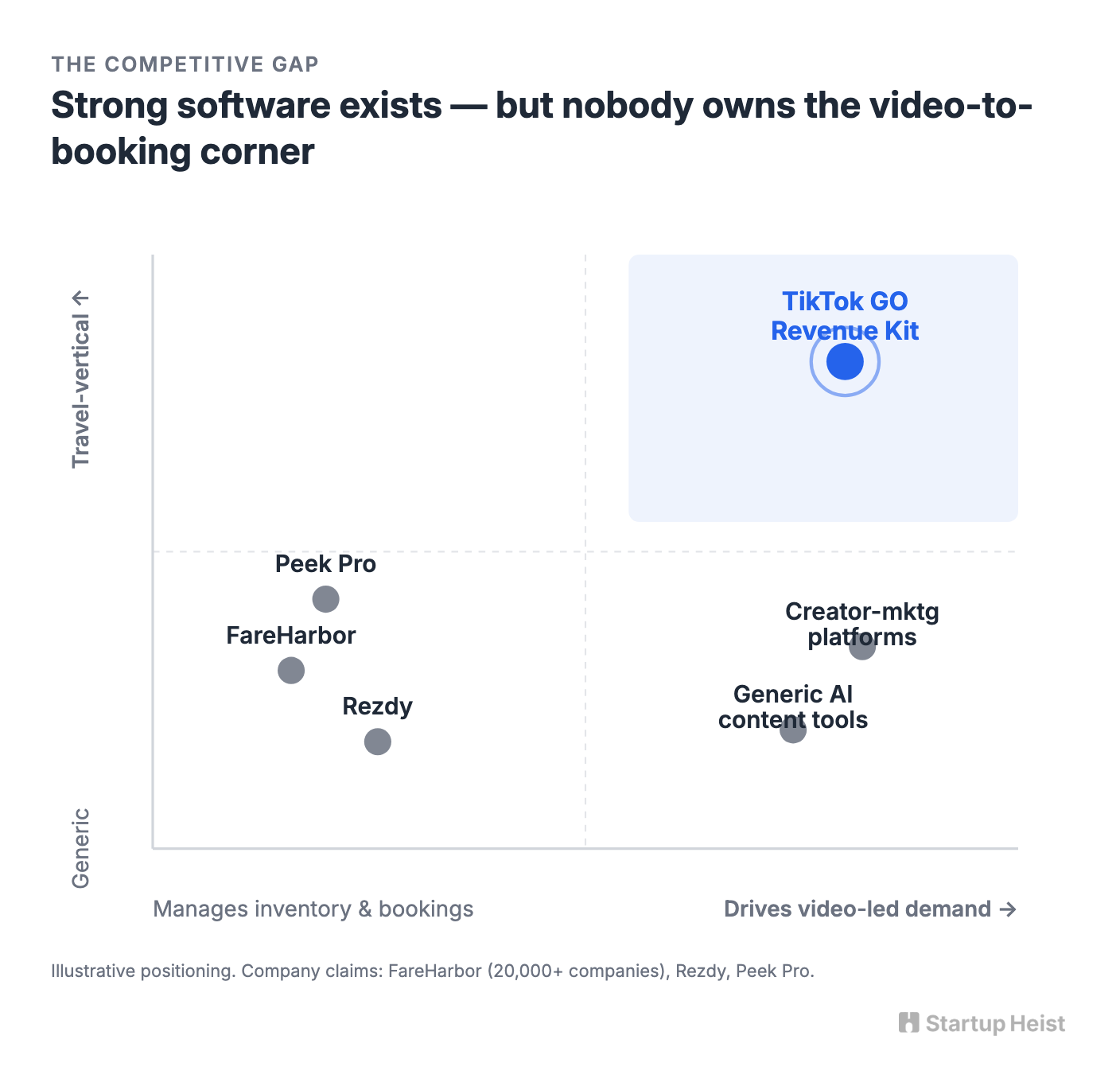
The opportunity sits in that gap. Think of it as a lightweight, travel-vertical creator ad server: it turns inventory into content, content into trackable campaigns, and results into next week's instructions. It should ride on top of the operator's existing booking stack rather than replace it. Rebuilding reservation software would drag a two-person team into payments, waivers, staffing, refunds, and dozens of integrations. The smarter heist sits above the systems of record and stays close to revenue.
The product: a travel-vertical creator revenue layer
A strong first product should feel like a sales assistant, not an enterprise marketing suite.
Unlock the Vault.
Join founders who spot opportunities ahead of the crowd. Actionable insights. Zero fluff.
“Intelligent, bold, minus the pretense.”
“Like discovering the cheat codes of the startup world.”
“SH is off-Broadway for founders — weird, sharp, and ahead of the curve.”


