


Sell the Verdict, Not the Landing Page
Technical founders have never had more ways to build software quickly. They can generate an interface with AI, wire up a database in an afternoon, deploy to production before dinner, and then spend three months polishing a product nobody asked for.
The bottleneck isn't access to engineering anymore; it's the psychological gravity of it. Writing code feels productive, and shipping another feature produces visible progress. Talking to prospective customers feels awkward, and asking strangers to pay for an unfinished idea invites rejection, which most builders have organized their careers to avoid.

That gap is the service opportunity: instead of selling founders another landing page, sell them a disciplined decision about whether the product deserves to exist.
The business is a productized startup validation sprint for technical founders. You identify the riskiest assumption behind an idea, turn it into a credible offer, launch a fake-door experiment, instrument the funnel, put it in front of the right audience, and deliver a plain-English recommendation: proceed, pivot, or kill.
The page is test equipment. What you sell is the verdict.
Here's the opportunity in brief:
The money: Four sprints a month at a $2,250 average is $9,000 in revenue; six pushes past $13,000. A plausible $100K-$250K solo business.
Inside:
• Full 7-phase sprint, intake to decision memo
• Four-tier pricing from $750 to $4,500
• Three traffic lanes matched to the market
• Outreach template that diagnoses, not pitches
The Heist
The obvious version of this business is tempting and bad: charge $350, build a sharp Framer page, add a Stripe button and analytics, hand it to a developer who wants to validate an idea.
It fails because every piece of that stack has been commoditized. Framer offers a free plan for experimenting, a large template marketplace, native forms and analytics, and built-in A/B testing on its paid tiers. Stripe Payment Links let anyone spin up a hosted payment page with no code, at the standard U.S. rate of 2.9% plus 30 cents per charge. PostHog's free tier covers one million analytics events per month, more instrumentation than a small validation experiment will ever need.
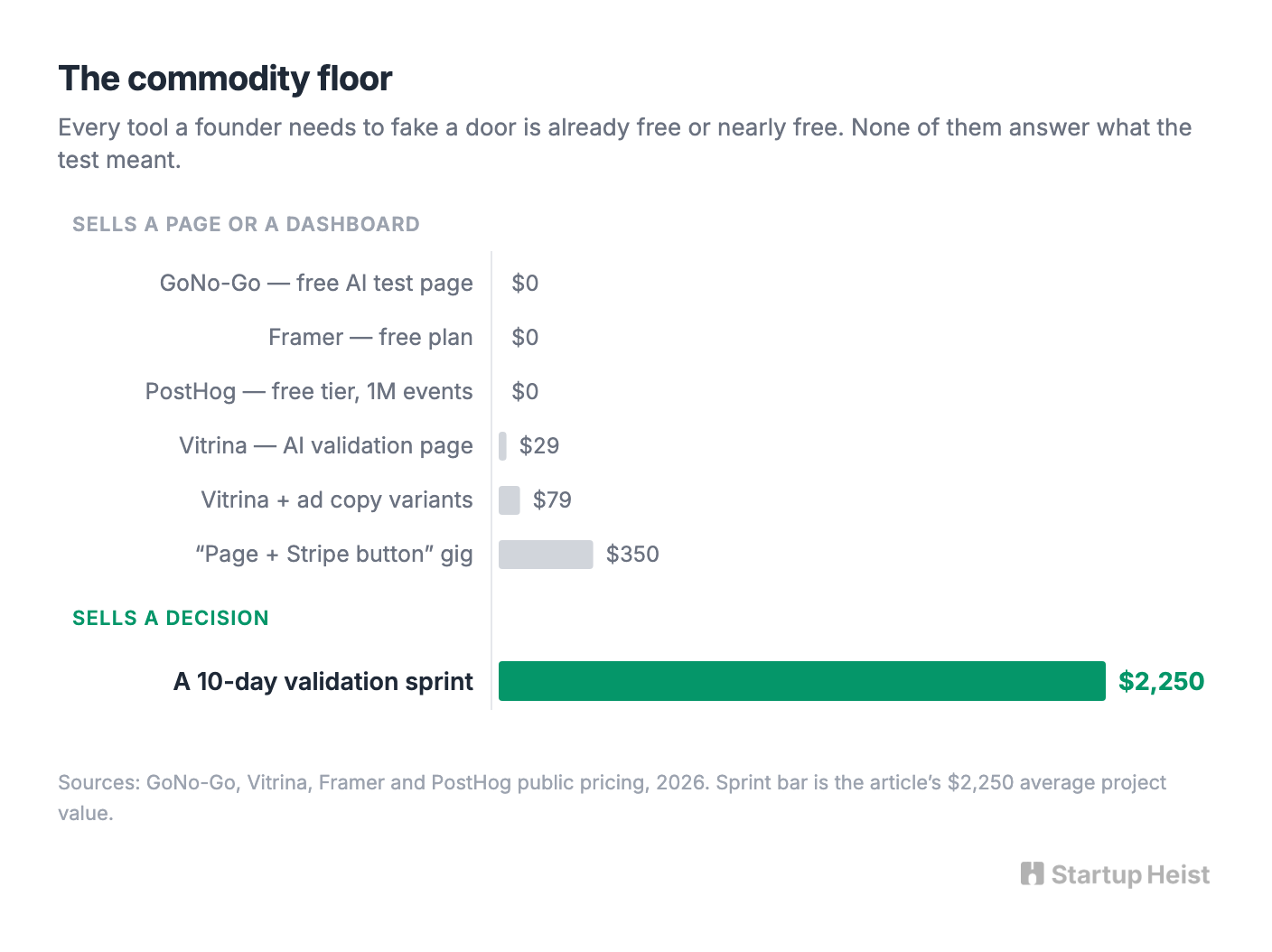
The same squeeze is hitting the first generation of automated idea validation products. Vitrina sells an AI-generated validation page with lead collection for $29 and adds ad copy variations at $79, while GoNo-Go offers free AI-generated test pages that collect emails and deliver a go/no-go readout in about a minute. Competing with $29 tools on price is a race you lose before you start.
All of those tools share the same limitation: they produce pages and dashboards. None of them can answer the four questions that determine whether a validation effort means anything.
- What assumption are we actually testing?
- Which audience must see the offer?
- What action would represent meaningful commitment?
- How much evidence is enough, and what should we do with an ambiguous result?
Answering them is where the money is. The role is outsourced validation operator, and the deliverable is a decision.
What the Customer Is Really Buying
The customer says, "I need a landing page to test my idea."
What they mean is, "I've become emotionally attached to this idea, and I need someone to force reality into the room."
Technical founders usually know they should validate a startup idea before building it. They've read The Lean Startup and heard "sell before you build" a hundred times. What they can't do is execute under emotional load.
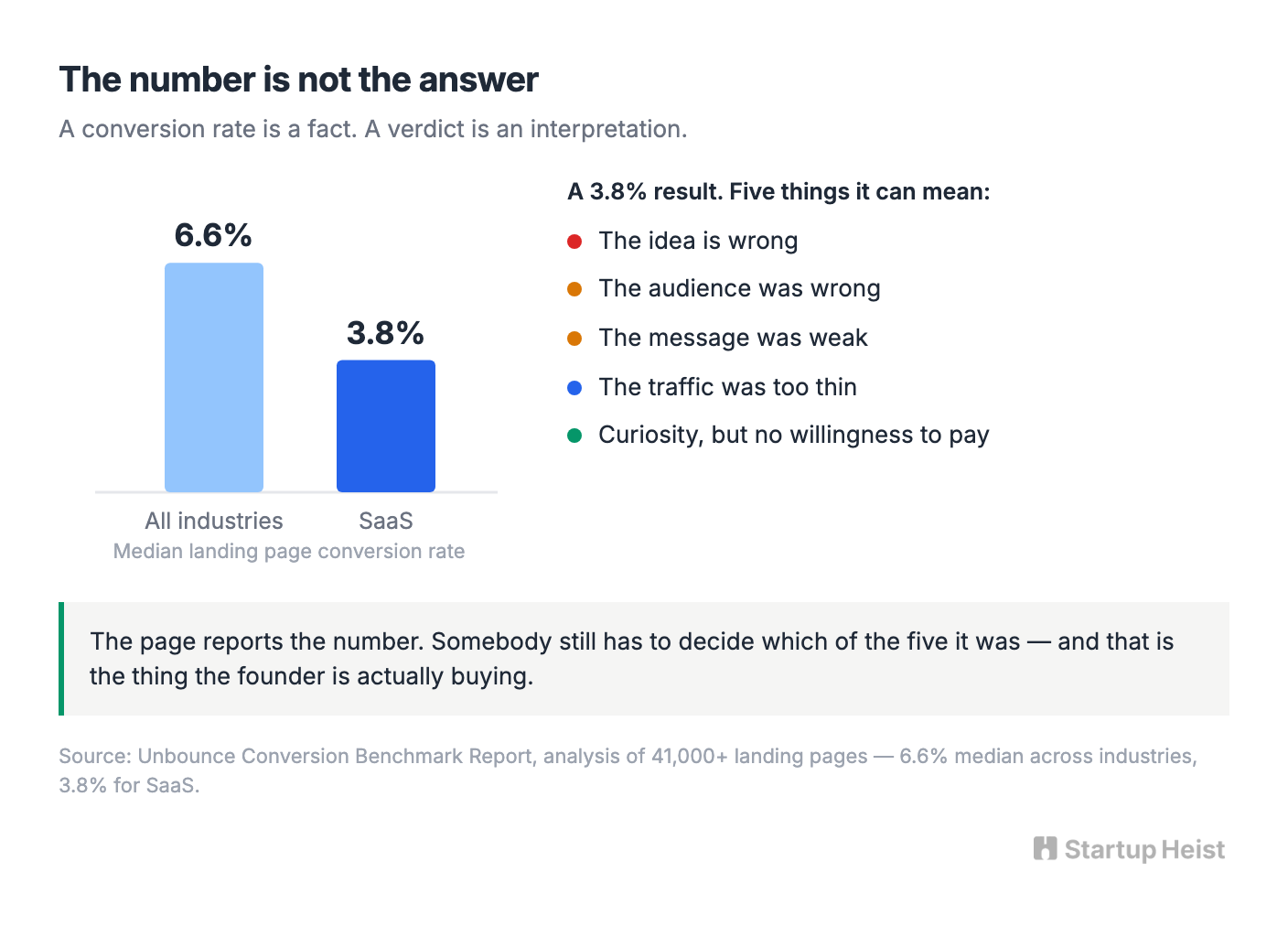
A proper validation sprint does three jobs at once. It creates the experiment: positioning, copy, the offer, the commitment mechanism, and measurement. It creates accountability, because the founder agrees to a decision threshold in advance, before disappointing results tempt them to move the goalposts. And it provides interpretation. Someone has to distinguish between a bad idea, a bad audience, a weak message, insufficient traffic, and an offer that generated curiosity without willingness to pay.
That last distinction is the heart of the business. A landing page tells you what happened. A validation operator tells you what it means.
Why This Works Now
The cost of building has collapsed faster than the cost of finding customers.
The classic smoke-test stories come from an era when running the test was itself hard. In 2007, Dropbox validated demand with a screencast video and a signup form; the waitlist jumped from 5,000 to 75,000 essentially overnight, before the sync engine was finished. Buffer launched in 2010 as a landing page whose pricing button led to a "we're not ready yet" reveal, then added pricing cards to measure willingness to pay. Those founders had to assemble their tests by hand. Today the mechanics take an afternoon.
Cheaper tooling hasn't produced better experiments, just more bad ones. AI will happily generate polished copy for the wrong customer, wrap a professional page around a vague problem, and lay out five pricing tiers before the founder has spoken to five buyers. The abundance of tools raises the value of judgment.
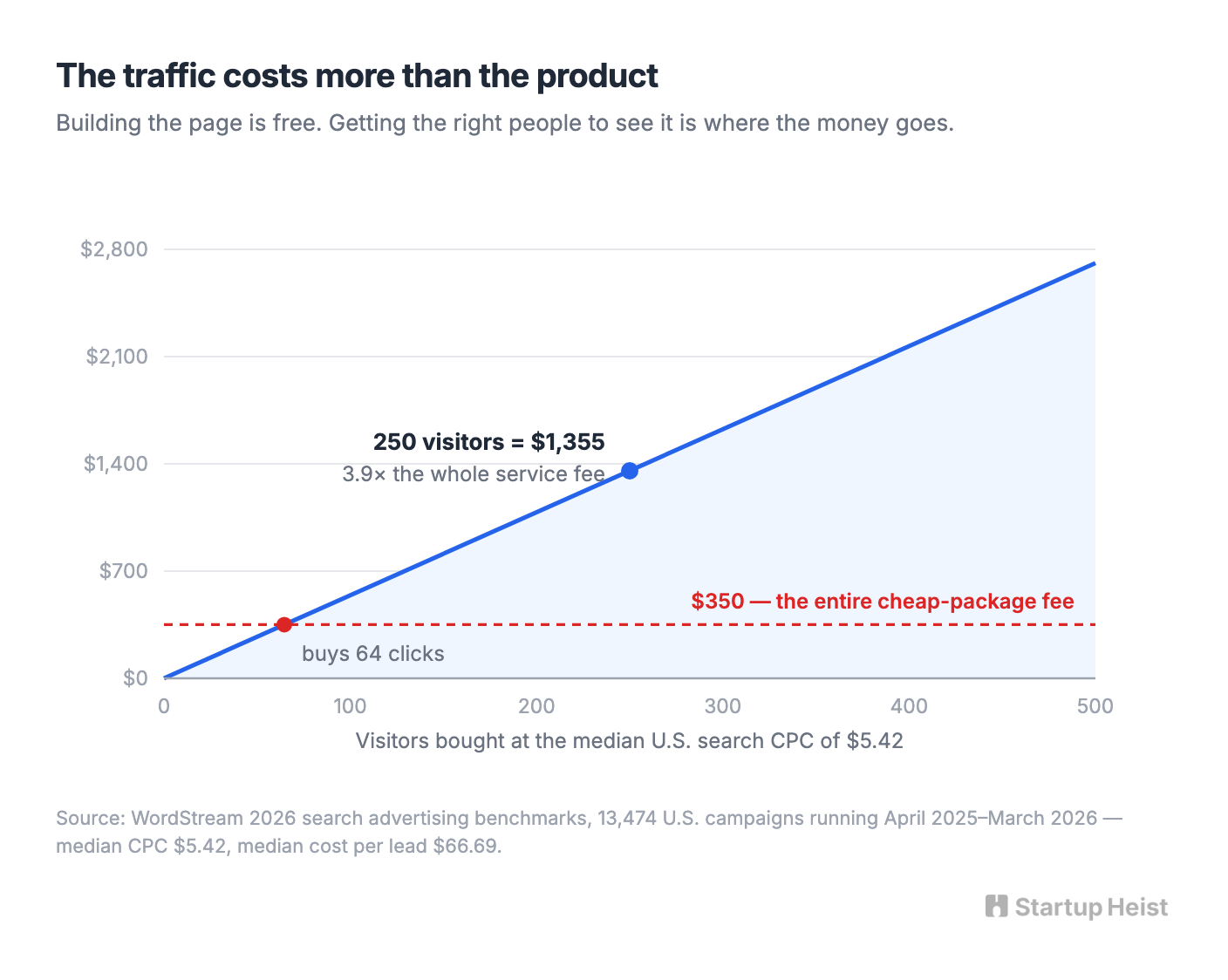
Meanwhile, the distribution side has gotten harsher. WordStream's 2026 search-ad benchmark, drawn from 13,474 U.S. campaigns running between April 2025 and March 2026, puts the overall median cost per click at $5.42 and the median cost per lead at $66.69. At that CPC, buying 250 visitors costs roughly $1,355, nearly four times the entire fee of the $350 landing-page package. The math destroys the cheap-page business and exposes the real opportunity. A page is worthless without a plan for who will see it; what founders need is a market test designed around the traffic they can realistically obtain.
The Product: A 10-Day Validation Sprint
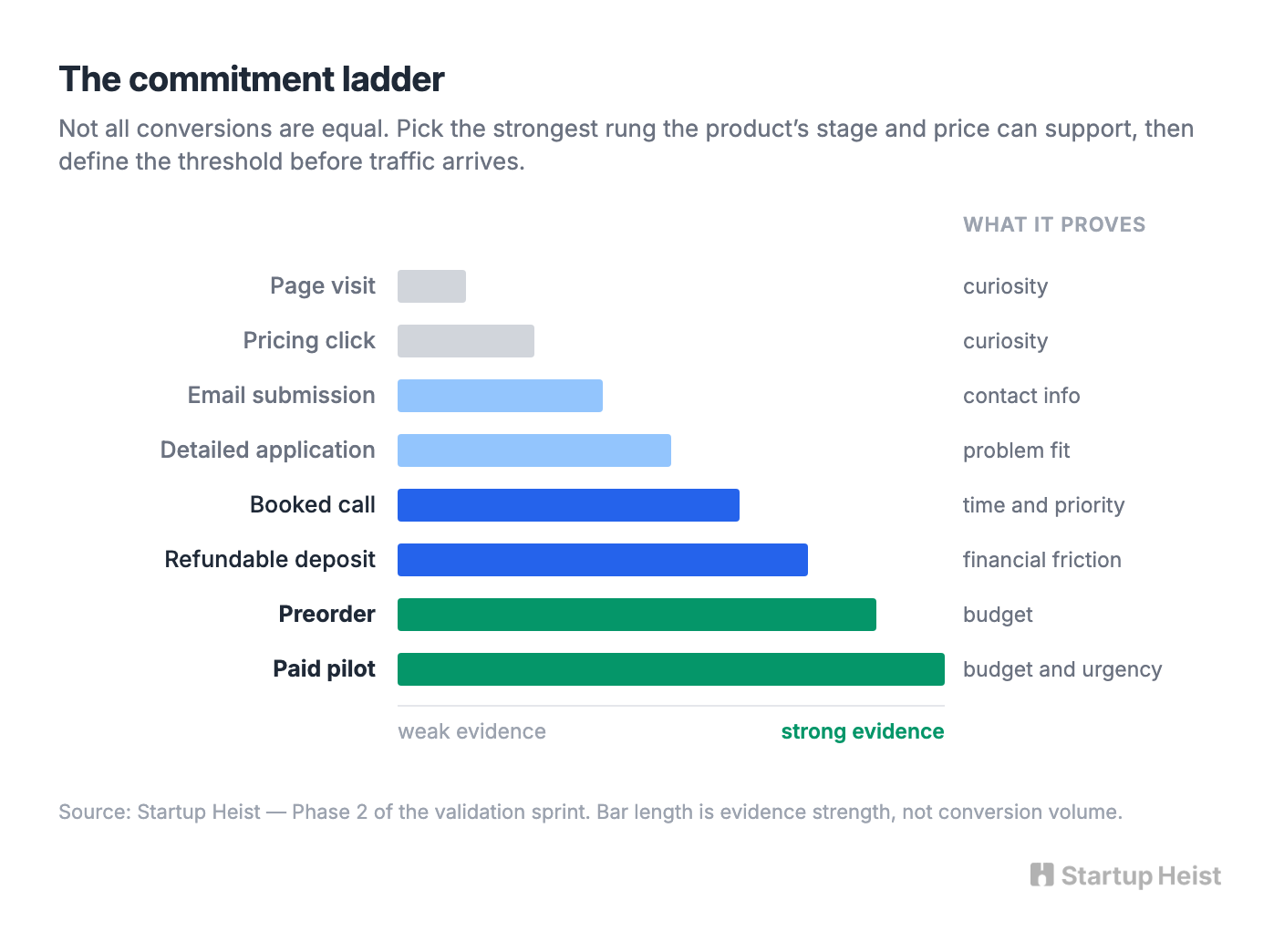
The offer should be tightly scoped, repeatable, and decisive. A good promise: in 10 business days, we turn your startup idea into a live market test and deliver a documented recommendation to proceed, pivot, or stop.
The wording is deliberate. Promising to "validate the idea" invites founders to treat you as a marketing agency whose job is to manufacture a positive result. The promise here is decision-quality evidence.
Unlock the Vault.
Join founders who spot opportunities ahead of the crowd. Actionable insights. Zero fluff.
“Intelligent, bold, minus the pretense.”
“Like discovering the cheat codes of the startup world.”
“SH is off-Broadway for founders — weird, sharp, and ahead of the curve.”


