


The Next Booking Channel Is AI. Your First Business Is Fixing What Already Breaks.
Build a booking-repair and inquiry-recovery service for independent salons. Start with paid audits, turn stranded inquiries into deposit-backed appointments, and become the operational layer between customers, AI agents, and the booking software salons already pay for.
Remy teaches founders how to use AI through his account, AI with Remy. In Copenhagen he wanted a perm, so he handed the job to Instinct, an invite-only AI assistant that works over text message. The agent researched salons, pulled reviews, and sent him photos of options. When he picked one, the salon's online booking form demanded a Danish phone number.
The agent couldn't supply one, so it emailed the salon, and a few hours later it messaged Remy: you're booked. When he walked through the chat on Greg Isenberg's podcast, the email the agent sent read like a person had written it.
Run the story back without the AI. A booking flow failed, and the appointment survived because someone at the salon read an inbox and replied. The salon paid for booking software that turned away a ready customer, then won the sale back through the oldest channel it had.
The gap between a customer who wants to book and an appointment on the calendar is where this business lives. Human customers fall into it every day: the first-timer who can't tell partial highlights from full highlights, the visitor whose foreign number fails validation. AI agents now fall into it too, and they leave a trail of emails and, increasingly, phone calls.
Here's the opportunity for a solo builder:
The money: 100 salons at $79/month is $7,900 MRR, plus $199 audits on the way in. Fresha already charges $99.95 a month per location for its AI front desk.
Inside:
• The $199 Booking Friction Audit, step by step
• Six-state inquiry queue and Square integration
• 30-day plan: five paid audits, three pilots
• Outreach email plus the agency reseller channel
Agents now fill out forms and place calls
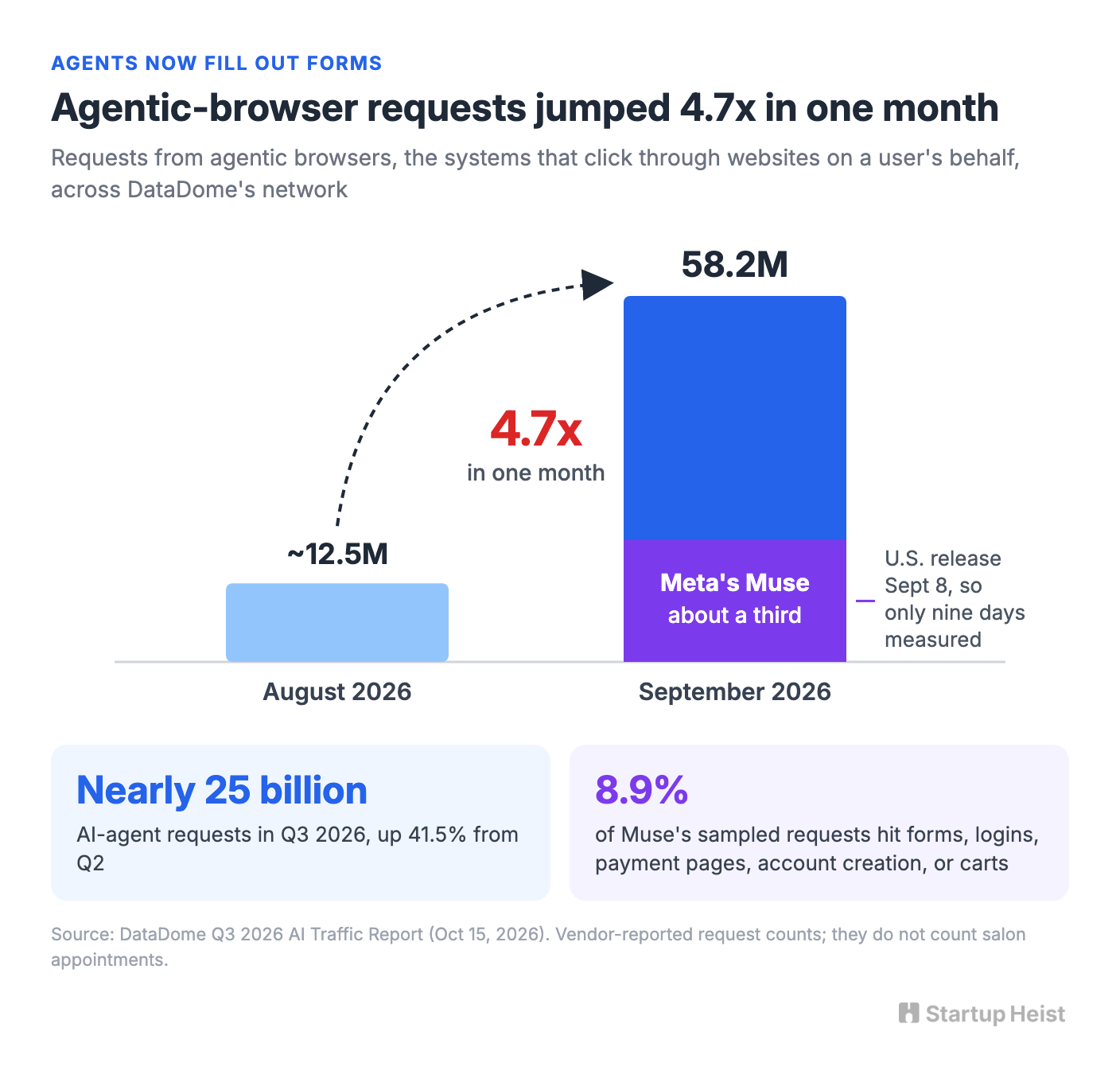
On October 15, 2026, bot-management company DataDome reported that its network handled nearly 25 billion AI-agent requests in the third quarter, up 41.5% from the second. The sharper figure concerns agentic browsers, the systems that click through websites on a user's behalf. Their requests rose from about 12.5 million in August to 58.2 million in September, a 4.7x jump in one month. Meta's Muse, released in the U.S. on September 8, accounted for a third of September's agentic-browser traffic despite being measured for only nine days. Muse runs a full browser inside a cloud machine and doesn't identify itself as an agent, and 8.9% of its sampled requests hit forms, logins, payment pages, account creation, or carts.
The money is moving with the traffic. In Andreessen Horowitz's October 2026 consumer AI report, Instinct founder Noah Shinn said 40% of users connect a personal credit card within three weeks, and those who make a purchase spend about $1,300 a month through the assistant. He claims more than $1 billion in annualized transaction volume, roughly half of it travel.
The channels are multiplying just as fast. Instinct gives each user's agent its own email address for confirming bookings and contacting businesses. On September 16, 2026, Instinct and Muse both added phone calls: Instinct pitches its early-access Concierge for booking restaurants that don't take online reservations and getting users onto a dentist's cancellation list, and Muse expanded a beta of outbound calls to U.S. businesses. A salon's inbox and phone line are now agent endpoints. Google's AI Mode, meanwhile, has pulled live beauty-appointment availability from Booksy, Fresha, and Vagaro since a November 2025 Search Labs launch, then handed users to the platform to book.
These are vendor and founder figures. None of them counts salon appointments, and a request isn't a customer. They do show direction: agents have moved from finding businesses to trying to transact with them, and the big platforms are wiring up approved paths. The independent salon sits on someone else's booking widget, a marketing site, an Instagram inbox, and whoever is free at the front desk. It can't rewrite Booksy's form, but everything around that form is fair game.
Where the bookings leak
Salon owners tend to lump together discovery (how someone finds the salon), intent (the moment they want a specific service), and conversion (when that intent becomes an appointment in the calendar, deposit included). Booking software is built for conversion. The leaks happen in the handoff from intent.
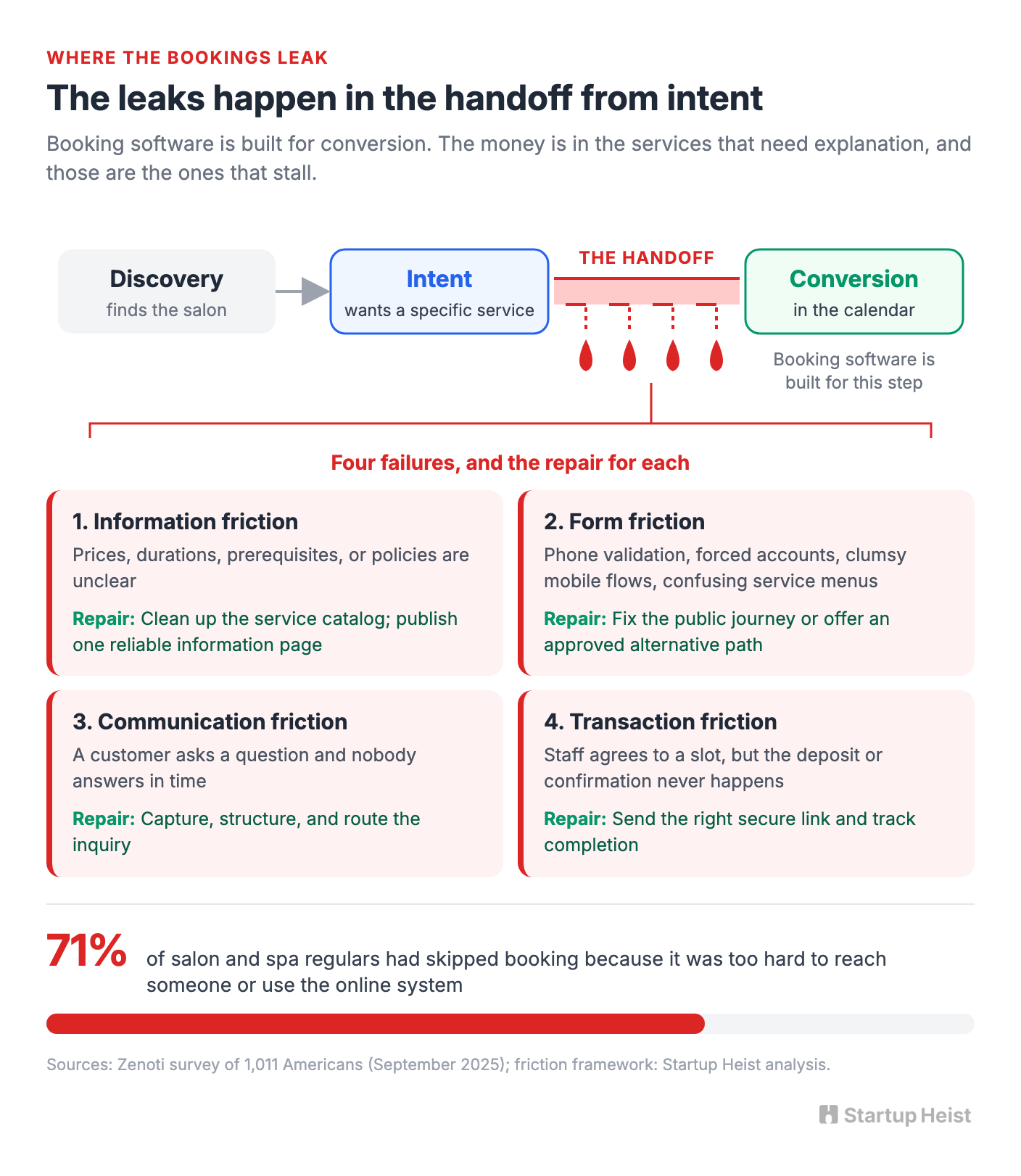
Take a four-chair salon doing cuts, color, highlights, corrections, and bridal. Haircut bookings flow fine. The money is in the services that need explanation, and those are the ones that stall. A September 2025 survey of 1,011 Americans by salon-software company Zenoti found 71% of salon and spa regulars had skipped booking because it was too hard to reach someone or use the online system.
| Failure | What happens | The repair |
|---|---|---|
| Information friction | Prices, durations, prerequisites, or policies are unclear | Clean up the service catalog; publish one reliable information page |
| Form friction | Phone validation, forced accounts, clumsy mobile flows, confusing service menus | Fix the public journey or offer an approved alternative path |
| Communication friction | A customer asks a question and nobody answers in time | Capture, structure, and route the inquiry |
| Transaction friction | Staff agrees to a slot, but the deposit or confirmation never happens | Send the right secure link and track completion |
Only some of these are agent problems, and that works in your favor. A business that depends on agent-originated salon bookings would be speculative today, because nobody publishes how many exist. A business that converts the inquiries a salon already receives can prove its value in the first week: three people asked for appointments last week and never made it onto the calendar.
Your credibility depends on refusing to count every recovered booking as new revenue. If a salon leaves eight of 40 monthly inquiries unresolved and you convert four, some of those four would have called back or booked another way. Track before and after, verify each final booking in the salon's own calendar, and report the difference honestly. The owner renews only if the numbers survive scrutiny.
Why another booking app is the wrong build
Salon software is crowded and cheap. Booksy charges $29.99 a month for a solo user plus $20 per additional staff member. Fresha's Independent plan runs $19.95 a month, and Square Appointments has a free tier. Fresha also sells AI Concierge, an add-on that answers calls and messages and books, reschedules, and cancels inside the Fresha calendar for $99.95 per location per month, plus overage beyond 200 call minutes. A solo founder building a generic AI receptionist walks straight into that product.
The calendar is also a permission boundary. Your software has no automatic right to read or write a salon's Booksy or Fresha schedule, and simulating clicks through someone else's account to get around that is how you lose a client and a platform relationship at once. The sound design keeps the existing system as the single source of truth and works around it: better information, captured inquiries, recommended actions, approved booking links, and verified outcomes wherever an authorized integration allows.
The result is a narrow product and a pitch an owner can say yes to in one meeting: Keep your calendar. We fix the path into it.
The product: three stages, earned in order
The first stage earns money as a service, the second turns that work into recurring value, and the third adds automation only where integrations and measured demand justify it.
Unlock the Vault.
Join founders who spot opportunities ahead of the crowd. Actionable insights. Zero fluff.
“Intelligent, bold, minus the pretense.”
“Like discovering the cheat codes of the startup world.”
“SH is off-Broadway for founders — weird, sharp, and ahead of the curve.”


