


The Legacy Machine Sidecar
Don't replace the $120,000 system. Make the old machine observable first.
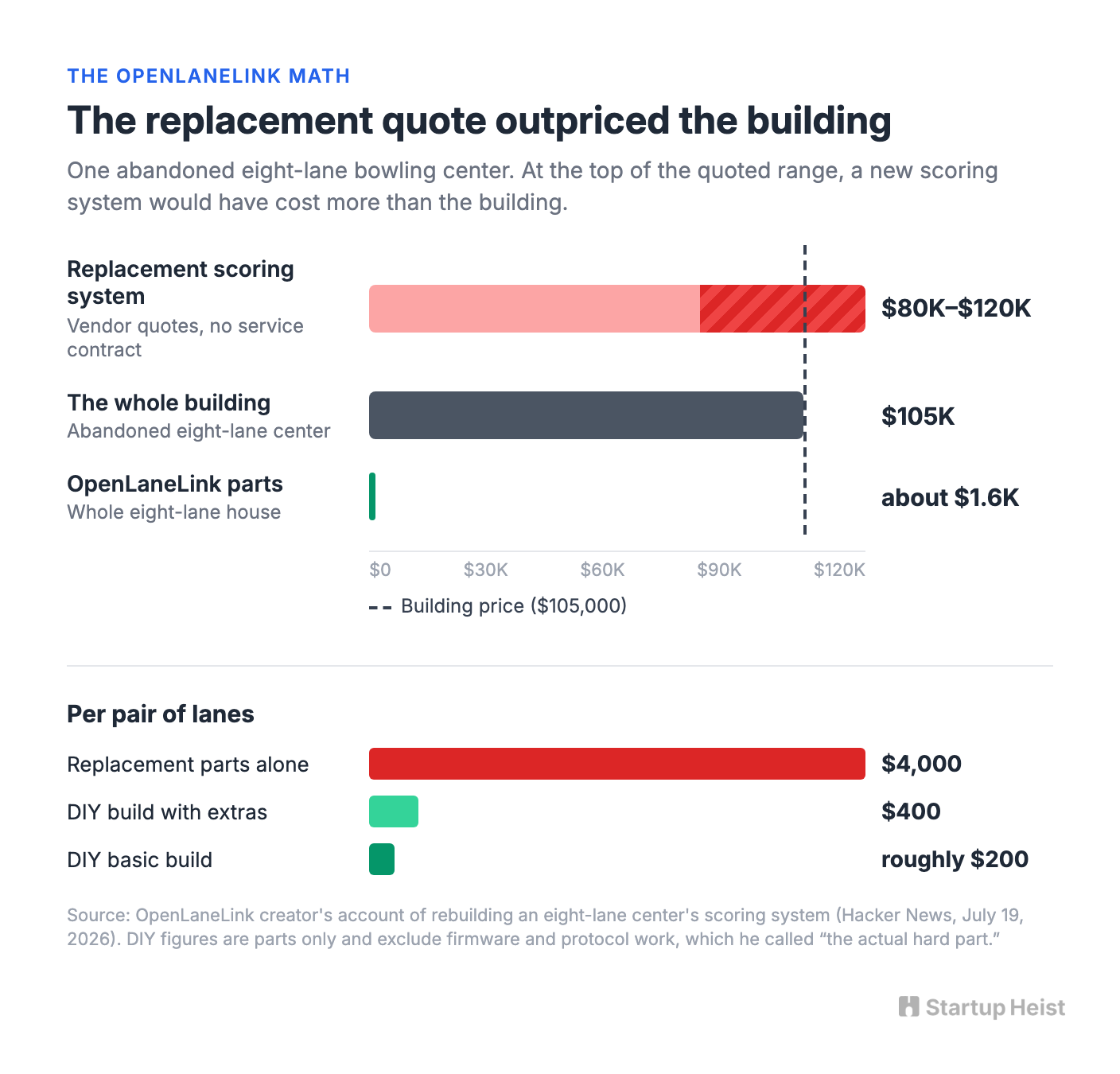
A site reliability engineer and his family bought an abandoned eight-lane bowling center in a small Midwestern town for $105,000. The roof leaked, the electrical system surged, and the pinsetters behind the lanes were 70 years old. Then the scoring system, installed in 2008, needed replacing. The quotes ran from $80,000 to $120,000 depending on vendor and features, with no service contract included. At the top of that range, the new system would have cost more than the building.
He looked at what the system actually did. Up front it was impressive: ball speed, camera-based pin detection, fouls, animations. Out back, its job with that 70-year-old pinsetter came down to firing a single relay. Everything else on the machine was mechanical. Replacement parts alone cost $4,000 per pair of lanes.
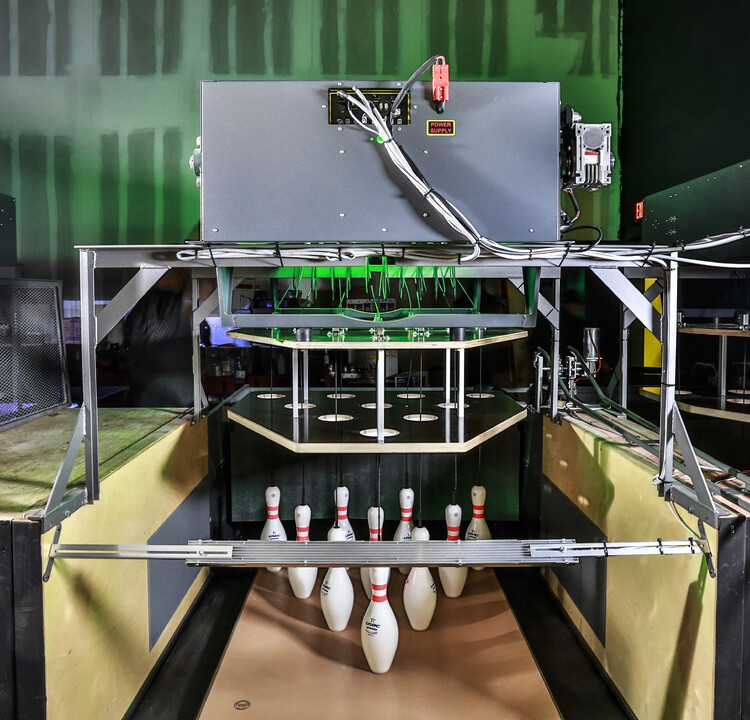
So he built his own. ESP32 microcontrollers wired to relays, optocouplers and infrared break-beam sensors talk over a wireless mesh, with a wired RS485 fallback for the electrically noisy machine room, and everything reports to a Raspberry Pi running Redis and a state machine. The parts came to roughly $200 per lane pair for the basic build and $400 with extras, about $1,600 for the whole eight-lane house. He called it OpenLaneLink, and when he posted it to Hacker News on July 19, 2026, it drew nearly 3,000 upvotes. His own verdict is the one founders should underline: writing the firmware and protocol "is the actual hard part."
The tempting startup takes the wrong lesson from this and promises to replace six-figure commercial systems with $20 boards. That company walks straight into the liability and every edge case of a live machine, on the ground where incumbents are strongest.
The better business leaves the old machine where it is and attaches a retrofit telemetry layer beside it. Monitor it remotely, log every event, alert on faults, build its maintenance history and give the owner the browser dashboard that should have existed 15 years ago. Control comes much later, after hundreds of thousands of machine-hours in the field, and only for carefully chosen low-voltage functions. Holding that line is what turns a hacker project into a vertical business.
Here's the opportunity in brief:
The money: 300 centers at $299 a month is about $90K MRR, plus $3,000 to $5,000 per install. The U.S. base: 3,400+ certified bowling centers.
Inside:
• Sensor-only V1 spec and an 8-screen MVP
• Field-service pricing: install fee plus monthly
• 90-day plan from bench rig to five sites
• Cold email for the first ten centers
The middle-aged machine problem
A huge population of commercial equipment sits in an awkward technological middle age. It works fine mechanically while digitally it might as well be 1998, and it can run another 15 years while telling its owner almost nothing about itself. Something fails, an employee notices, someone calls a technician, the technician drives over and opens the machine, and only then does diagnosis begin. Sometimes nothing serious was wrong. A cheap sensor may have triggered an expensive service call, or the equipment had been failing intermittently for two weeks before anyone knew. And eventually the owner hears that the real fix is a five- or six-figure capital upgrade.
Call the startup that lives in this gap a legacy-machine sidecar, a remote equipment monitoring retrofit built for small operators. It doesn't manufacture the machine, replace its safety system or process its payments. It sits beside the machine and answers the questions the machine can't: Is it running? What happened, and when? How often? Is it getting worse? Does someone need to go there, and what should they bring?
Factories solved a version of this years ago with SCADA, PLC gateways and industrial IoT. The small-business world never got the same treatment. Cheap hardware stopped being the obstacle a while ago. What's still missing is a retrofit for one specific class of old equipment that's cheap, repeatable and simple enough for an independent business to actually buy.
Why the window is open now
Owners now expect their physical business to behave like software. They check cameras, thermostats, alarms, POS terminals and delivery orders from their phones, then walk into the machine room, where the equipment that runs the business communicates only by making a horrible noise.
The big vendors have done the market education for you. Brunswick's Pronto app sells "real-time pinsetter operational alerts and troubleshooting" and data-driven maintenance reminders. QubicaAMF's Tech Wizard pushes real-time trouble-call notifications and scheduled-maintenance guidance to technicians' phones, and its newest EDGE pinspotter ships with cloud monitoring. Laundry tells the same story from another direction: Nayax sells card readers bundled with telemetry and maintenance alerts, PayRange bought the laundromat operating system Turns in February 2025, and Cents raised a $140 million Series C in March 2026 for its integrated software, hardware and payments stack. Operators have been told, loudly and repeatedly, that machine visibility saves money.
OpenLaneLink, meanwhile, shows that commodity computing can talk to ugly old machinery with sensible architecture: local processing, cheap nodes, a wired fallback, event streaming and a web interface. The software side is largely solved. Productizing the physical interface is still hard, and that difficulty is what keeps the opportunity open.
Skip laundromats, at least at first
Laundry looks irresistible, with thousands of unattended locations, plenty of old machines, owners obsessed with utilization and familiar pulse-based interfaces. It's also where Nayax, PayRange and a freshly funded Cents are already wired into the machines, and all three make their money on payments. Cents alone says it serves more than 4,500 laundromat locations processing about $1 billion a year. Payments tempt founders because they tax every cycle, but they also drag in certification, PCI responsibilities, merchant relationships and a fight against companies whose hardware is already installed. There may be a fine laundry add-on business someday, but a two-person startup shouldn't open by attacking the strongest part of three incumbents. The first product should be deliberately non-payment.
The beachhead: one family of old bowling equipment
Bowling is small, and that's useful. The United States Bowling Congress measured more than 3,400 certified centers and 73,000 lanes in its 2025 inspections. Nobody builds the next Salesforce on that, but it's plenty for a serious bootstrapped company, especially since the largest operator, Lucky Strike Entertainment (formerly Bowlero), runs about 360 venues and the rest of the map is mostly independents.
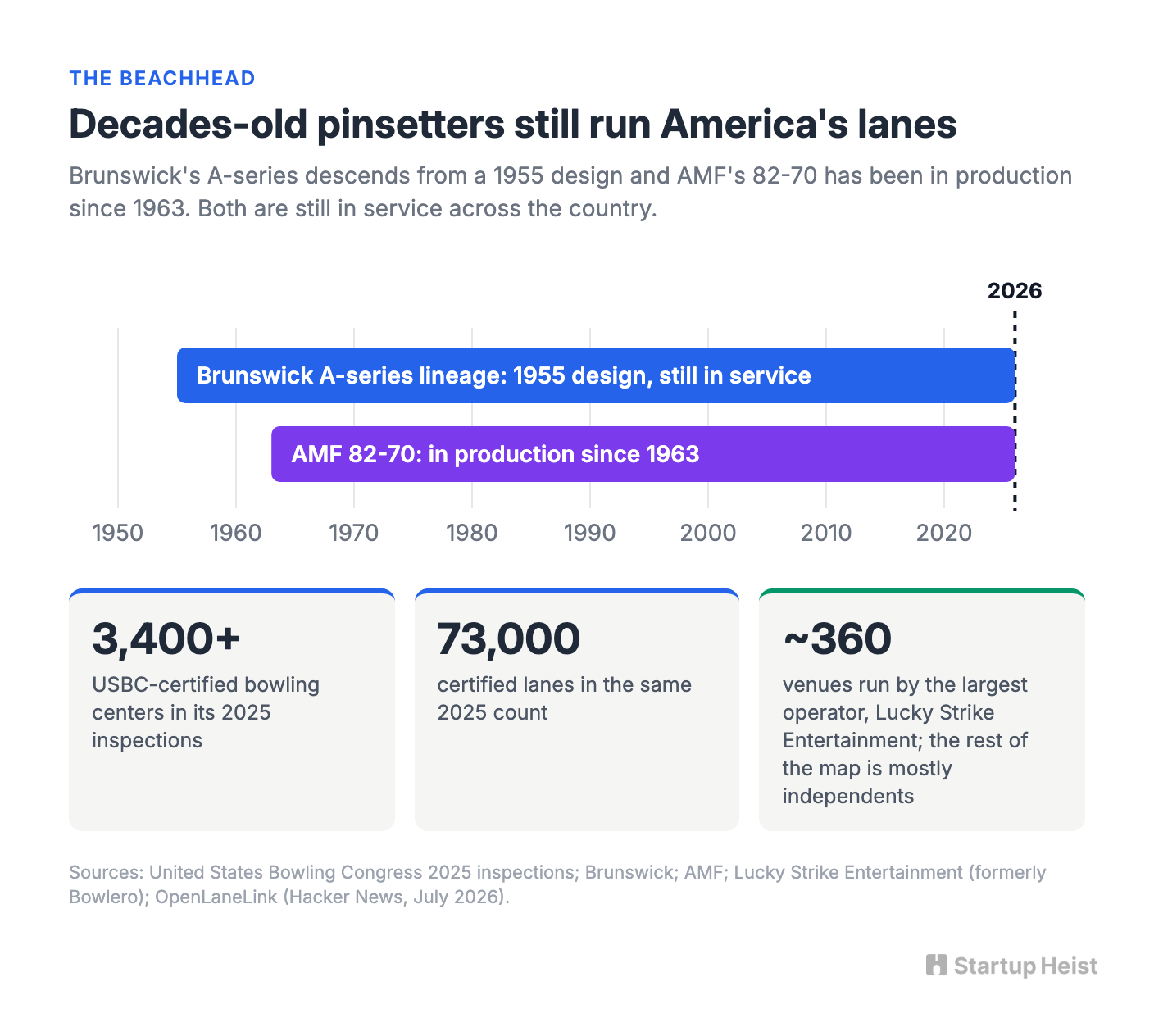
A bowling center also has what you want in a first retrofit market: many identical machines under one roof, expensive downtime on league nights, decades-old mechanical equipment that keeps running, owners who already buy parts and service, and repair knowledge concentrated in a shrinking pool of pinsetter mechanics. Brunswick's A-series pinsetters descend from a 1955 design, and AMF's 82-70 has been in production since 1963. Both are still in service across the country.
Unlock the Vault.
Join founders who spot opportunities ahead of the crowd. Actionable insights. Zero fluff.
“Intelligent, bold, minus the pretense.”
“Like discovering the cheat codes of the startup world.”
“SH is off-Broadway for founders — weird, sharp, and ahead of the curve.”


