


The Physical Game Passport
On July 1, 2026, Sony Interactive Entertainment announced that physical disc production for new PlayStation games ends in January 2028. Titles that ship before that date keep their discs. Everything after is digital, including the copies sold at retail counters.
Gaming media read the announcement one way: physical is dying, buy discs now, everything becomes rare.
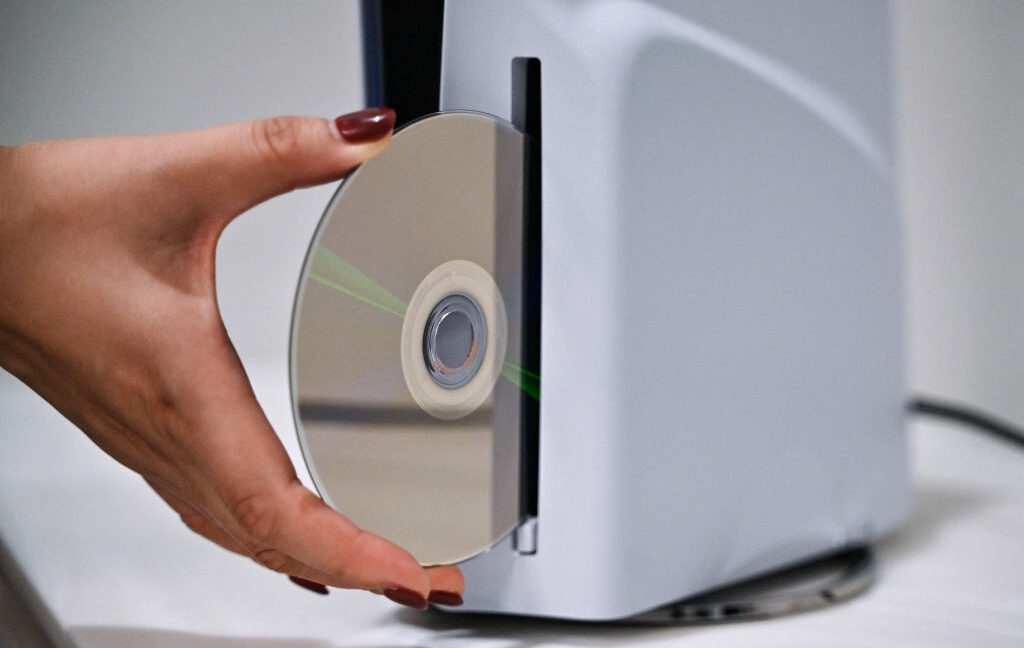
That's a bad trade. The interesting thing already happened, and it happened to the discs sitting on shelves today.
Here's the opportunity:
The money: 1,200 collector subscribers at $45 a year plus 250 shop accounts at $49 a month is $201,000 in ARR for a team of two.
Inside:
• 8-week MVP scope and 200 seed releases
• A four-level verification schema that holds
• Free/$5/$49 pricing and the seller wedge
• Cold outreach script for indie game shops
"Physical" stopped meaning one thing
Put three boxes side by side at a game store. All three are physical games. One holds a complete title that installs and finishes on a console that has never touched the internet. The second holds a broken launch build that needs a 40 GB patch before you can reach the credits. The third is a Nintendo Switch 2 Game-Key Card, which Nintendo describes plainly in its own support documentation: the game data isn't on the card, and the full software downloads the first time you launch it. The card is a license key that has to stay in the slot forever while holding nothing.
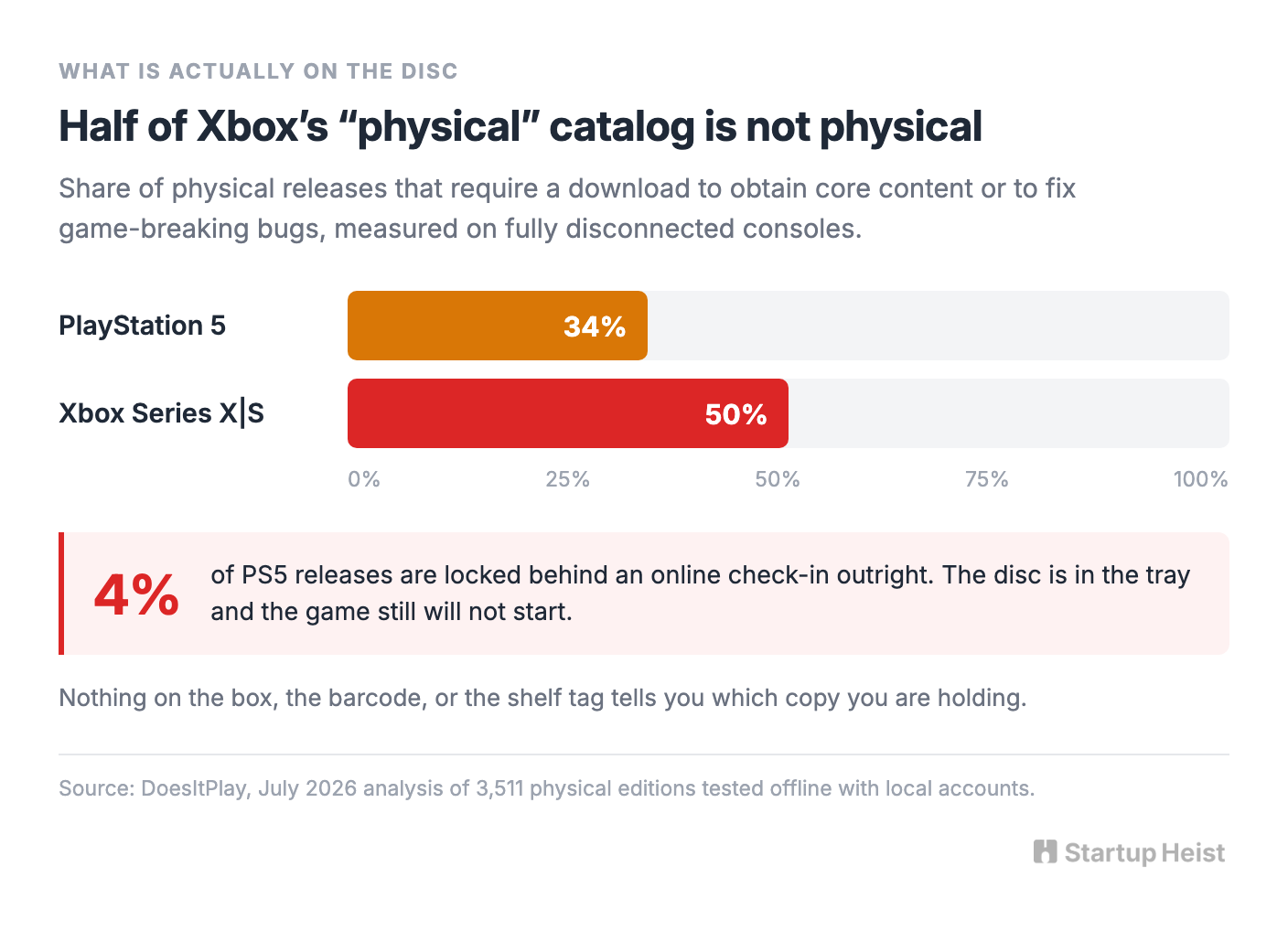
DoesItPlay, a game preservation group that tests physical releases on fully disconnected consoles using local accounts, has now run 3,511 physical editions through a standardized protocol. Their July 2026 analysis found that 34% of PlayStation 5 discs and 50% of Xbox Series X and Series S discs require a download to obtain core content or to fix game-breaking bugs. Roughly 4% of PS5 releases are locked behind an online check-in outright.
Half of Xbox's physical catalog doesn't function as a physical product, and nothing on the box, the barcode, or the shelf tag tells you which half you're holding.
Underneath the platform level it gets messier. Publishers press second and third runs with newer builds burned to the media, and the box art stays identical. A "Complete Edition" sometimes ships the base game on disc and the DLC on a paper voucher. Regional versions of the same title carry different content and different requirements. A used copy can have a completely different disc revision inside a case that looks untouched. Retail catalogs all of it as one product.
The buyers who stayed got more serious
The category is shrinking hard. U.S. spending on new physical video games landed at roughly $1.5 billion in 2025, down 11% year over year and 87% off the $11.6 billion peak set in 2008, according to Circana's tracking. Total U.S. consumer spending on games, hardware, and accessories was $60.7 billion the same year, up 1.4%. Money isn't leaving gaming. It's leaving discs.
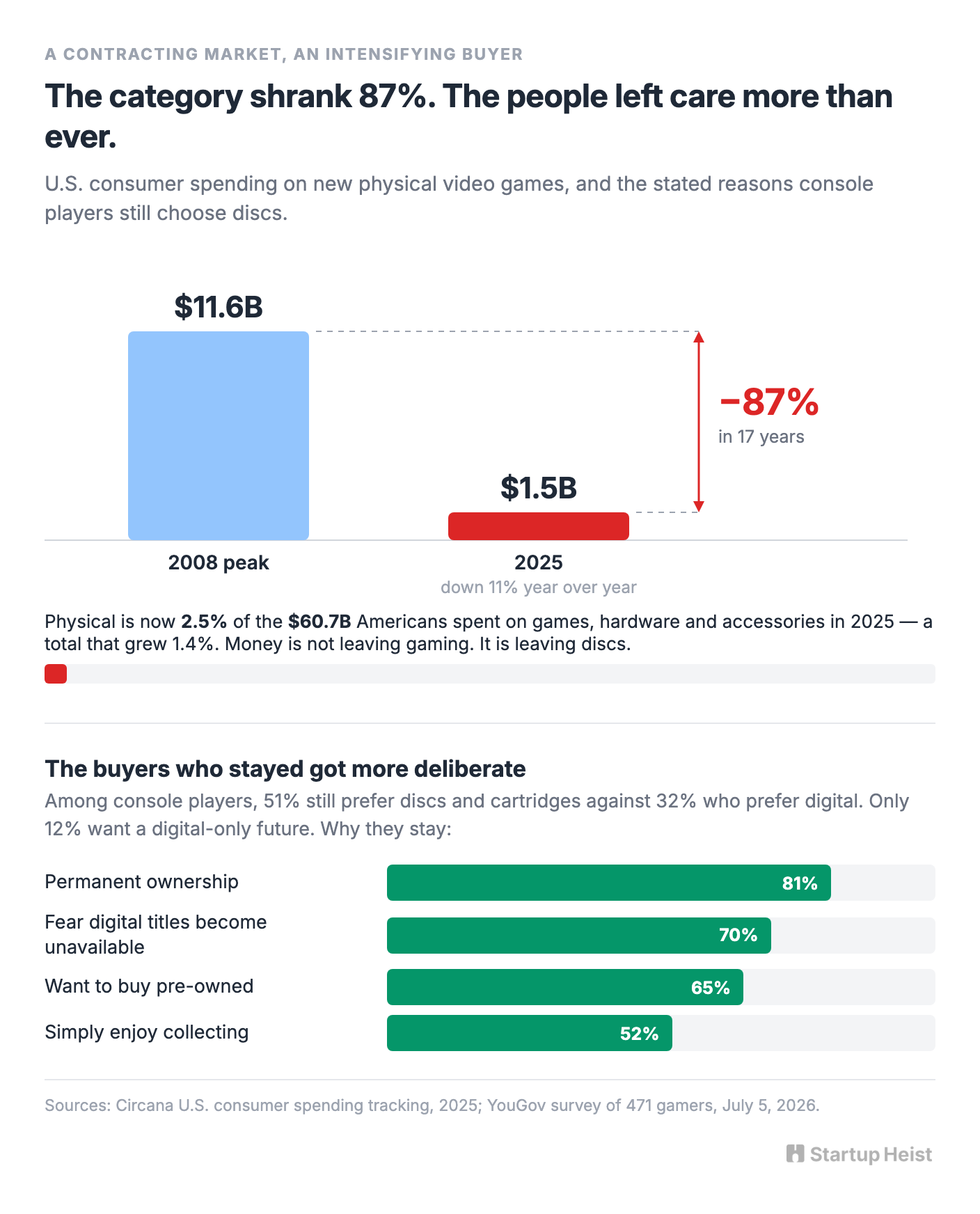
The people who stayed are unusually deliberate about it. YouGov surveyed 471 gamers on July 5, 2026. Among console players, 51% still prefer discs and cartridges against 32% who prefer digital. Their reasons are specific: 81% cited permanent ownership, 70% said they fear digital titles becoming unavailable, 65% wanted the ability to buy pre-owned, and 52% simply enjoy collecting. Only 12% support a digital-only future, and 53% said they'd be less likely to buy hardware that doesn't support physical games.
So you have a contracting audience of high-intent video game collectors, buying a product whose defining feature has quietly become unreliable, with no way to tell which copy in front of them actually delivers it.
Markets do this every time a mass product becomes a collector object. Wine got vintages. Records got matrix numbers and pressings. Sneakers got production codes. Trading cards got sets, printings, and grades. The pattern holds: while a product is mass market nobody studies the SKU, and once only enthusiasts remain the SKU becomes the whole conversation.
Three companies almost solve this
PriceCharting owns the value question. Free unlimited collection tracking, decades of transaction history, barcode scanning, wishlists, and marketplace data, with a paid tier that starts at $4.99 a month or $39.99 a year and a retailer plan on top of it that adds downloadable price lists, full API access, and automated Shopify price syncing. They have the SEO, the product matching, and the collector mindshare. Building a nicer PriceCharting is a bad business.
DoesItPlay owns the truth question, and Redump owns a piece of the identity question. DoesItPlay's testers disconnect the console, install fresh, play through the primary mode, and record region, edition, file version, disc ID, and revision. Redump's contributors document ring codes and mastering codes, the tiny stamped identifiers near a disc's center hole that distinguish software revisions. Both projects are excellent, and both are built for preservation and archival. Neither shows up at the moment a person is standing in a store deciding between two copies, or a reseller is writing a listing, or a used game store is pricing a trade-in.
The knowledge already exists. Somebody has done the testing. What's missing is a layer that puts that knowledge inside a transaction, at the second money changes hands.
What you're actually building
An identity and verification layer for physical video games. A database and buying assistant that answers one question at the counter: what exactly is in this box, and is a better version of the same game sitting three feet away?
Think Carfax for a game disc. Carfax built 35 billion records from more than 151,000 sources, sells a single consumer vehicle history report for $44.99, and now makes more money from dealers than from car buyers. The consumer report was the wedge, and the trade infrastructure turned out to be the business.
Your core unit is the specific physical release, down to the pressing, rather than the game title.
The Passport
Every distinct physical release gets a page with a canonical URL. Scan a barcode, photograph the case, and read a disc identifier if the barcode alone can't resolve the pressing. What comes back looks like this:
Metaphor: ReFantazio, PS5. Edition: Standard. Region: ESRB North America. Pressing: Revision 01. Build on disc: 1.02. Game data: complete base game. Installs offline: yes. Launches offline: yes. Campaign finishable offline: yes. Mandatory account: no. Mandatory download: none. Optional patch: 6.4 GB. Languages on media: English, French, Spanish. Tested on: PS5 Slim, system software 25.02. Last verified: July 18, 2026. Evidence: full offline playthrough. Confidence: verified.
Beside it sits the comparison that changes what somebody buys:
| Version | Integrity | Key difference |
|---|---|---|
| ESRB Rev. 00 | B | Complete base game, major launch bugs |
| ESRB Rev. 01 | A | Patched build pressed to disc |
| PEGI Rev. 00 | A | Complete |
| Collector's Edition | A | Same Rev. 01 disc |
| Retail bundle | D | Download code only |
You haven't told the buyer whether the game is worth $32. PriceCharting already does that. You've told them which $32 copy to walk out with.
Record evidence, don't hand out grades
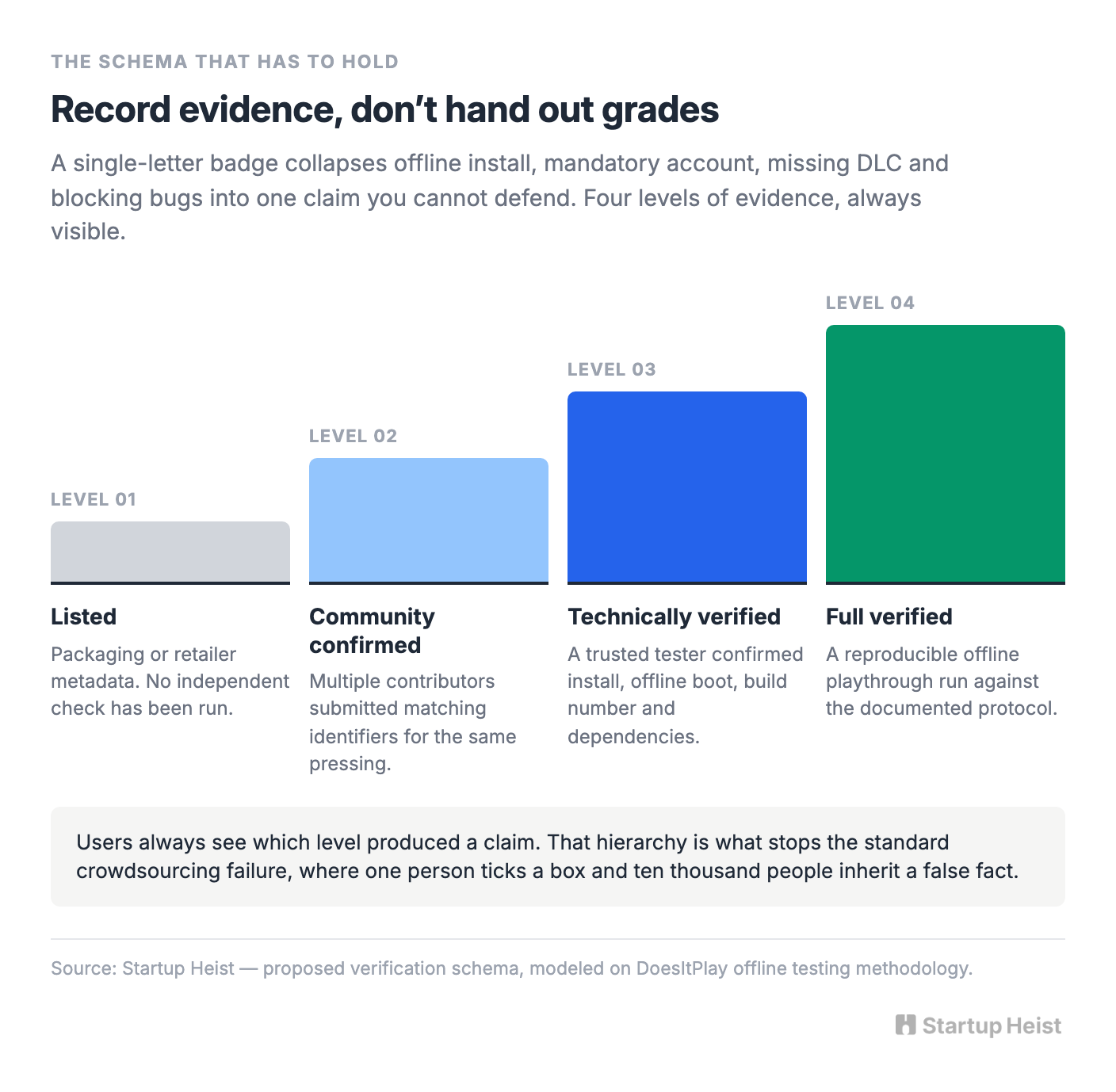
There's a strong temptation to slap a green "TRUE PHYSICAL" badge on everything and call it a product. Resist it. A game can be finishable offline while missing its DLC, or hold every advertised asset and still suffer a progression-breaking bug, or boot without internet and then demand an account. Single-letter grades collapse all of that into a claim you can't defend, and the first time your badge is wrong on a title collectors care about, your credibility is gone.
Unlock the Vault.
Join founders who spot opportunities ahead of the crowd. Actionable insights. Zero fluff.
“Intelligent, bold, minus the pretense.”
“Like discovering the cheat codes of the startup world.”
“SH is off-Broadway for founders — weird, sharp, and ahead of the curve.”


