


The Patent Graveyard Heist
Build an AI scout that turns expired consumer patents into product opportunities for Amazon and DTC sellers
Most product-research tools tell sellers to study what already sells. Find a product with demand. Count the reviews. Estimate the margins. Source a slightly better version from a factory. Launch another listing into a crowded category.
That playbook works, and it produces a predictable problem: every seller stares at the same marketplace data, runs the same filters, and discovers the same "hidden" opportunities. Hidden to whom? Everyone is looking through the same window.

There is a second database, far larger, that almost no private-label seller mines. The United States patent system holds decades of product ideas, mechanisms, feature combinations, and design concepts. Some were commercialized and won. Some never became products at all. Others reached shelves briefly, vanished, and are now old enough that the patents protecting them have lapsed into the public domain.
Here's the opportunity:
The money: 500 subscribers at $49/month is $24,500 MRR. Stack four bespoke scouting reports at $3,500 and you clear $38K a month solo.
Inside:
• The kitchen-and-home category wedge
• 8-part product brief that sellers will pay for
• Three-tier pricing plus concierge engagements
• The legal vocabulary that builds trust
• 90-day plan to first paid subscribers
A Federal Reserve working paper put a number on the waste. Matching product-scanner data to patent texts, the authors estimate that 62% of patents never lead to a product introduction. The patent system records successful innovation, but it is also a graveyard of inventions that never made it to a store shelf.
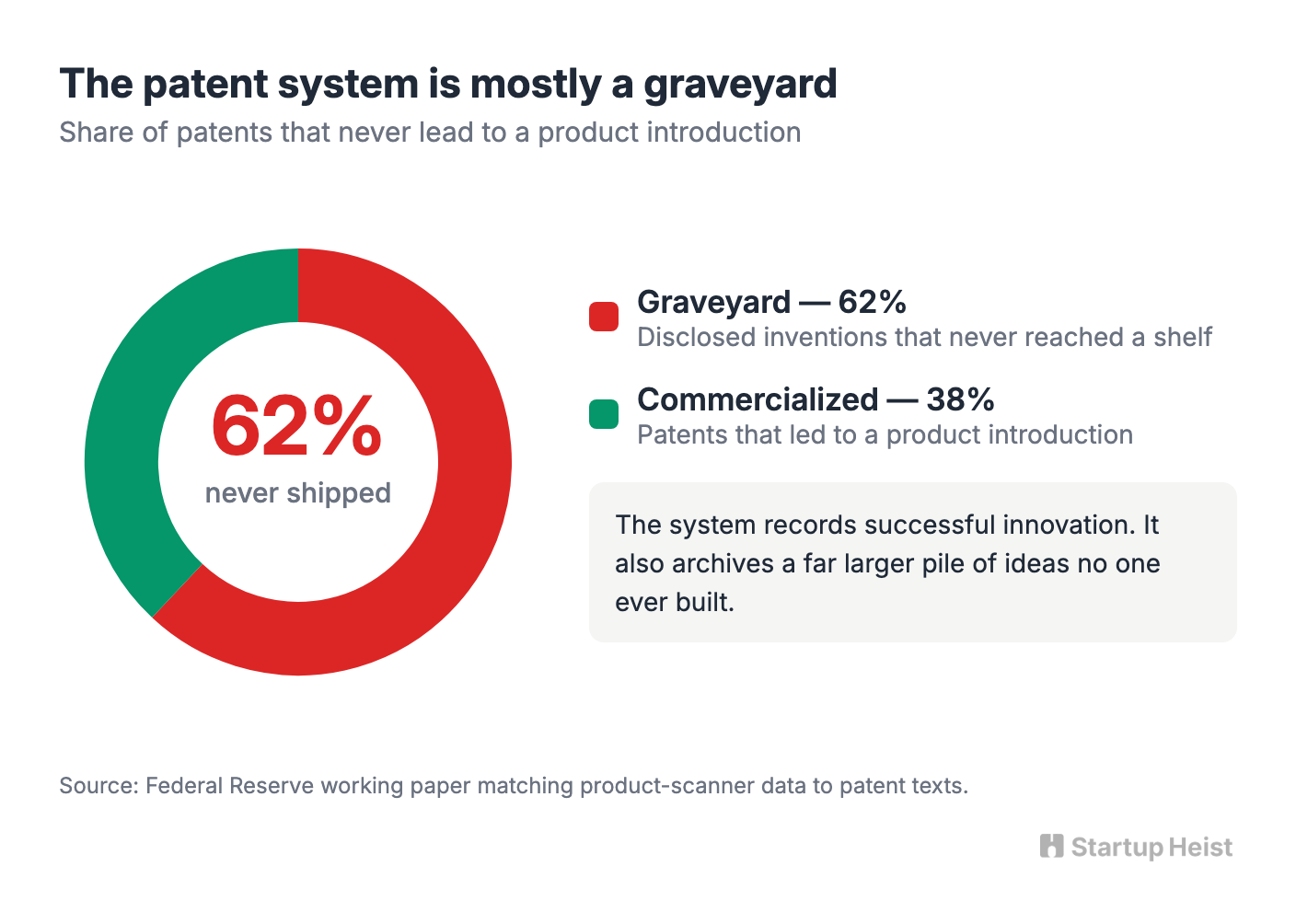
That gap is the opening: an AI-powered expired-patent scout for Amazon sellers and small consumer brands. Mine public patent data continuously. Filter for simple, buildable consumer inventions. Flag patents that have expired or are close to it. Cross-reference each against real marketplace demand. Then deliver the best of them as a curated paid feed, with a higher-ticket scouting service on top.
The pitch is not to copy whatever you find in an old patent. The pitch is that here are overlooked product concepts with a more interesting starting point than another generic Alibaba catalog search. That difference is the whole business.
The overlooked bargain inside the patent system
A patent is a trade. The inventor gets a window of exclusivity. In return, the invention is disclosed to the public in full. The deal was always meant to feed the commons eventually, and most patents do.
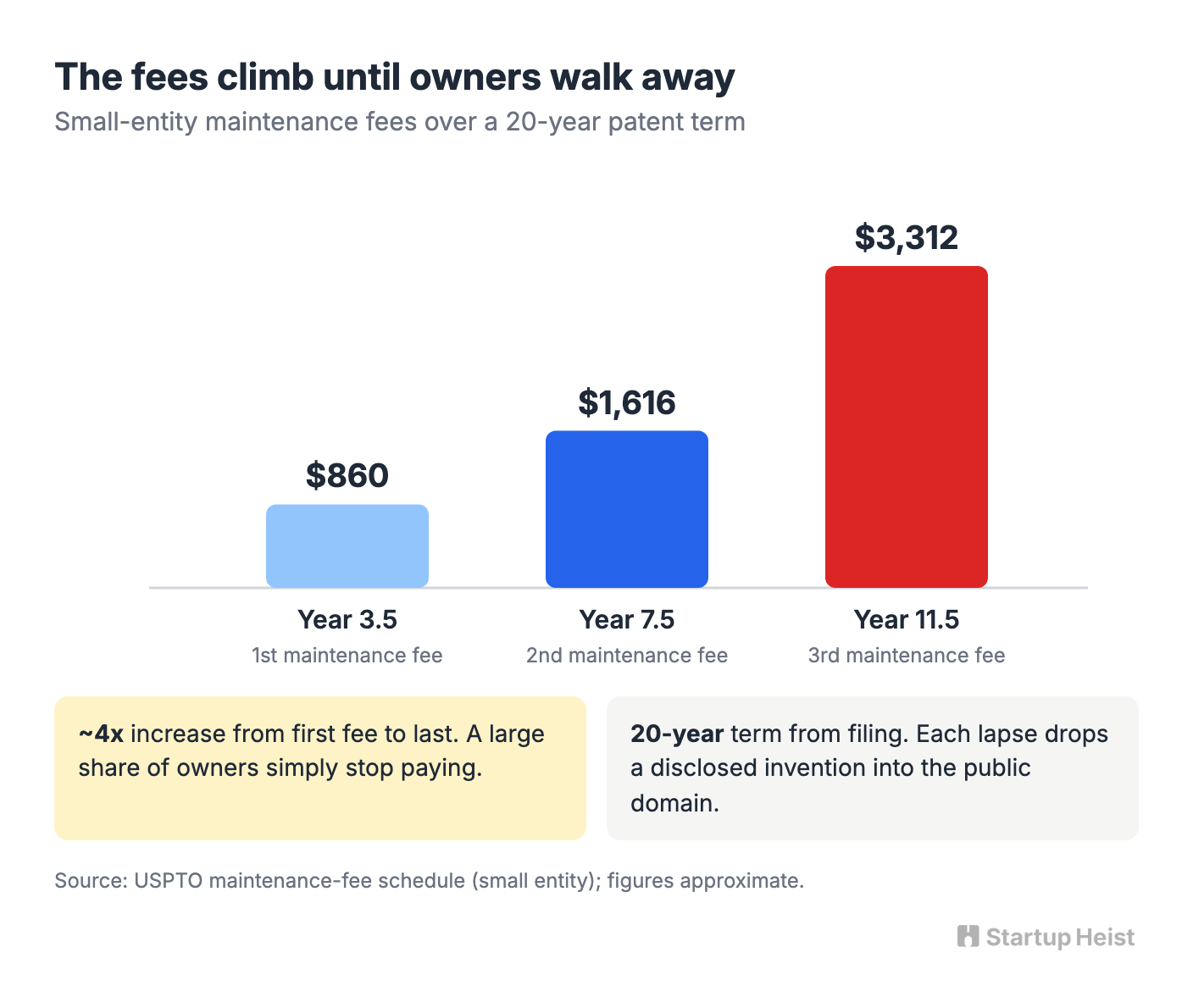
For most U.S. utility patents, the term runs 20 years from the filing date, subject to adjustments. Owners also have to pay maintenance fees at 3.5, 7.5, and 11.5 years after grant to keep the patent alive. For a small entity those fees climb from roughly $860 to $1,616 to $3,312, and a large share of owners simply stop paying. When a patent lapses, the disclosed invention can generally be made, used, sold, or imported without the former owner's permission, as long as the activity is not still covered by another live patent.
That last clause is the catch. An expired patent is not a clearance certificate. Follow-on utility patents, design patents, trademarks, trade dress, and foreign family members can all still apply. Treat expiration as a starting flare, not a finish line.
The opportunity is real anyway. The system steadily releases disclosed product ideas into the public domain. Aspirin, the safety razor, and the modern touchscreen all became open territory the moment their patents fell, and each spawned an industry. The problem is not access. It is usability.
Google Patents indexes full-text patents worldwide. USPTO Patent Public Search offers a deep prior-art interface. PatentsView, which migrated into the USPTO Open Data Portal on March 20, 2026, provides structured datasets and bulk downloads for free. These tools are built for lawyers, researchers, and corporate IP teams. They are not built for a private-label seller asking a much simpler question: what could I manufacture and sell next quarter?
A seller does not want to read 40 pages of claims describing "an apparatus comprising a first member rotatably coupled to a second member." They want to know whether this is basically a kitchen tool or a pet accessory, whether the underlying patent is actually expired, whether related patents still need a look, whether buyers are already searching for something like it, whether the category is crowded, whether a factory can make it without custom electronics or a seven-figure tooling bill, and whether there is a clear improvement angle. The raw data exists. The translation layer does not. That is the heist.
Why the first customer is the Amazon seller
Start with Amazon FBA and private-label sellers rather than broad DTC brands. Not because they are more sophisticated, but because they already pay for product intelligence as a reflex.
Amazon reports that independent sellers account for more than 60% of sales in its store, most of them small and medium-sized businesses. In 2025, more than 75,000 of those sellers crossed $1 million in sales, a 36% jump in a single year. This is a large population of operators actively spending money to find their next product.
The tooling around them is mature, and it proves the demand. Helium 10 sells a full suite for product research, keyword research, listing optimization, and analytics, with plans that scale from entry tiers into the several-hundred-dollars-a-month range at the Diamond level, plus a separate Elite add-on for power users. Jungle Scout sells data-backed tools for evaluating demand, search volume, seasonality, and competition, starting around $49 per month. Sellers pay these bills every month because product discovery is genuinely painful.
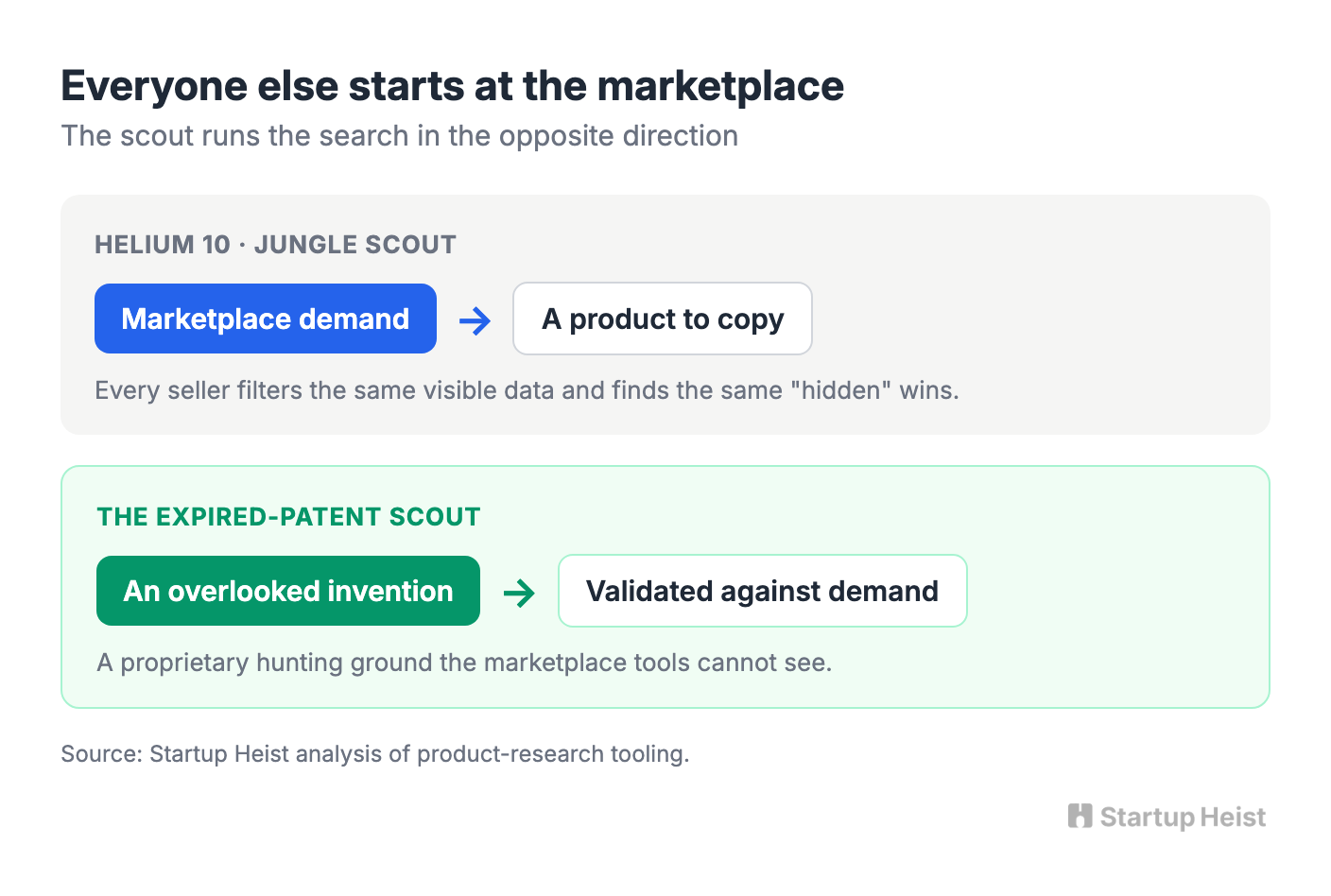
Both tools share a blind spot. They are optimized around visible marketplace behavior: search volume, rankings, reviews, pricing, and sales estimates. They begin with the marketplace and work backward to a product. An expired-patent scout does the opposite. It begins with an overlooked invention and works forward to the marketplace. It is not a replacement for Helium 10 or Jungle Scout. It is a proprietary hunting ground those tools cannot see.
The wedge: expired kitchen and home patents
Do not index every patent. That sounds ambitious and is the fastest path to an unusable product. Patent data is full of pharmaceuticals, semiconductor processes, chemical compositions, and industrial machinery that a small seller can neither manufacture nor legally touch.
The first product should cover a handful of consumer categories where the path from patent to shelf is unusually short: kitchen tools and food-storage accessories, home organization and cleaning, pet accessories, simple garden and outdoor products, non-regulated beauty accessories, and low-complexity fitness gear. Kitchen and home come first. They are understandable at a glance, they often hinge on one mechanical "aha" feature, they map cleanly onto Amazon search behavior, and factories already know how to make them.
The filter should aggressively exclude anything with electronics, batteries, motors, wireless, medical claims, heavy certification, oversized shipping, difficult tooling, many moving parts, or unclear safety. The goal is not the cleverest patent. The goal is the most commercially useful one. Those are different scoring systems, and the second one is the product.
What the brief actually delivers
The simplest version is email-first. Every week, subscribers get a small number of deeply filtered opportunities, each written as a plain-English product brief rather than a patent summary. A good brief carries eight things:
- Product concept. One sentence on the physical product and the customer problem it solves.
- Patent status. The relevant utility patent, estimated expiration, maintenance-fee status, and a confidence label.
- Related-IP warning. Whether automated searches surfaced live patents, design patents, trademarks, or foreign family members that need a human look.
- Marketplace overlay. Relevant Amazon keywords, demand proxies, listing competition, price bands, review density, and the complaints buyers keep posting.
- Buildability score. A practical read on materials, tooling, assembly complexity, size, weight, likely manufacturing method, and landed cost.
- Differentiation angle. Why this beats a commodity private-label item. The old patent often reveals a mechanism or feature bundle competitors have ignored.
- Launch path. A realistic first move: contact injection molders, request an off-the-shelf adaptation, 3D-print a prototype, or test demand with a landing page.
- Risk label. A blunt verdict: Scoutable, Sourceable, Needs counsel, or Skip.
This is a judgment product, not a database dump. The reader is paying you to throw away the 95% that wastes their time.
The MVP: a research desk with software underneath
The temptation is to spend six months building a beautiful search engine. Resist it. The best first version looks like a niche analyst service. In 3 phases:
Unlock the Vault.
Join founders who spot opportunities ahead of the crowd. Actionable insights. Zero fluff.
“Intelligent, bold, minus the pretense.”
“Like discovering the cheat codes of the startup world.”
“SH is off-Broadway for founders — weird, sharp, and ahead of the curve.”


