


The New-Market Launch Desk
Regional restaurant chains are crossing state lines faster than their reputations can follow.
A restaurant chain can be a cultural institution in one state and a complete unknown two states away.
In Georgia, Zaxbys needs no introduction. On the Upper East Side of Manhattan, where the chain is opening its first New York City location, the brand has to explain what it sells, why a million Southerners are loyal to it, and what a first-timer should order. The logo made the trip; the demand stayed home.
This problem is multiplying as restaurant franchise expansion accelerates. Zaxbys crossed 1,000 restaurants across 22 states in early 2026 and is targeting more than 60 openings this year on its way to a stated ambition of 100 a year, with recent debuts in Las Vegas and Phoenix, far from its Southeastern base. Whataburger, the Texas burger institution, has passed 1,100 restaurants and plans at least 40 openings in 2026, entering Nevada, Tennessee, Missouri, and Kansas for the first time, a year after its North Carolina debut. Marco's Pizza is targeting more than 80 openings from California to Florida. Potbelly plans 50 on its way to a 500th shop.
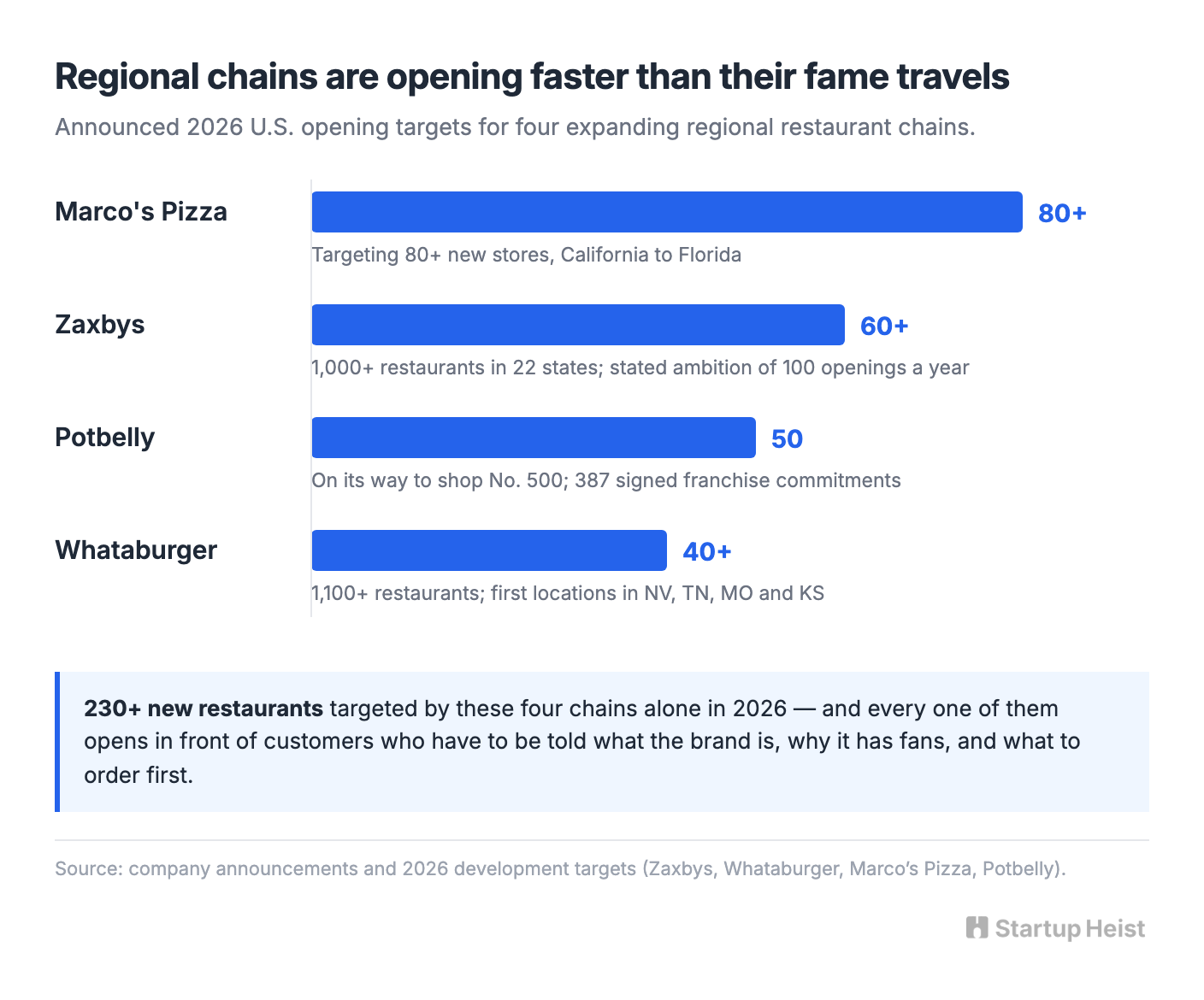
Every one of those openings creates the same temporary marketing problem: corporate has the brand assets, the local operator has the address, and nobody has enough market-specific creative ready to run.
That gap is the opening for a specialized service: a done-for-you content desk that turns corporate restaurant assets, store information, and local context into short-form launch campaigns for each new market. Sell it as new-market launch infrastructure rather than an AI video factory; AI is simply what makes the economics work.
The shape of the business:
The money: Eight clients on $7,500 monthly retainers is $60,000 MRR; franchise grand-opening budgets already run $15,000 to $25,000 per location.
Inside:
• Three-phase, 8-to-12-week launch program
• Pilot-to-retainer pricing: $4,500 to $20K
• Opening-triggered outreach, with template
• Five compounding moats, benchmarks to creators
The Awareness Reset
Cult brands overestimate how far their fame travels. Executives see two decades of loyalty, earned media, and social engagement. Consumers in a new city see a restaurant name they might have heard once, a menu they can't parse, and a building that hasn't opened yet.
A national ad doesn't close that gap. "Fresh chicken fingers and famous sauce" reinforces a brand people already know. It tells a first-time customer in Philadelphia nothing about why this chain is suddenly appearing, which menu item explains the cult following, where the restaurant is, when it opens, or why to pick it over the five familiar options nearby. Market entry is a translation problem: the brand has to convert its existing reputation into locally legible answers to five questions. What is this? Why do people elsewhere care? What should I order first? Why should I visit now? Where exactly is it?
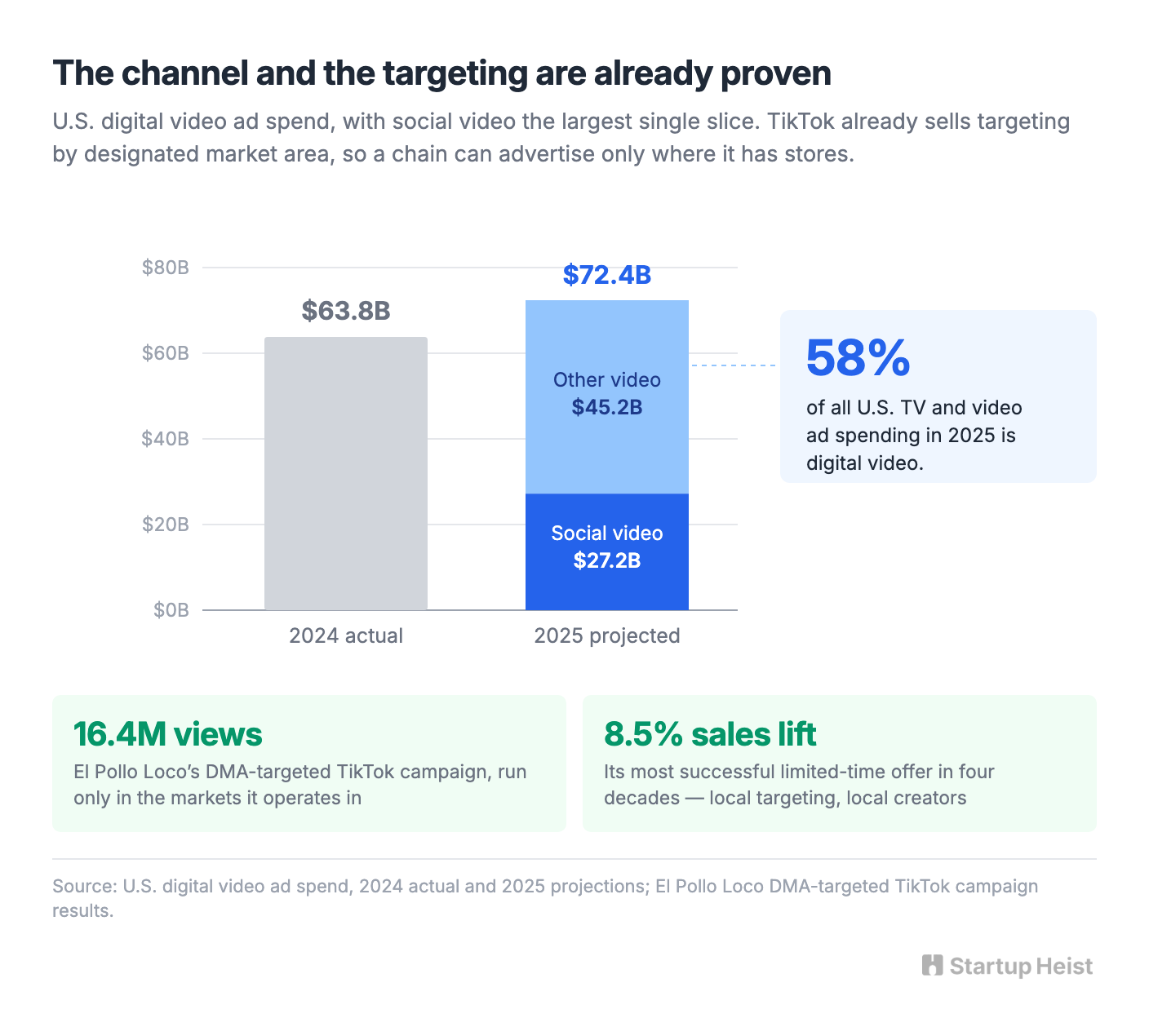
Short-form video is built for this work, and the channel data backs it. U.S. digital video ad spend hit $63.8 billion in 2024 and was projected to reach $72.4 billion in 2025, 58% of all TV and video ad spending, with social video the largest slice at a projected $27.2 billion. The local mechanics already have proof. TikTok lets advertisers target by designated market area, the county clusters that share a media market, so a chain can run ads only in cities where it operates. El Pollo Loco used DMA targeting plus local creators to drive its most successful limited-time offer in four decades: 16.4 million video views and an 8.5% lift in overall sales.
The channel and the targeting are already proven. What's missing is an operating system for producing enough market-specific creative before, during, and after each opening, and that production layer is the business.
The Heist
Build a specialized creative service for restaurant brands entering unfamiliar markets.
The service ingests approved brand footage, menu photography, logos and templates, brand voice rules, opening dates, store addresses, approved promotions, delivery and loyalty details, market-specific facts, and local operator footage. It returns a coordinated library of TikToks, Reels, Shorts, and paid-social variations for each market.
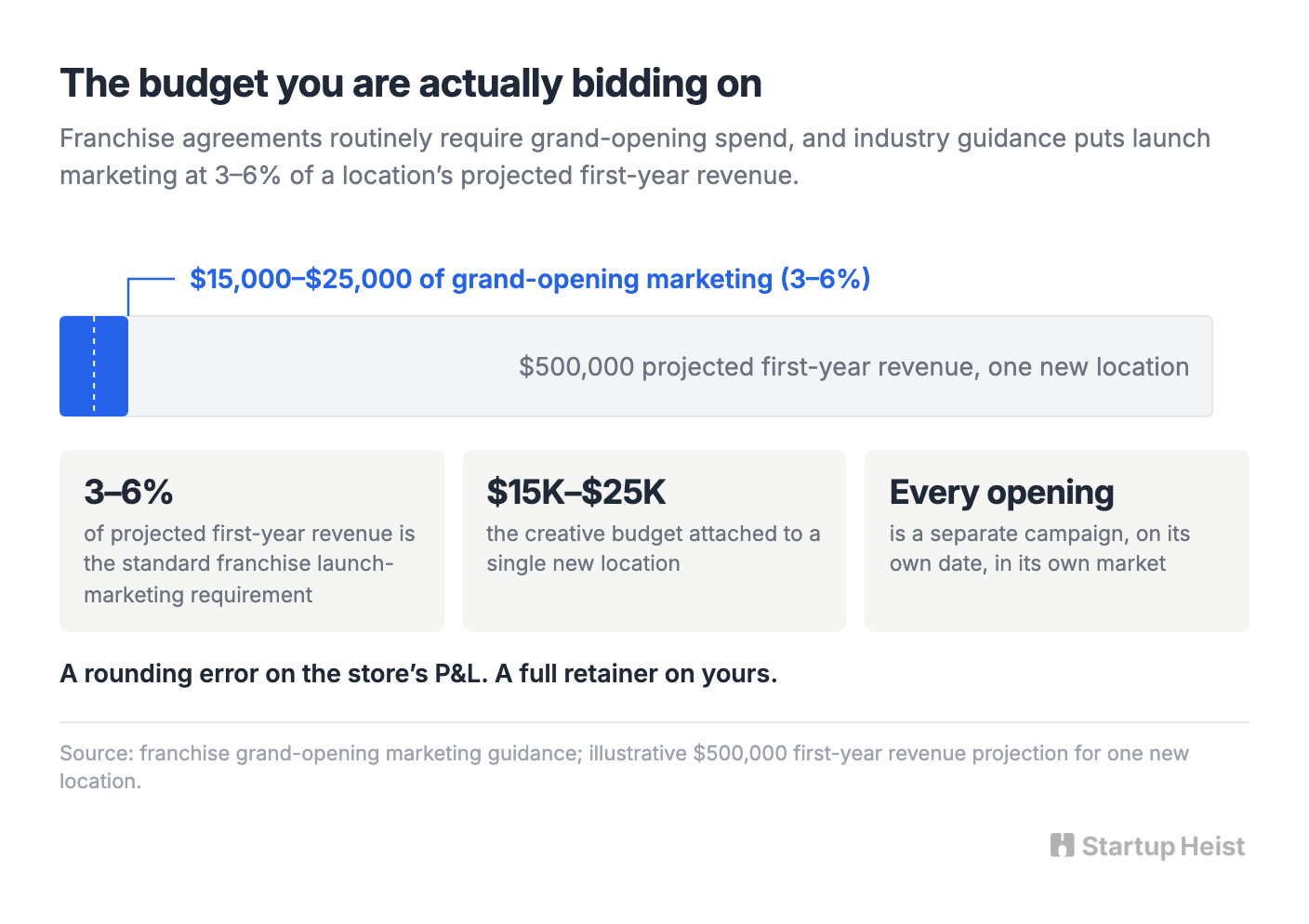
The initial product is a managed service with a repeatable production process, not software, and the framing matters more than the deliverables. A client buying "50 videos" is buying commodity editing, and will negotiate like it. Sell a successful market-entry sequence instead and the client is buying a slice of the store-opening budget, which is real money: franchise agreements routinely require franchisees to spend on grand-opening marketing, and industry guidance puts launch marketing at 3-6% of projected first-year revenue. For a location projecting $500,000, that's $15,000 to $25,000.
Call it the New-Market Launch Desk: a done-for-you short-form content operation for restaurant brands entering new cities. That takes you out of competition with freelance editors charging by the clip and puts you in competition for the launch budget.
What You Deliver
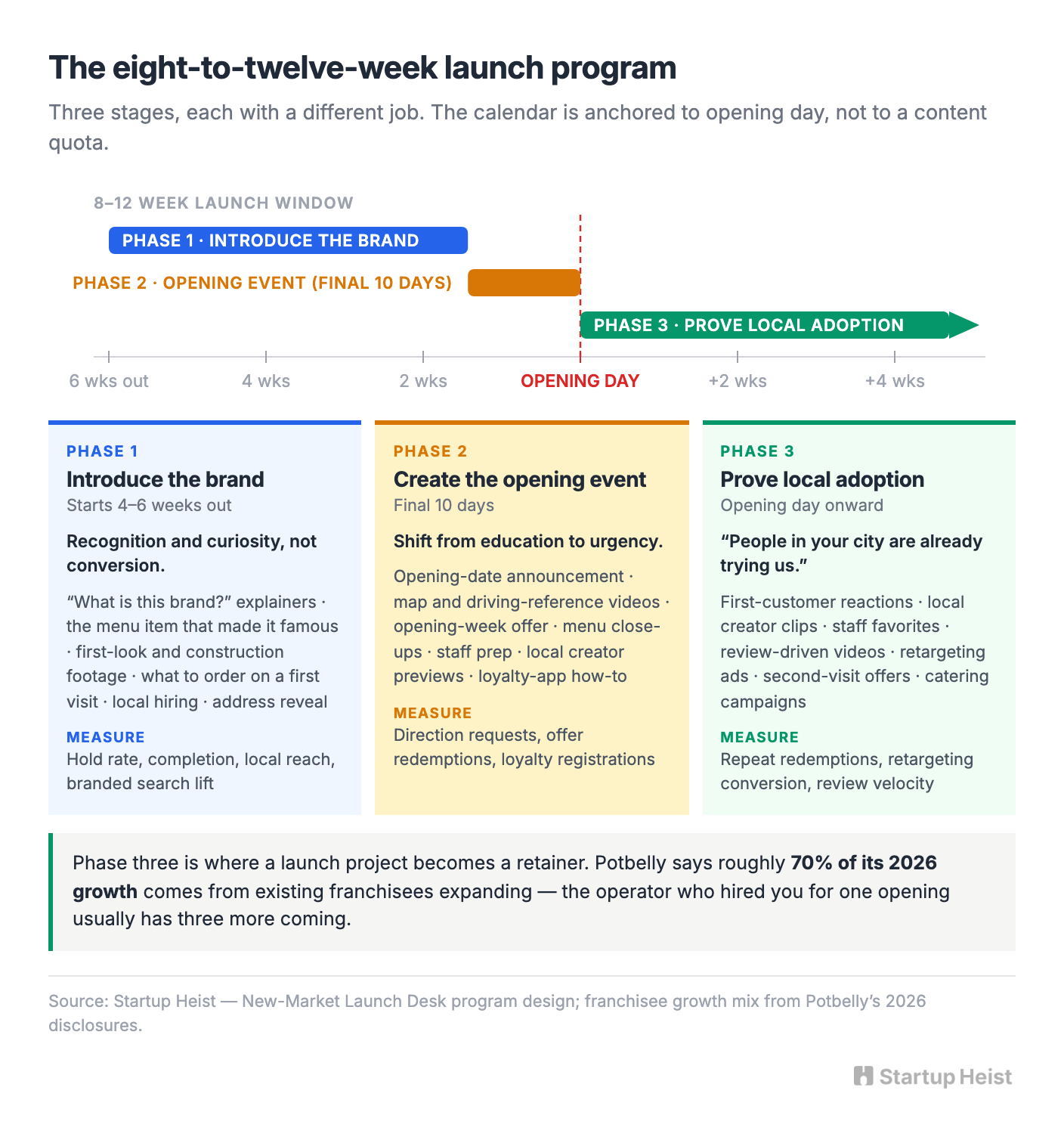
The strongest offer is an eight-to-twelve-week launch program in three stages, each with a different job.
Unlock the Vault.
Join founders who spot opportunities ahead of the crowd. Actionable insights. Zero fluff.
“Intelligent, bold, minus the pretense.”
“Like discovering the cheat codes of the startup world.”
“SH is off-Broadway for founders — weird, sharp, and ahead of the curve.”


