


The Needlepoint Slogan Factory
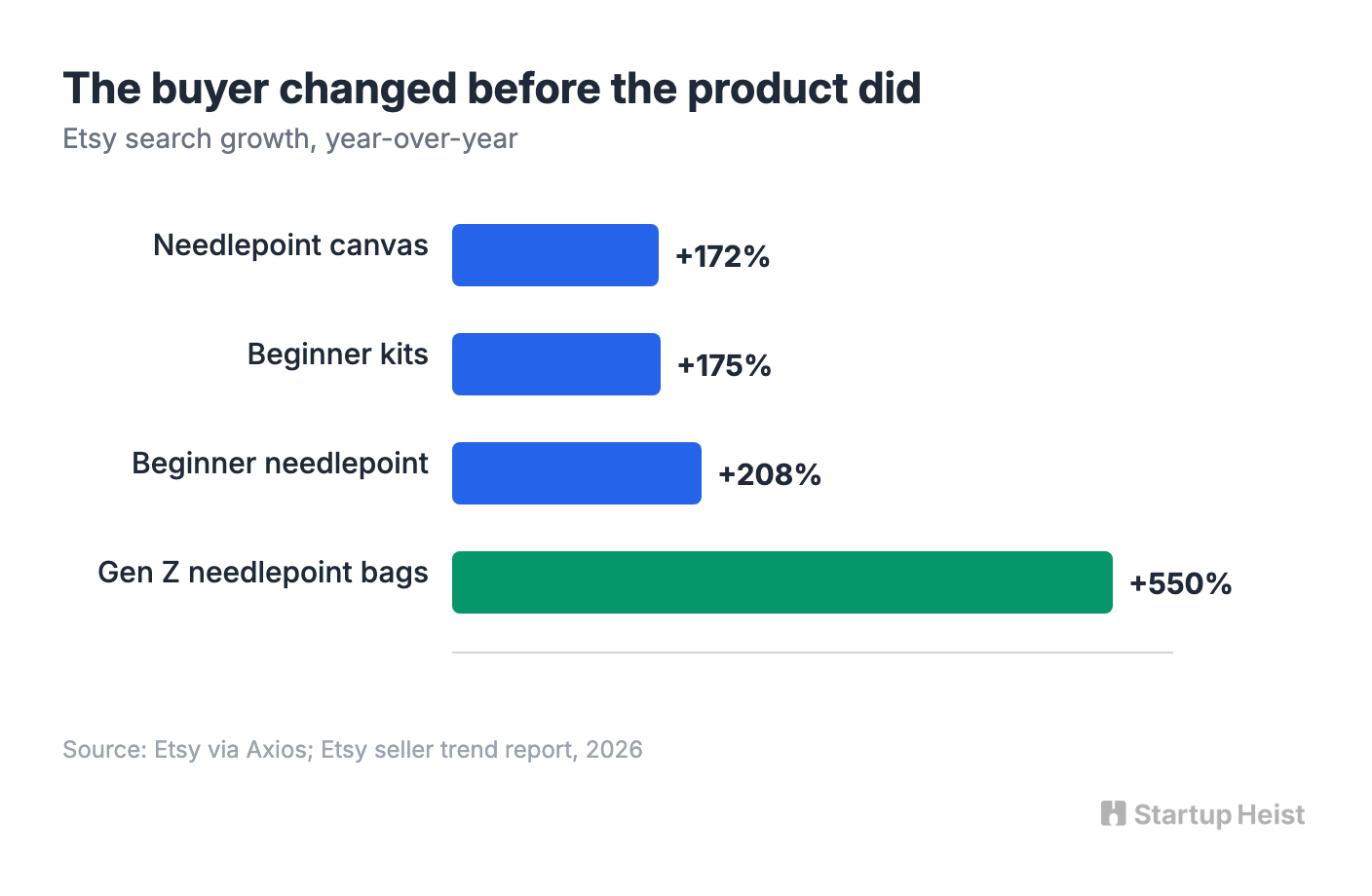
A 25-hour craft project doesn't look like the start of a 2026 cultural shift. The data says otherwise. Etsy told Axios that searches for "needlepoint canvas" climbed 172% year-over-year. Gen Z searches for needlepoint bags jumped 550%. Etsy's own seller trend report flags beginner needlepoint items at 208% year-over-year, with beginner kits up 175%.
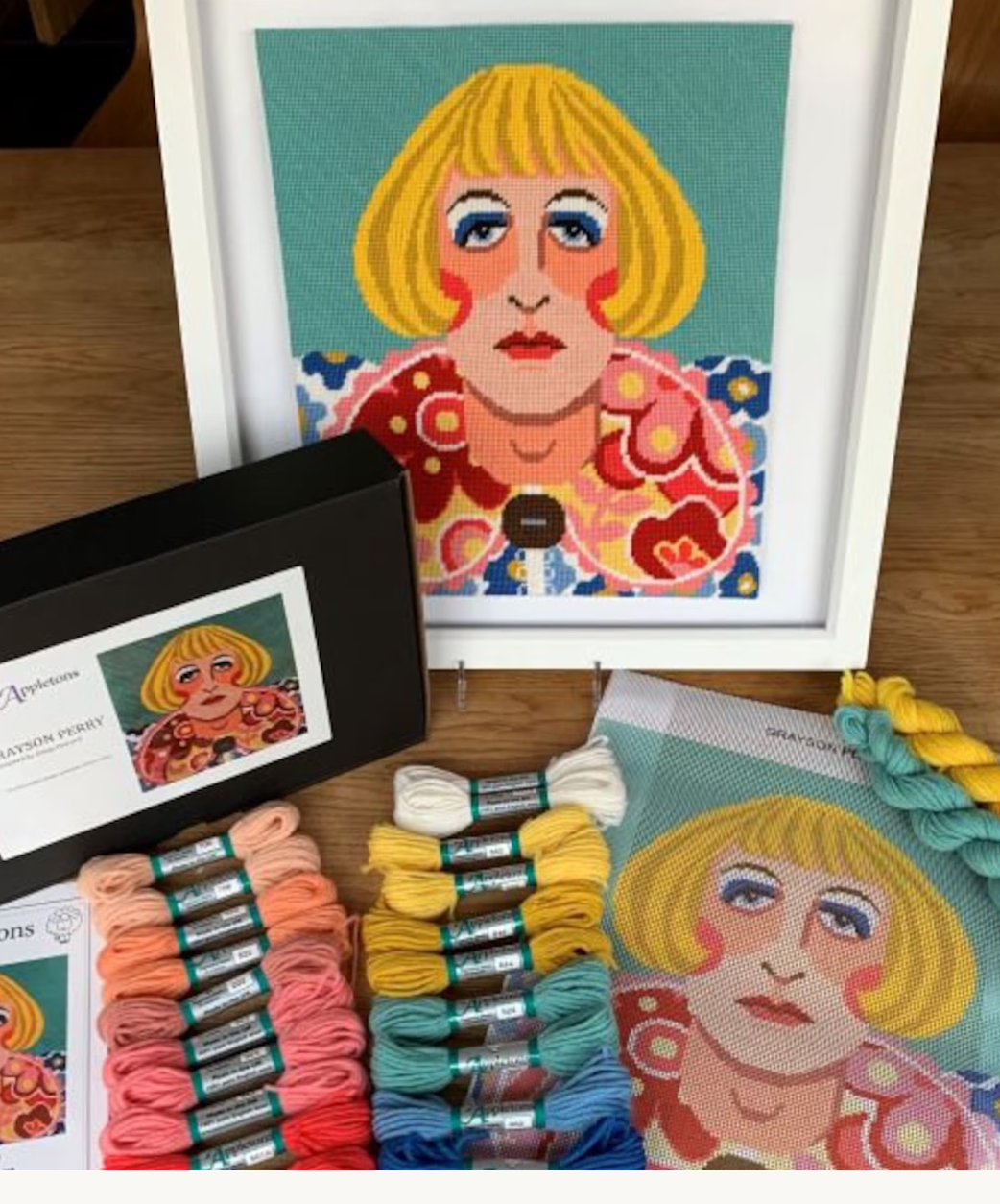
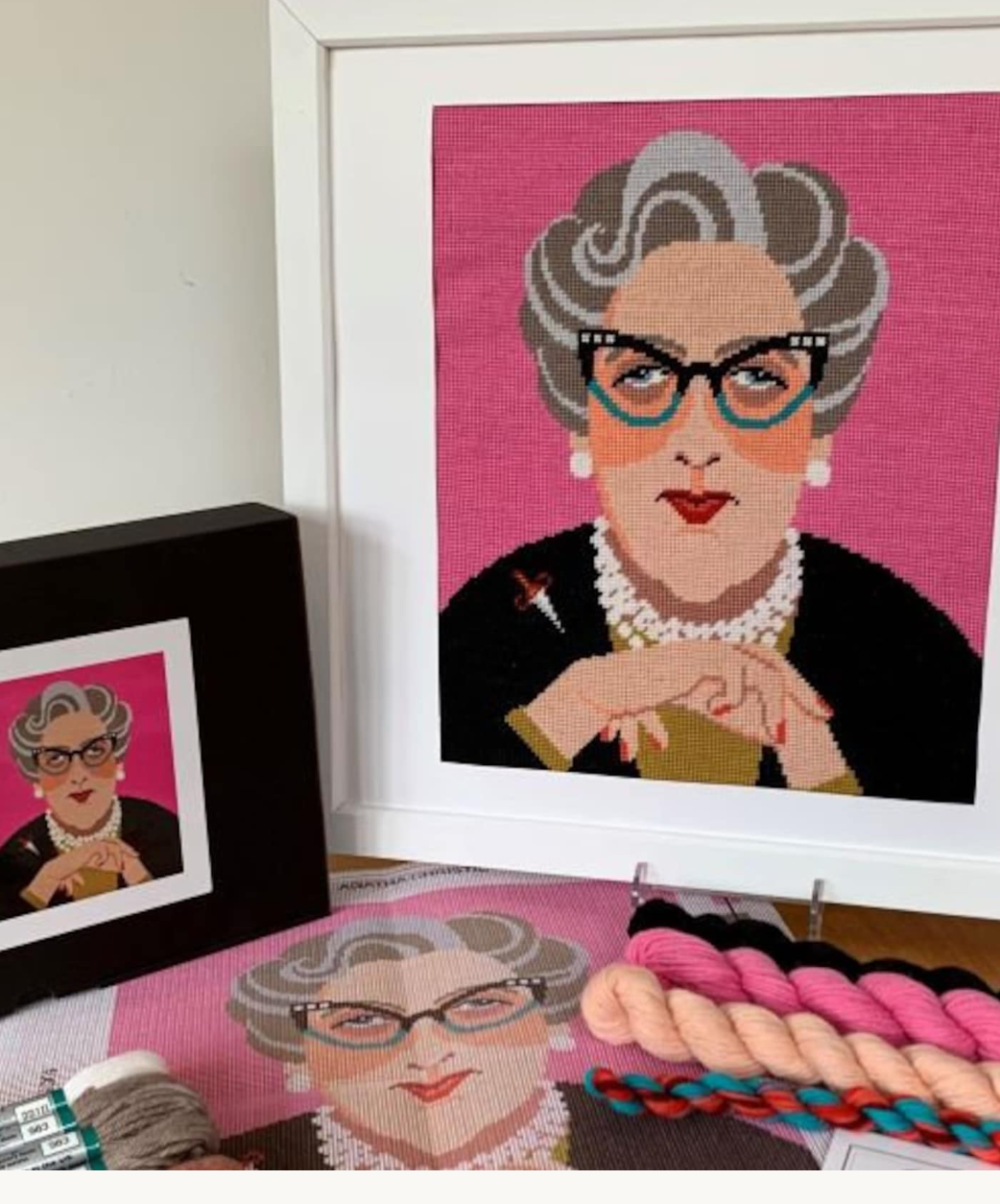
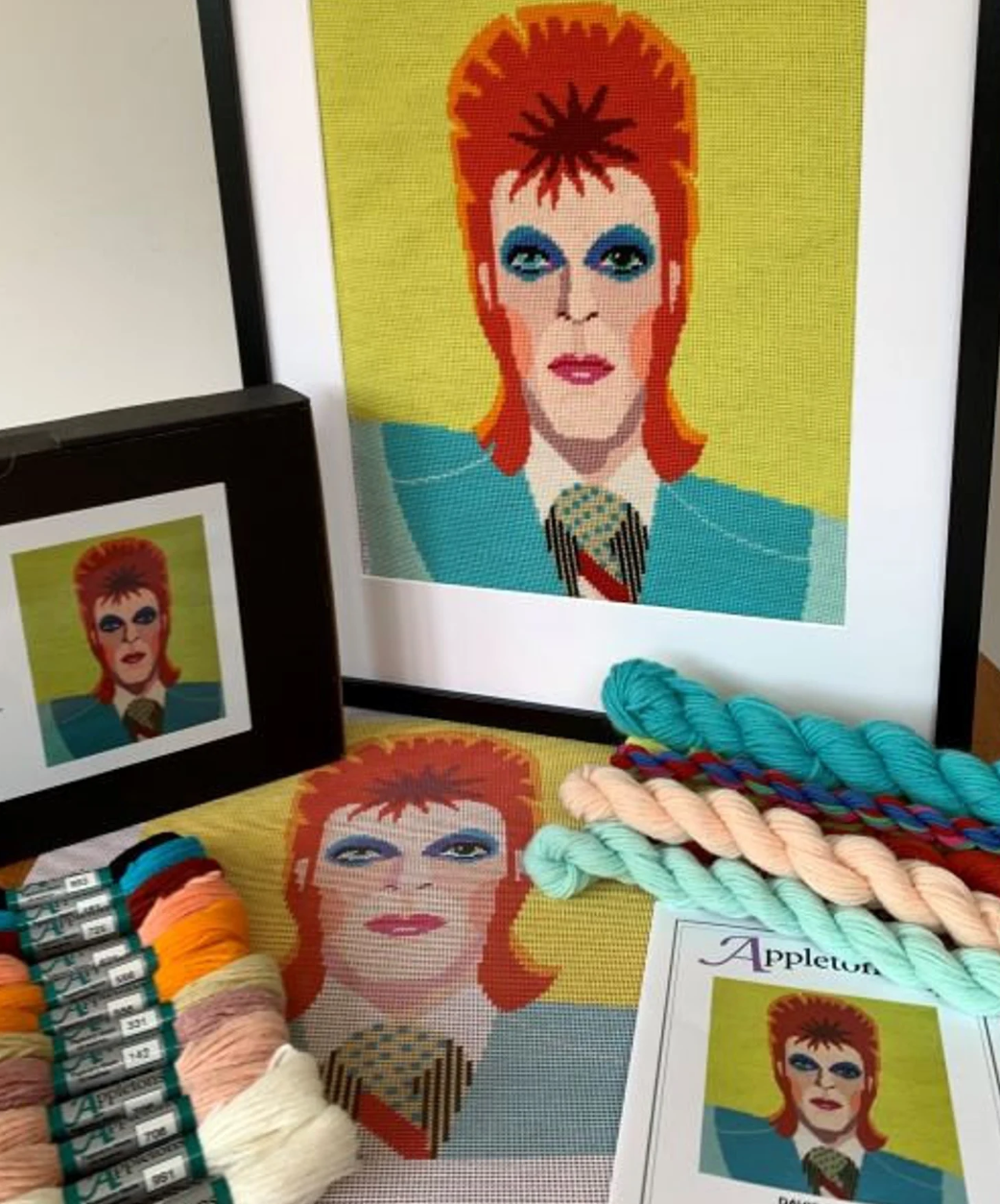
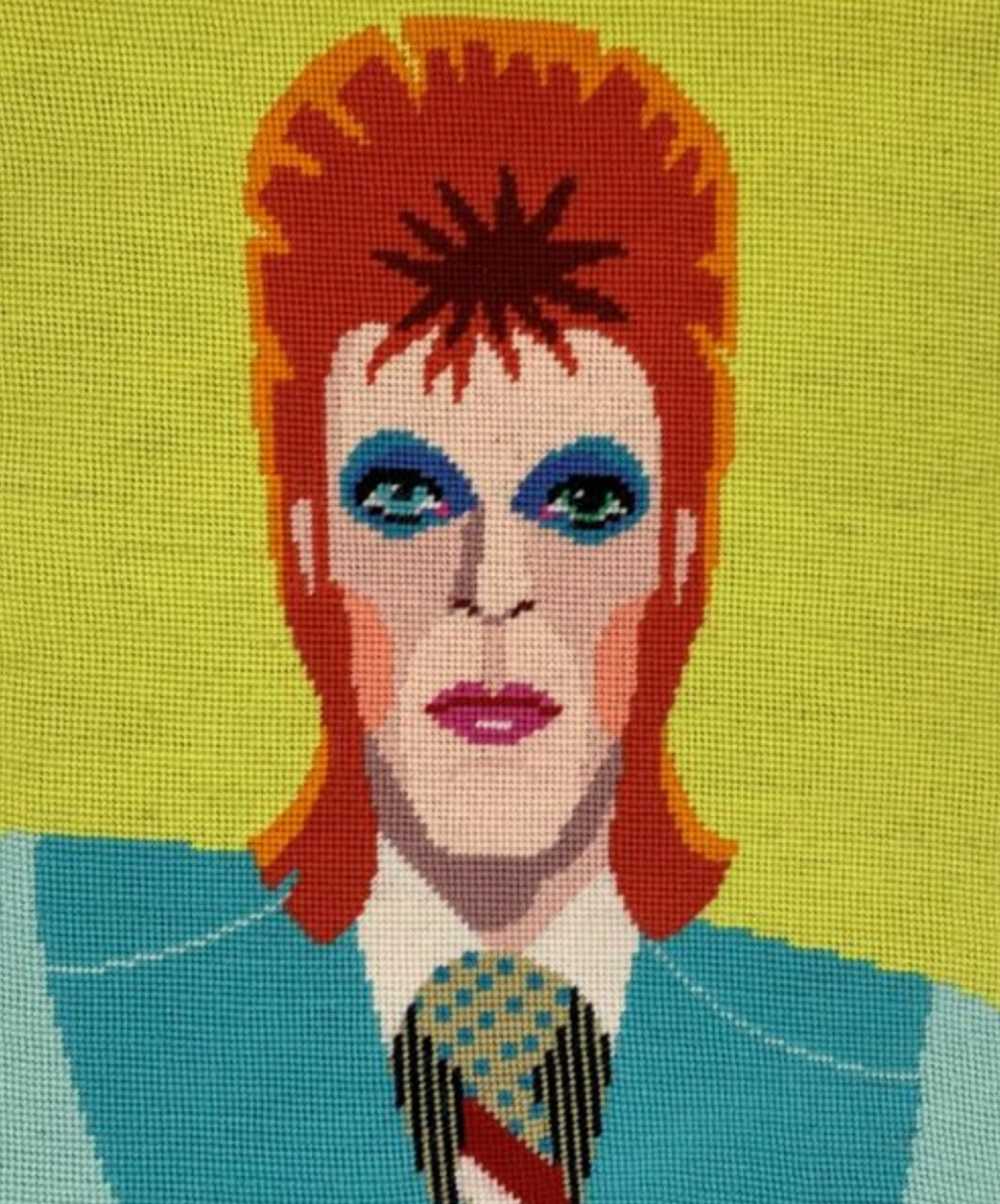
The product hasn't changed. The buyer has. The 2015 average stitcher was 61. The 2026 stitcher is around 30 years younger.
For a solo operator, that gap is opportunity-shaped. Here's the play in one block:
The money: A solo operator can run $7K to $13K per month between a 30-pattern shop on Etsy and Shopify and a small SaaS layer. One Etsy slogan shop already has 611+ five-star reviews.
Inside:
• Full pattern shop and SaaS pricing tiers
• 30-pattern MVP scope with drop calendar
• Phrase-first charting tool spec
• Creator and store outreach templates
• Five compounding moats worth building
The wrong move is to build "Etsy for needlepoint." Marketplaces are seductive and brutal: supply, demand, fulfillment, search, payments, reviews, and liquidity all at once. The smarter wedge is smaller and more profitable. Sell slogan needlepoint patterns as digital downloads. Watch what converts. Then turn the repeated production work into a phrase-to-chart tool: DMC-coded PDFs in 60 seconds.
This isn't AI replacing craft. It's AI taking the boring pre-craft work off the table. The buyer still stitches for 25 hours. The seller stops doing 25 hours of layout, palette, and PDF formatting per pattern.
That's the heist.
Why this is happening now
Three consumer shifts collide in modern needlepoint.
First, friction is back in fashion. The internet made everything frictionless, and now friction itself feels like a luxury. A 25-hour stitching project isn't efficient, and that's the appeal. Hands stay busy, the phone stays down, and the result is a real object you can post. Analog hobbies are doing for Gen Z what running clubs did for millennials.
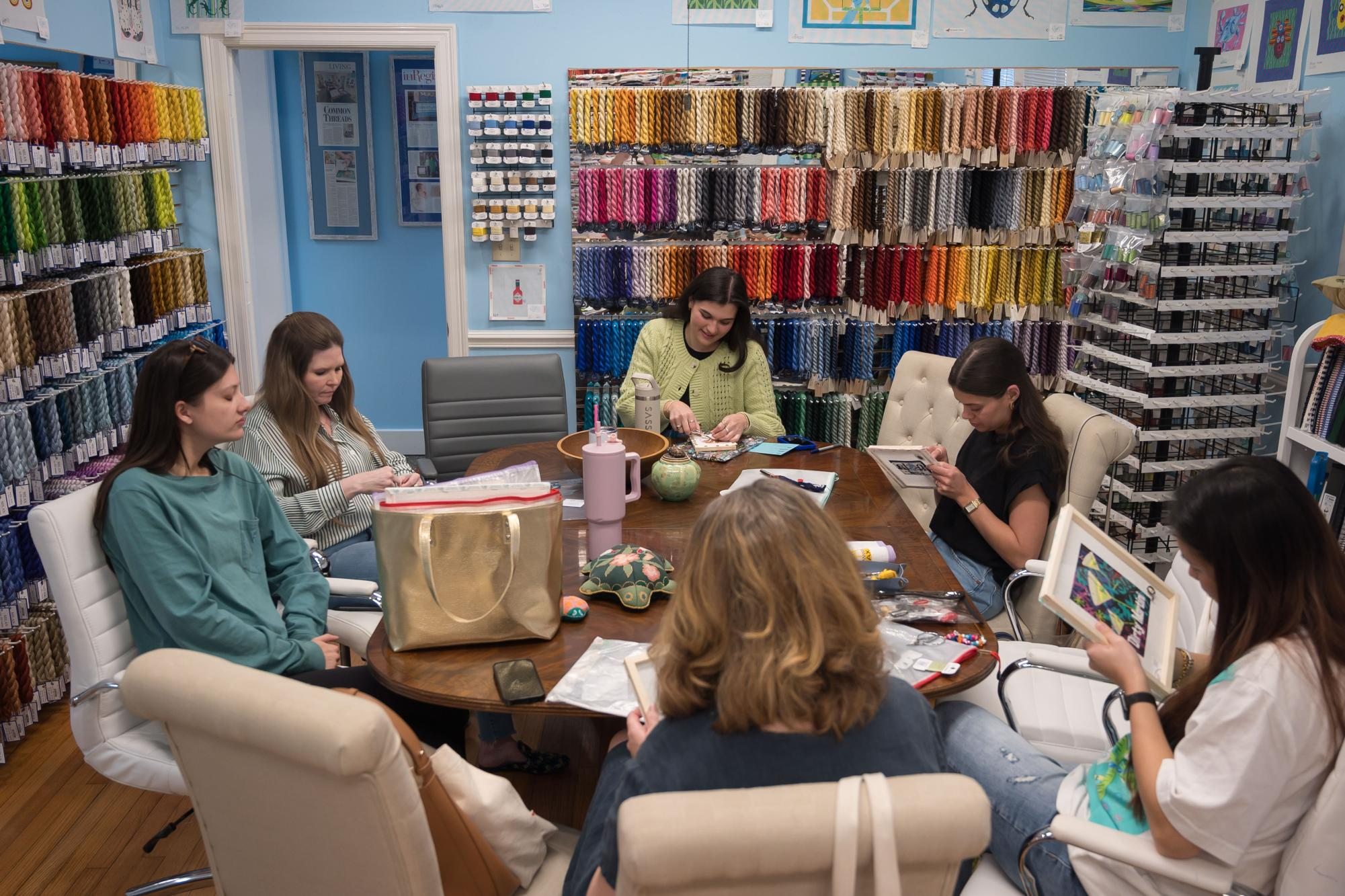
Second, the taste has changed. The old image is floral pillows, monograms, and country-club décor. The new image is cheekier: cocktail phrases, apartment humor, dinner-party jokes, vacation-house energy, soft luxury. The audience is the culturally online woman who wants an analog hobby that still photographs well.
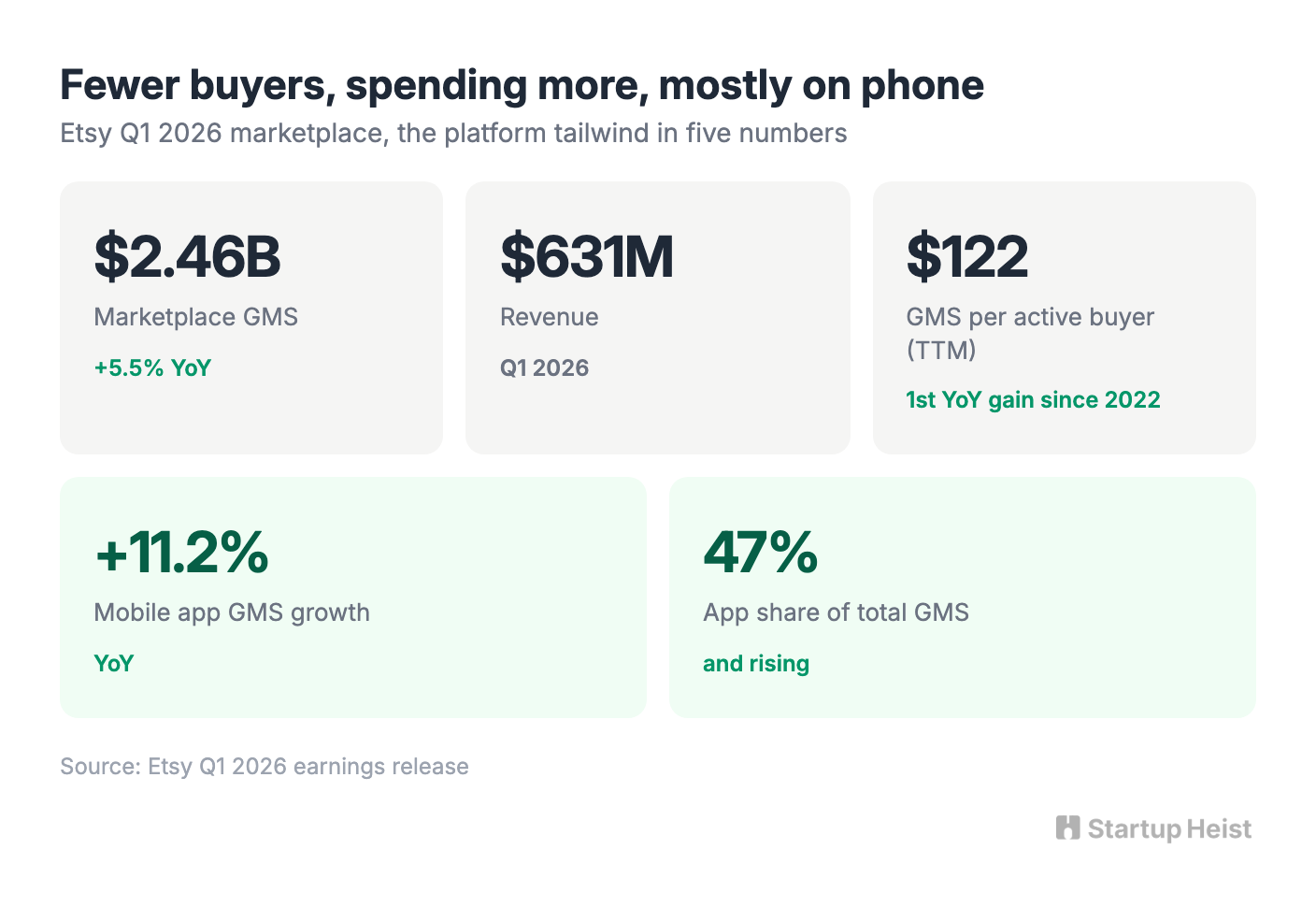
Third, the platform tailwind is real. Etsy reported Q1 2026 marketplace GMS of $2.46 billion, up 5.5% year-over-year, on revenue of $631 million. GMS per active buyer hit $122 on a trailing-twelve-month basis, its first year-over-year improvement since late 2022 and the fourth consecutive quarter of sequential gains. Mobile app GMS grew 11.2%, and app transactions accounted for 47% of total GMS. Active buyer counts are actually contracting slightly, which makes the spend-per-buyer story more useful: the buyer who's left is more valuable, more mobile, and spending more per visit.
Use Etsy as the search engine. Use TikTok as the trend lab. Use Shopify and email as the owned-margin layer. Save the SaaS for last.
The product: slogan charts, not finished canvases
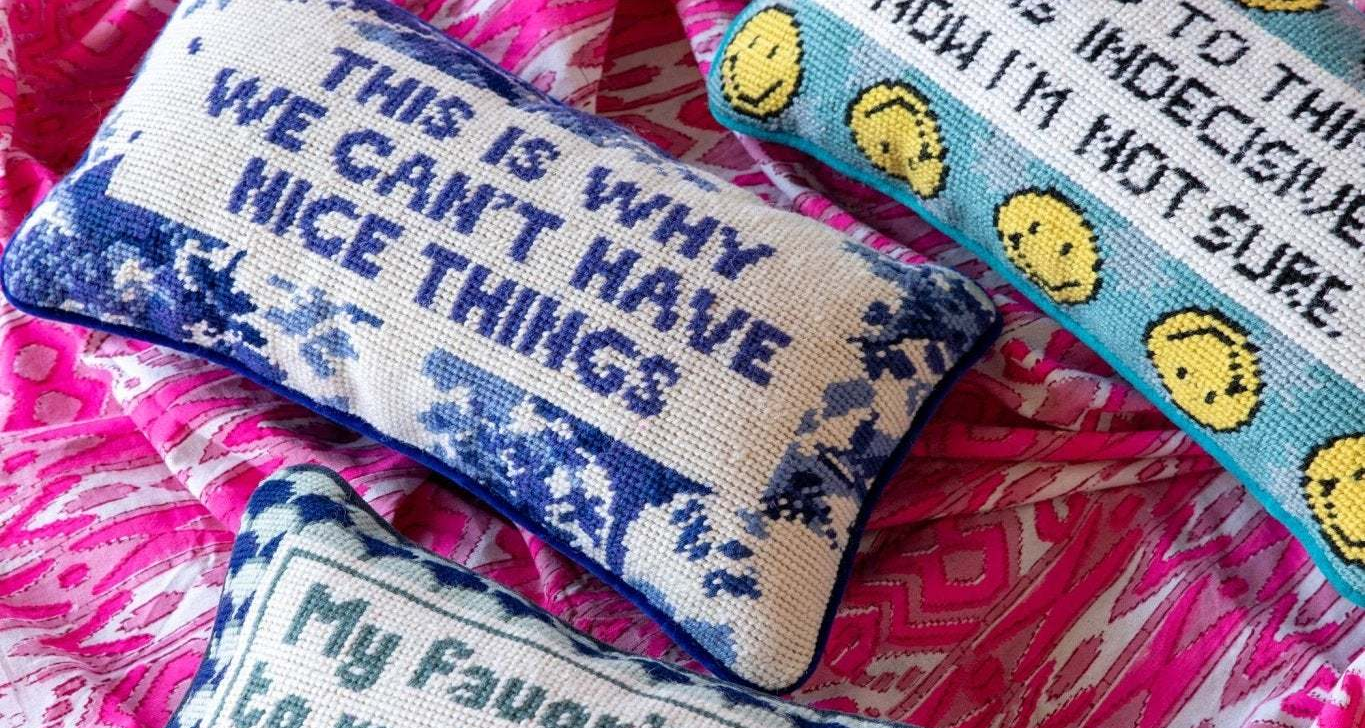
The simplest version is a downloadable cross-stitch pattern PDF. A customer sees a finished mockup of a stitched canvas reading "Please Leave By 9." She buys the PDF. Inside: a full-color chart, a symbol chart, DMC thread codes, canvas size and mesh count guidance, beginner instructions, a shopping list, finishing ideas. No inventory. No painting. No shipping. No returns from a pillow that came out wrong.
Hand-painted needlepoint canvases routinely sell from $80 to $400 because they require human design labor, painting time, materials, and retail markup. Digital needlepoint patterns avoid most of that. You're selling taste, layout, and convenience, which is why the first business shouldn't be a marketplace. The scarce resource is taste, not infrastructure.
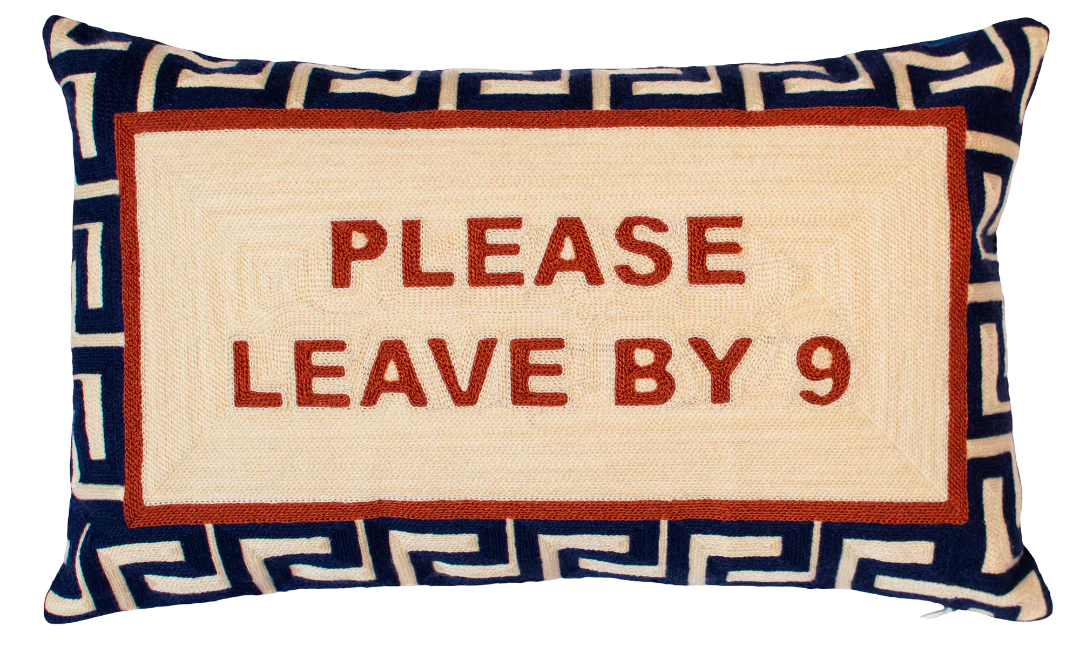
A good slogan chart needs the right phrase, the right line break, the right font, the right border, the right palette, the right negative space, and the right difficulty level. The customer isn't buying "a pattern." She's buying an identity object: something to stitch on the couch, post as a work-in-progress, and eventually display as a private joke about her life. The opening catalog should be a tight world. Some examples:
- "Please Leave By 9"
- "Full Bar, No Agenda"
- "Emotional Support Martini"
- "Book Club Was a Lie"
- "Rotisserie Chicken Summer"
- "I Came. I Saw. I Made a Reservation."
- "No One Is Coming to Save the Crudités"
- "Soft Launching My Third Coffee"
- "Museum Gift Shop Energy"
- "Sorry, My Calendar Is Linen"
These belong in stylish apartments, girls' trip tote bags, bachelorette weekend gift bags, dinner-party bathrooms.
The market gap
The category is small enough to win and big enough to matter. A digital pattern shop selling $12 to $25 PDFs only needs a small group of buyers. At an $18 average order value, 300 orders per month is $5,400 in gross. Bundles, seasonal drops, starter kits, and commercial licenses stretch that to a meaningful side business.
The software layer has a higher ceiling, and existing needlepoint chart maker tools both prove the demand and reveal the gap. PCStitch is a long-running Windows program at $49.95 lifetime, and its last meaningful update was 2016. Stitch Fiddle runs in-browser with a free tier and premium under $6 per month, dropping to roughly $33 a year if billed annually. StitchSketch is iOS-only at $8 with DMC palettes and PDF export. All three behave like CAD for stitching. Each assumes the user already knows she wants a pattern editor.
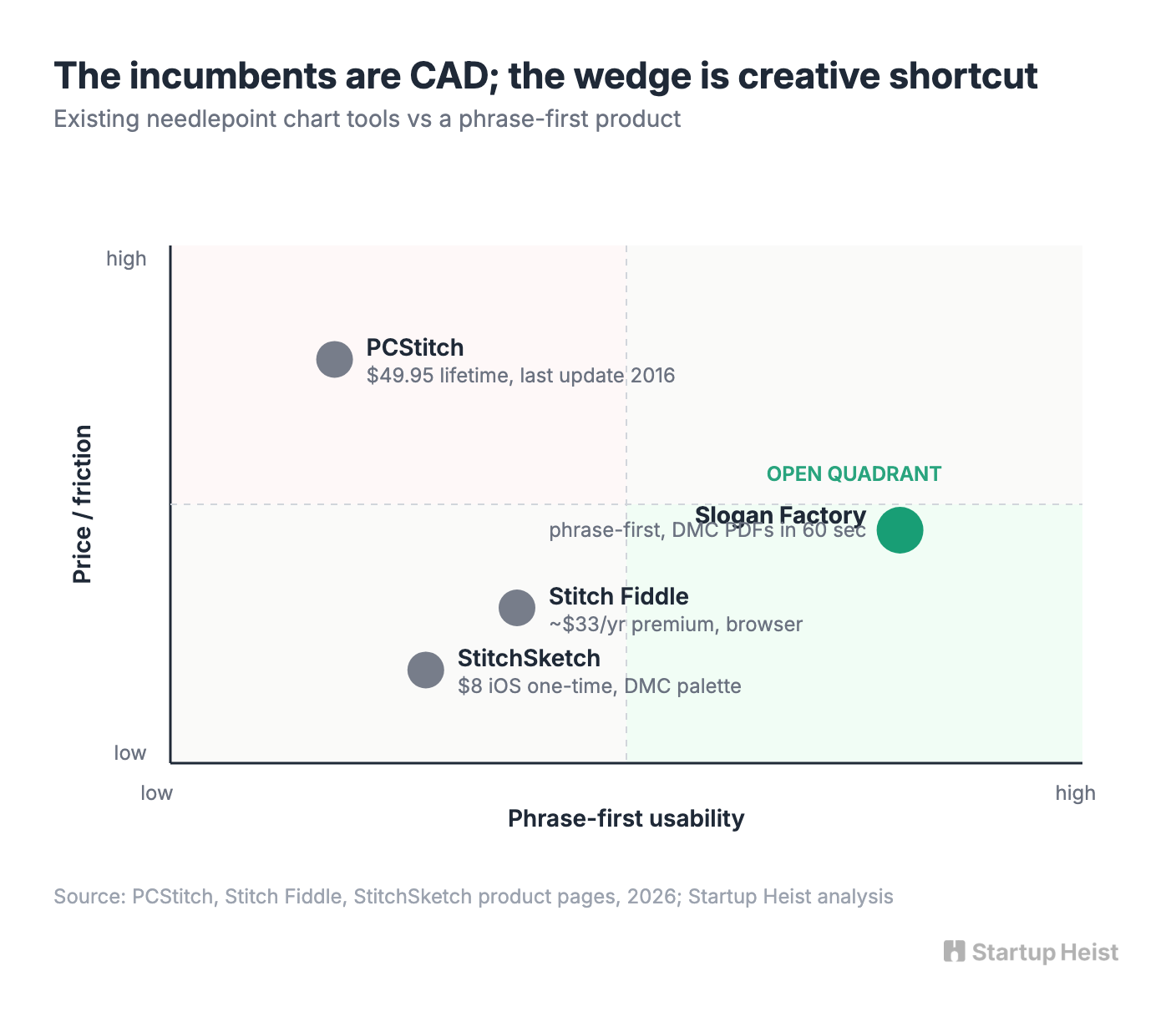
A handful of modern slogan needlepoint shops have noticed the new buyer. Poppy Monk markets "modern needlepoint with a side of sass." NeedlepointAfterDark sells under "Everything fun happens after dark." Etsy sellers like WTSNeedlepoint, MagnoliaHarborGoods, FiftyShadesStitches, and Everinscription are pulling the category into the cocktail-and-apartment-humor zone. None of them have built a tool. They're still doing the layout work by hand, which is the door.
The wedge: phrase-first charting
The buyer in 2026 doesn't wake up wanting cross-stitch design software. She wakes up wanting to turn a phrase she heard at brunch into something cute enough to stitch. That's a creative shortcut, not a tool. The SaaS shouldn't start as a general image-to-needlepoint converter. Phrase-first is the wedge.
User flow:
- Enter a phrase.
- Choose a format: mini canvas, ornament, pillow insert, bag panel, bookmark, coaster.
- Choose an aesthetic: preppy cocktail, washed linen, coastal grandmother, chaotic dinner party, retro café, sorority gift, book-club noir.
- Choose skill level.
- Generate a DMC-coded chart.
- Export a print-ready PDF and a social mockup.
The promise is turn a funny phrase into a stitchable canvas in 60 seconds. Commercially specific. A phrase-first MVP also dodges the hard problems: image generation, segmentation, copyright-flavored uploads, ugly outputs. Text and simple shapes are easy to control. Canvas size, grid density, fonts, borders, and palette can all be constrained, so the user gets something that looks intentionally designed instead of algorithmically mangled.
The DMC ecosystem gives the software a natural standard. StitchSketch already supports DMC palettes. Stitch Fiddle treats DMC as a default floss option. Users expect thread-code output, not just on-screen colors. The insight is structural: this is a structured export tool for a specific creative workflow, dressed in better taste than the engineering-first incumbents.
The business model
There are two businesses here, and they reinforce each other.
Unlock the Vault.
Join founders who spot opportunities ahead of the crowd. Actionable insights. Zero fluff.
“Intelligent, bold, minus the pretense.”
“Like discovering the cheat codes of the startup world.”
“SH is off-Broadway for founders — weird, sharp, and ahead of the curve.”


