


The Matcha Supply Chain Is Breaking. Cafés Need a Verified Importer.
Matcha used to be a menu upgrade. In 2026, it's an operating risk.
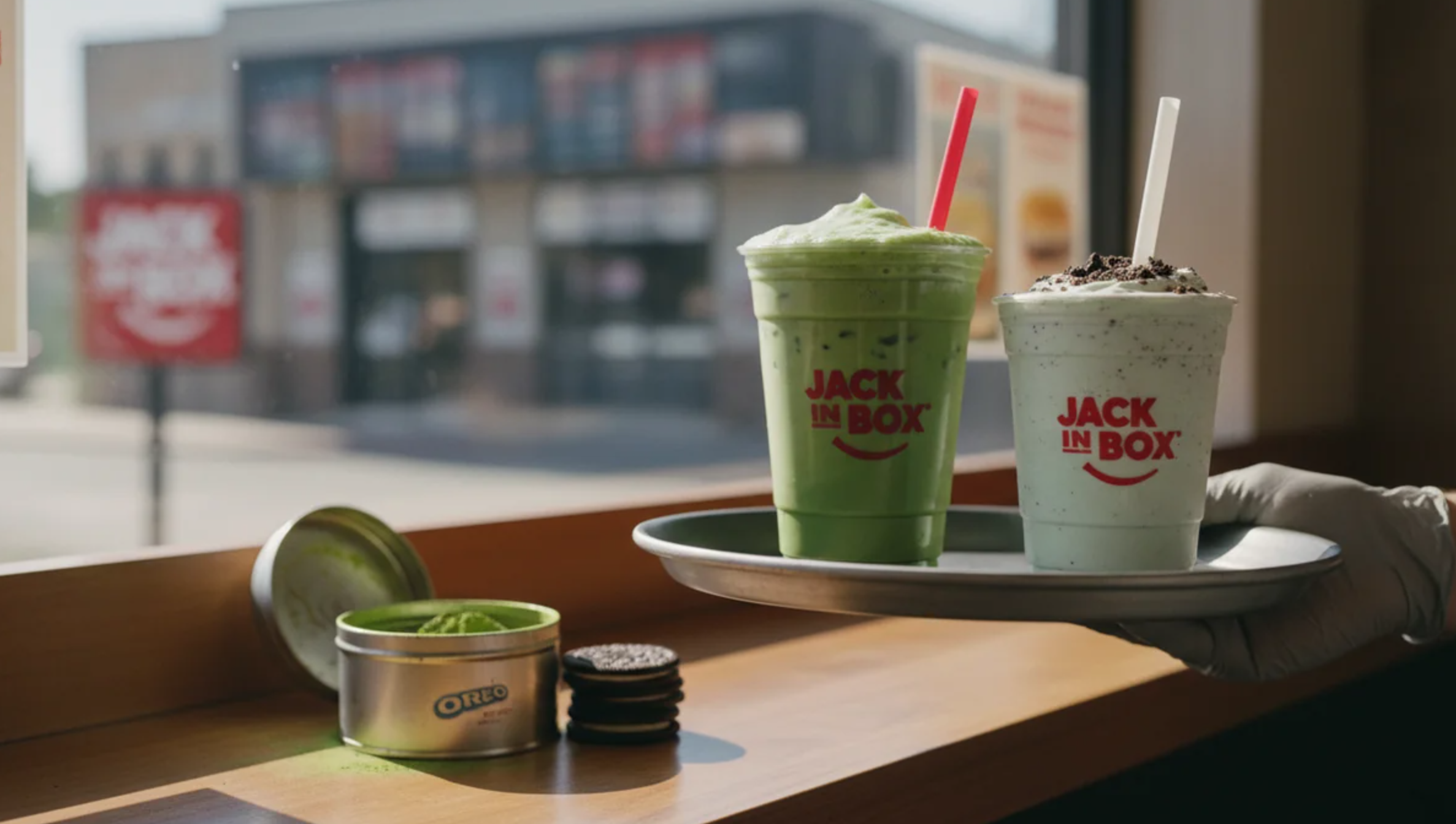
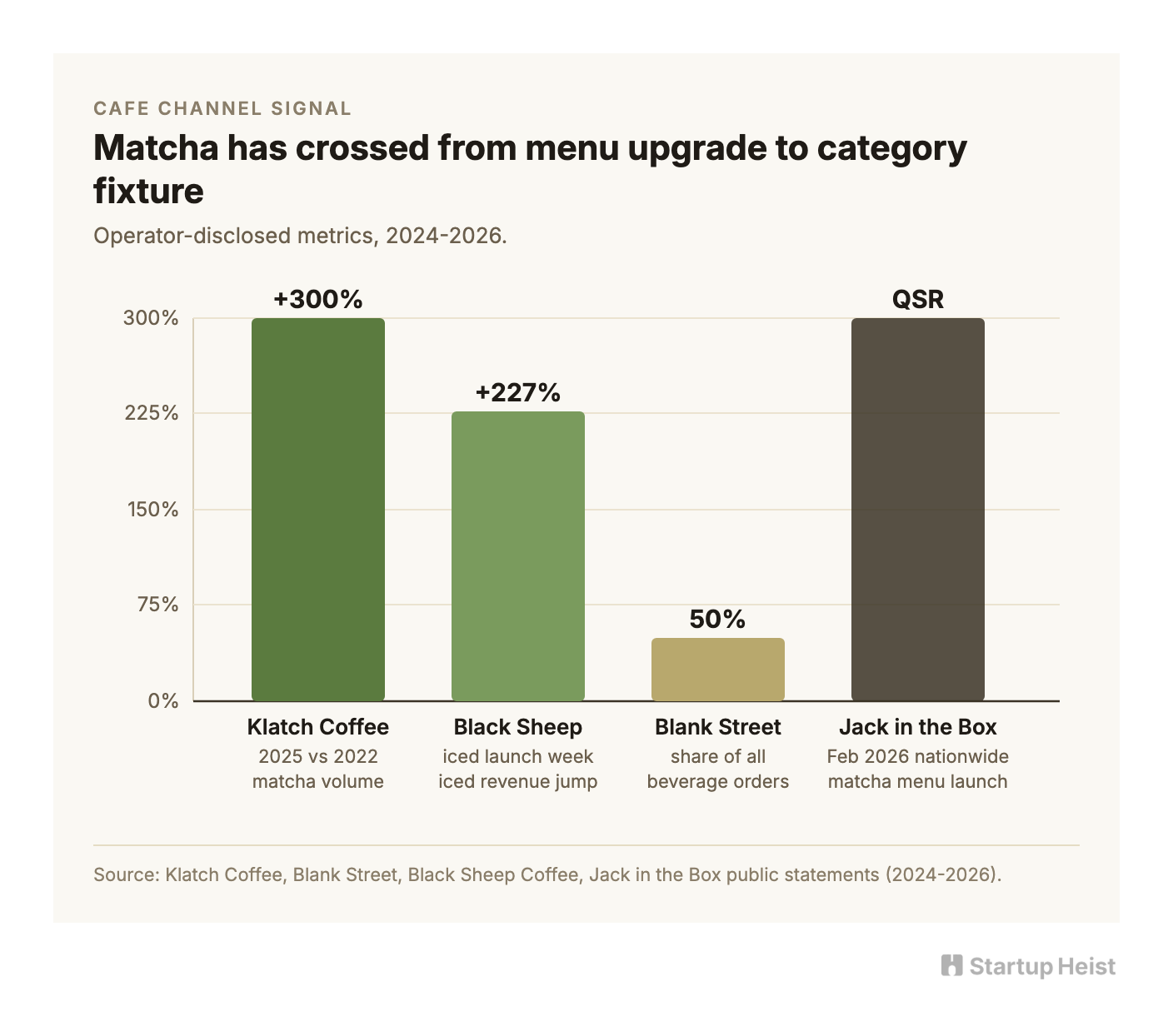
For specialty cafés, the product looked almost too perfect. Beautiful color. Strong margins. Instagram-friendly photos. Enough functional-wellness halo to justify a $6 to $9 drink. Klatch Coffee is on track to sell four times as much matcha in 2025 as it did in 2022. Blank Street reports matcha at roughly 50% of all beverage orders. UK chain Black Sheep Coffee logged a 227% jump in iced-beverage revenue the week it launched its new iced range, with matcha as the headline driver. In February 2026, Jack in the Box rolled out a nationwide matcha lineup, the kind of QSR move that signals a category has crossed from trend to fixture.
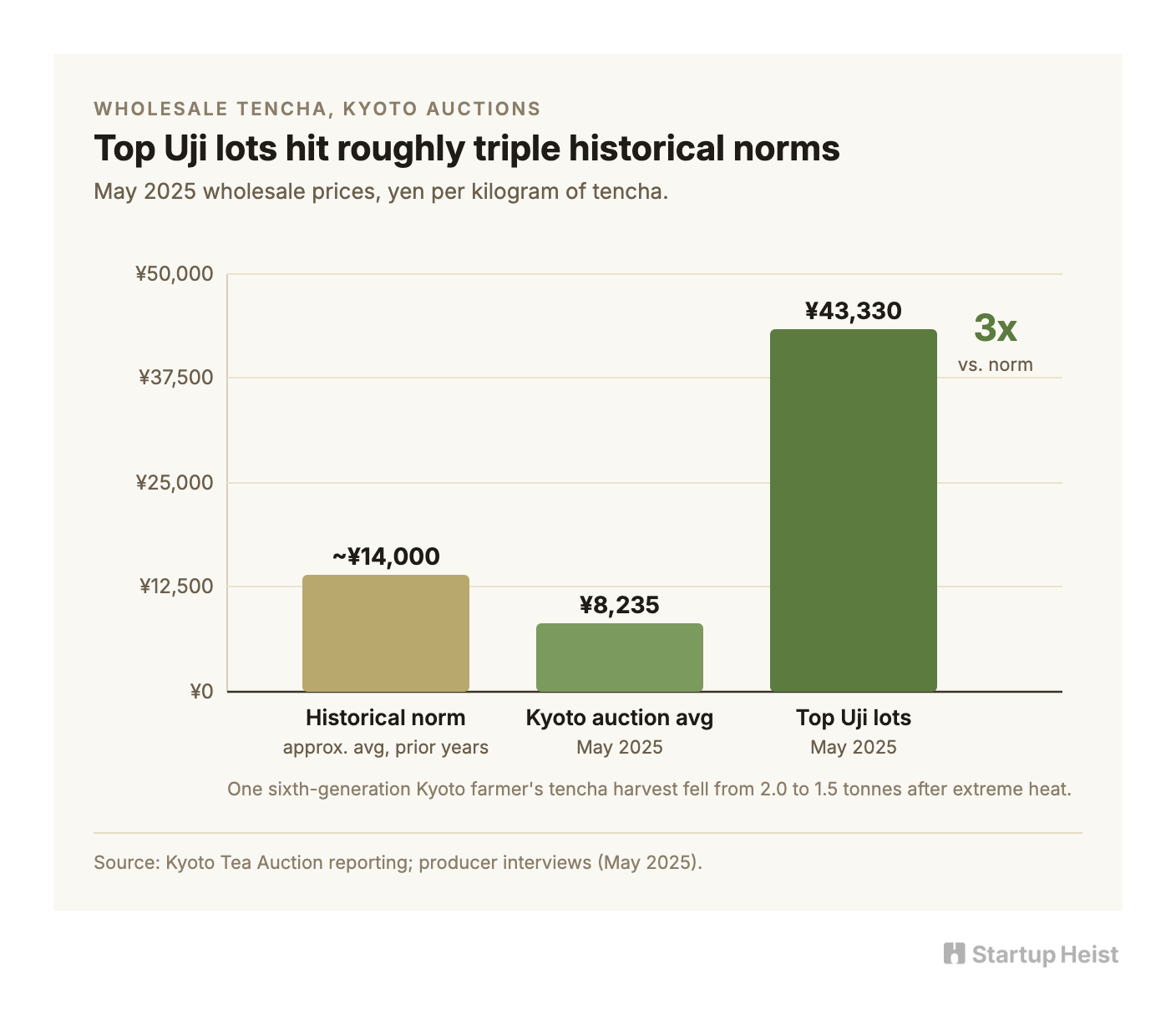
Then the supply chain cracked. Heat-stressed harvests. Viral global demand. An aging farming population. Limited grinding capacity. The slow biology of tea cultivation. One sixth-generation Kyoto-area farmer saw his typical two-tonne tencha harvest fall to 1.5 tonnes after extreme heat damaged his bushes. Kyoto auction prices hit 8,235 yen per kilogram in May 2025, with top-quality Uji lots reaching 43,330 yen, roughly triple historical norms. Japan produced 5,336 tons of tencha in 2024, several times the level of a decade earlier. New plantings take roughly five years to mature.
This isn't a one-month stockout. It's a structural mismatch between demand that goes viral overnight and agricultural supply that moves in five-year cycles. Big buyers get allocation. Heritage producers protect long-standing relationships. Small cafés get squeezed. They pay more, accept inconsistent grades, buy from unauthorized resellers, or quietly switch to cheaper blends that damage the drink.
Here's the opportunity:
The money: 50 cafés at 5kg/month and $80 gross profit per kg = $20K MRR. Klatch is on pace to 4x its 2022 matcha volume in 2025.
Inside:
• Two-SKU foodservice catalog
• Kagoshima-led multi-region sourcing
• Allocation pricing with transparent bands
• Four moats: supply, trust, data, compliance
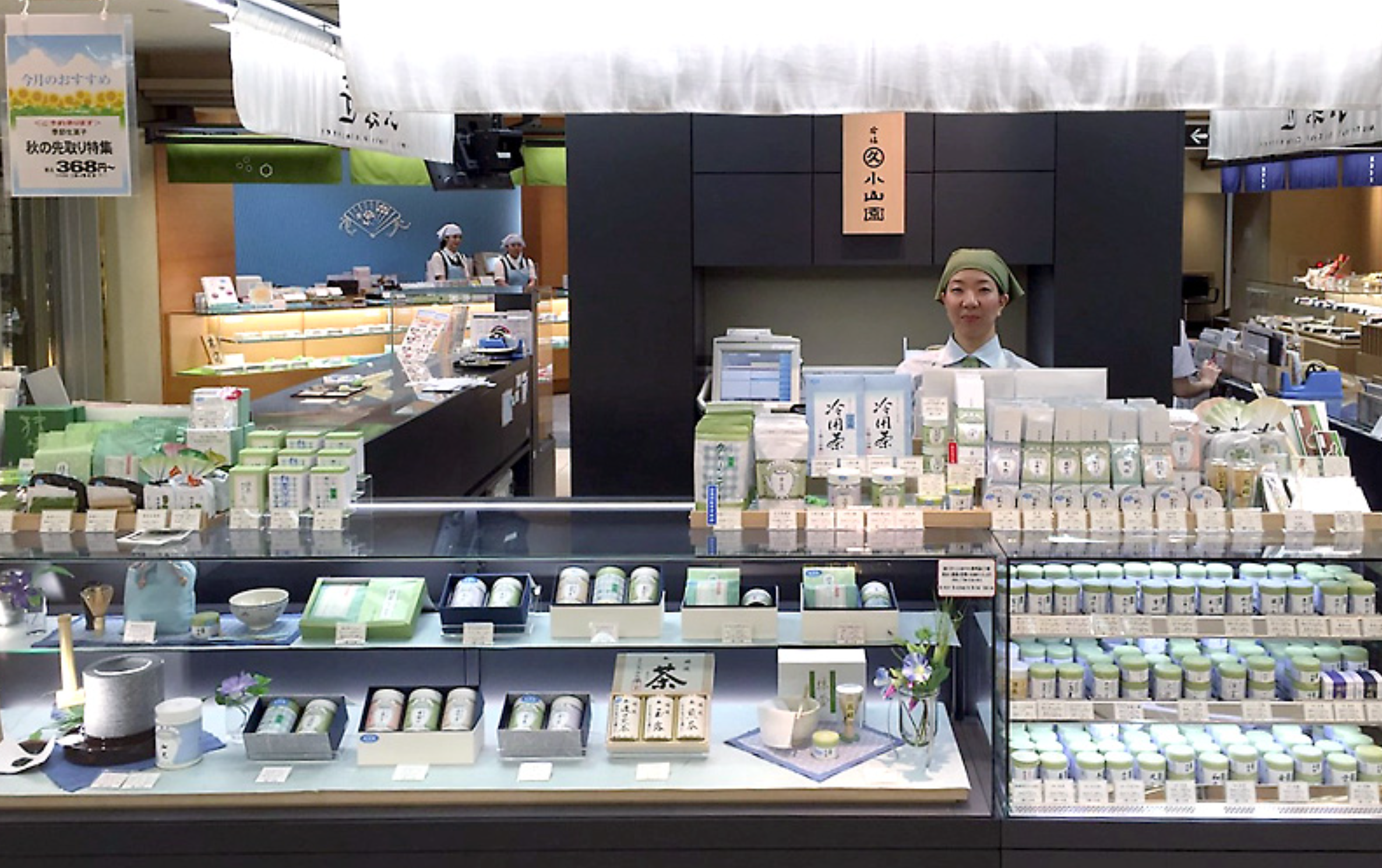
Marukyu Koyamaen, one of Kyoto's most respected producers, now publishes a public unauthorized-reseller list, last updated April 7, 2026. The company states plainly that it doesn't directly supply those sellers and doesn't stand behind the quality of products bought through them. That isn't luxury-brand theater. The gray market has grown large enough to threaten trust, and a serious producer is publicly drawing a line.
The play is a B2B verified Japanese matcha importer for specialty cafés. Not another DTC tea brand on Shopify moving 30-gram tins to wellness consumers. A focused, operationally serious supplier that helps cafés answer three questions. Is this real Japanese matcha? Will I get the same quality next month? Can I price my menu without being held hostage by spot-market chaos? The business isn't selling matcha. It's selling reliability.
The obvious move is to chase consumers. The consumer market is loud, aesthetic, and crowded. The better wedge is the café buyer. A specialty café doesn't need poetry. It needs matcha that performs in milk, arrives on schedule, has documentation, and protects margin. The owner doesn't want to spend five hours comparing TikTok-famous tins, auction rumors, and distributor PDFs. She wants a supplier who can name the origin, the lot, the grade, the lab result, the landed price, and the allocation she can count on for the next quarter. That's a real painkiller. The play isn't a $5,000 inventory flip. It's a small import-export company disguised as a modern B2B brand. Harder to build. More defensible.
Why now
Matcha has crossed from niche Japanese tea culture into global foodservice infrastructure. The global matcha market grew from roughly $4.59 billion in 2024 to $4.92 billion in 2025, with industry projections pointing to $6.96 billion by 2030 at a 7.15% CAGR. Consumer interest on social media climbed 19% year-over-year. The average price of matcha items in foodservice rose 14% in the same window. Japanese green tea export value rose 25% to 36.4 billion yen, and matcha alone now accounts for 58% of Japan's tea exports by value, the first time it's ever been the majority.
Supply is expanding, but too slowly. Matcha isn't ordinary green tea powder. It starts with tencha, a shaded leaf that requires specific cultivation, processing, and stone grinding. Green tea farms can't be flipped overnight into premium matcha capacity. New plantings take roughly five years to produce harvest-ready bushes. Café demand doesn't wait. TikTok discovers iced strawberry matcha. Tourists buy out tins in Kyoto. Wellness creators replace coffee with matcha. The demand signal arrives instantly. The agricultural response doesn't.
When supply tightens, trust becomes valuable. In normal markets, cafés tolerate mediocre distributor relationships because convenience wins. In broken markets, the buyer starts asking harder questions. Why did my price jump? Why does this batch taste different? Why is the color duller? Why am I seeing the same tin on reseller sites at insane markups? The shortage creates urgency, authenticity creates the wedge, and the café channel creates repeat revenue.
Why cafés pay
The café owner's math is simple. A matcha latte uses 2 to 4 grams of powder. At $80 per kilogram, a 3-gram serving costs $0.24 in matcha. At $200, it costs $0.60. At $400, it costs $1.20. On a $7 drink, even the high end is workable if the product is reliable.
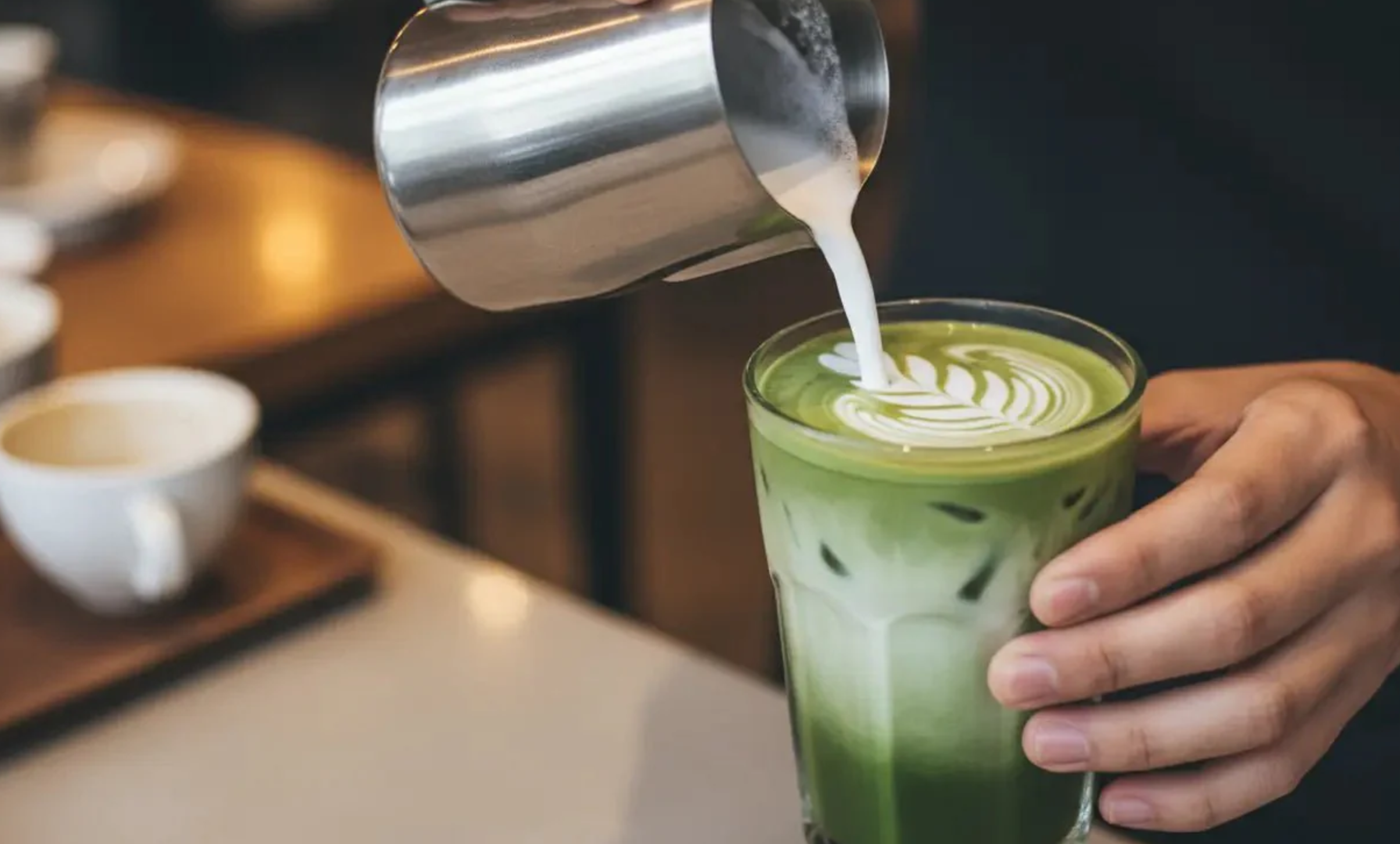
The nightmare is uncertainty. A café can raise a drink from $6.50 to $7.50. It can train staff to dose precisely. It can build a premium menu story around authentic Japanese sourcing. What it can't easily handle is random stockouts, inconsistent taste, and emergency buying from unknown resellers. The offer isn't cheaper matcha. The offer is margin stability, a predictable input cost, and a trust story she can put on her menu. Industry analyses indicate direct Japan import can save 25% to 40% versus distributor stock at equivalent grade once volume scales. That gives the entrant room to build a margin while still beating panic-buying through fragmented channels.
The wedge: Kagoshima and multi-region sourcing
The romantic version of matcha is Kyoto. The business version needs more nuance. Kyoto and Uji carry prestige, and they're capacity-constrained, brand-protected, and viciously contested. A new B2B importer shouldn't start by trying to outbid everyone for the most famous names.
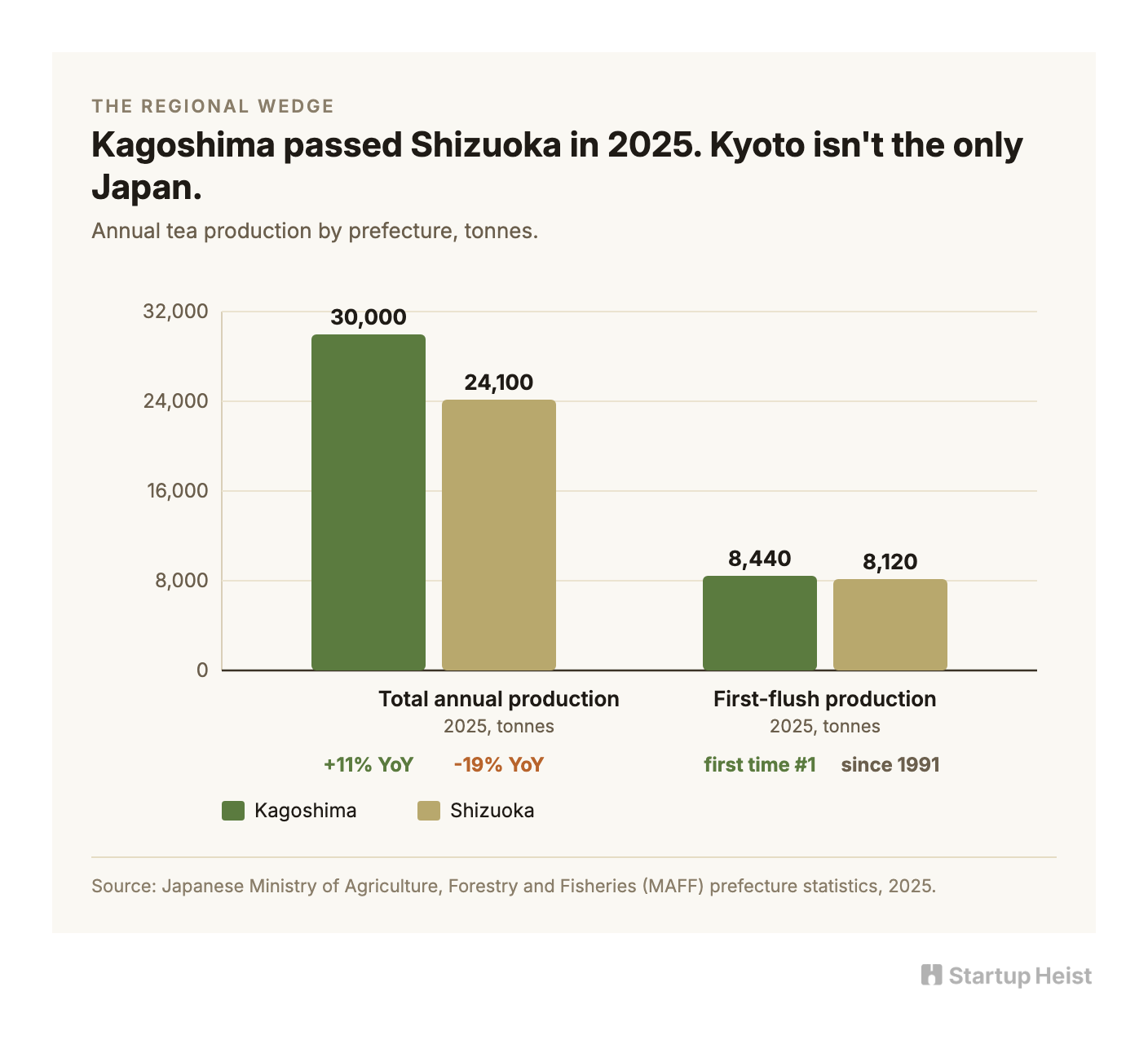
The smarter wedge is emerging-region Japanese matcha: Kagoshima, Shizuoka, and other production areas with scalable agricultural capacity and less brand congestion. In 2025, Kagoshima surpassed Shizuoka in first-flush production for the first time since statistical surveys began in 1991. Kagoshima held steady at 8,440 tonnes. Shizuoka dropped 19% to 8,120 tonnes. Total annual tea production widened the gap further: Kagoshima reached roughly 30,000 tonnes in 2025, up 11% year-over-year, against Shizuoka's 24,100 tonnes. Kagoshima's southern latitude, flat terrain, and mechanized cultivation produce consistent high-volume output at price points Kyoto and increasingly Shizuoka can't match for B2B beverage applications.
Kagoshima doesn't solve everything. What it gives the entrant is a real shot at building supplier relationships without fighting only on heritage prestige. Kyoto made matcha famous. Japan's next supply chain will be multi-region. The pitch becomes traceable, region-aware, quality-controlled sourcing built for cafés. Long term, the moat isn't one farm. It's a diversified network: two primary Japanese sourcing partners, one backup processor, two grade specifications, quarterly allocation planning, lab testing per lot, and a transparent substitution policy. Exclusivity sounds impressive. In agriculture, it becomes fragility.
The actual product
Two SKUs. Both Japanese-origin. Both built for foodservice, not collector tins.
Barista Matcha is the workhorse. Latte-optimized. Consistent color, flavor, and foam behavior. Built for milk drinks, iced drinks, batch prep, and daily service. No ceremonial cosplay.
Reserve Matcha is the upgrade. Higher grade. Origin-forward. For cafés that want a premium unsweetened latte, a seasonal feature drink, or a straight preparation that actually tastes like the region it came from.
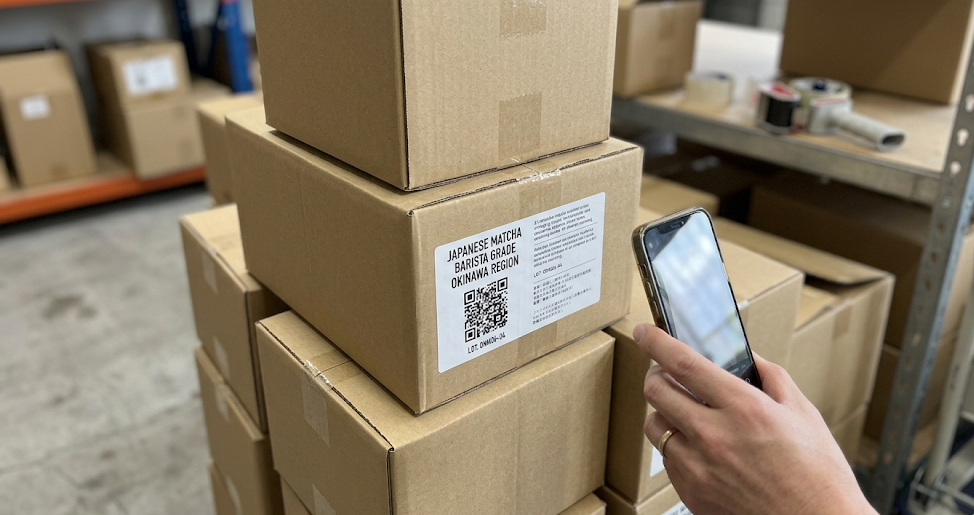
Each lot ships with a QR-linked certificate page covering origin region, harvest period, processor or farm partner, grade and use case, lab test summary, best-by date, storage instructions, recommended grams per drink, and a cost-per-drink calculator. The verification layer matters because the category is now full of confusion. The first portal can be a clean Webflow or Shopify-backed lot page with Airtable as the source of truth. Credibility comes from real supply, real documentation, and consistent delivery. The website message stays brutally simple: Verified Japanese matcha for cafés. Stable supply, traceable lots, lab-backed quality.
MVP scope
Don't start with a marketplace. Don't start with AI grading. Don't start with ten origins and a beautiful tea education library. Start with 20 cafés.
The MVP includes seven things:
Unlock the Vault.
Join founders who spot opportunities ahead of the crowd. Actionable insights. Zero fluff.
“Intelligent, bold, minus the pretense.”
“Like discovering the cheat codes of the startup world.”
“SH is off-Broadway for founders — weird, sharp, and ahead of the curve.”


