


The Employee Creator Agency: Turn Payroll Into a Distribution Channel
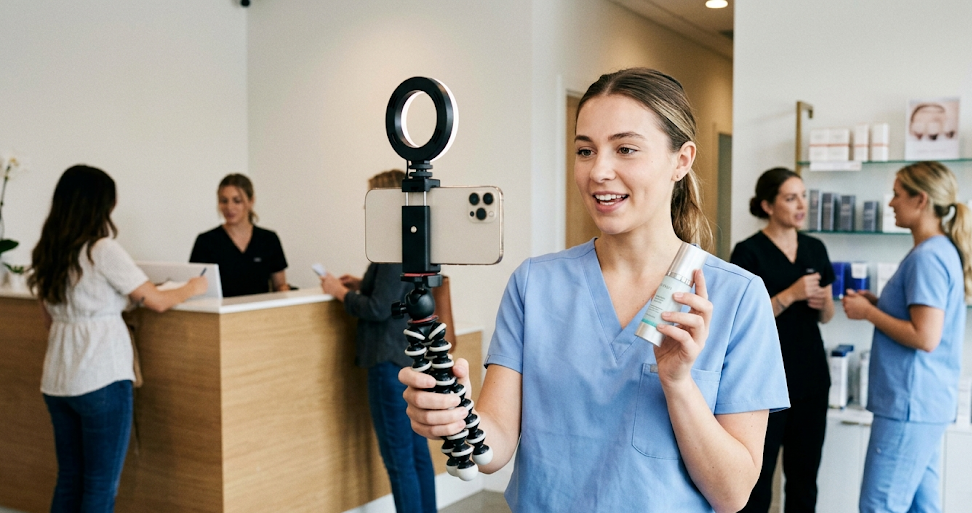
The best short-form creator a regional business could hire is already on the schedule next Tuesday. They're clocking in at the front desk, the treatment room, the squat rack, the color station, the stockroom. They know the customer's first three objections, the joke that closes the sale, and the question every walk-in asks. They know which product gets returned because customers buy the wrong size. They're surrounded by content. They're paid hourly. Nobody treats them as a marketing channel.
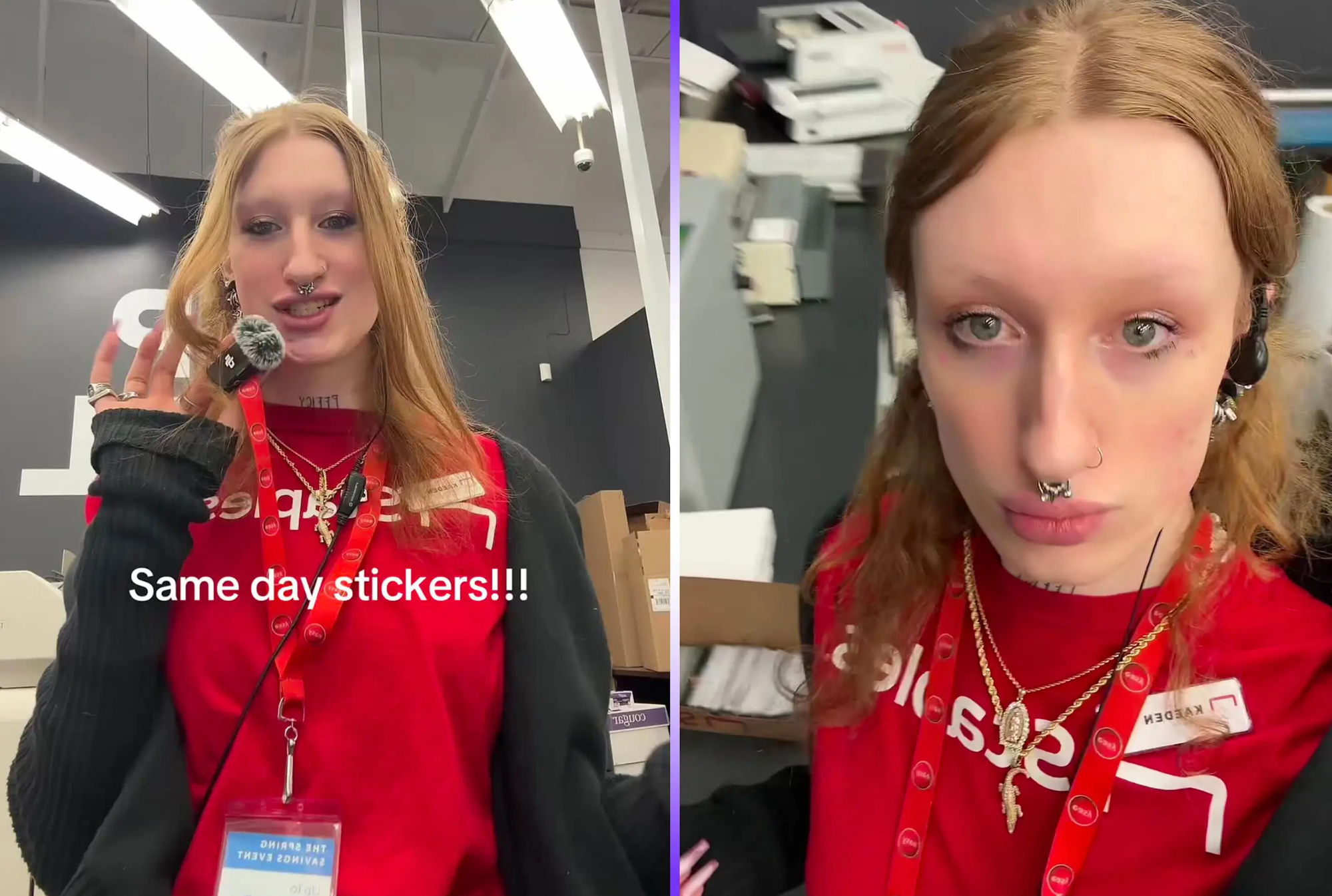
A specialized agency can close that gap by turning regional retailers, gyms, med-spas, salons, and wellness chains into employee creator factories. Not a TikTok management shop. A program builder that recruits the right staff, trains them, hands them prompts, sets up tracking through existing affiliate infrastructure, and pays them when their content moves the business forward.
The enterprise version of employee-generated content is already validated. The version for a 12-location med-spa group, a regional gym chain, or a 30-store specialty retailer doesn't exist yet. Those businesses can't buy a Fortune 100 platform. They can pay $3,000 to $7,500 to launch a program and $1,500 to $4,000 a month to keep it alive. Whoever productizes that price point owns a category nobody is naming.
Here's the shape of the play.
The money: 10 retainer clients at $3K/month equals $30K MRR for one founder. First three pilots close inside 90 days at a $2,500 to $5,000 launch fee.
Inside:
• Three-tier offer stack with pricing
• 30-day MVP sprint, week by week
• Compliance moat and FTC playbook
• 90-day founder launch plan
Why short-form rewired the local marketing stack
The old local stack was four channels: Google reviews, local SEO, paid search, and Meta ads. A polished brand video on Instagram was the upgrade.
The new stack runs through algorithmic discovery. Customers don't search "best med spa near me." They watch a nurse explain filler migration in 45 seconds and follow her. They don't search "gym membership discount." They watch a trainer narrate why their shoulder hurts during bench press. They don't search "best running shoes." They watch a store associate compare three pairs in the aisle.
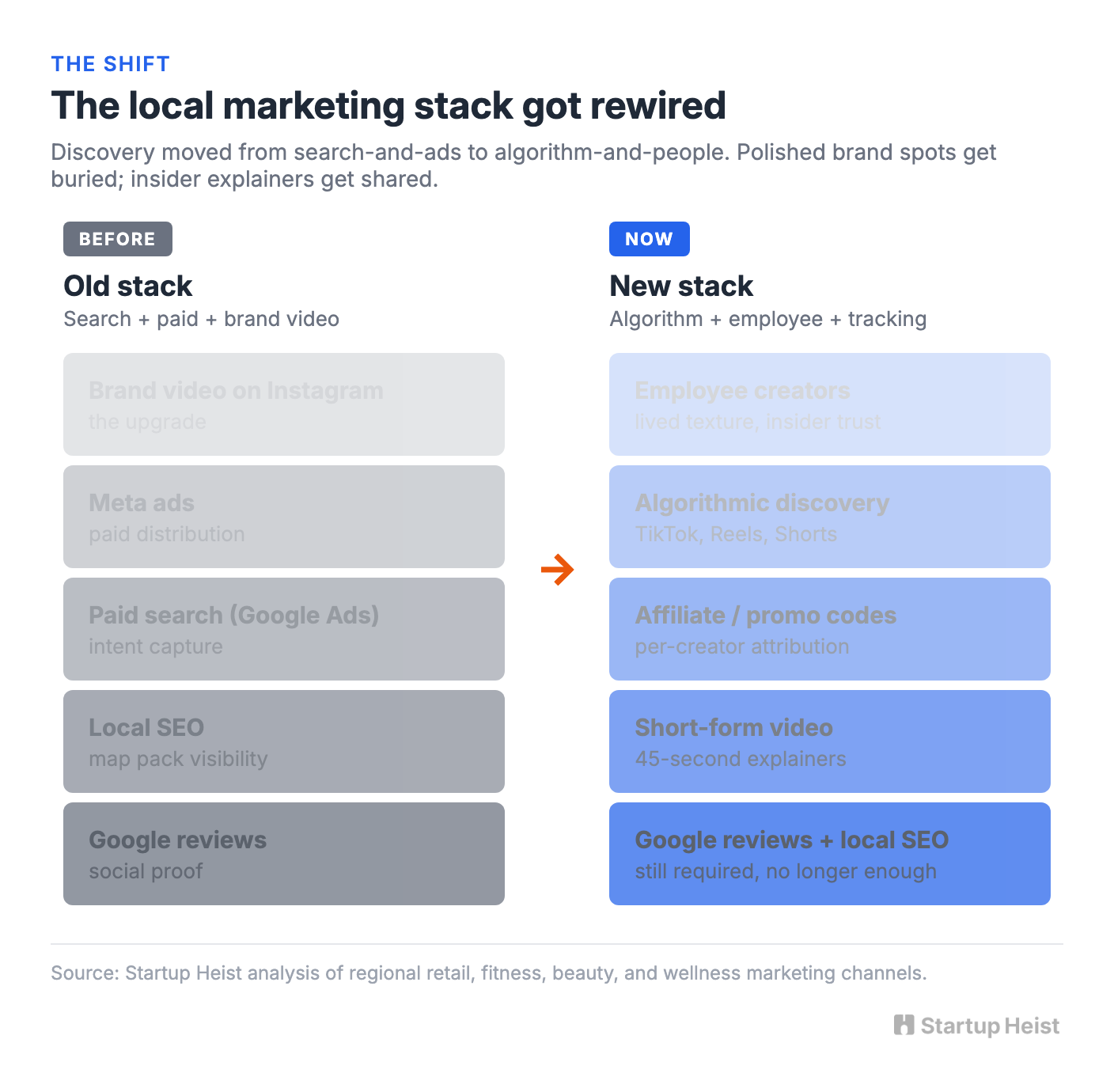
The agency has a videographer. The owner has opinions. The marketing manager has a calendar. The employee has the lived texture, and the platform rewards lived texture. A polished brand spot saying "visit our med spa for glowing skin" gets buried. A nurse saying "three things I wish every first-time Botox client knew" gets shared in DMs.
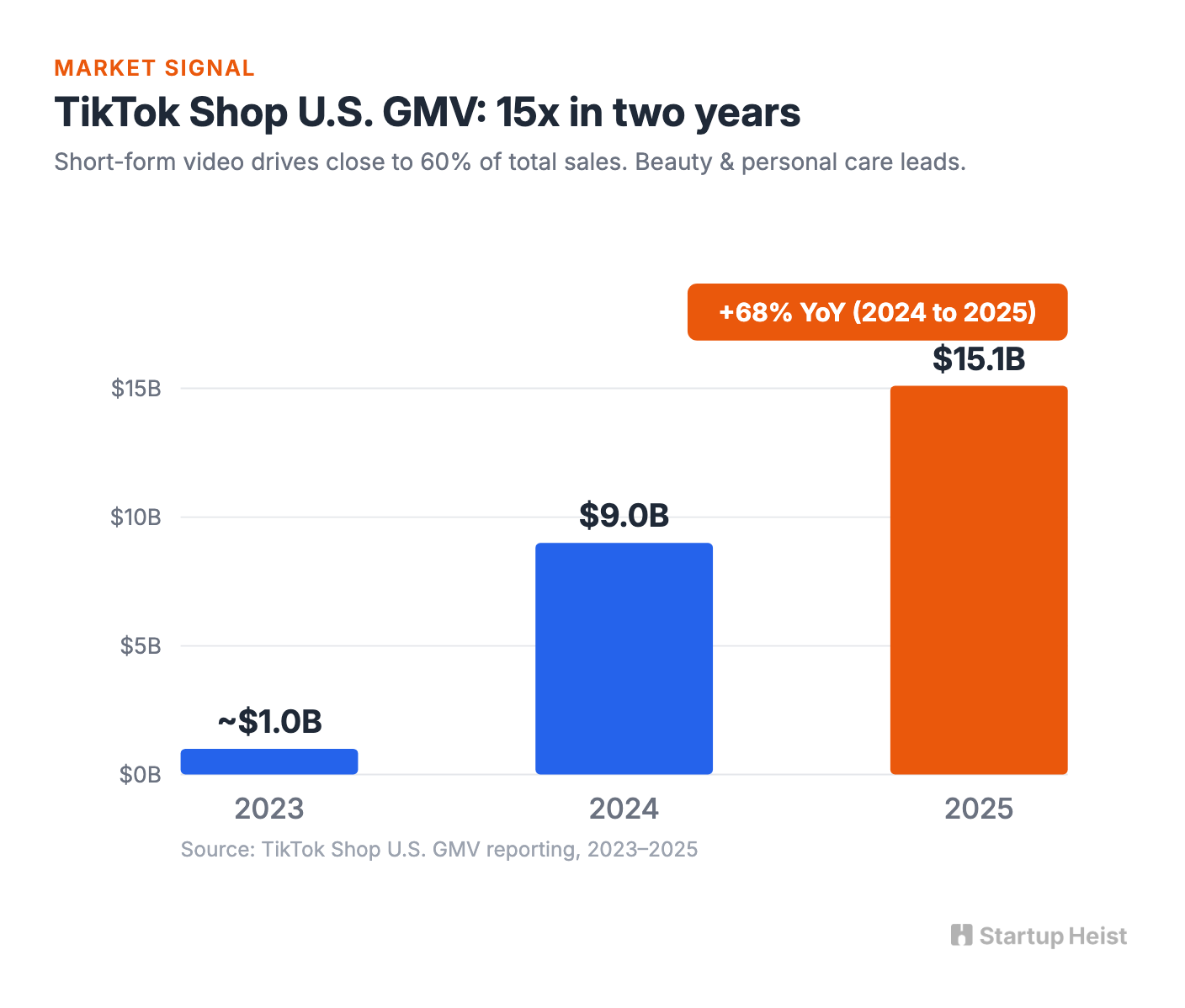
The numbers settle the argument. TikTok Shop's U.S. GMV reached roughly $15.1 billion in 2025, growing 68% year over year, with beauty and personal care the largest category and short-form video driving close to 60% of total sales. Industry coverage of employee-generated content cites engagement running roughly eight times higher than branded posts. Insider voices outperform corporate ones, and the platforms have built their algorithms around that fact. The local version of that behavior is the employee.
The strongest verticals share four traits: multi-location, consumer-facing, visually demonstrable, and high enough LTV to absorb a $2,500-plus monthly retainer. Four fit cleanly:
Med-spas and aesthetic clinics. The sharpest first wedge. Staff already educate. The product is visual. The buyer carries fear, curiosity, and social proof needs. A single booked treatment is worth hundreds to thousands of dollars. TikTok marketing for med spas is already moving inventory; the compliance burden is the moat, not the obstacle.
Gyms, boutique fitness studios, and wellness chains. Trainers are natural creators. They teach for a living. They build parasocial trust with members in person. The content writes itself: form fixes, beginner mistakes, trainer POVs, member transformations, "what I wish new members knew." The revenue events are clean: trial signups, memberships, personal training, class packs.

Salons, beauty retailers, and cosmetics chains. Stylists, colorists, estheticians, and retail associates already shape purchase decisions in the chair and at the counter. Content drives both product sales and appointment bookings, doubling the monetization surface.
Specialty retail. Running stores, bike shops, baby stores, pet stores, outdoor gear, specialty food. Staff carry deep product knowledge and serve loyal repeat customers. The play is converting expertise into searchable explainer content. "Three mistakes new runners make when buying shoes" is sales enablement disguised as useful video.
A 10-location med-spa might have 80 employees. The agency picks 8 to 12 who are comfortable on camera or strong at explaining things, runs a half-day workshop, ships a vertical prompt library, writes the disclosure language, installs affiliate or referral software with per-creator codes, builds a simple dashboard, and runs a 30-day sprint that reports output, reach, leads, bookings, and tracked revenue.
The pitch lands sharper than "we'll make TikToks for you." It sounds closer to: "Your employees are already the most credible people in your business. We turn them into a managed creator bench and pay them when they drive sales." Generic agencies sell content. The employee creator agency sells an internal capability the client keeps.
Why agencies have missed this
Most local agencies are external production shops. They plan, they shoot, they edit, they post, the client approves. The model has a ceiling because the content source sits outside the building.
Local business creator marketing reverses the flow. The agency stops being the camera crew and becomes the system designer: recruitment, training, governance, incentives, attribution, reporting. Less glamorous. More defensible.
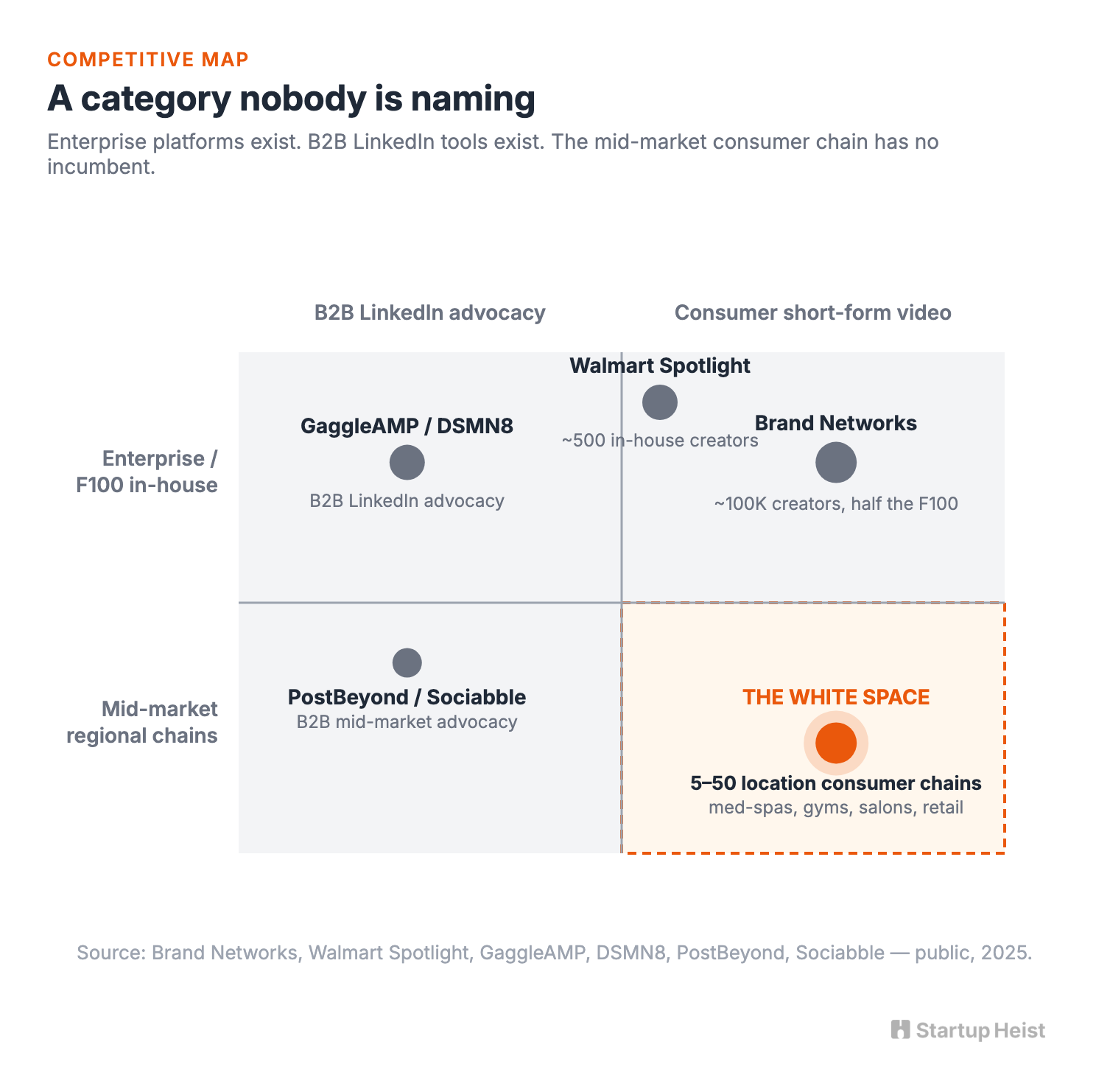
The proof at the top of the market makes the gap obvious. Brand Networks runs the dominant employee creator platform, claiming 100,000 active creators across roughly half the Fortune 100. Walmart's Spotlight program runs the brand-side version, enrolling about 500 salaried employees as in-house influencers and signaling intent to extend it across its 1.5 million U.S. workforce. Even Walmart hasn't publicly cracked mass rollout past that initial 500. Both prove brands are willing to bet headcount on this. Neither serves the 12-location chain that needs a training day, a prompt library, a legal-safe posting policy, attribution links, a manager dashboard, and someone to keep the program alive past week three.
The plumbing is sitting on the shelf. GoAffPro starts free, with a premium tier at $49 a month. Refersion, Social Snowball, UpPromote, and Rewardful sit in adjacent price bands. None of them deliver the human system around the software, which is the entire job. The agency rebundles tools that already exist and sells the missing layer: implementation. Affiliate software handles links, codes, and payouts. The agency handles the people. The people are where the money is.
Adjacent software companies are circling. GaggleAMP, DSMN8, PostBeyond, and Sociabble are all built for B2B LinkedIn advocacy, not short-form video for a regional med-spa group. The mid-market employee creator program for consumer chains has no name and no incumbent. That's the white space.
What the business actually sells
Three offers, stacked:
Unlock the Vault.
Join founders who spot opportunities ahead of the crowd. Actionable insights. Zero fluff.
“Intelligent, bold, minus the pretense.”
“Like discovering the cheat codes of the startup world.”
“SH is off-Broadway for founders — weird, sharp, and ahead of the curve.”


