


The Retreat Host Back Office
The easiest way to misunderstand the "reading retreat" trend is to treat it like a book trend. It is something bigger. Internet communities are turning into paid, hosted, offline trips. Book clubs, writing circles, knitting groups, sober-curious communities, women's wellness collectives, creator audiences, and niche fandoms are all discovering the same business model. A weekend away with 30 to 80 people becomes a serious income stream.

The audience sees the romantic version: cabins, paperbacks, fireside conversations, yoga mats, tote bags, shared meals, and soft socializing without the nightclub energy. The host sees a 14-tab spreadsheet with conditional formatting and a roommate request that just changed for the third time.
That spreadsheet is the opportunity.
Here's the play in a single frame:
The money: 300 hosts at $99 per month is roughly $30K MRR. Concierge onboarding adds $499 a pop. Reading retreats already price between $749 and several thousand per guest.
Inside:
• 6-week MVP scope and stack
• 3-tier pricing plus concierge setup
• Cold email + first 30 customers playbook
• The workflow-memory moat
The Cultural Signal Is Real, the Business Signal Is Realer
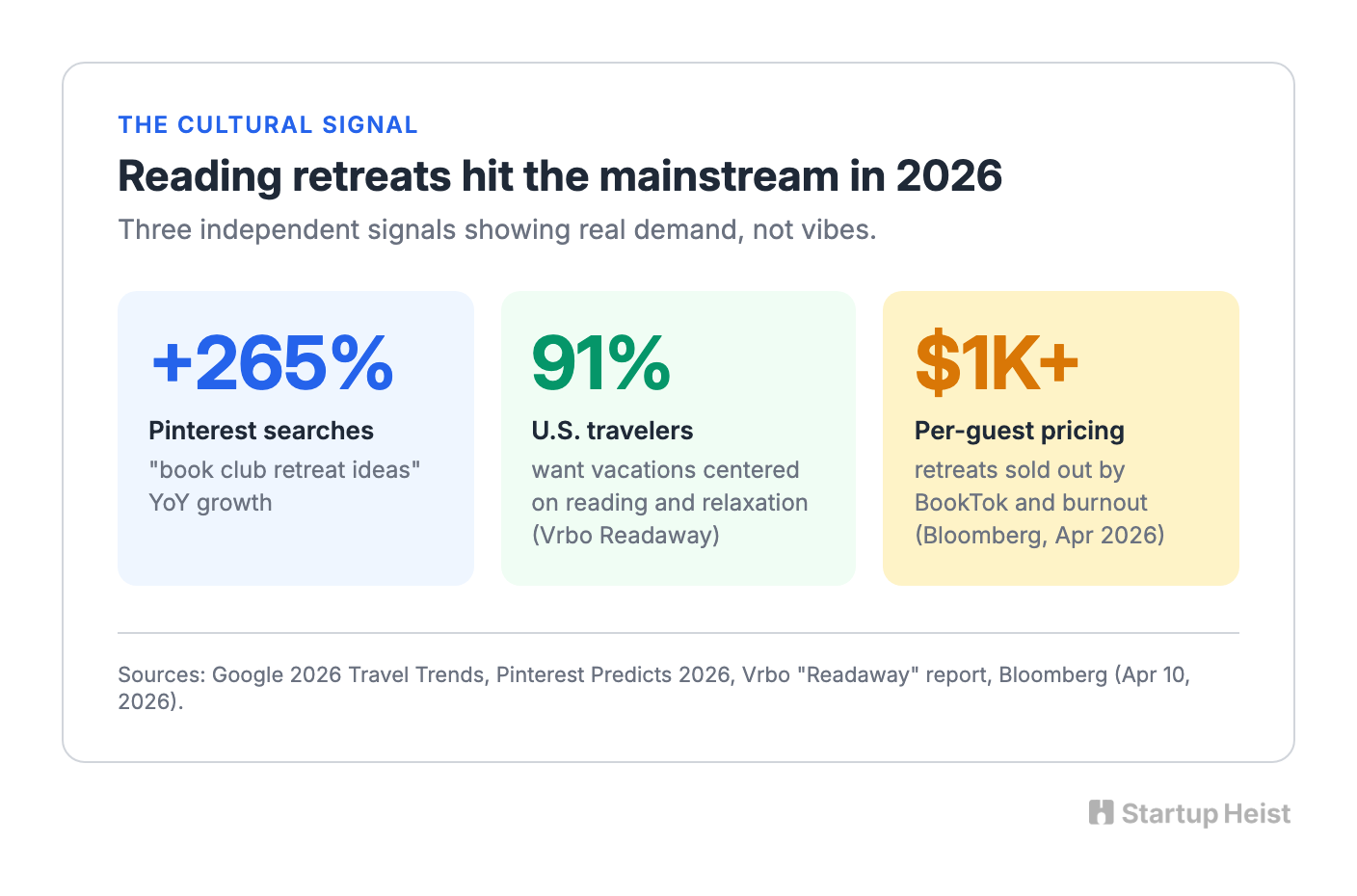
Reading retreats are the visible wedge. In 2026, "reading weekend" landed on Google's top travel trends list and Pinterest searches for "book club retreat ideas" jumped 265 percent. Vrbo's "Readaway" report claimed 91 percent of travelers want vacations centered on reading and relaxation. Bloomberg covered the shift in an April 10, 2026 feature on $1,000 reading retreats sold out by BookTok and burnout.
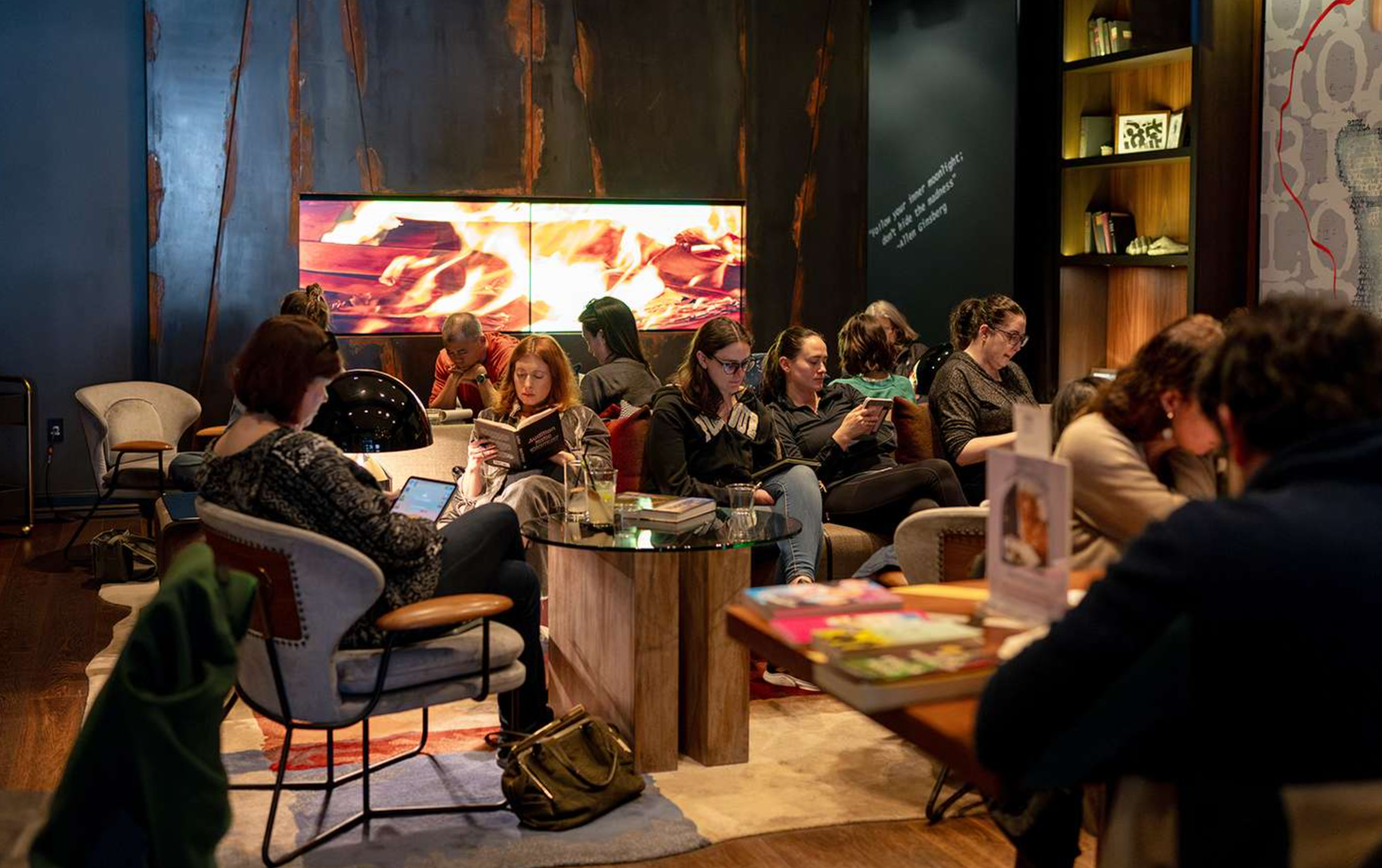
The operator side already has scale. Silent Book Club runs about 2,000 chapters across 60-plus countries with more than a million members, and its 2026 retreats in Italy and Iceland drew demand strong enough to launch sold-out early-access tiers within days of opening. Reading Rhythms hosts reading parties in 30-plus cities and partnered with the New York Public Library on an after-hours winter takeover. Smaller operators show the same heat: Forest & Fawn is running themed Catskills weekends like a November 2026 ACOTAR retreat at Callicoon Hills, and Book Huddle has sold out 19 reading retreats since 2023, most within minutes of opening.
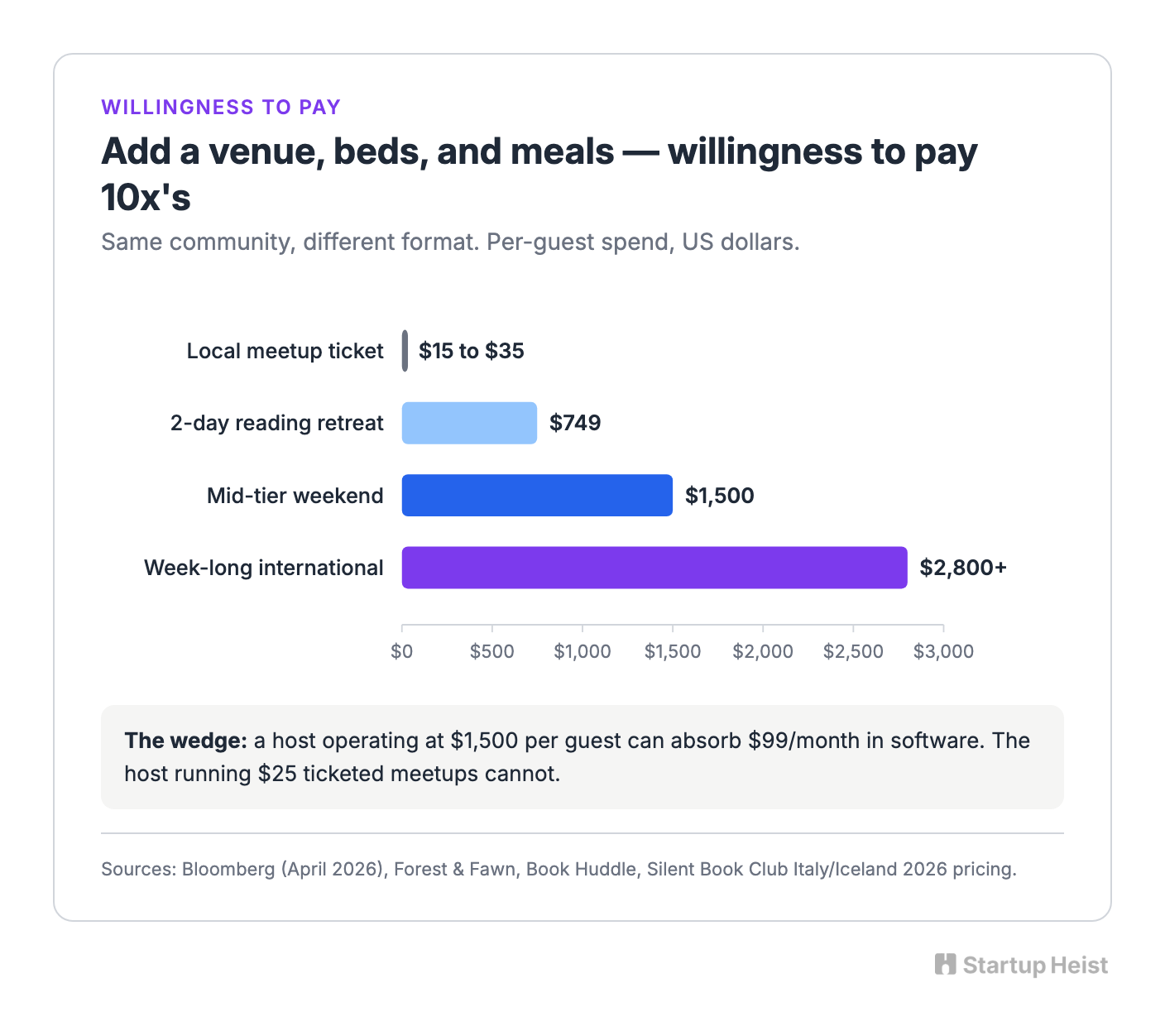
Standalone book retreats now price between $749 for a two-day and several thousand dollars for a week-long international trip. The reader behavior is the surface story. The operator behavior is the business hiding underneath.
The Market Is Community-Led Travel, Not Reading
A book retreat is operationally similar to a writing retreat. A writing retreat is operationally similar to a knitting retreat. A knitting retreat is operationally similar to a sober-curious wellness weekend. The content changes. The back office does not.
Every host runs the same operational stack: guest intake, payment plans, room assignments, dietary restrictions, allergies, waivers, photo releases, emergency contacts, arrival logistics, private-room upgrades, friend and couple rooming requests, packing lists, sponsor boxes, itinerary updates, last-minute cancellations, post-trip photo delivery, testimonials, and repeat-booking waitlists.
A local reading meetup might charge $15 to $35 per ticket. A retreat charges $900, $1,500, $2,800, or more. Willingness to pay multiplies tenfold the moment a venue, beds, and meals enter the equation. Reading retreats give the wedge a clean go-to-market: visible communities, premium pricing, fresh cultural timing, and operators graduating from monthly meetup organizer to small travel business owner. The durable business is Shopify-for-tiny-retreat-operators, and the host already knows she needs it.
Why the Existing Software Leaves a Gap
The travel and event software shelf is not empty. WeTravel runs an operating system for multi-day group travel: itineraries, payments, 24-installment payment plans, free with a 1 percent processing fee, used by more than 5,000 companies. TrovaTrip runs a three-sided marketplace pairing creators with vetted trip operators in 49 countries; hosts earn around $6,000 per trip and TrovaTrip takes a service fee plus 2.9 percent card fees, around 15 to 20 percent of trip revenue. Silent Book Club's Iceland 2026 trip is operated through TrovaTrip, which says something about who serves the upper end. Retreat Guru is the closest comparable at $110 per month plus 14 percent marketplace commission, with color-coded room maps and meal reports built for venues running their own programs.
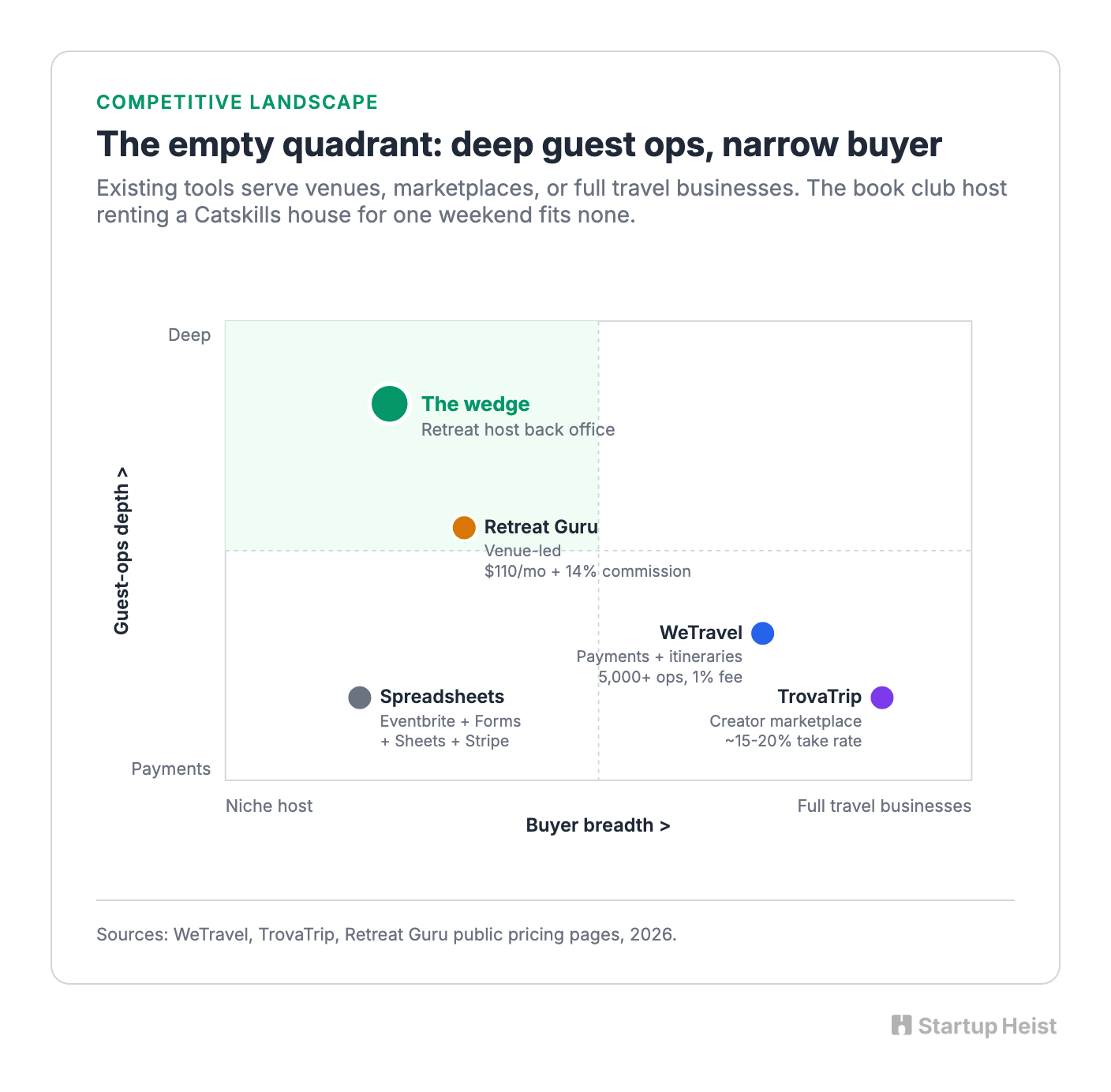
The pattern across these tools is the same. Each was built for venues, full travel businesses, or creator marketplaces. The book club host renting a 12-bedroom Catskills house for one weekend fits none of those buyer profiles. She uses Eventbrite, Squarespace, Forms, Stripe, Mailchimp, Airtable, and Sheets, and they break the moment she has to match dietary restrictions to meal plans, assign guests to shared rooms, track waiver completion, and keep every guest's preferences in one clean place. That is the wedge. Do not out-platform the platforms. Out-detail them on the painful workflow.
The Pain Is Rooming, Food, Waivers, and Last-Minute Changes
The founder should resist the urge to build a beautiful trip page first. Hosts already have landing pages. They use Instagram, Squarespace, Luma, Eventbrite, Tally, Typeform, Stripe, Sheets, and email. The pain is what happens after people say yes.
Picture the real workflow. A host sells 52 spots for a four-day reading retreat. Some guests want vegetarian meals. Some are gluten-free. Some have allergies. Some want a private room. Some want to room with a friend. Some are coming alone and open to sharing. Some are light sleepers. Some need accessible rooms. Some are arriving late. Some paid in full. Some are on payment plans. Some need airport pickup. Some have not signed the waiver. Some changed their email address. Some bought the retreat as a gift. The host now has to build an operational truth table by hand. That is exactly where the product should start.

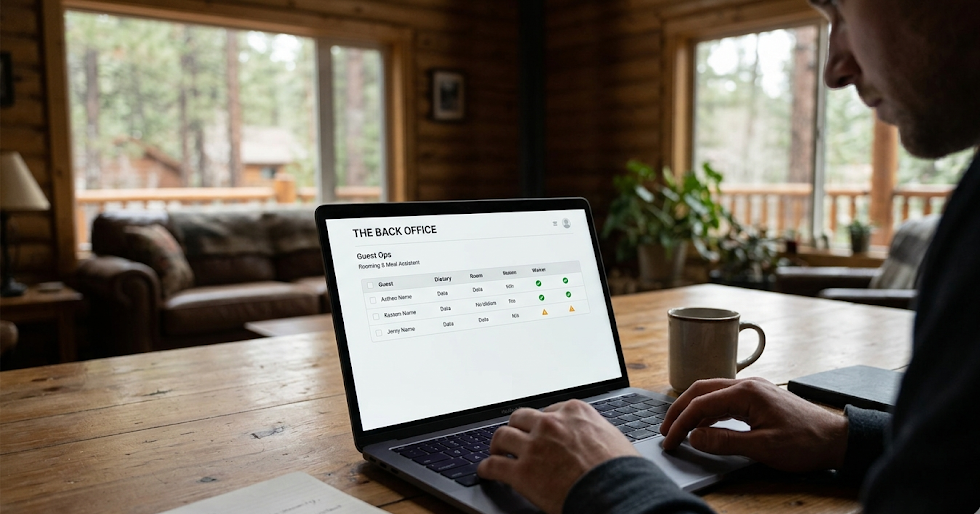
The MVP is a guest logistics cockpit with five core jobs. First, an intake builder for retreat-specific guest forms covering dietary needs, allergies, emergency contacts, roommate preferences, accessibility, arrivals, waivers, and add-ons. Second, a guest profile database where every attendee becomes a clean record, filterable by tag, payment status, room type, waiver status, arrival time, and notes. Third, a rooming and table assistant that suggests assignments based on private-room upgrades, friend requests, couples, gender preference, accessibility, and snoring or light-sleeping notes, rules-based, with manual override. Fourth, an ops dashboard that surfaces what is missing: unsigned waivers, unpaid balances, unconfirmed dietary info, missing emergency contacts, undisclosed arrival times, unassigned rooms. Fifth, segment exports so the host can email targeted slices: "everyone arriving Friday after 7 p.m.," "guests with unpaid balances," "vegetarians," "Cabin B," "anyone missing waivers."
Unglamorous software. That is why it works. The best micro-SaaS opportunities sit where the customer sees magic and the operator sees admin. Below the gate is the full playbook: MVP scope, pricing, the first 30 customers, the moat, and the 6-week build plan.
The Product Should Start Narrower Than "Retreat OS"
"Retreat OS" is a good brand promise and a dangerous MVP scope. Do not start with marketplace discovery, itinerary booking, hotel inventory, flights, supplier payments, creator monetization, travel insurance, native mobile apps, or community forums. The first product should feel like Airtable and Typeform had a baby designed specifically for retreat hosts. Build it:
Unlock the Vault.
Join founders who spot opportunities ahead of the crowd. Actionable insights. Zero fluff.
“Intelligent, bold, minus the pretense.”
“Like discovering the cheat codes of the startup world.”
“SH is off-Broadway for founders — weird, sharp, and ahead of the curve.”


