


Most small digital agencies don't lose government contracts because they're unqualified. They lose them because they never see them.
Somewhere on a county purchasing page, a town clerk uploads a PDF asking for a website redesign. A small city wants to digitize twenty years of paper meeting minutes. A school district needs a vendor portal so principals stop emailing W-9s back and forth. A township needs ADA remediation, online forms, GIS cleanup, a cybersecurity assessment, document scanning, or a new permitting workflow.
The contract isn't huge. It might be $12,000. It might be $38,000. It might be capped at $50,000 because the municipality doesn't want a heavyweight procurement process. That cap is the reason the opportunity is interesting in the first place.
Here's the opportunity:
The money: 300 agencies at $149/month is $44,700 MRR, plus $7,500/month in done-with-you proposal services. Pure SaaS path scales to $74K+ MRR.
Inside:
• 6-10 week MVP scope and source map
• Three-tier pricing plus services upsell
• Cold email + free digest GTM playbook
• Four moats that compound past scraping
Big government contractors aren't chasing these jobs. Enterprise procurement platforms weren't built for three-person web shops. The small agencies that could do the work are busy serving restaurants, dentists, nonprofits, and local businesses, and they don't have a business development team refreshing forty municipal websites every week.
So the wedge is simple. Build a niche micro-SaaS that finds small municipal and county RFPs, filters them for low-dollar digital services work, translates the requirements into plain English, and gives small agencies a ready-to-customize response kit. Not a giant procurement marketplace. A tiny, opinionated municipal RFP software for small shops that want public-sector work without becoming government contractors full-time.
The market is bigger than the incumbents make it look
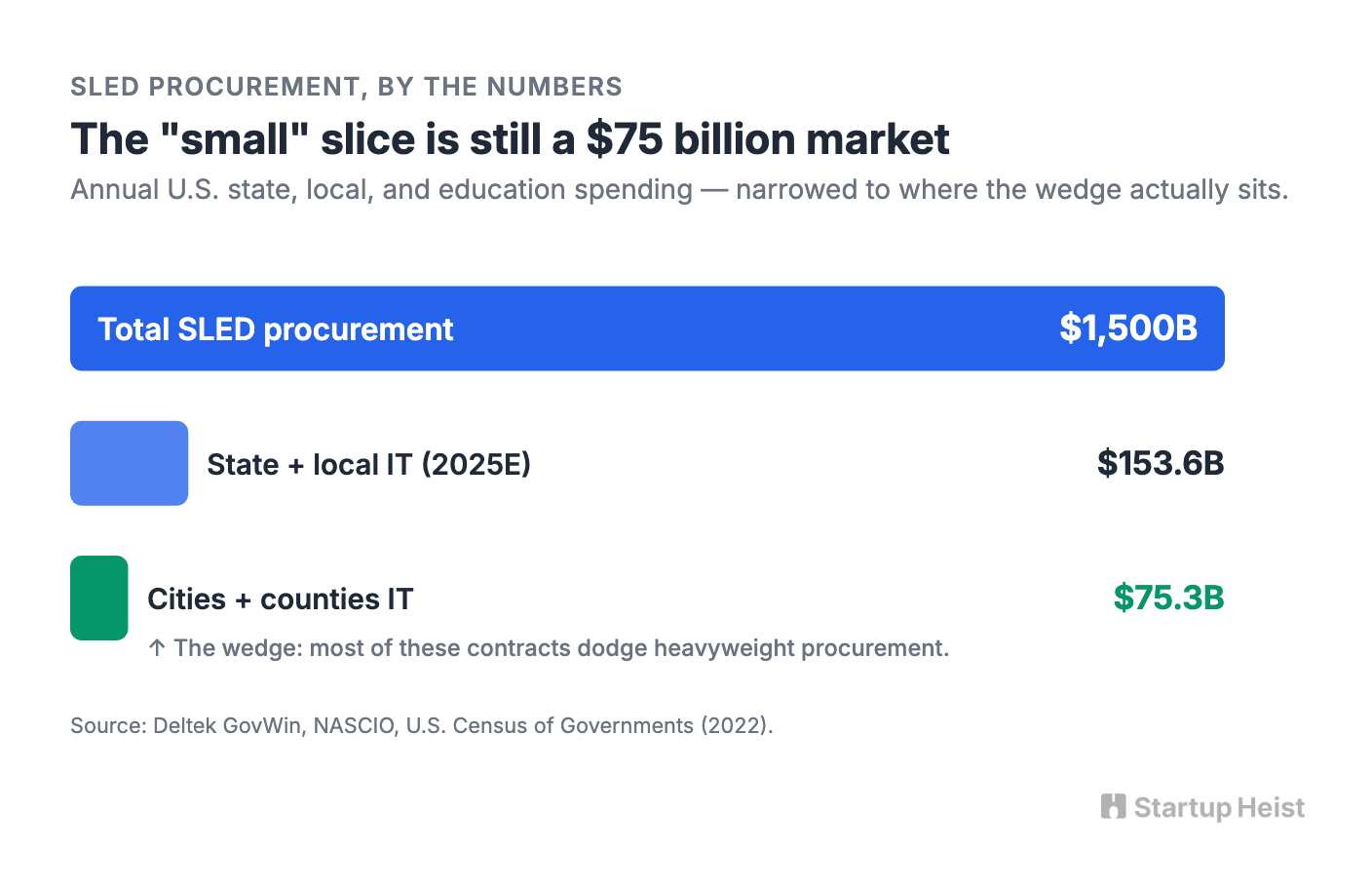
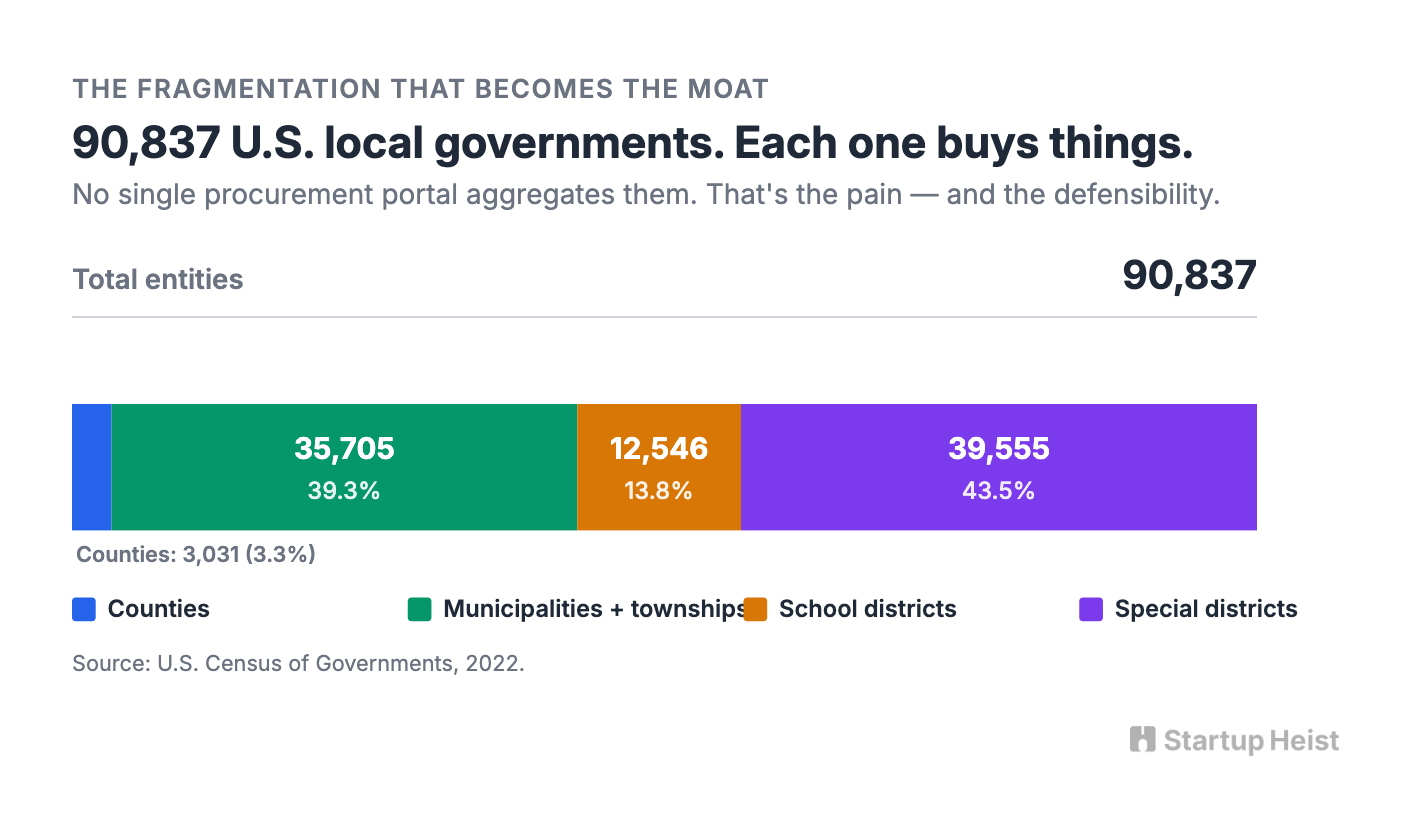
State, local, and education procurement — known as SLED — does roughly $1.5 trillion in annual spend. More than 100,000 purchasing entities issue more than 500,000 RFPs a year. State and local IT spending alone is projected to clear $153.6 billion in 2025, with about $75.3 billion of that coming from cities and counties. The 2022 Census of Governments counted 90,837 local governments in the United States: 3,031 counties, 35,705 municipalities and townships, 12,546 independent school districts, and 39,555 special districts. Each one buys things, and most of them buy small.
Serious SLED procurement intelligence vendors have already proven the demand. Deltek's GovWin IQ tracks federal, state, local, education, and Canadian opportunities and claims coverage of 95% of publicly reported government spending. Periscope S2G, formerly BidSync, pushes more than 100,000 government bid notifications a month. BidNet Direct aggregates state and local bids through purchasing groups. Ontopical mines council minutes and budgets across 20,000-plus municipalities to flag buying signals before an RFP ever hits a portal. The shape of the market is settled, and so is the gap underneath it.
When a market has serious incumbents at the high end, the opportunity is rarely to build the same thing cheaper. It's to serve a customer the incumbents structurally don't want.
The customer the big platforms don't serve
A two-person WordPress agency in Ohio doesn't need a capture intelligence platform. It doesn't need a six-month pre-RFP relationship strategy or a national SLED sales motion. It needs this:
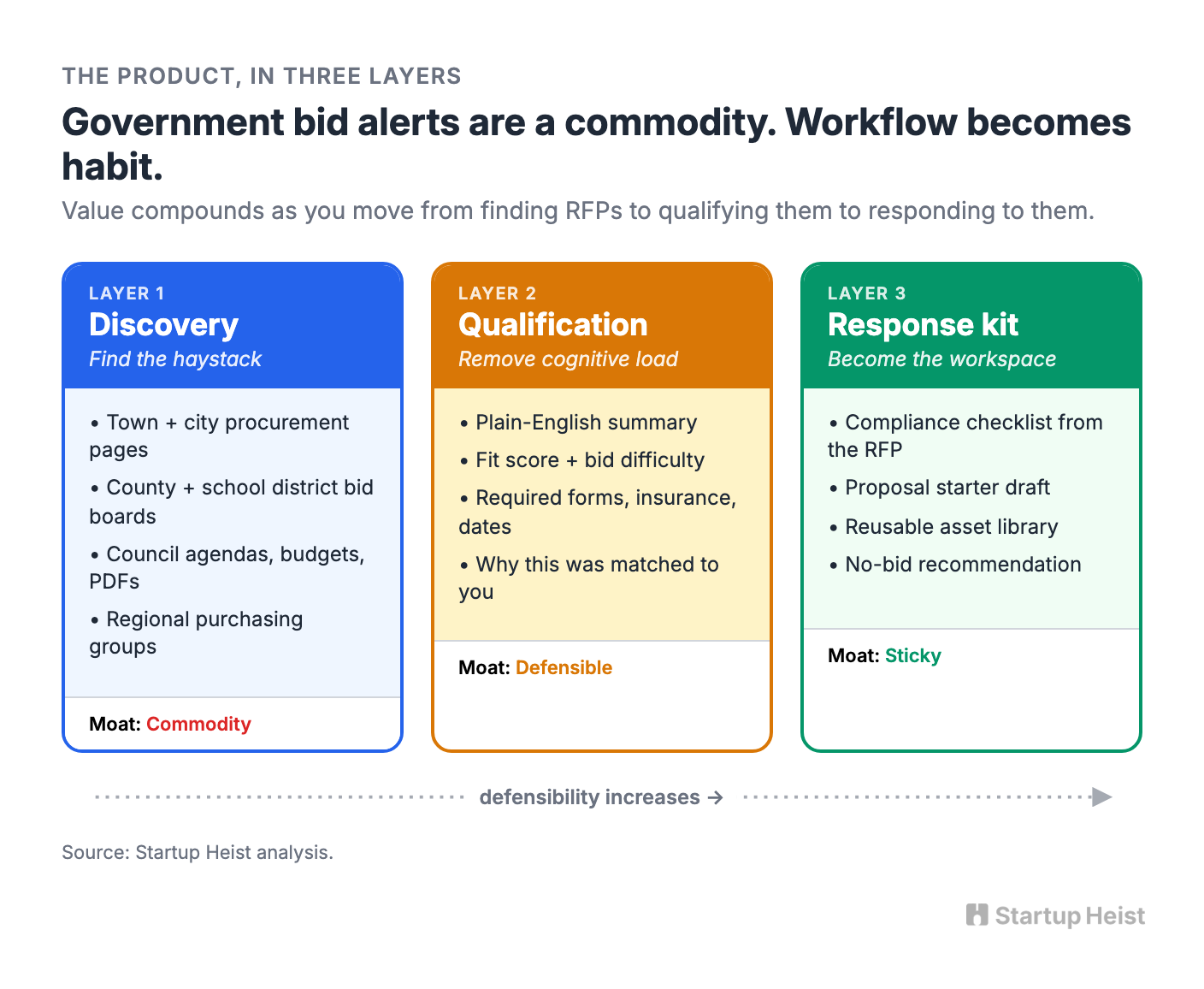
"Here are twelve local government RFPs this week within 200 miles of you, under $50,000, that match your services. Here's what they're asking for. Here's the deadline. Here's the required insurance. Here's whether you need a site visit. Here's a first-pass response outline. Here's the exact checklist so you don't get disqualified."
That's a sales assistant for agencies, sold in plain English. The wedge fits in one sentence: small public-sector digital services opportunities for small agencies. Municipal website redesigns. Records digitization. Online forms. Permitting workflow cleanup. ADA remediation. IT support. Cybersecurity assessments. GIS cleanup. Resident-service portals. Small data migrations. Meeting video archives. Public communications systems. Grant-funded modernization.
The customer isn't a Fortune 1000 government contractor. It's the local web shop, the small managed service provider, the civic-tech freelancer, the document-scanning vendor, or the digital transformation consultant who would happily bid on a $25,000 municipal project if discovery and response didn't feel like learning a foreign language. There are tens of thousands of them. Almost none of them have a procurement system.
Why the timing is unusually good
The pain existed long before large language models. What changes now is the labor economics of triage. Manually finding municipal procurement pages, downloading PDFs, reading dense legal language, deciding whether the opportunity is worth pursuing, building a checklist, and tracking a deadline across dozens of towns is too much work for a small agency. AI doesn't remove procurement complexity, but it makes the first 80% of that workflow cheap enough to package and sell.
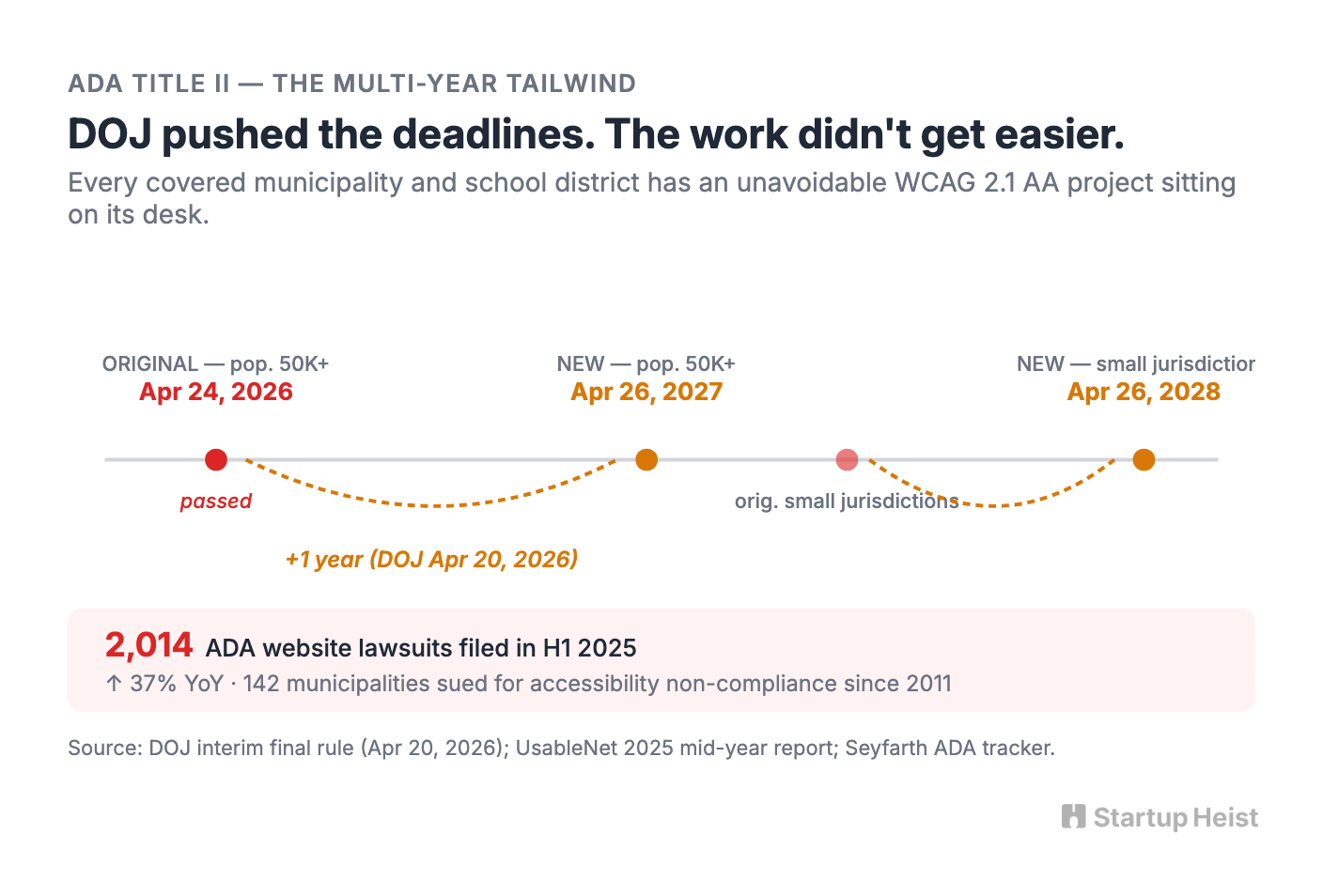
The second piece of timing pushes this from a good idea into a build-it-now situation: ADA Title II compliance. The Department of Justice's web accessibility rule was originally set to take effect on April 24, 2026 for state and local governments with populations of 50,000 or more, and April 26, 2027 for smaller jurisdictions. On April 20, 2026 — four days before the first deadline — DOJ issued an interim final rule pushing each date back by a year. Larger jurisdictions now have until April 26, 2027. Smaller ones have until April 26, 2028.
Read that carefully, because the easy take is wrong. DOJ's stated reason for the extension was that it "overestimated the capabilities" of covered entities to comply. Thousands of jurisdictions are not compliant. The extension exists because the work isn't being done, not because anyone decided it was less important. WCAG 2.1 AA is still the standard. 142 municipalities have been sued for accessibility non-compliance since 2011. The first half of 2025 produced 2,014 ADA website lawsuits, a 37% increase year over year — that figure skews private sector, but governments face their own enforcement track through DOJ complaints and consent decrees, and now they have an extra year of exposure on the clock without an extra year of staffing.
Every covered municipality and school district in the country has an unavoidable WCAG 2.1 AA project on its desk, and most won't be doing it themselves. That's a multi-year tailwind sitting under the entire wedge, and it's invisible to every incumbent procurement platform that treats accessibility as one tag among many.
The actual business
Unlock the Vault.
Join founders who spot opportunities ahead of the crowd. Actionable insights. Zero fluff.
“Intelligent, bold, minus the pretense.”
“Like discovering the cheat codes of the startup world.”
“SH is off-Broadway for founders — weird, sharp, and ahead of the curve.”


