


Kitchen Overload Is the New Restaurant Tech Problem
Independent restaurants did exactly what the platforms told them to do.
DoorDash. Uber Eats. Grubhub. First-party online ordering. QR ordering. Catering portals. Loyalty-driven mobile app orders. Each channel was sold as more revenue. Stack them all and a small shop has eight ways to make money it didn't have a decade ago.
In a lot of kitchens, that math went sideways.
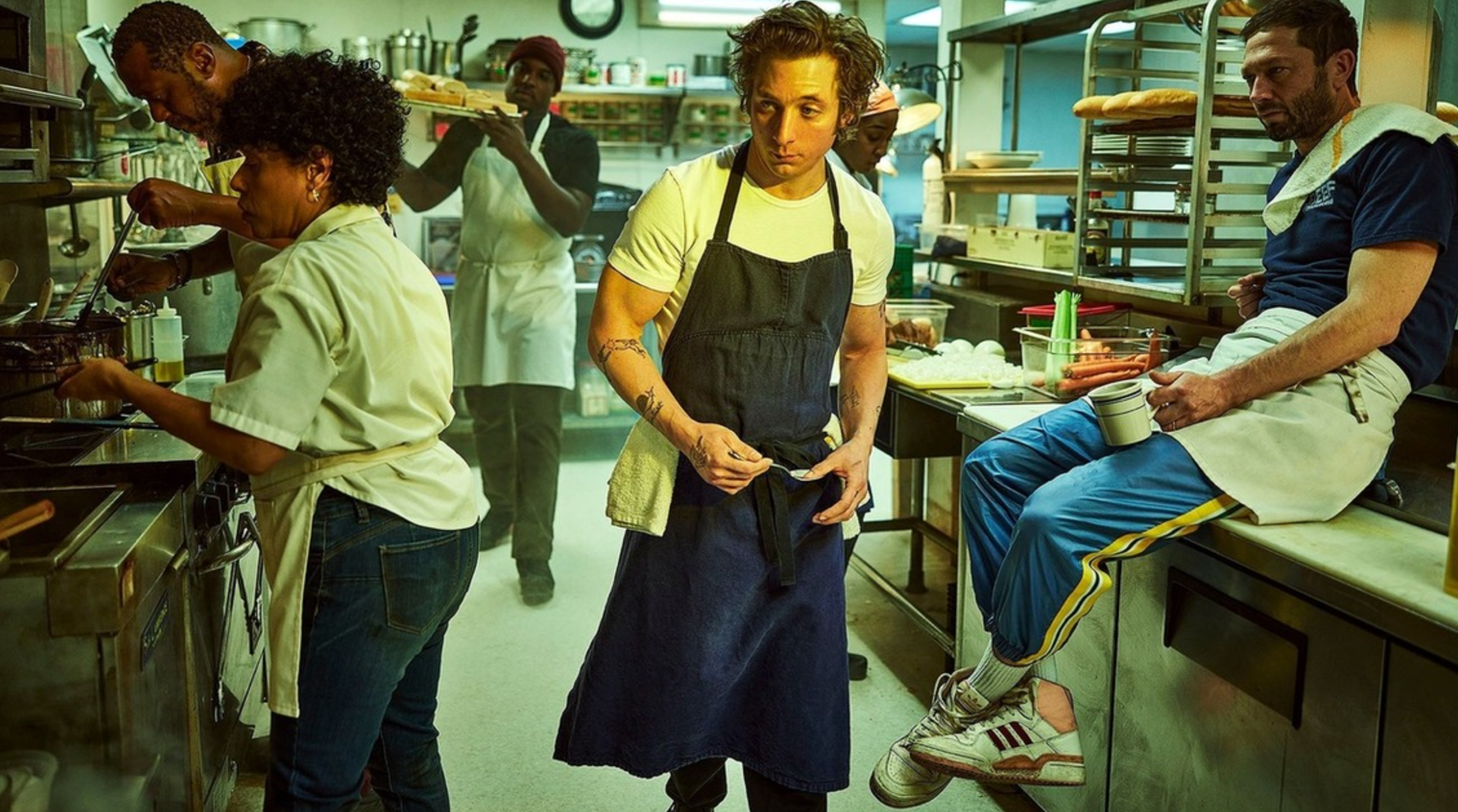
The front door admits one customer at a time. The dining room has visible limits. A line out the door tells everyone what's happening. Digital ordering has no natural brake. The tablet keeps ringing. The POS keeps printing. The driver keeps arriving. The customer sees a promised pickup time generated by software, not by the line cook standing next to the fryer.
Restaurant tech 1.0 was built around volume capture: get on the apps, connect the POS, automate the phone, harvest demand. That worked. It also created a second-order problem nobody priced in. Once every channel is wired up, the restaurant becomes trivially easy to overload.
The new question isn't how to capture more orders. It's how to stop good revenue from melting down the kitchen.
Here's the opportunity:
The money: 500 locations at an average $59/month is roughly $29,500 MRR. 2,000 locations is about $118,000 MRR. Vertical SaaS path to $1M–$3M ARR.
Inside:
• Three-mode MVP: Yellow, Red, Blackout
• Pricing tiers from $29 to $149/location
• Cold-email and in-person pitch scripts
• Four moats, three exit paths
The play is a lightweight kitchen overload control layer for independent restaurants. Not a new POS, not a new marketplace, not a full enterprise ordering platform. A simple control surface that lets small operators pause, throttle, reopen, and understand off-premise demand before service collapses.
The red-button version is emotionally perfect: the kitchen is in the weeds, the chef taps one big button, DoorDash and Uber Eats pause for 20 minutes, then automatically reopen. The actual business is subtler. Direct marketplace API access is uneven. Many controls live inside aggregators, POS systems, KDS tools, or enterprise ordering stacks. The better wedge isn't a single button to control every marketplace on day one. It's giving independent restaurants the operational control layer that enterprise chains are now building for themselves.
The Category Signal
The big restaurant tech vendors have a name for the shift: ordering orchestration. Some call it kitchen capacity management. Both terms describe the same move.
Tillster, which powers digital ordering for many large brands, is openly building toward capacity-aware throttling and intelligent routing that prioritizes manageable, higher-margin orders. Their 2026 outlook talks about extending ready times, capping item quantities, dynamically adjusting promise times based on store load, and temporarily pausing third-party channels when the kitchen is strained. Olo Dispatch frames its job as coordinating make-time logic across channels and providers. Lunchbox/Novadine sells order throttling directly as a product feature. Toast's quote-time strategy lets large operators tune how aggressive their promise times are by daypart.
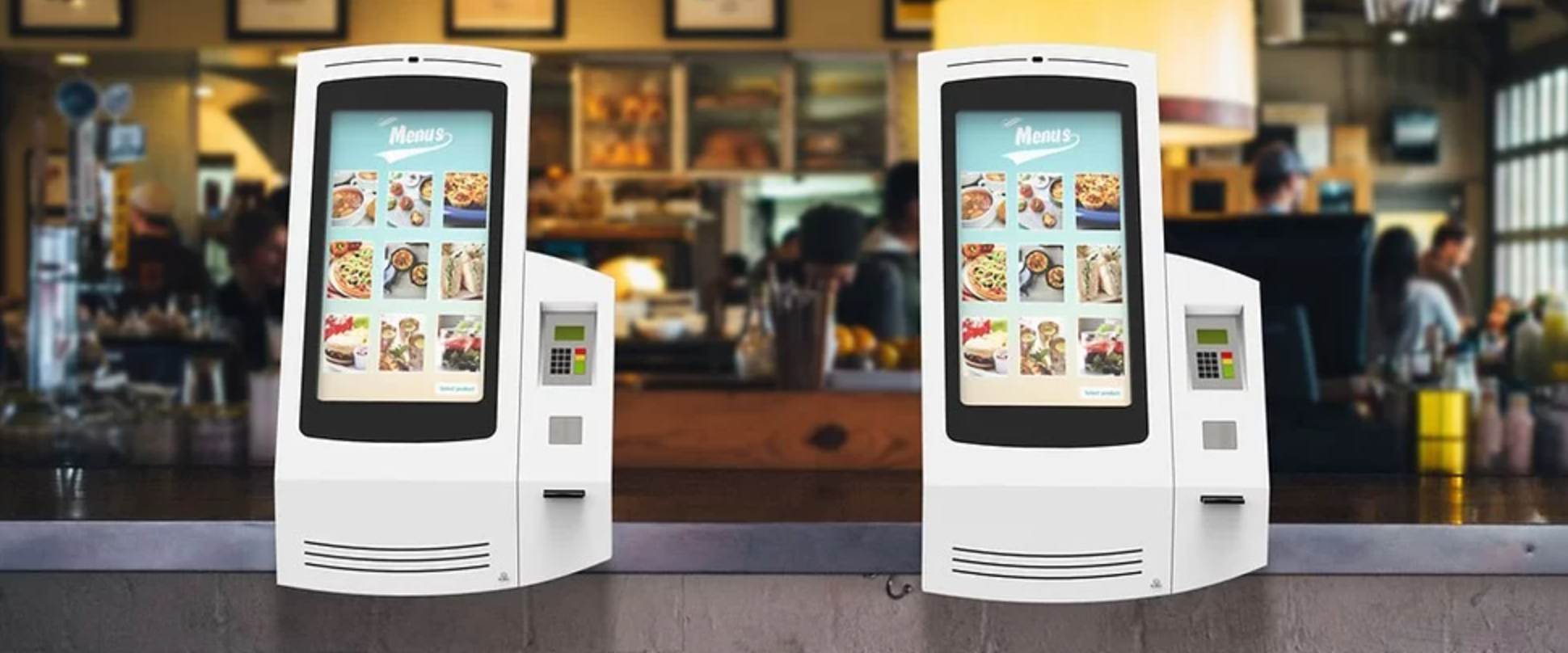
QSR Automations, a major kitchen-display vendor, breaks throttling into three concrete techniques: orders-in-progress limits, make-time minutes per period, and orders per window. Curbit goes further, selling AI-powered real-time kitchen capacity management that integrates with Olo and serves multi-unit operators like Lazy Dog. That's the real shape of the category. It already exists. It's already in market. It's mostly being sold to chains.
The independent restaurants that need it most don't have it.
The Old Promise Hit a Wall
A small pizza shop used to feel demand physically. The phone rang. People lined up. The cashier saw the room filling. The owner could yell, "Tell them forty minutes." The constraint was crude, but visible.
The same shop today receives simultaneous demand from dine-in, pickup, DoorDash, Uber Eats, Grubhub, website orders, and catering inquiries. Each channel acts like it's the only channel. Each app has its own settings, incentives, timers, promotions, and customer expectations. The kitchen doesn't care which app the order came from. It only knows there are eight burgers, six fries, three substitutions, two angry drivers, one missing ticket, and a staff member who just walked out to smoke.
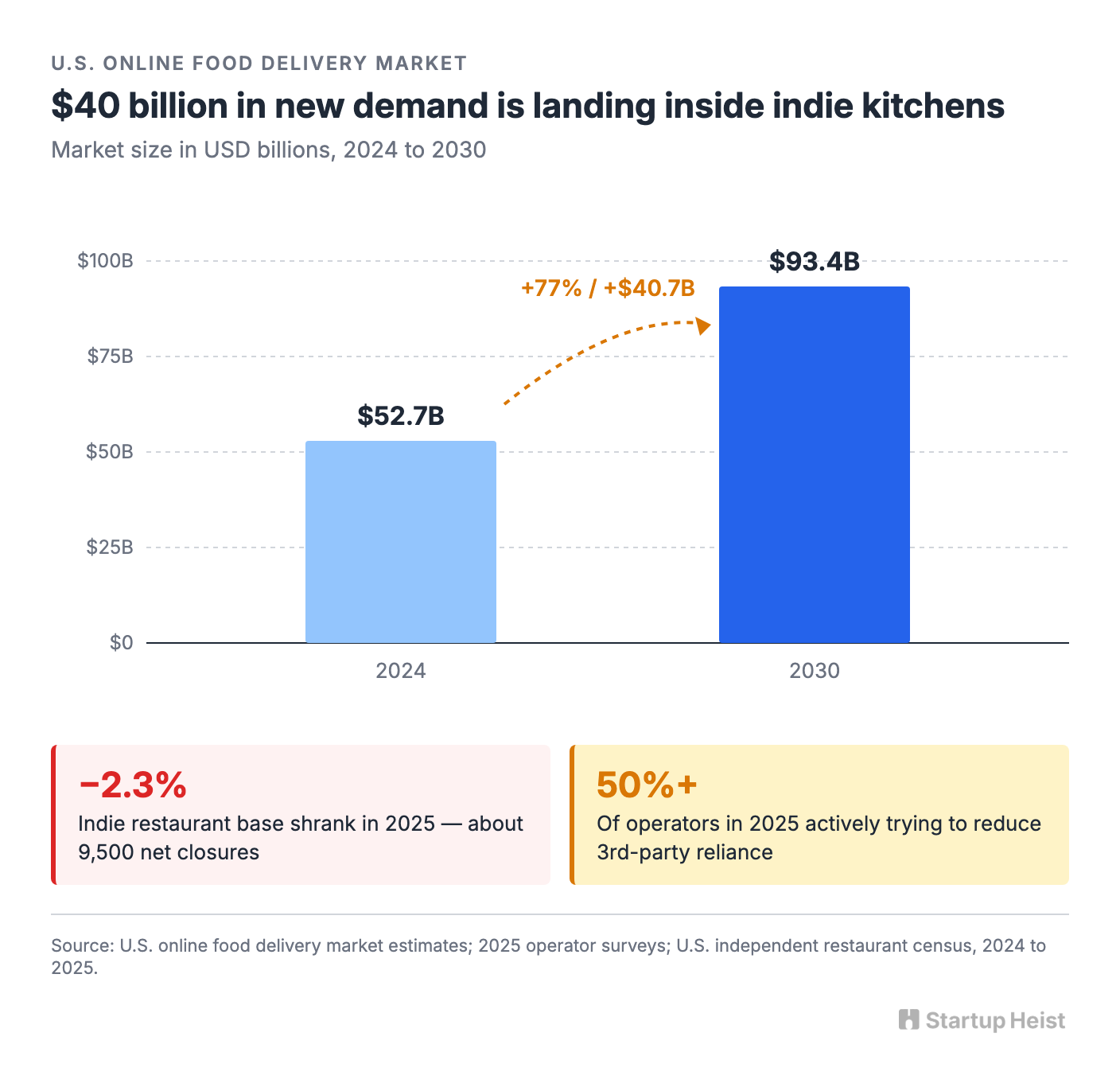
The U.S. online food delivery market generated about $52.7 billion in 2024 and is projected to reach $93.4 billion by 2030. That growth doesn't land evenly. It lands inside real kitchens. And it lands at the same time more than half of operators surveyed in 2025 said they're actively trying to reduce reliance on third-party delivery to protect margins. The independent restaurant sector itself contracted roughly 2.3% in 2025, a net loss of about 9,500 locations. The market is pushing more demand into systems that operators are already trying to throttle by hand, inside a shrinking base of indie kitchens.
The result is a narrow but painful software opportunity: capacity-aware off-premise control built specifically for small restaurants.
The Pain Is Operational, Not Abstract
This is a shift problem that lives on the line, not a dashboard problem to solve from upstairs.
A restaurant doesn't need another analytics screen telling them Friday night was busy. They lived through it. The pain points are concrete and they all happen in real time:
- An expo lead realizes the kitchen is 25 minutes behind, but nobody has time to log into DoorDash, Uber Eats, Grubhub, and the restaurant website.
- The staff turns off delivery during a rush, survives the rush, then forgets to turn it back on for two hours.
- A high-margin dine-in table waits because low-margin marketplace orders are flooding the line.
- A customer receives a cold order because the software promised a pickup time the kitchen could not meet.
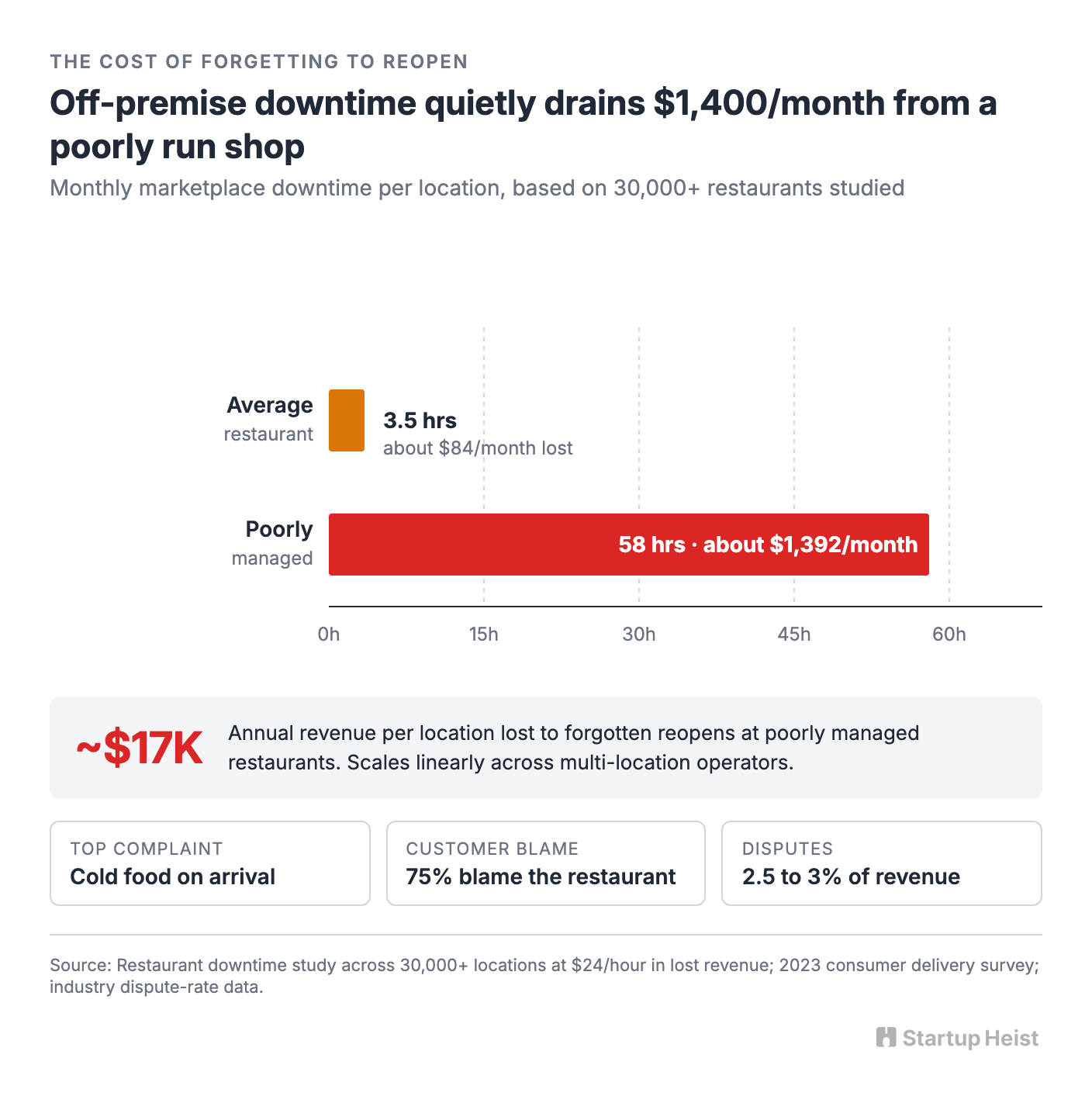
The financial bleed is real. Multiple consumer surveys find temperature complaints among the top delivery grievances — one 2023 study found 75% of customers blame both the restaurant and the delivery provider when food arrives at the wrong temperature. For restaurants with high dispute rates, industry data shows 2.5% to 3% of total revenue can be tied up in delivery disputes, a meaningful share of already thin delivery margins. Restaurant downtime data from over 30,000 locations shows the average restaurant is offline 3.5 hours per month at $24 per hour in lost revenue. Poorly managed restaurants average 58 hours of monthly downtime, or about $1,392 per month and roughly $17,000 per year in lost sales per location.
The restaurant doesn't need more order management. It needs load management.
Order management says, "Here are all your orders."
Load management says, "You are about to break. Change the flow now."
The behavior already exists in pieces. DoorDash's Order Manager lets merchants pause and reactivate the store. Uber Eats has a manual Busy Mode that adds prep-time padding, and the platform automatically pauses incoming orders when the kitchen falls behind. Lightspeed's restaurant support materials describe pausing incoming orders when staff can't keep up. The gap is workflow. For an independent restaurant, controls are fragmented across devices, logins, platforms, and staff permissions. A feature buried in three different merchant portals isn't the same as an operational control surface placed next to the expo line.
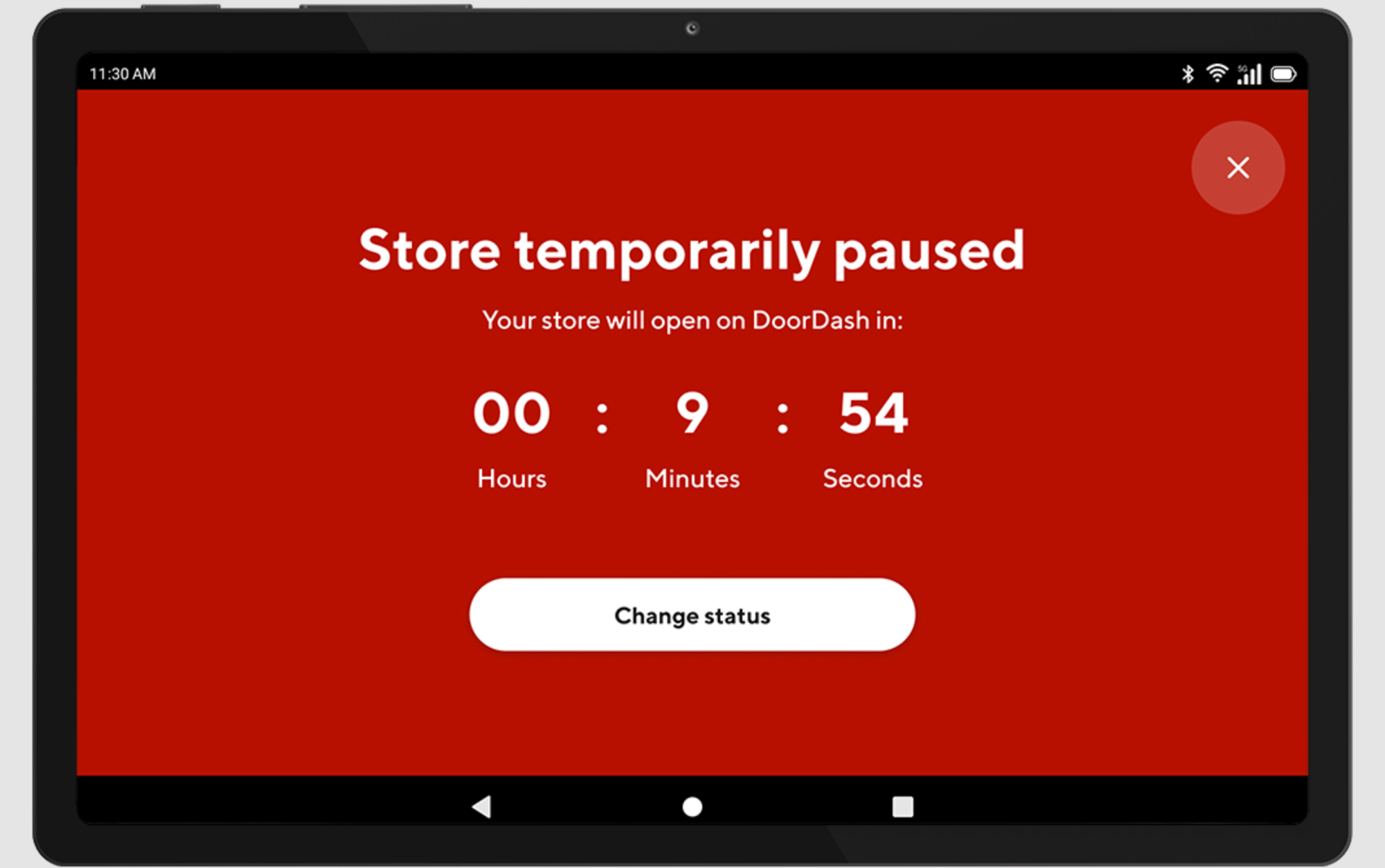
DoorDash's algorithm-driven auto-pause from driver-wait reports adds another wrinkle: the platform can quietly pull a restaurant offline based on signals the operator never sees. That's its own form of pain, and it strengthens the case for proactive, operator-controlled pausing rather than reactive, platform-controlled pausing.
Becoming that control surface — third-party delivery management owned by the kitchen, not by the marketplaces — is the play.
The Product: A Kitchen Overload Control Layer
Call it RushGuard, ExpoShield, Kitchen Brake, Off-Premise Control Desk. The name matters less than the promise:
When the kitchen is overloaded, one screen tells the team what to do — and restores normal operations automatically.
The first version shouldn't pretend to be magic. It should support three modes.
Mode 1: Manual Panic Mode
This is the wedge.
The restaurant defines a few overload presets:
Unlock the Vault.
Join founders who spot opportunities ahead of the crowd. Actionable insights. Zero fluff.
“Intelligent, bold, minus the pretense.”
“Like discovering the cheat codes of the startup world.”
“SH is off-Broadway for founders — weird, sharp, and ahead of the curve.”


