


Store Brands Are Eating the Middle. Sell Shovels to the Factories.
Private label used to mean the sad generic cereal on the bottom shelf. Now it's the growth engine of American retail, and the companies that actually manufacture it are prospecting like it's 1998.
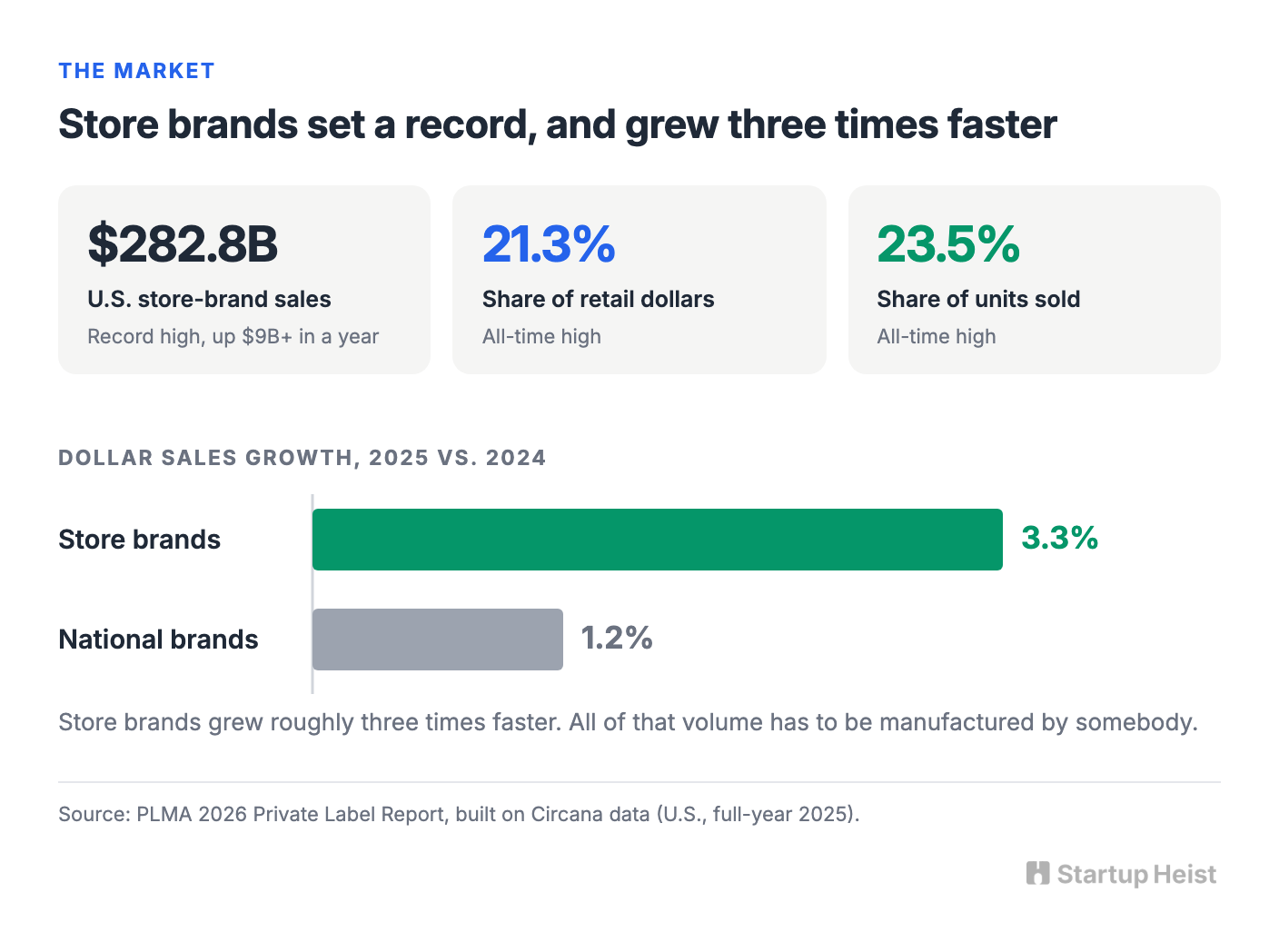
U.S. store-brand sales hit a record $282.8 billion in 2025, up more than $9 billion in a year, according to PLMA's 2026 Private Label Report built on Circana data. Store-brand dollar sales grew 3.3% against 1.2% for national brands, roughly triple the rate. Store brands now hold 21.3% of retail dollars and 23.5% of units, both all-time highs.
This stopped being a trade-down story a while ago. Deloitte's 2026 Global Consumer Products Industry Outlook surveyed 300 senior executives and found 79% expect power to shift further toward retailers over the next two to three years, driven by retailer scale, consumer data, and private-label growth. The squeeze on national brands is the part that gets written about. The more interesting question sits one level upstream: somebody has to actually manufacture all of it.
Here's the opportunity:
The money: Ten factory clients at $2,000 a month is $20K MRR, run by a founder and one analyst. A hundred is $2.4 million ARR.
Inside:
• The $1,500-$3,000 pilot dossier, spec'd
• Three-tier pricing from watchlist to agency
• The two traps that kill this business
• Why outcome data is the only real moat
Retailers are pouring capital into it. In March 2025, Target laid out a plan to add roughly 600 new food and beverage products across Good & Gather and Favorite Day as part of a $15 billion growth push through 2030. Walmart's bettergoods launch was its largest private-brand food rollout in two decades, reaching 300 items in its first year. Aldi, whose entire model runs on store brands, plans more than 180 new U.S. stores in 2026 on the way to 3,200 locations by the end of 2028, backed by $9 billion of investment between 2024 and 2028. All of that volume has to come out of somebody's plant.
The question a factory can't answer
Thousands of American co-packers and contract manufacturers are excellent at answering one question: can you make it?
Far fewer can answer the question that comes before it. What should we make, for whom, at what price, and why would that specific buyer care?
Take a 50-person food manufacturer. SQF-certified plant. Three formats of oat-based bar. It knows its minimum economical run, its packaging equipment, its allergen controls, its target gross margin. It probably already runs somebody else's branded product as a co-packer. Operationally, this company is sharp.
Commercially, it's flying blind. A sales VP goes to the PLMA show in Chicago. A broker knows a category manager somewhere. Somebody hears a rumor that a retailer wants more protein. Then three people manually click through retailer websites, paste screenshots into PowerPoint, and pitch whatever the plant happens to already run.
What's missing is a translation layer, not another giant CPG database. Retail buyers think in assortment architecture. Factories think in production capability. Almost nobody gets paid to sit between the two.
The buyer's calendar is the whole game
Outsiders miss the timing, which is what turns this from a research hobby into a business.
Retailers don't buy continuously. They buy on a schedule. A line review is the formal category evaluation where a merchant decides which items keep their spot on the shelf, which gain space, and which get cut. A category reset follows, and that's when the retailer rebalances private brands, expands premium tiers, kills duplication, and adds whatever's new. Grocery categories cycle through this multiple times a year because turnover and promo pressure are high.
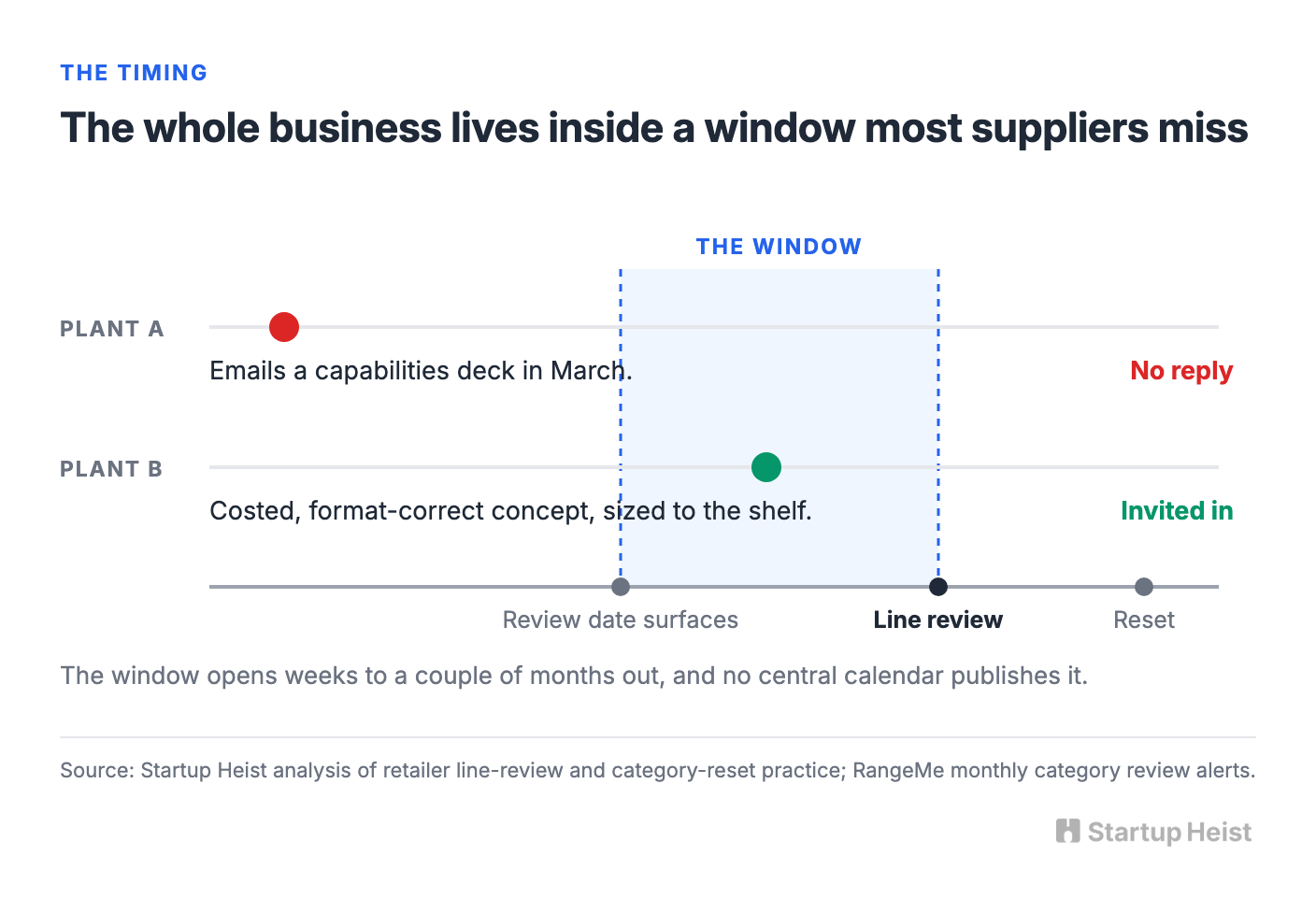
Lead times vary. Depending on the retailer and the category, a supplier might learn a review date anywhere from a few weeks to a couple of months ahead, and some categories run on far longer planning horizons. There's no central calendar. The dates aren't secret either, which is why RangeMe pushes a monthly category review alert to suppliers. When a retailer runs an RFP for a private-label item, it often ships a costing exercise alongside it: here's the product currently on our planogram, price it. Beat the incumbent's cost at our margin expectation, and you get invited to the next line review.
For a factory, that window is narrow, dated, and category-specific. The plant that walks in with a costed, format-correct, shelf-aware concept inside the window before a reset is playing a completely different game from the plant that emails a capabilities deck in March. The distance between those two plants is where the business lives.
The heist: an intelligence desk between the factory and the shelf
Call it ShelfGap.
The business takes a manufacturer's actual production capabilities and continuously asks one question: where do those capabilities line up with visible holes, weak spots, or emerging patterns in a retailer's assortment?
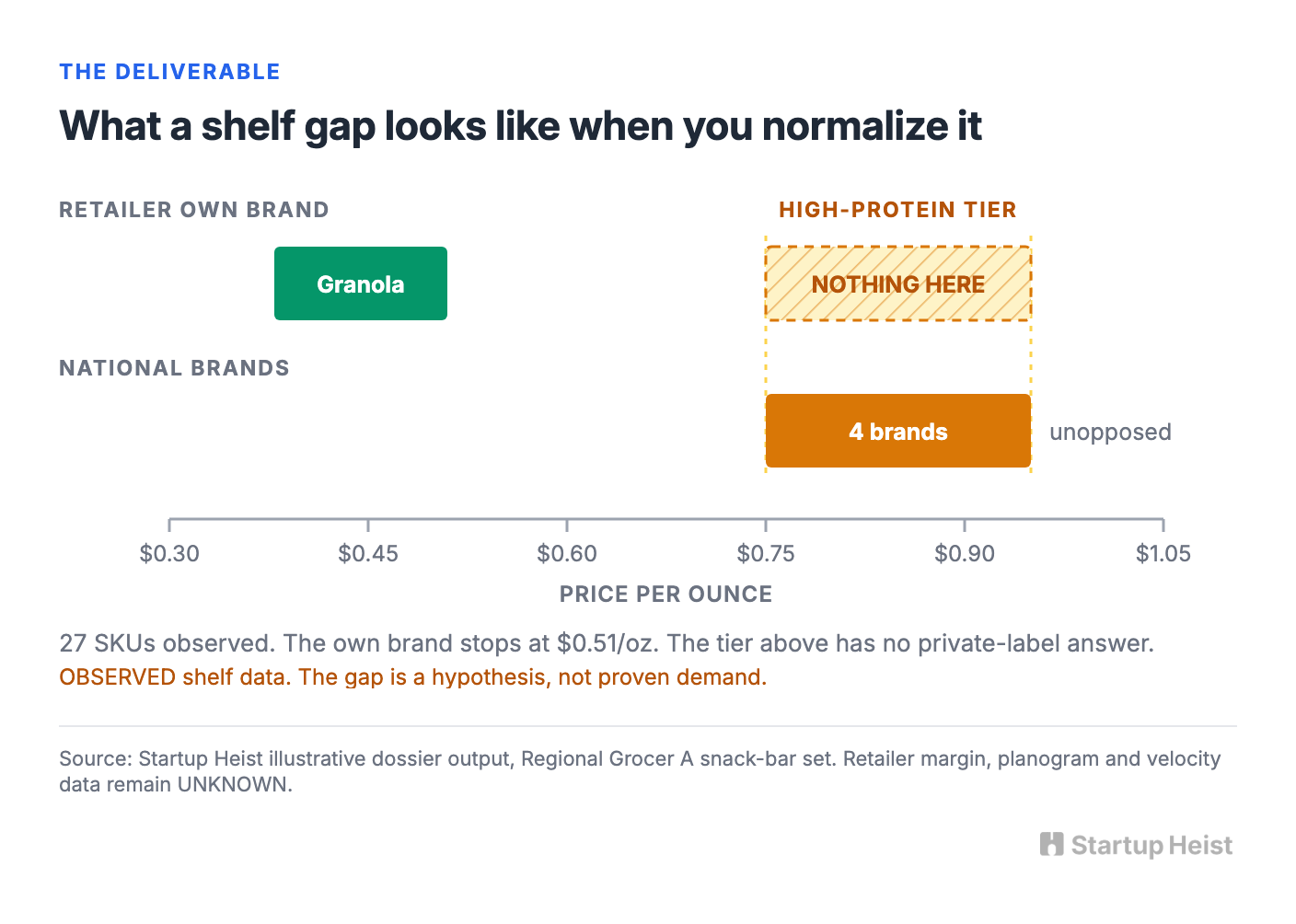
Be precise about the limits. This isn't software that divines what a Target buyer will purchase. Public data can't tell you a retailer's internal margin hurdle, planogram constraints, vendor scorecard, item-level velocity, promotional funding requirements, or category strategy. A shelf gap is a hypothesis, and a hypothesis is a long way from demand.
What ShelfGap sells is narrower and far more believable: evidence-backed launch theses that give a manufacturer's sales team a defensible reason to contact a buyer, timed to the buyer's own calendar.
Start with one niche. Shelf-stable snack bars and bites made on flexible bar-forming lines, say. The manufacturer completes a capability intake covering ingredients and restrictions, certifications, allergen environment, bar dimensions and weights, wrappers and multipack formats supported, minimum economical run, shelf-life capability, throughput, target factory price, shipping radius, existing formulations open to modification, and the retailers the sales team actually wants.
Then you map a defined retailer universe. For every relevant SKU you capture what's publicly observable: retailer, brand, private-label ownership, category, pack count and net weight, retail price and price per ounce, promotional history, protein and sugar and calorie counts, organic and gluten-free claims, ingredients, packaging format, ratings, review counts, availability, and observation date. On top of that you track change over time, which is where most of the signal hides. New SKUs appearing. Items disappearing. Reformulations. Price movement.
The output isn't "there's a gap in protein bars." It reads more like this:
Retailer: Regional Grocer A. Observed shelf: 27 snack-bar SKUs. The own brand covers commodity granola at $0.38–$0.51 per ounce and has nothing in the $0.75–$0.95 high-protein tier, where four national brands sit unopposed. Observed complaint: low-sugar competitors draw recurring criticism for chalky texture and artificial aftertaste, n=37 of 481 reviews analyzed. Factory fit: the client already runs 45g enrobed bars, can reach 15g protein, supports the required flow-wrap format, and has a compatible allergen environment. Concept: 4-count, 45g low-sugar crisp protein bar priced roughly 15% under the dominant national brand. Unknowns: buyer margin requirement, volume commitment, promotional program, appetite for another protein subcategory. Next step: present as a category hypothesis and request the buyer's cost and volume targets before any development work.
That's a document a salesperson can send tomorrow morning. One factory, one category, one retailer, one thesis: that unit of work is the entire product.
Why this isn't "scrape Target"
Collection is the easy part, and the value lives downstream of it.
Unlock the Vault.
Join founders who spot opportunities ahead of the crowd. Actionable insights. Zero fluff.
“Intelligent, bold, minus the pretense.”
“Like discovering the cheat codes of the startup world.”
“SH is off-Broadway for founders — weird, sharp, and ahead of the curve.”


