


The IOLTA Cleanup Layer Incumbents Don't Want to Build
Build the forensic reconciliation workbench for legal bookkeepers. Leave the accounting system to Clio.
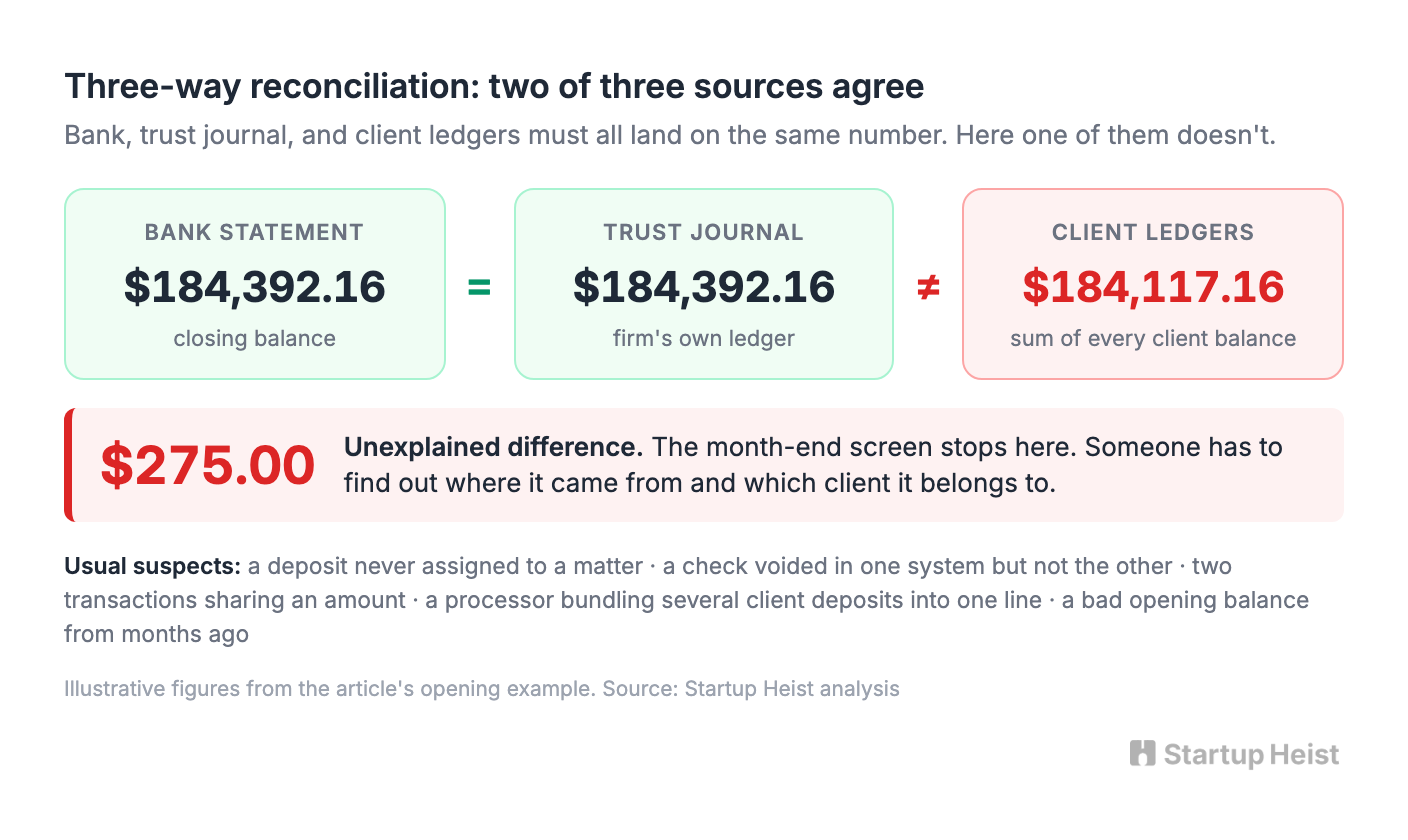
A law firm has $184,392.16 in its IOLTA client trust account.
Its trust journal says $184,392.16.
Add up the balances belonging to every individual client and you get $184,117.16.
There's $275 somewhere it shouldn't be, and someone has to find it.

Maybe a deposit hit the bank and the trust journal but never got assigned to a matter. Maybe a check was voided in one system and not the other, or two transactions share an amount, or a payment processor bundled three client deposits into one line. Or the books went wrong seven months ago and every month since has been reconciled on top of a bad opening balance.
For an ordinary company this is an accounting annoyance. For a law firm holding client money it's a different category of problem, and that category is where this startup lives.
The brief, before the case file:
The money: Twenty bookkeeping firms on the $599 Practice tier is $12K MRR, plus $1,500 to $5,000 per historical repair. California now bills attorneys $5,000 to $10,000 for trust audits.
Inside:
• Eight exception cases the engine must catch
• The close packet a CTAPP auditor asks for
• $299/$599/$999 portfolio pricing for bookkeepers
• The outreach email and the 90-day plan
The rule that turns $275 into a career risk
Lawyers are fiduciaries over trust funds. ABA Model Rule 1.15 requires client and third-party property to be kept separate from the firm's own, with complete records maintained. The ABA's Model Rules for Client Trust Account Records go further: client ledgers, a trust journal, bank records, and periodic three-way reconciliation, with quarterly as the floor and monthly as the recommended practice because errors get harder to isolate the longer they sit.
States are stricter than the model. California's Rule 1.15 requires a written monthly three-way reconciliation balancing the account journal, the client ledgers, and the bank statement, plus the supporting documentation behind it. Florida requires monthly reconciliation of bank to journal, a monthly comparison of the reconciled balance to the sum of client ledgers, and six years of retained records.
The rule is old. What's new is how openly the profession admits it's failing. In the September–October 2026 issue of the ABA's Law Practice Magazine, legal operations consultant Diane Camacho described the bank-to-ledger-to-client-balance check as "the elusive three-way reconciliation," wrote that it "is not being done or is out of balance" at many solo and small firms, and called the work of reconstructing the books back to the first bad month extremely time-consuming.
That reconstruction job is the product: the thing a firm reaches for once trust accounting has already gone wrong.
California put a price on the problem
The State Bar of California launched mandatory Client Trust Account Protection Program (CTAPP) compliance reviews on September 29, 2025, randomly selecting 100 attorneys to have a State Bar-approved CPA examine their 2024 trust records. On June 17, 2026, it announced the second round: 400 attorneys, covering 2025.
The attorney pays for the review, which the State Bar estimates at $5,000 to $10,000, with the bill rising for firms whose records are messy or slow to produce (attorneys grossing $150,000 or less can request an in-house review instead). A serious failure escalates to an investigative audit and a referral to the Office of Chief Trial Counsel.
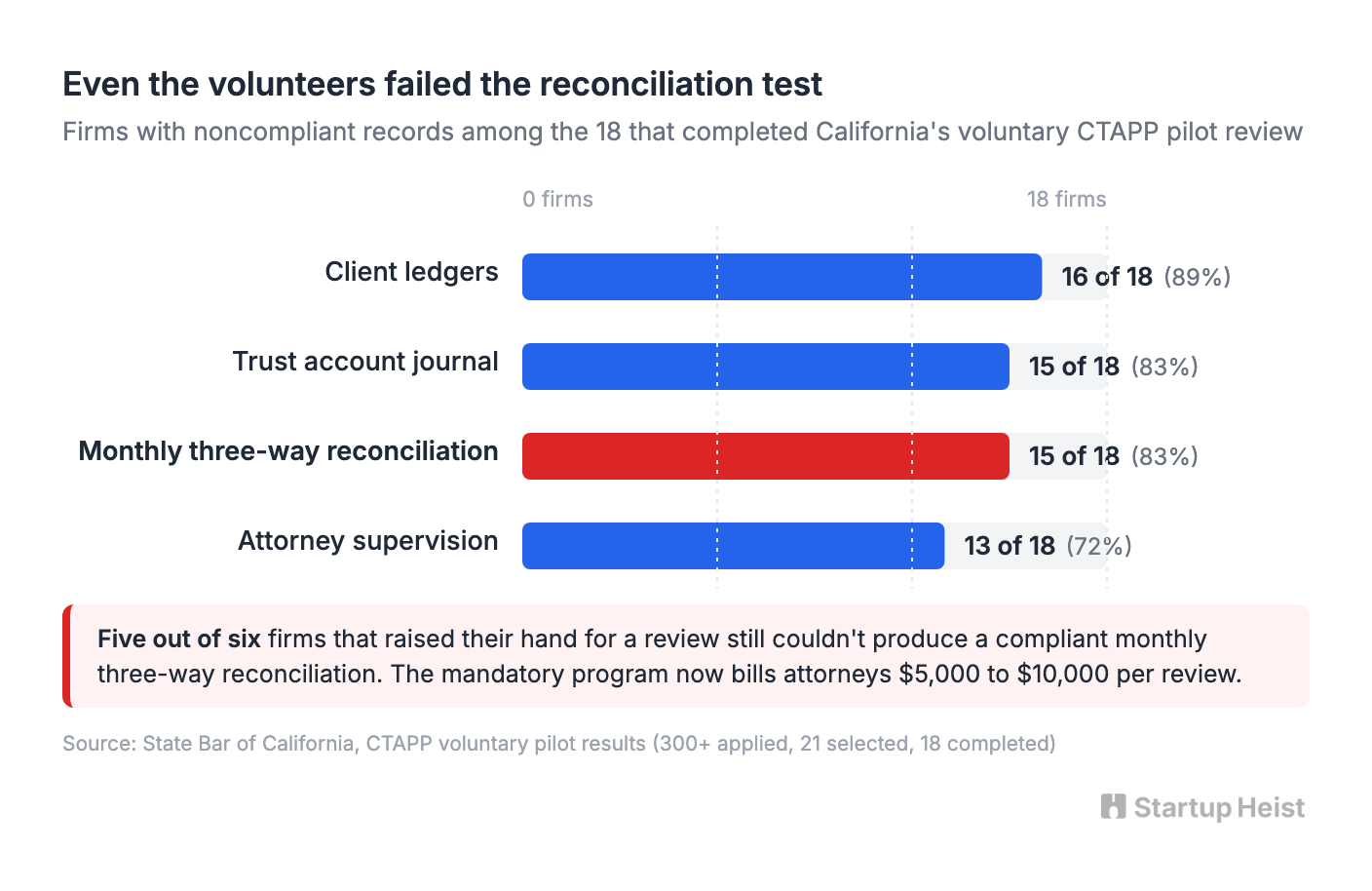
Before going mandatory, the State Bar ran a voluntary pilot. More than 300 firms applied, 21 were selected, and 18 completed the process. The results:
- 15 of 18 (83%) had noncompliant trust account journals.
- 16 of 18 (89%) had noncompliant client ledgers.
- 15 of 18 (83%) had noncompliant monthly three-way reconciliations.
- 13 of 18 (72%) had deficient attorney supervision.
Eighteen firms is a small sample. It's also the group that raised its hand, and even that group failed the reconciliation test five times out of six. California attorneys hold more than $14 billion in client trust funds, and the State Bar now spells out exactly what it wants retained: journals, client ledgers, bank statements, monthly three-way reconciliations, and the documentation that supports each one.
So a firm has two jobs, getting the numbers right and then proving how it got them right. The second job is where this becomes more interesting than a reconciliation calculator.
The obvious startup is the wrong startup
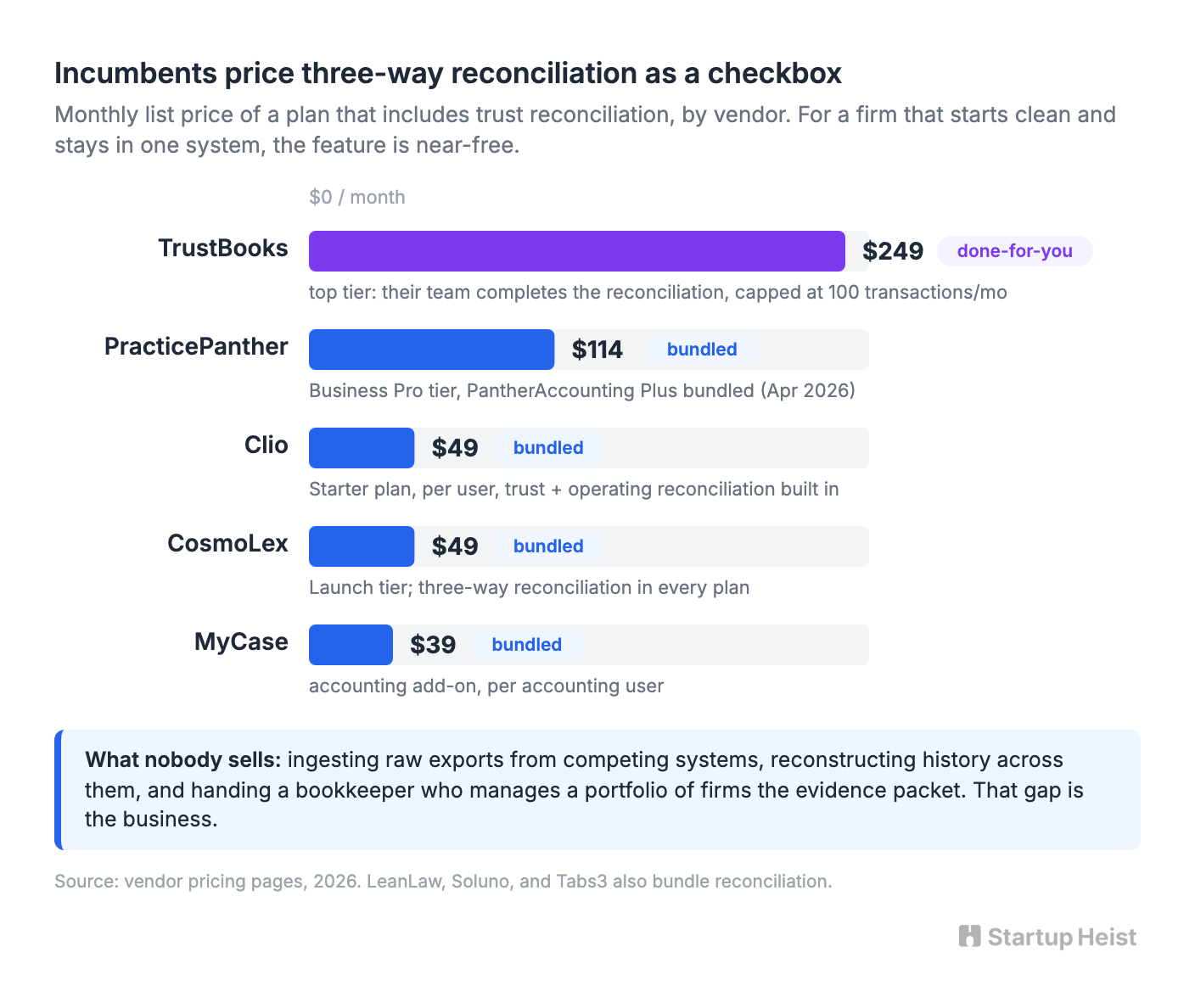
Your first instinct is to build better trust accounting software for lawyers, with a cleaner three-way reconciliation screen. The incumbents already have one, and they've priced it as a checkbox.
Clio's Starter plan runs $49 per user per month and lists trust and operating reconciliation as a built-in feature, no separate bookkeeping software required. MyCase sells three-way reconciliation inside a $39 per accounting user add-on. PracticePanther launched PantherAccounting Plus in April 2026, a native trust and operating accounting suite bundled into its $114 Business Pro tier. CosmoLex bundles three-way trust reconciliation into every plan it sells, including its $49 Launch tier. LeanLaw, Soluno, and Tabs3 do the same. Across seven vendors, the monthly reconciliation for a firm that starts clean and stays inside one system is a solved, bundled, near-free feature.
Clio also closed a $500 million Series G at a $5 billion valuation on November 10, 2025, the same day it completed its $1 billion acquisition of vLex. A roadmap knife fight with that company over a screen in its accounting module is a fight you lose by default.
The closest thing to a repair service on the market is TrustBooks, a standalone trust-accounting product whose $249-a-month top tier has the TrustBooks team complete the firm's bank reconciliation and fix what it finds, capped at 100 transactions a month. It sells to lawyers one firm at a time and wants to be the firm's system of record from that point forward. Nobody is ingesting raw exports from competing systems, reconstructing history across them, and handing a bookkeeper who manages a portfolio of firms the evidence packet.
Leave the clean books to the platforms and compete for the broken ones.
The stranded workflow
All-in-one systems work when the customer starts clean and never leaves. A real small firm might have trust activity in Clio, general accounting in QuickBooks, payments arriving through LawPay, a bank CSV, old client balances in a spreadsheet, and a new bookkeeper decoding a predecessor's three years of conventions. Then the firm switches software. A staff member leaves. Someone discovers the prior six reconciliations were built on a bad opening balance.
The incumbent's month-end screen can tell you that you're out by $4,817. The professional in the chair needs to know why, and the answer is scattered across three exports from three vendors who each think they're the system of record.
What's missing is a system of investigation sitting above every system of record: something that ingests the mess, finds where the numbers stopped agreeing, documents what probably happened, and produces a human-reviewed evidence packet showing how it was resolved.
Call it ThreeWay. It doesn't keep a law firm's books. It explains why the books stopped agreeing and hands the professional a packet they can put their name on.
The product: exception finder plus workpaper system
Unlock the Vault.
Join founders who spot opportunities ahead of the crowd. Actionable insights. Zero fluff.
“Intelligent, bold, minus the pretense.”
“Like discovering the cheat codes of the startup world.”
“SH is off-Broadway for founders — weird, sharp, and ahead of the curve.”


