


The Hyperlocal Offer Engine: Turning Dead Hours Into Revenue
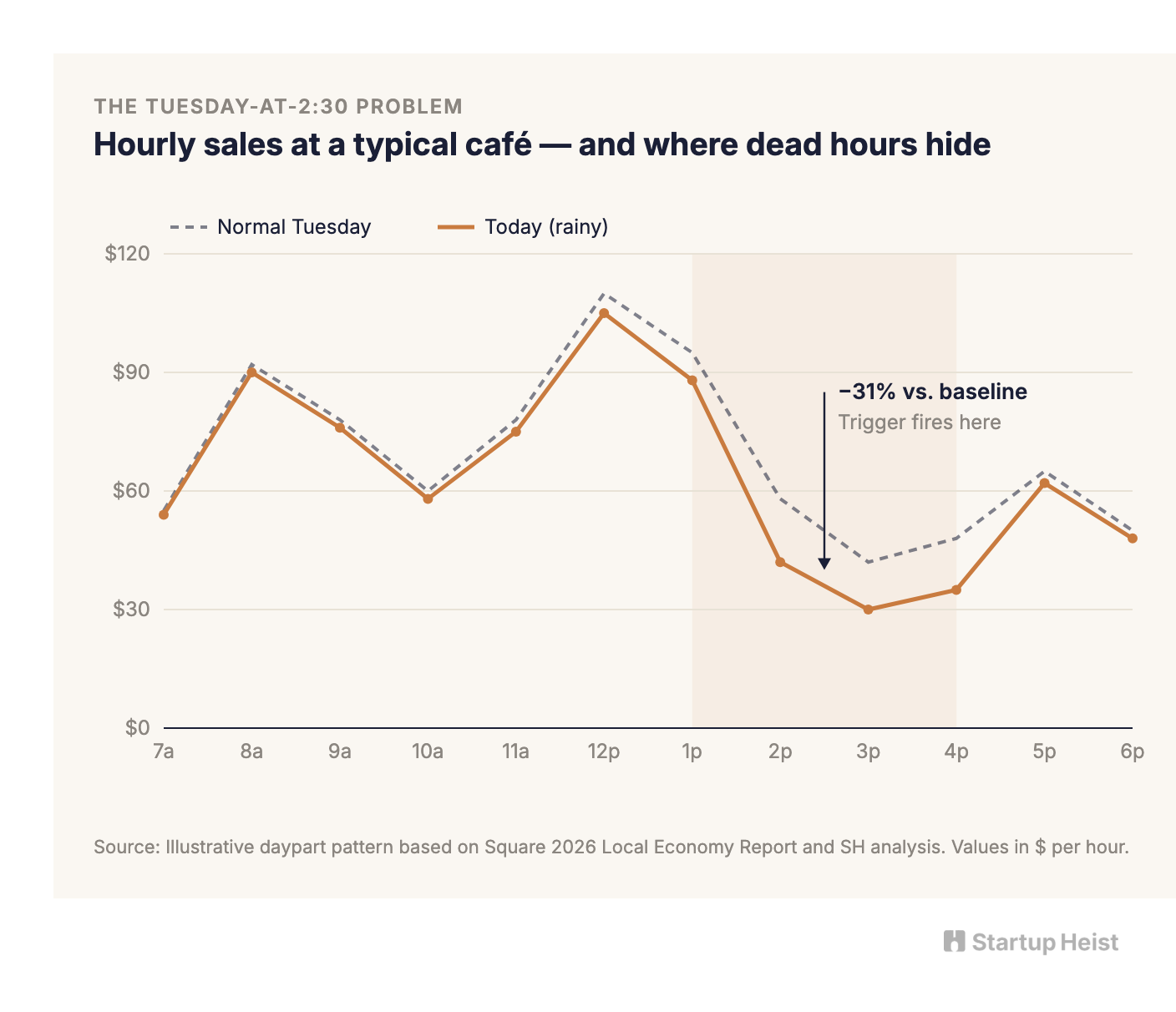
Most local businesses don't have a marketing problem in the abstract. They have a Tuesday-at-2:30 problem.
The café has pastries left in the case after the lunch rush. The salon has two open chairs before closing. The boutique has a rainy Saturday with foot traffic down. The gym has a class slot that never fills. The medspa has expensive equipment, fixed labor, and appointment gaps that quietly destroy margin.
What the owner doesn't need is another AI tool offering ten Instagram caption ideas. What they need is something much more specific:
"It's raining. Your 1–4 p.m. sales are running 28% below your normal Tuesday average. You have 312 reachable regulars within three miles. Send this offer now?"
The opportunity is a narrow hyperlocal offer engine for cafés, salons, gyms, boutiques, and similar local SMBs. It reads simple signals — POS history, weather, daypart patterns, local events, appointment gaps, expiring inventory — and turns them into same-day promos through SMS, email, and Google Business Profile. Social publishing comes later. The first win isn't "AI local marketing." It's recovering dead inventory in dead hours.
This isn't a venture-scale category on day one. It's a real micro-SaaS or vertical SaaS wedge with the potential to become a neighborhood revenue network if executed carefully.
The mistake would be building a broad "local marketing autopilot." The heist is building the slow-hour revenue button.
Here's the opportunity in one frame:
The money: 50 cafés at $249/month is $12,450 MRR. 500 locations at $299 is $149,500 MRR. Toast just priced its enterprise version at $499.
Inside:
• Full MVP scope and trigger logic
• Three-tier pricing from $149 to $399
• Direct-outreach playbook with templates
• 90-day roadmap from audits to product
Why This Exists Now
Local operators are ready for AI help, but their tolerance for software bullshit is low.
A café operator or salon manager doesn't want to log into another dashboard to brainstorm "engaging content." They're already buried in payroll, staffing, rent, vendors, no-shows, reviews, and customers showing up at the worst possible time. What changed is the market signal. Deloitte's 2026 Retail Industry Global Outlook surveyed 330 global retail executives and found 67% expect AI-driven personalization capabilities within the next year, with operators explicitly planning to hand off marketing tasks to AI so they can focus on higher-impact customer interactions. Owners aren't asking whether software can write something. They're asking whether it can remove work.
The macro trendline backs the shift. Grand View Research puts the global marketing automation market at $6.65 billion in 2024, growing to $15.58 billion by 2030 at a 15.3% CAGR, with North America holding 43.6% of the market. That aggregate hides the real opportunity. Enterprise marketing automation is already crowded with HubSpot, Klaviyo, Salesforce, Braze, Mailchimp, SOCi, Toast, SpotOn, and Thanx. The open space isn't local business marketing automation in general; it's local context automation. Most SMB tools know the customer list. Some know purchase history. A few know loyalty behavior. Almost none behave like a local operator with a good sense of the day. That gap is the entire opening for café marketing software, salon scheduling promos, and small business SMS marketing built around real-world signals instead of generic content.
Local Demand Is Rhythmic
Local businesses aren't SaaS companies. They don't sell to a global audience on a continuous funnel. They live by rhythm.
Morning coffee. Lunch rush. Rainy afternoons. Sunday resets. Friday-night traffic. Back-to-school season. The first warm day of spring. The local high school game. The farmer's market two blocks away. The snowstorm that kills foot traffic. The heat wave that makes cold drinks sell. The 3 p.m. dead zone. The pre-holiday gift rush. The post-holiday slump.
Most marketing software treats customers like segments. Local businesses experience customers as moments. That distinction is the product.
A café doesn't need a monthly campaign calendar as much as it needs a smart nudge when croissants are still sitting at 1:45 p.m. A salon doesn't need a generic "we have openings this week" post; it needs to know which repeat customers historically book on short notice and which service can be discounted without wrecking margin. A gym doesn't need more inspirational quotes; it needs to fill the Tuesday 6:30 a.m. class that always runs half empty.
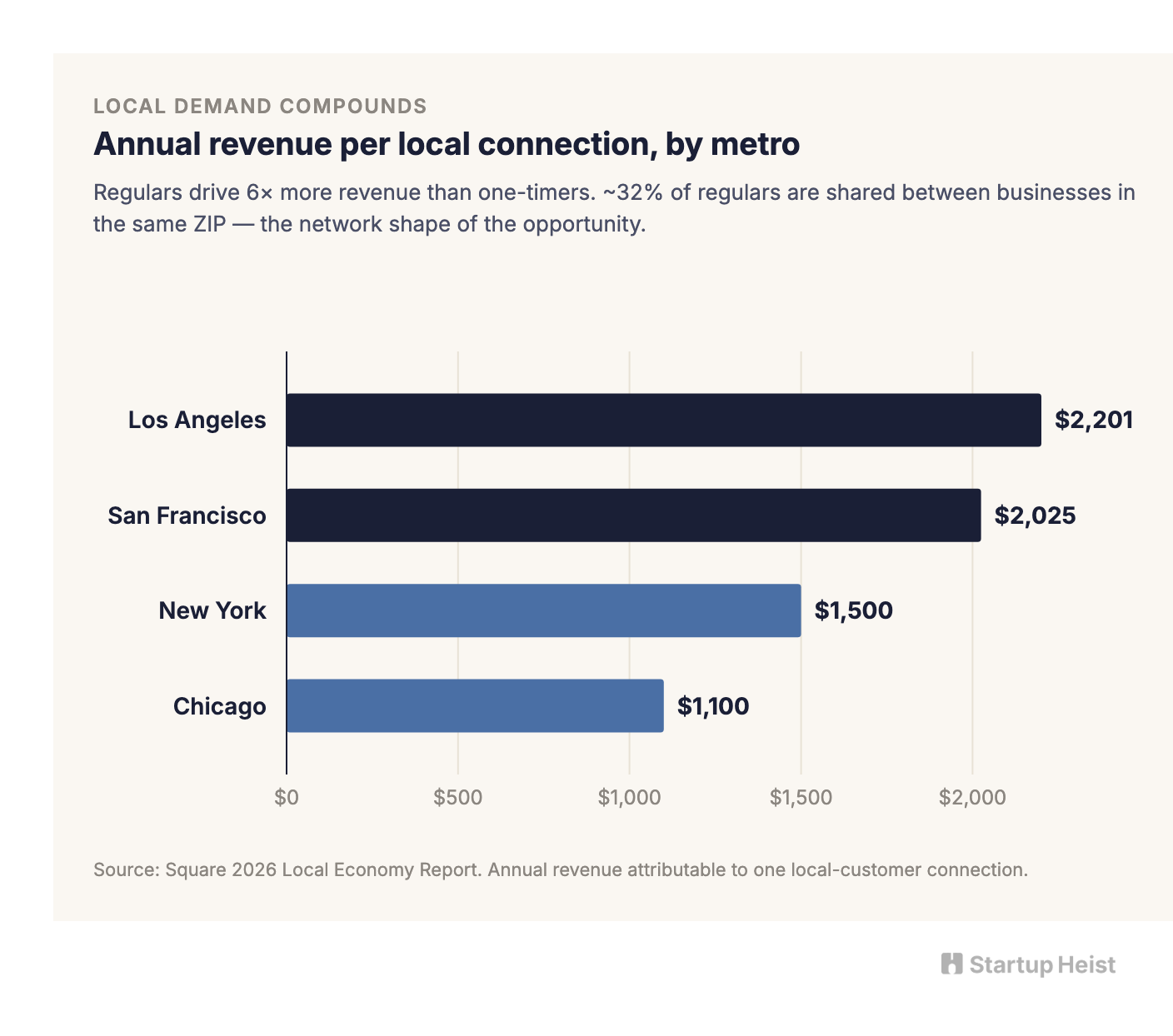
Square's 2026 Local Economy Report sharpens the picture. Regular customers drive 6x more annual revenue than one-time visitors. Even better, those regulars overlap. Roughly 32% of regulars are shared between businesses in the same ZIP code, with revenue per local connection landing at $2,201 in Los Angeles, $2,025 in San Francisco, $1,500 in New York, and $1,100 in Chicago. Local demand isn't isolated. It moves through neighborhoods.
That's the long game. You don't start there. You start with one location, one slow period, one offer.
The Product: A Same-Day Offer Engine
The product should be brutally simple. Every day, the system watches a few signals: hourly sales or booking performance, the historical baseline for that daypart, weather, local events, inventory or appointment availability, customer list behavior, and channel permissions across SMS, email, and Google Business Profile. When a trigger fires, it recommends an offer.
Picture the trigger:
"Today's 1–4 p.m. café sales are tracking 31% below your normal Tuesday. Rain is expected until 5 p.m. You sold 46 iced lattes last rainy Tuesday when paired with a pastry offer. Suggested campaign: 'Rainy afternoon pick-me-up: $2 pastry with any latte until 4 p.m.' Send to 286 nearby regulars?"
The owner sees the expected customer segment, offer copy, estimated margin impact, suggested channel, expiration time, and one-tap approve, edit, or skip. Recommendation first, autopilot later. Local operators won't trust a new tool to blast discounts automatically. They will trust a tool that says, "Here is the slow hour. Here is the offer. Approve?" That approval step isn't friction. It's the trust bridge.
The framing matters as much as the feature set. "AI marketing for local businesses" is too broad. It sounds like a dashboard. It attracts tire-kickers. It competes with every POS, email tool, agency, social scheduler, and AI caption generator. "Recover dead hours" lands differently. It's specific. It ties to revenue. It gives the owner a mental model. The pitch becomes: "We help you turn your slowest hours into targeted same-day sales without planning campaigns." It also protects the product from becoming a generic content tool. Generic AI copy has no moat. Trigger quality does. A competitor can copy captions. It's much harder to copy a location-level memory system that learns rainy Tuesdays work for pastry bundles, heat waves work for smoothies (not sandwiches), first-time visitors respond to low-friction offers, top regulars shouldn't receive heavy discounts, last-minute salon openings fill better with upgrade offers than price cuts, Google Business Profile automation drives discovery while SMS drives immediate action, certain customers only respond after 4 p.m., and certain offers cannibalize full-price demand.
The moat isn't the LLM. It's the local performance memory.
Competitive Landscape: Crowded, Not Closed
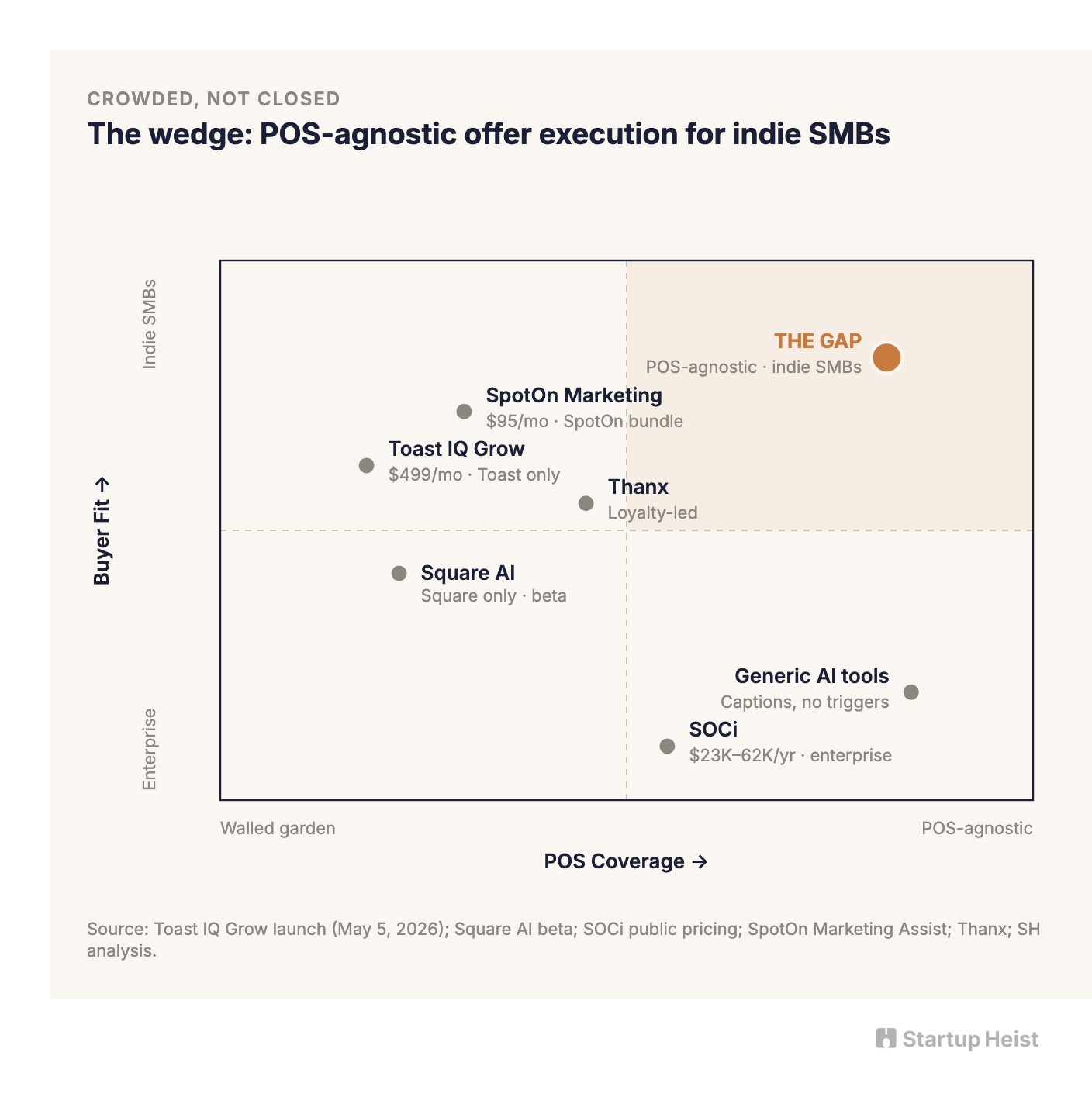
This category has serious incumbents, which is both a warning and a validation.
Unlock the Vault.
Join founders who spot opportunities ahead of the crowd. Actionable insights. Zero fluff.
“Intelligent, bold, minus the pretense.”
“Like discovering the cheat codes of the startup world.”
“SH is off-Broadway for founders — weird, sharp, and ahead of the curve.”


