


TikTok Just Mandated Humans
In June 2026, TikTok Shop published rules that redraw the economics of live commerce in the United States. Shopping livestreams must now feature a real person, speaking or signing in real time, demonstrating products and responding to viewers. AI-generated voices, prerecorded narration, radio-style audio, looping footage, and screens full of static product images are all prohibited. The platform now requires evidence of live human participation.
The enforcement mechanism arrived in the same window. In July 2026, TikTok replaced its old violation-points system with the Account Health Rating, a score from zero to 1,000 that governs everything a seller can do. Every shop starts at 200 points. Violations and performance failures deduct points; completed orders and policy quizzes restore some. At 150 points, a seller can lose access to new listings and major campaigns for seven days. At 100, the restrictions stretch to 14 days. At 50, four weeks. At zero, the shop can be permanently deactivated.
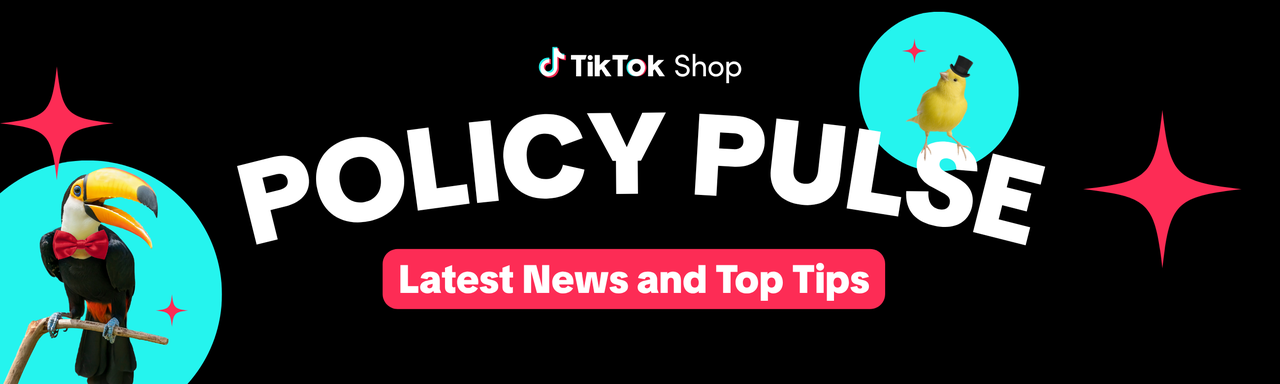
A bad livestream used to be embarrassing. Now it can throttle the distribution of the entire shop. Every seller who was padding live hours with synthetic voices or looped demos woke up in July 2026 needing something they can't download: reliable humans who can sell on camera for hours at a stretch.
That scramble is the opening.
The money: Five desk clients at $7,500 a month is $37,500 MRR before performance fees. Agency comps already charge $9,000 plus a cut of LIVE GMV.
Inside:
• Three-tier pricing: sprint, desk, staffing
• Unit economics: 30-42% margins per client
• Eight-week launch plan with host screening
• Adjusted host-performance moat and data plan
The heist is a services-first operation: supply trained hosts, remote producers, compliance procedures, and performance analysis to TikTok Shop sellers who can't staff their own streams. Keep every session inside a runbook and capture structured data from the first stream onward. The software business comes later, built on a workflow you'll have already proven by hand.
The market, sized honestly
TikTok Shop is projected to clear $23.4 billion in U.S. sales in 2026, up 48% from 2025, according to EMARKETER. The platform did $15.1 billion in U.S. gross merchandise value in 2025, per Momentum Works and Tabcut, growing 68% year over year. Those are headline numbers, and most of that merchandise doesn't move through livestreams. Short shoppable videos remain the largest channel. Livestreams accounted for 14% of U.S. GMV in 2025.
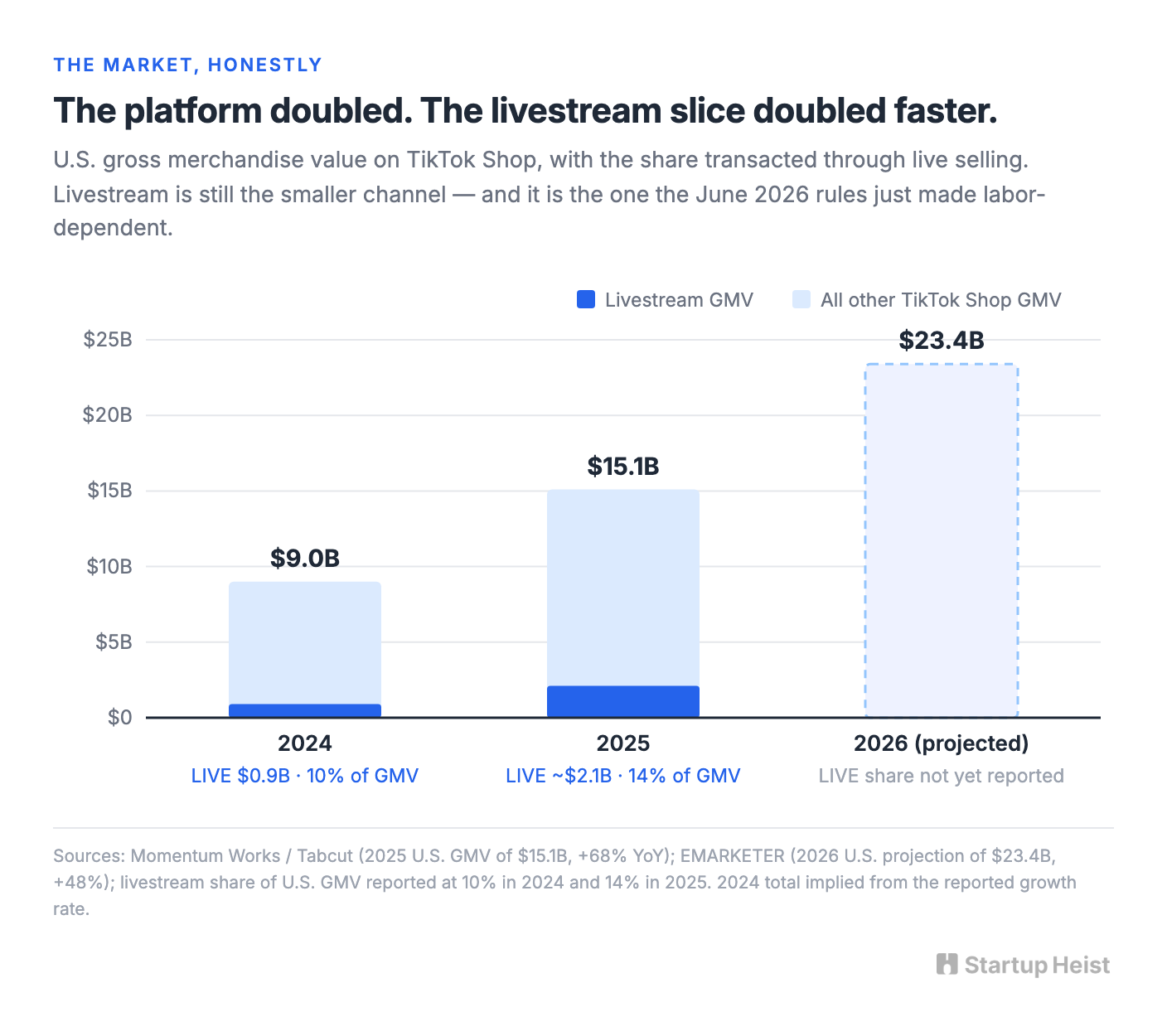
That share was 10% in 2024. On a platform growing 68% a year, the livestream slice roughly doubled in dollar terms in one year, to around $2 billion. Zoom out past TikTok and U.S. livestream ecommerce reached $14.64 billion in 2025, up nearly 50% year over year. American shoppers are still warming to the format. Only 21.7% of U.S. digital buyers purchased through a livestream in 2025, and 43% of U.S. adults say they have not tried live shopping and do not intend to. The market is early, which is exactly why the operational layer is worth building now rather than three years ago.
Underneath those numbers sits the constraint that matters. Brands and creators produced more than eight million hours of shopping livestreams in the U.S. during 2024, before the human mandate. Every one of those hours now requires a person who can talk continuously, demonstrate products, field objections without inventing claims, and stay inside TikTok's content rules. Millions of live hours, each one newly required by policy to contain a competent human, and somebody has to supply them.
What the mandate actually changed
Before June 2026, a seller could extend operating hours cheaply. Synthetic voices, looped demos, and low-touch streams resembled automated television, and the quality was poor, but the labor cost was near zero. Now every additional live hour has a human price tag. A seller running four hours a day, five days a week, needs roughly 80 host-hours a month. At six hours a day, 120. That's before training, rehearsal, setup, and producer coverage.
The labor itself is affordable on paper. Job listings put TikTok live-host pay between roughly $20 and $50 per hour, sometimes with commission. The scarce thing is reliability. A seller needs someone who learns the product fast, holds energy for a three-hour block, demonstrates without repeating the same sentence every minute, answers questions without wandering into prohibited health or performance claims, and shows up for the Saturday evening shift. That combination is much rarer than generic creator labor, and with AHR in force, a host who improvises the wrong sentence risks the whole account, not just the stream.
The wrong startup, and who is already in the water
The obvious startup here is a marketplace: host profiles, calendars, reviews, a booking button, and a 15% to 20% take. The math kills it. At $35 per hour and a 20% fee, a four-hour stream earns the platform $28. That doesn't fund auditions, product training, compliance review, backup coverage, or dispute handling, which are the things sellers actually need. Liquidity is ugly too. Demand clusters on evenings, weekends, and launches; hosts want predictable blocks; the best performers go direct to brands the moment they can.
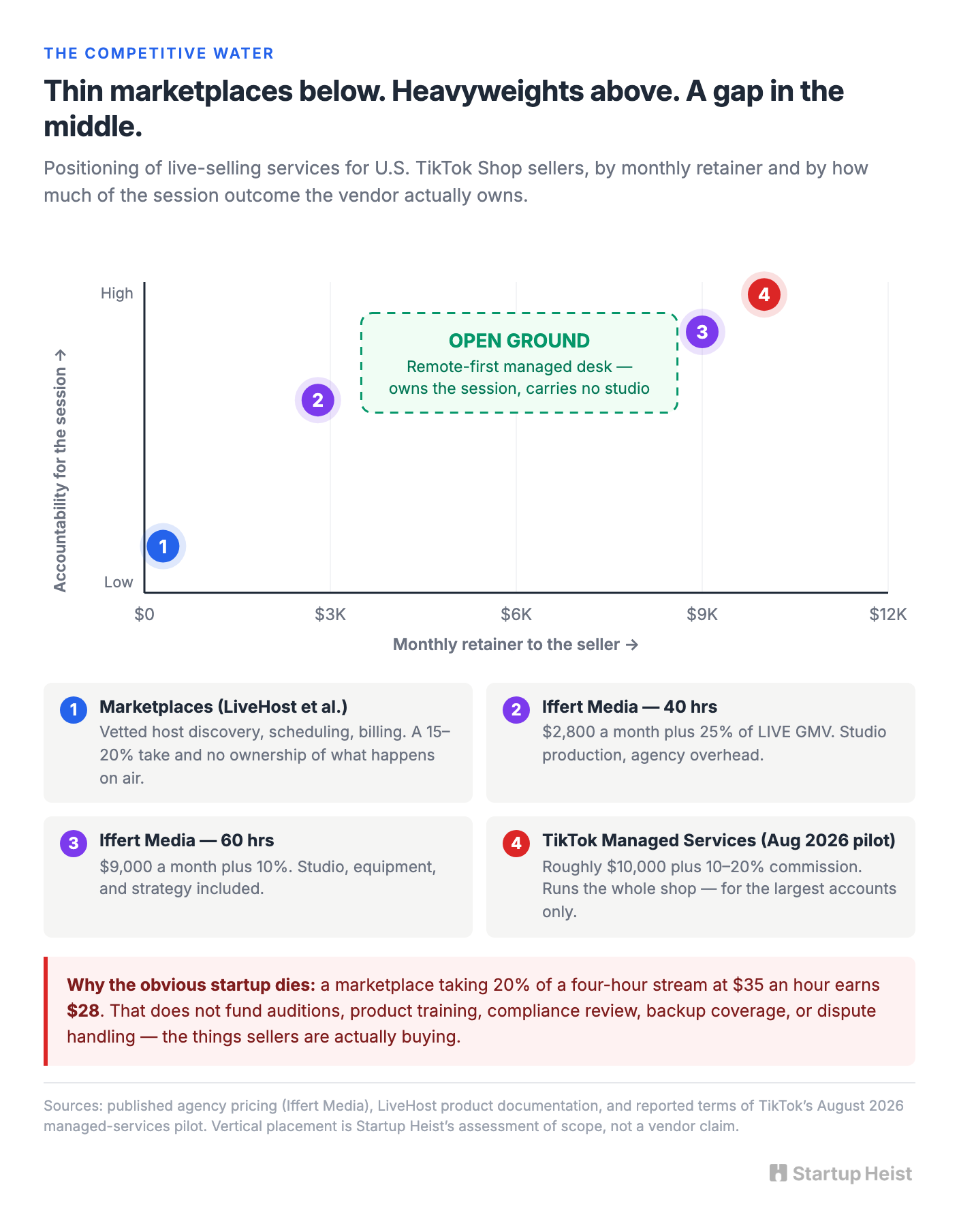
The space is also no longer empty. LiveHost already offers vetted host discovery with scheduling, billing, and TikTok Shop performance data matched to each booking, down to GMV per hour and conversion rate, and smaller entrants are chasing the same marketplace playbook. At the heavy end, full-service TikTok Shop agencies sell studio production: Iffert Media charges $2,800 a month plus 25% of LIVE GMV for 40 hours, or $9,000 plus 10% for 60 hours with studio, equipment, and strategy included. And TikTok itself is entering the field. In August 2026 the platform begins piloting a managed-services program that runs nearly every part of a seller's shop, from ads to creator recruiting, reportedly priced at a $10,000 fee plus a 10% to 20% commission.
TikTok's entry is both validation and threat: sellers will clearly pay five figures for managed execution, and TikTok will just as clearly compete with its own ecosystem for the largest accounts. The defensible ground sits between the thin marketplaces and the heavyweights: a remote-first managed operation that takes accountability for the session itself, priced for sellers who will never get TikTok's white-glove treatment.
The product: a managed LIVE desk
Sell one thing: we put a trained human on your stream, give that person a producer, keep the session inside an approved runbook, and show you exactly what happened afterward. Delivering on that promise takes four components.
Unlock the Vault.
Join founders who spot opportunities ahead of the crowd. Actionable insights. Zero fluff.
“Intelligent, bold, minus the pretense.”
“Like discovering the cheat codes of the startup world.”
“SH is off-Broadway for founders — weird, sharp, and ahead of the curve.”


