


The Ed-Tech Exit Desk
Software accumulates inside a school district the way sediment does: layer settling on layer, nothing ever removed.
A reading platform purchased with grant money sits beside another reading platform chosen by the curriculum department. Teachers adopt free classroom apps on their own. A former administrator's favorite tool keeps renewing because nobody owns the contract. Capabilities the district already pays for inside Google Workspace, Microsoft 365, or its learning management system get purchased again from point-solution vendors.
Then someone in the finance office asks a deceptively simple question: what are we actually paying for?

The numbers behind that question are staggering. Instructure's 2025 analysis found that U.S. school districts accessed an average of 2,982 distinct ed-tech tools during the school year, up nearly 9 percent in a year. Its 2026 follow-up, measuring actual tool launches across more than 12.6 million Canvas users, found districts maintaining access to an average of 3,001 digital tools while individual students and educators meaningfully used about four. The two reports count differently, but the structural fact is the same: districts are responsible for far more software than their people actually touch.
The money at stake is real. Denver Public Schools spent two years working through a pile of more than 1,000 ed-tech tools carrying roughly $21 million in spend, cut the approved list to 346, and saved roughly $1 million. Denver needed an internal working group spanning IT, purchasing, curriculum, and legal to pull it off. Most of the 13,335 regular public school districts in the United States can't staff that effort, and their technology directors are already absorbing more responsibility without more headcount.
That gap is the opportunity: an ed-tech exit desk, a productized software audit, consolidation, and migration service for K-12 districts under budget pressure. Audit the stack, flag the tools that are redundant, underused, expensive, or difficult to leave, then execute the cleanup before renewal season forces a rushed decision. It's fast to build, slow to sell, and durable once a few districts trust you. Here's the brief:
The money: Six hygiene retainers at $3K a month is $18K MRR; a boutique mix of audits, sprints, and retainers clears $500K a year.
Inside:
• The seven-dimension tool-scoring rubric
• Three-product ladder from $2.5K scan to retainer
• Outreach email built on public budget signals
• The Ed-Tech Exit Index moat plan
The real problem is inertia
The dramatic version of this opportunity makes headlines. AllHere, the venture-backed company behind Los Angeles Unified's "Ed" chatbot, launched the product in March 2024 on a contract worth roughly $6 million over five years. On June 14, 2024, the company furloughed most of its staff and the district shut the chatbot down; by mid-August, AllHere was in Chapter 7 bankruptcy and the nation's second-largest district was answering questions about where student data lived and who could still access it. Collapses like that will keep happening, but they're too rare and unpredictable to build a business on.
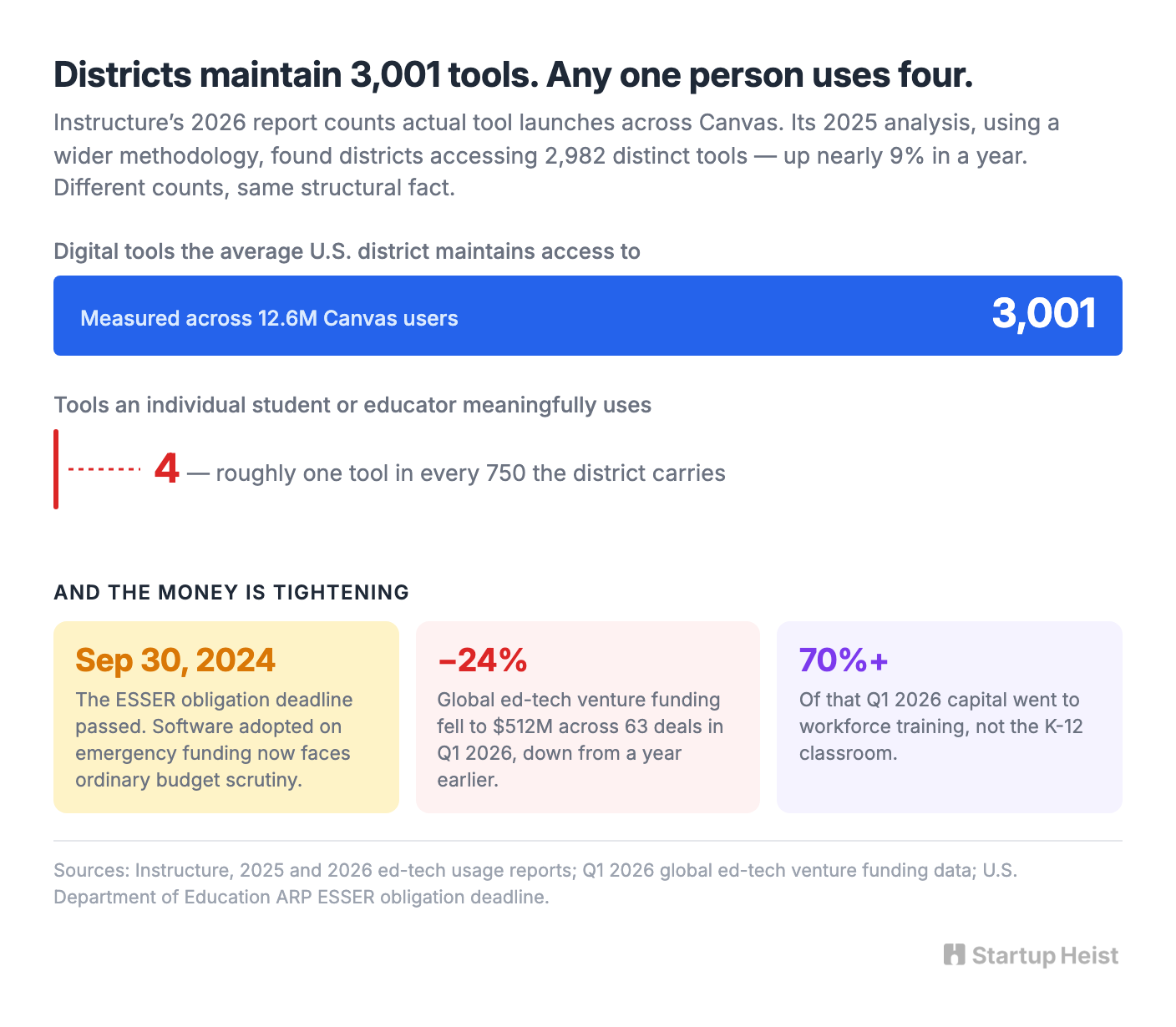
The larger problem is mundane. Nobody maintains a complete inventory, different departments buy overlapping tools, and purchased licenses quietly exceed active users. Contracts renew before anyone evaluates alternatives, and data exports get postponed until access is about to disappear. The district knows what a tool costs and has no idea what leaving it would cost.
Two macro forces are now squeezing this slack out of district budgets. The venture market has repriced education: global ed-tech venture funding reached $512 million across 63 deals in the first quarter of 2026, down 24 percent in value from a year earlier, with more than 70 percent of that capital going to workforce training rather than K-12 classrooms. Startups selling to schools are operating with less runway and less investor patience. And the federal money is gone. The ESSER funding cliff arrived on schedule: the deadline to obligate American Rescue Plan funds passed on September 30, 2024, so every subscription adopted during the emergency-funding era now has to survive ordinary operating-budget scrutiny.
Districts still need technology to operate. They just can't afford to keep accumulating it casually, and that squeeze is exactly what a cleanup service gets paid to relieve.
What the customer is actually buying
Don't sell "technology consulting." That phrase invites an open-ended engagement, a lengthy RFP, and a final report that gets filed in a shared drive and forgotten.
Sell a defined result instead: before your next renewal cycle, we'll show you which tools to keep, renegotiate, consolidate, migrate, or retire, and we'll prepare the exit plan for every high-risk system.
The deliverable is a decision system with seven parts:
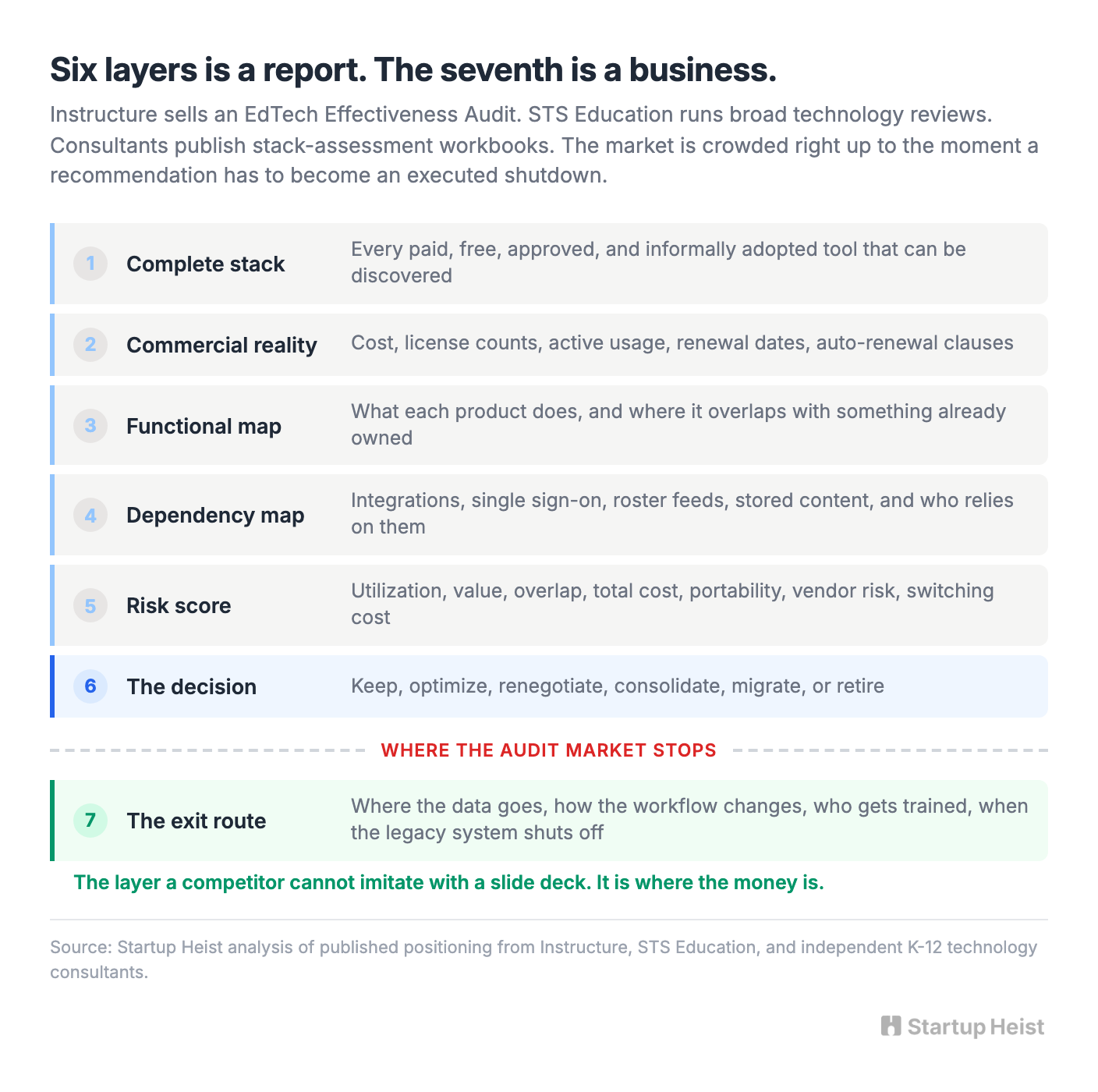
The audit layer of this market is already occupied. Instructure sells an EdTech Effectiveness Audit focused on redundancy, waste, and privacy. STS Education runs broad technology reviews. Plenty of consultants publish stack-assessment workbooks. The market is crowded right up to the moment a recommendation has to become an executed shutdown.
That last mile is where districts actually bleed. Beaverton School District in Oregon, one of the more disciplined technology shops in the country, has retired 59 tools and found each exit took an average of 72 days against a 60-day contractual requirement, because the person who signed the contract and the person who holds the data are often different people at the vendor. The School District of Indian River County in Florida terminated a five-year contract in spring 2025 and was still chasing written confirmation of student-data deletion more than 90 days later, with the vendor's sales contact promising engineering help "in two weeks" and then going quiet for months.
Union Public Schools in Tulsa tests vendor deletions by seeding submitted files with dummy variables, and its technology director concedes that at some point the district is taking the vendor's word. One district discovered a data breach in a product it had stopped using seven years earlier. One vendor, asked to certify deletion, told a district flatly: "We don't know. You're proving a negative."
Most consultants are comfortable saying "you should consolidate these three products." The stronger offer keeps going: we'll export the data, configure the replacement, rebuild the workflow, test it with staff, reconcile the records, obtain the deletion certificate, and document the shutdown. That's a harder sale and a harder delivery, and it's nearly impossible for a competitor to imitate with a slide deck.
Start outside the student information system
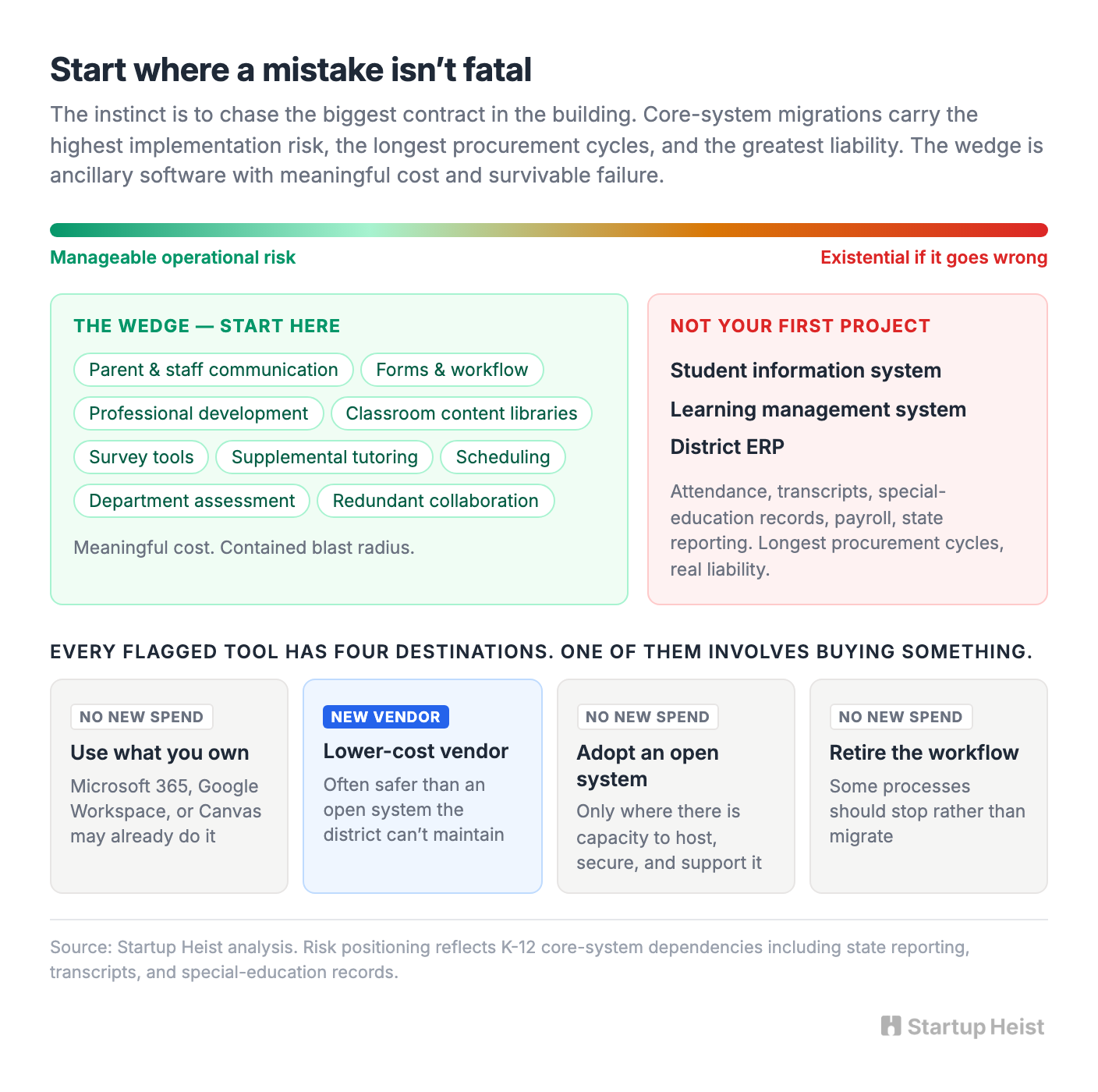
The temptation is to chase the biggest contract in the building: replacing the student information system, the LMS, or the ERP. Resist it.
Unlock the Vault.
Join founders who spot opportunities ahead of the crowd. Actionable insights. Zero fluff.
“Intelligent, bold, minus the pretense.”
“Like discovering the cheat codes of the startup world.”
“SH is off-Broadway for founders — weird, sharp, and ahead of the curve.”


