


The USPTO Just Created a Mandatory Middleman
On July 20, 2026, a quiet change to U.S. patent procedure took effect. Patent applicants and patent owners domiciled outside the United States must now be represented by a registered U.S. patent practitioner in almost everything they file with the United States Patent and Trademark Office.
The final rule, published in the Federal Register on March 20, 2026, covers far more than new applications. Amendments, replies, application data sheets, micro-entity certifications, petitions, and issue-fee papers all require a practitioner's signature if they arrive at the USPTO on or after July 20, regardless of when the underlying application was filed. One foreign-domiciled party in a mixed applicant group triggers the requirement for the entire application. The USPTO considered carving out an exception for mixed groups and refused, on the grounds that an exception would invite people to add a U.S. inventor purely to dodge the rule.
The traps inside the rule are sharp. A foreign inventor can still secure a filing date on their own. But an application data sheet signed by the inventor instead of a practitioner gets treated as a mere transmittal letter, which means inventorship goes unrecorded and priority claims never take effect. Nonpublication and prioritized-examination requests must be submitted with the original filing, and if one is signed improperly, the rule text is blunt: it is not possible to subsequently meet the requirements. Some mistakes here are permanent.
The practical effect is a gate. Foreign filers can still walk up to it, but they now need an authorized person to open it. That gate is the opportunity. You're never going to be the patent lawyer, but you can own the intake, routing, and operating system around the handoff, then sell that workflow back to the practitioners who need it.
The money: 30 practitioner subscriptions at $149/month plus concierge intake fees comes to roughly $6,000 MRR, scaling toward $20,000 to $25,000 at 100 practitioners.
Inside:
• The 4-8 week MVP: compliance checker to routing
• Pricing that stays fee-sharing compliant
• Practitioner-first GTM with the outreach pitch
• Four-phase path to cross-border filing infra
There's one important catch, and it reshapes the entire business: the market is much smaller than the headline makes it sound.
The Obvious Pitch Is Wrong
The breathless version of this opportunity says hundreds of thousands of foreign inventors have suddenly been forced to hire a U.S. patent attorney, so build the marketplace before anyone notices.
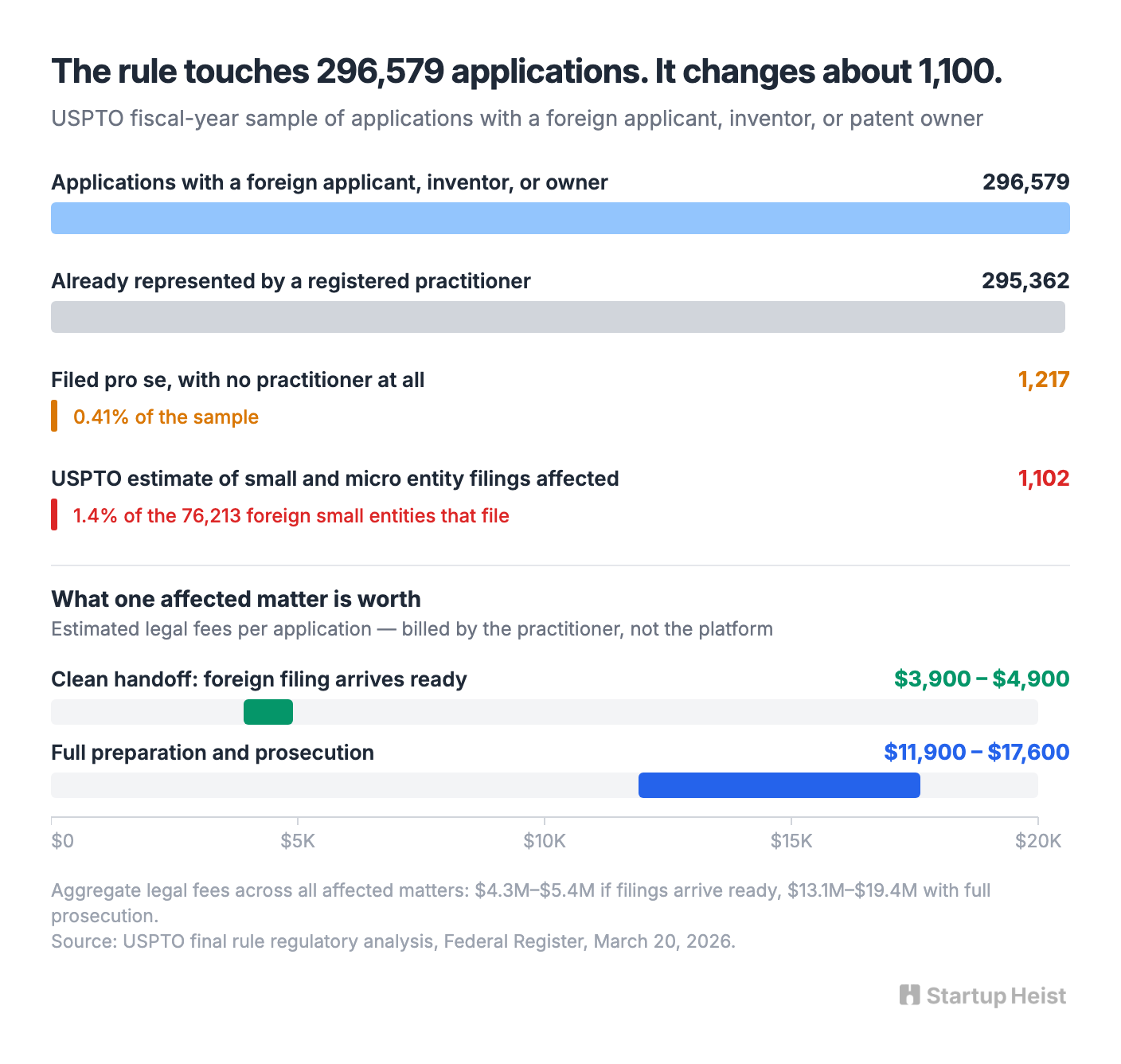
The rule's own data kills that pitch. In the fiscal-year sample the USPTO used for its analysis, 296,579 applications involved foreign applicants, inventors, or patent owners. Of those, 295,362 were already represented by registered practitioners. Exactly 1,217 were filed pro se. Among foreign small and micro entities, the USPTO estimates 1,102 applications will actually be affected, which is 1.4% of the 76,213 foreign small entities that file. Corporations and sophisticated international filers already worked through U.S. counsel. The newly stranded population is the thin edge of the market: individual inventors and micro-entities who handled U.S. patent prosecution themselves.
The money follows the same shape. The USPTO's own cost tables estimate the affected applications will generate roughly $4.3 million to $5.4 million in aggregate legal fees when foreign-origin applications arrive substantially ready to file, and $13.1 million to $19.4 million when a U.S. practitioner must do real preparation and prosecution. Per matter, that works out to roughly $3,900 to $4,900 for a clean handoff and $11,900 to $17,600 for full prosecution. That's lawyer revenue, and a routing platform can't legally treat a lawyer's billings as its own.
So no, there's no billion-dollar marketplace hiding in this Federal Register notice. What's there is a time-sensitive micro-SaaS and services opportunity with an unusually strong acquisition trigger, and played correctly, that can still be a very good business.
Why the Window Is Real
The recurring flow of newly affected applications is modest. The immediate transition is broader, because the rule applies to papers filed after July 20 in any pending matter. A foreign pro se applicant staring down an Office Action deadline is affected immediately, and so is a foreign patent owner filing a petition in a years-old case. That produces a one-time inventory of active matters that need representation now, followed by the smaller recurring stream.
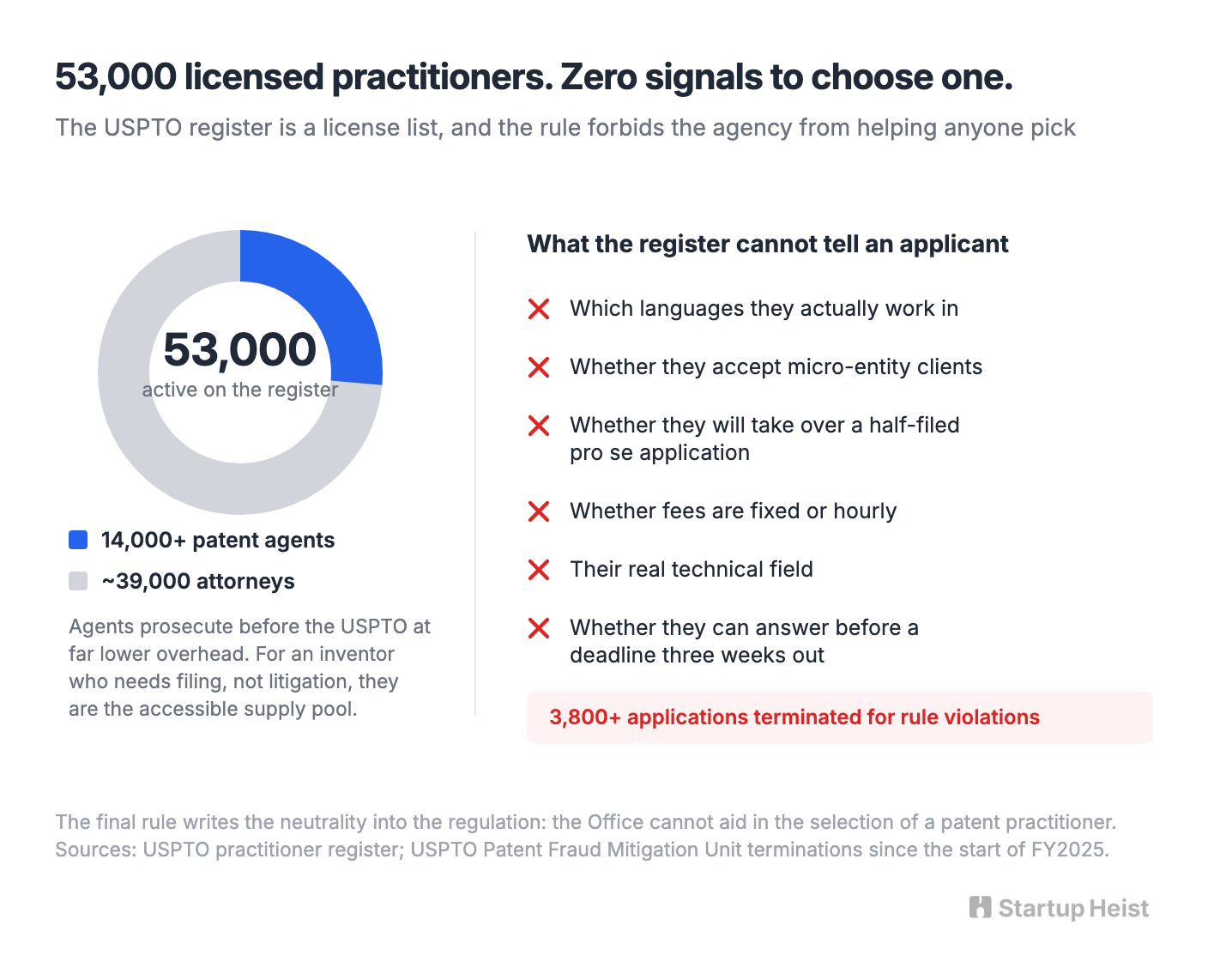
Enforcement pressure compounds the urgency. The USPTO's Patent Fraud Mitigation Unit has terminated more than 3,800 applications for rule violations since the start of fiscal year 2025, including a single April 2026 order terminating over 400 applications tied to unauthorized representation. Foreign filers who might once have muddled through, or leaned on an unregistered "consultant," are watching that option get burned down.
Meanwhile, the official discovery experience is broken by design. The USPTO maintains a searchable register of roughly 53,000 active practitioners, and the new rule writes the agency's neutrality directly into the regulation: the Office cannot aid in the selection of a patent practitioner. The register tells an applicant who holds a license. It says nothing about who speaks Mandarin, understands consumer electronics, accepts micro-entity clients, will take over a half-prosecuted pro se application, quotes fixed fees, or can respond before a deadline three weeks out. The government built the requirement and declined to build the matching layer, and that missing layer is the business.
The Product Is Not Uber for Patent Lawyers
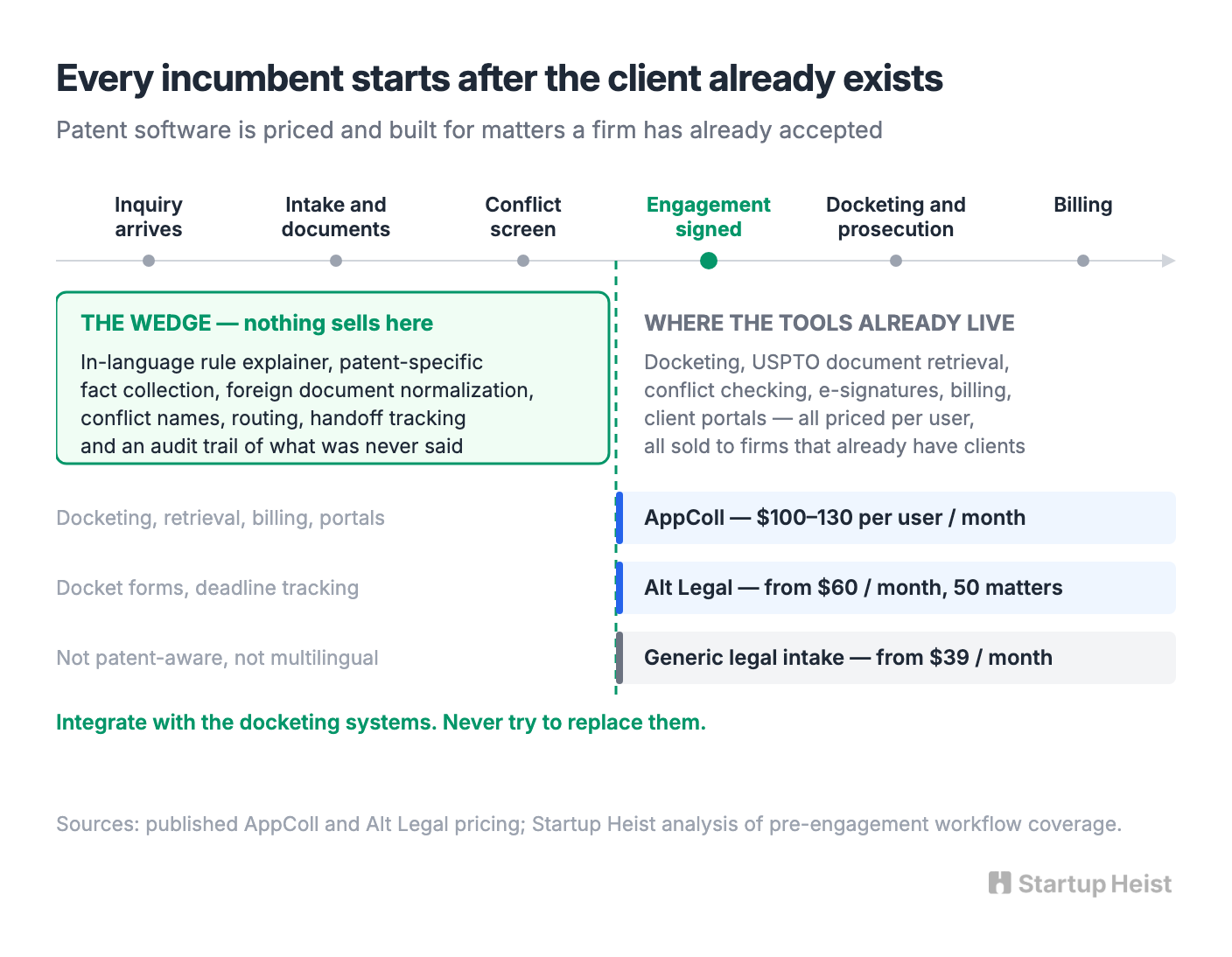
A thin two-sided marketplace fails here for predictable reasons. Applicants can't evaluate patent practitioners, and practitioners can't quote responsibly without seeing the invention, the filing history, the deadlines, and a conflicts check. Both sides are exchanging commercially sensitive documents, and every matter carries malpractice risk. Profile pages solve none of that.
Unlock the Vault.
Join founders who spot opportunities ahead of the crowd. Actionable insights. Zero fluff.
“Intelligent, bold, minus the pretense.”
“Like discovering the cheat codes of the startup world.”
“SH is off-Broadway for founders — weird, sharp, and ahead of the curve.”


