


Build the intelligence layer for dead software, not another expired-domain search engine
The domain market knows how to price a name. It can tell you how old a domain is, how many backlinks point at it, what comparable names sold for, and when the auction closes. What it can't tell you is whether that domain once belonged to a useful product somebody could profitably rebuild. That gap is the business.
When a software company shuts down, the operating business disappears before its demand does. Blog posts still recommend the product and tutorials still link to it. Customers keep it bookmarked and keep searching for the brand, the workflow it performed, and alternatives to it. The domain eventually expires, but the intent accumulated around it can survive for years.
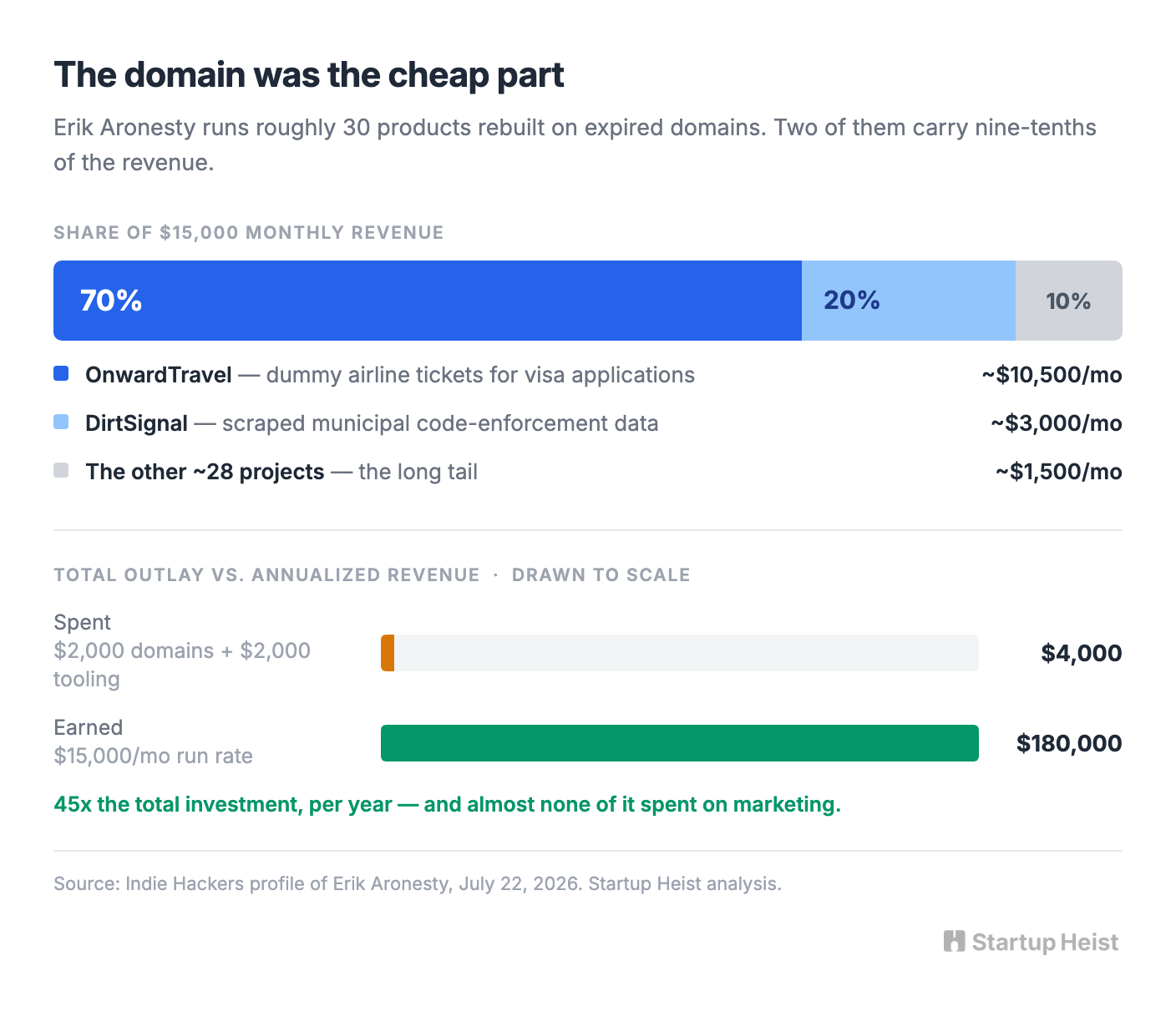
Erik Aronesty turned this into a portfolio strategy. A July 22, 2026 Indie Hackers profile lays out the numbers: he buys domains from defunct companies, builds products for the traffic and demand that remain, and now runs roughly 30 projects producing a combined $15,000 per month. The distribution is instructive. One project, OnwardTravel, a dummy-airline-ticket service for visa applications, generates about 70% of that revenue. DirtSignal, which scrapes municipal code-enforcement data, contributes another 20%. The rest is a long tail. His total outlay was around $2,000 in domain purchases plus $2,000 in tooling and hosting. A 30-year software veteran who previously built and sold ZoneEdit, he skips marketing almost entirely because the demand already exists. His rule: build exactly what the visitors came for.

The obvious heist is to copy him. Find a dead product, buy its expired domain, rebuild the useful portion, inherit the distribution. Do this and you might build your own $15,000-a-month portfolio.
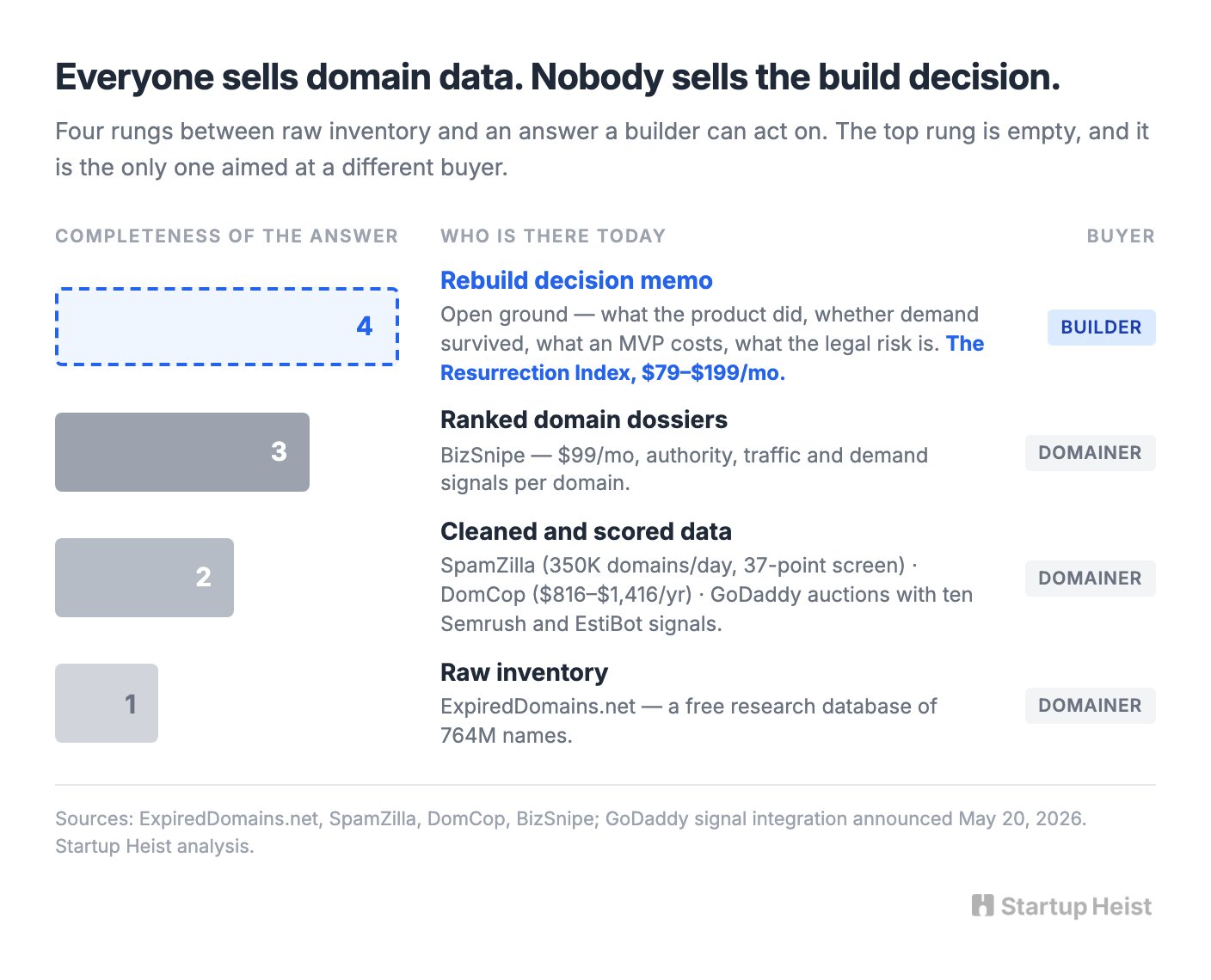
One wrinkle before you sprint: Aronesty already sells his shovel. BizSnipe, the tool he uses to identify targets, is a live product at $99 per month that scans expired-domain auctions and produces ranked domain dossiers with authority, traffic, and demand signals. The man who proved the model went and productized the scanner.
Which means the naive version of this business, an AI that summarizes expired domains, is already taken, and by the person with the most credibility to sell it. The open ground sits one layer up: a resurrection intelligence platform that answers the four questions no domain tool answers today. What did this product actually do? Does commercially useful demand remain? Could a small team rebuild it? Is acquiring and reusing the name worth the legal risk?
Those answers turn a domain listing into a startup acquisition memo, and a good one is worth thousands of dollars to the right buyer.
The whole thesis, compressed:
The money: 100 subscribers at $79, 20 at $199, and three $2,000 concierge projects put you near $17,900 MRR before the software is sophisticated.
Inside:
• Five-part dossier spec builders will pay for
• 100-point Resurrection Score with risk penalties
• 30-day build plan: manual first, automate later
• Pricing ladder from $79 feed to $7,500 sprints
The asset isn't the domain
Every expired-domain product on the market is built around the wrong unit of analysis. They treat the domain as the asset, because their customer is a domain investor who wants to park, redirect, flip, or build an affiliate site. For that buyer, domain age, keyword value, referring domains, and authority scores are the whole story.
A builder hunting for a software business wants something different: a compressed startup opportunity. The same data point reads completely differently through each lens. An investor sees 400 referring domains; a builder wants to know whether those links come from tutorials describing a still-unsolved workflow. Where an investor reads 2,000 monthly searches as keyword value, a builder asks whether former users are hunting for a replacement. And a recognizable brand, an asset in the investor's column, may be a trademark dispute waiting in the builder's.
Today's tools tell you "this domain has a Domain Authority of 31." The missing product tells you: "This domain belonged to a browser-based CSV cleaning tool with a $12 monthly plan. Its five most-linked tutorials still describe the same workflow, and several now point at a dead page. A replacement needs file upload, eight transformations, previews, exports, and Stripe billing. Estimated MVP scope: two weeks. Primary risk: spreadsheet platforms have absorbed the basic transformations." The first is a metric. The second is enough to make a decision.
A market drowning in inventory, starving for judgment
Supply isn't the constraint. ExpiredDomains.net tracks more than 764 million domains, including roughly 5.6 million expired and 580 million deleted names, and added about 1.6 million records in a single 24-hour window. ExpiredDomains.com indexes more than 19 million auction and aftermarket listings, about 17 million of them sitting in GoDaddy-owned Afternic. GoDaddy alone adds over 50,000 expired domains to its auction inventory every day. The aftermarket looks fragmented and mostly isn't.
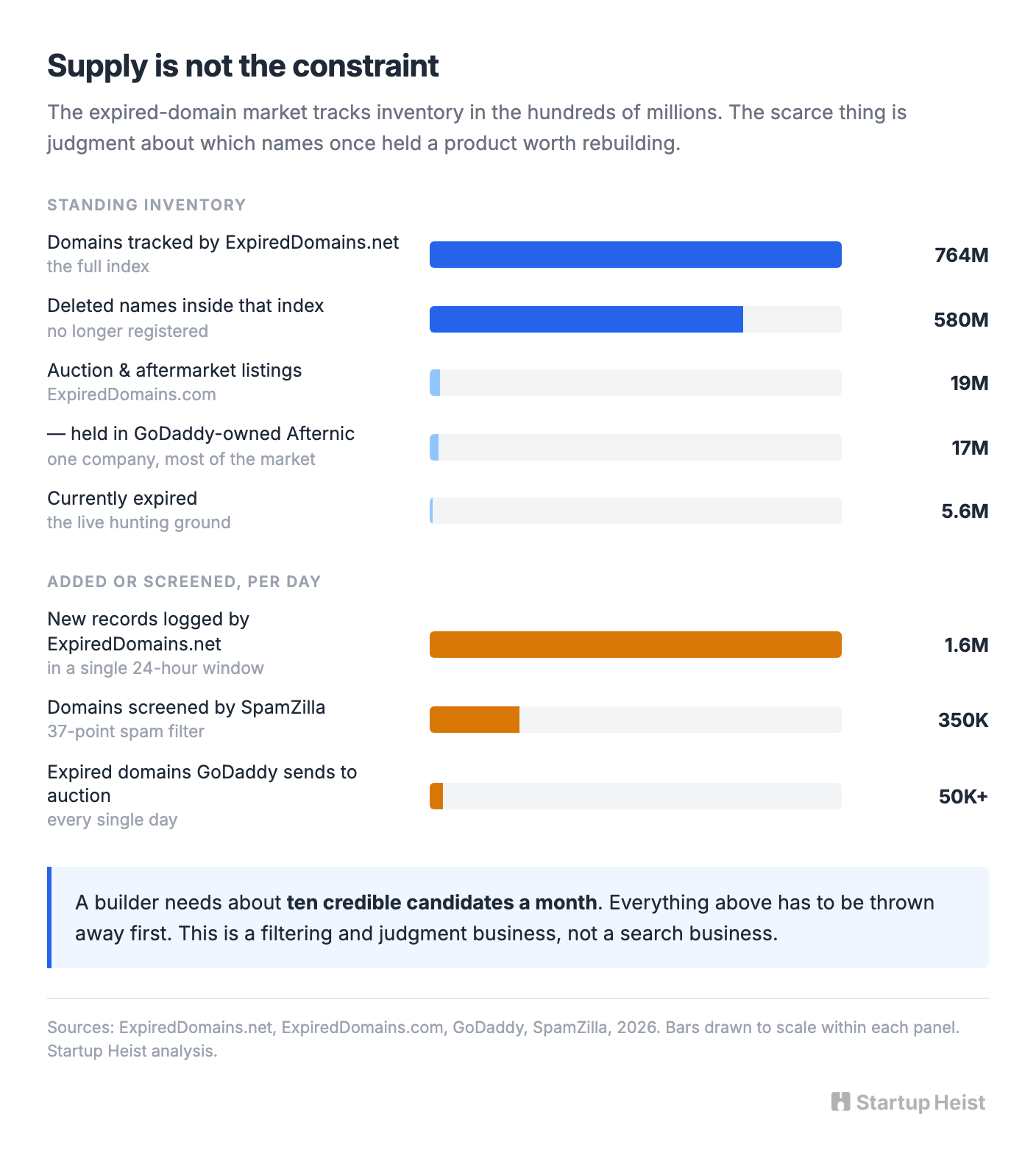
Nearly all of it is noise. The overwhelming majority of expired domains are abandoned blogs, defunct local businesses, spam sites, parked speculation, and products whose underlying need died with them. A useful intelligence tool has to eliminate almost everything, which makes this a filtering and judgment business rather than a search business.
The incumbents are well-armed on their own turf and moving up the stack. ExpiredDomains.net gives away a massive research database; SpamZilla runs 350,000 domains a day through a 37-point spam screen; DomCop aggregates auction inventory with third-party metrics at $816 to $1,416 per year. GoDaddy announced on May 20, 2026 that it had integrated ten domain signals from Semrush and EstiBot into its auctions, everything from authority scores to CPC data, and is shipping them in bulk JSON, XML, and CSV feeds for programmatic buyers. Add BizSnipe's ranked dossiers at $99 per month and the "smarter domain metrics" position is thoroughly occupied.
Competing with these platforms on domain data would be a mistake. The wedge is the question none of them is organized to answer: rank expired domains by their suitability for rebuilding the former product. GoDaddy can tell you a domain has 250 referring domains. The Resurrection Index tells you that 37 of them are tutorials for a discontinued integration, that the original product charged $19 per month, that the workflow can be recreated with two public APIs, and that three competing tools are currently catching complaints about complexity. It's a different product for a different buyer, and the buyer is the interesting part.
The buyer
The customer is the technically capable opportunity hunter, not the professional domainer: indie hackers looking for products with embedded distribution, SEO operators who can build software instead of content sites, micro-SaaS holding companies hunting small acquisitions, and developers who ship fast but struggle to choose ideas. None of them wants to sift millions of domains. They want ten credible opportunities matched to their skills, at acquisition prices between $100 and $5,000.
There's also a service buyer whose request sounds like an acquisition mandate: "Find discontinued Shopify apps with remaining organic demand, no active trademark owner, and an MVP rebuildable for under $20,000." Someone with that request will pay four figures for a good answer, and they'll pay it before your software is sophisticated.
The dossier is the product
The core deliverable is a continuously updated feed of resurrection candidates, each backed by an evidence packet with five sections.
Unlock the Vault.
Join founders who spot opportunities ahead of the crowd. Actionable insights. Zero fluff.
“Intelligent, bold, minus the pretense.”
“Like discovering the cheat codes of the startup world.”
“SH is off-Broadway for founders — weird, sharp, and ahead of the curve.”


