


The Cleanup Job Hiding Inside Every Hotel's AI Strategy
Hotels are racing to connect their inventory to ChatGPT. The connection is the easy part. The money sits in fixing the property data that decides which hotels get recommended, and whether the recommendation survives contact with a real guest.
On July 28, 2026, Radisson Hotel Group launched a hotel-discovery app inside ChatGPT. A traveler types "a family-friendly weekend in Amsterdam" or "a Paris hotel with a gym and spa near the Eiffel Tower" and gets back Radisson properties with live rates, amenities, map results, and a handoff to Radisson's booking site. It covers more than 1,000 hotels in over 100 countries.
Most coverage treated the app as the story. The more useful detail is buried in the announcement. Before the app could exist, Accenture ran Radisson through something it calls an AI Merchant Center, an accelerator whose job was to structure, validate, and optimize how Radisson's content, inventory, rate, and booking signals would be read by an AI assistant. A global consultancy built a product specifically to clean a hotel chain's commercial data before plugging it into a language model.
Radisson didn't have an AI problem. It had a data problem, and it hired one of the most expensive firms on earth to fix it. Chains can afford that. The 40-room boutique in Charleston cannot. That gap is the business:
The money: 150 boutique properties at $349 a month is roughly $52K MRR, on top of $1,500 to $5,000 in implementation fees per hotel.
Inside:
• Policy prose turned into computable rules
• 8-week MVP scope for two people
• Four-tier pricing with implementation fees
• Cold audit email that opens the sale
The obvious response is to connect independent hotels to AI travel assistants and build the MCP server nobody else built. That door is already crowded. SiteMinder, which connects 53,000 hotels across 150 countries, shipped two AI distribution products in April 2026, one exposing direct rates to conversational platforms and one feeding AI intermediaries, with DirectBooker as its first demand partner. Listo, founded in London in 2025, sells exactly that pitch: GEO plus an MCP layer over existing PMS and booking engines. Agentic Hospitality launched on Google Cloud with a travel operating system claiming connections to over 700 back-end systems. Cloudbeds and Mews own the underlying operational data and can extend into the category whenever they want. Building another pipe means racing four funded companies to a commodity.
The opening sits one level up:
Build the merchandising layer for independent hotels. Turn fragmented operational data, vague marketing copy, contradictory policies, and knowledge that lives only in the general manager's head into a verified, machine-readable product catalog, one that works on the hotel's own website today and feeds every agent channel that matures later.
Distribution tells an assistant that a room is available. Merchandising is what tells it this is the right room for the person asking.
The New Shelf Is a Sentence
Hotel discovery was built around filters. Pick a city, enter dates, set a price ceiling, check "parking" and "pet friendly," sort the grid. Twenty years of inventory structure follows from that interface.
Conversation breaks it. Travelers now ask which room is quiet enough for a light sleeper, whether they can bring two dogs and what the total fee will be, whether two adults can work remotely without one of them sitting on the bed, whether there's step-free access from the street to an accessible shower, whether "free breakfast" includes kids.
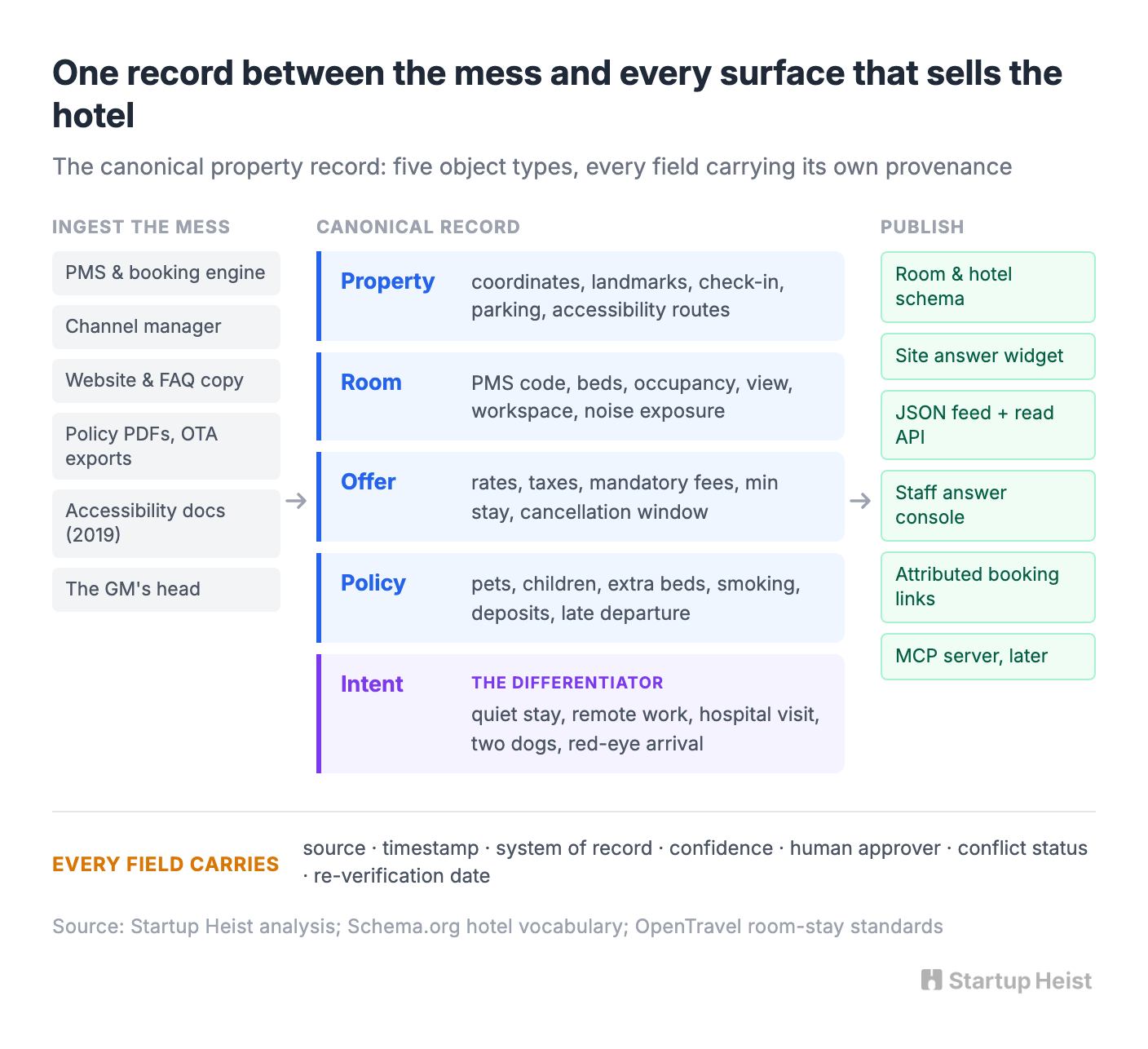
Almost none of those answers live in one place. Rates sit in the property-management system. Room descriptions sit in the booking engine. The pet fee is buried on a policy page. Parking says three different things on Google, Booking.com, and the hotel's own site. Accessibility details exist in a Word document somebody made for an audit in 2019. Whether the desk is usable for a full workday is knowledge held by the front-office manager and nobody else.
This gets treated as a content problem. It's a product-data problem, and the industry already half-solved it on paper. Schema.org covers hotels, rooms, occupancy, beds, amenities, and offers. OpenTravel has spent years standardizing room stays, rate rules, and availability. The industry has also watched the same failure mode for decades: experiential detail gets stripped as a property moves through distribution systems until it lands as a commodity room type. Searching for "a room" tolerates commodity data. Describing a situation requires attributes, exceptions, evidence, and some notion of confidence.
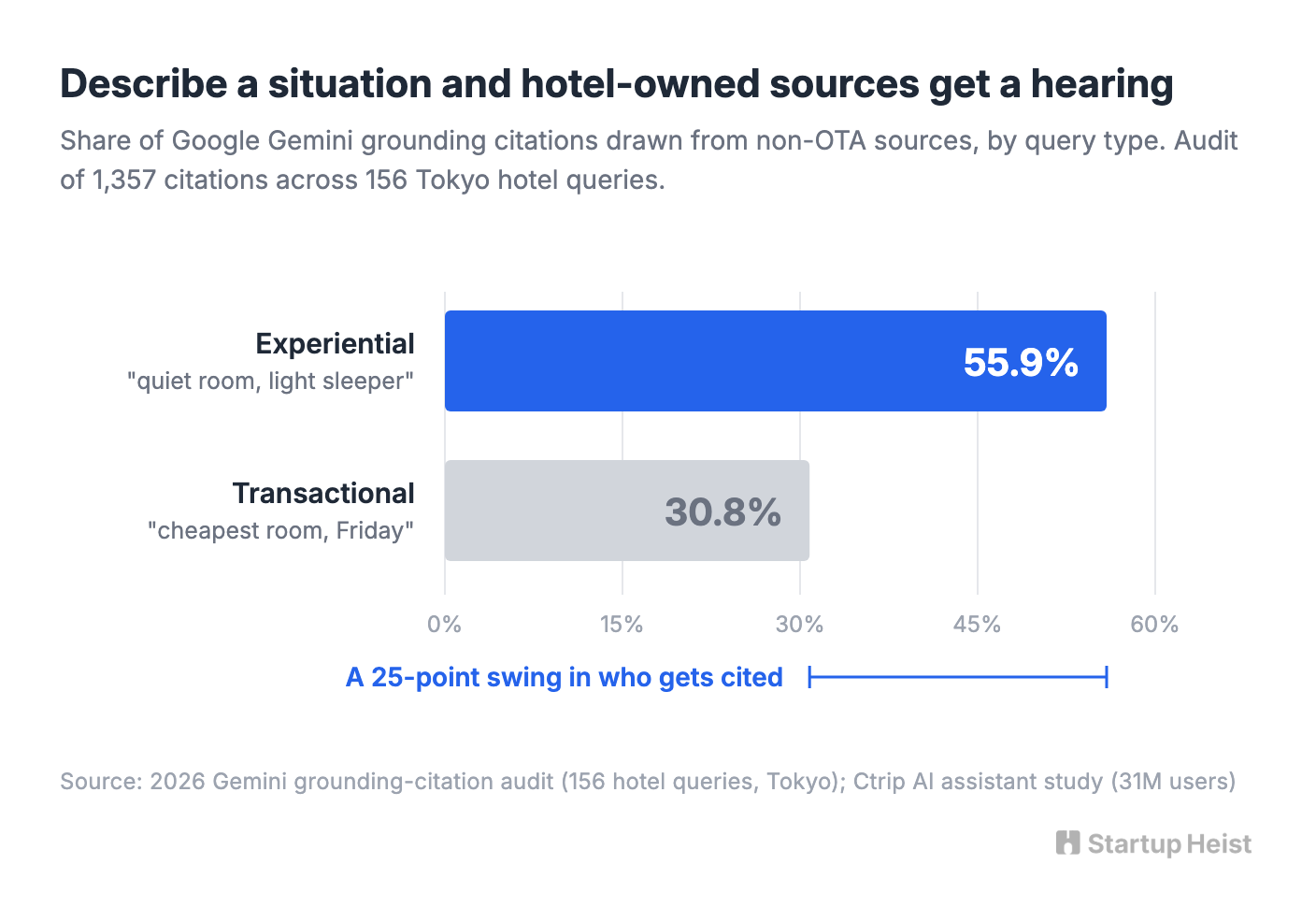
There's early evidence the shift is real. A 2026 audit of Google Gemini analyzed 1,357 grounding citations across 156 hotel queries in Tokyo and found what the researchers called an intent-source divide: experiential queries pulled 55.9% of their citations from non-OTA sources, against 30.8% for transactional queries. A 25-point gap. A separate study of 31 million users of Ctrip's embedded AI assistant found travelers reach for chat on exploratory, hard-to-keyword problems, interleaving it with conventional search rather than replacing search outright.
Neither finding is a ranking formula. Together they say something useful: when a traveler describes a situation instead of setting a filter, hotel-owned information gets a hearing it never gets on a price grid. And most independent hotels have nothing worth citing.
Why Hotels Will Pay
Independent hotels don't need another AI dashboard. They need something attached to a bill they already resent. Guest appetite isn't the obstacle: SiteMinder's Changing Traveller Report 2026 found eight in ten travelers want AI assistance while they book.
Cloudbeds analyzed 90 million bookings across 180 countries for its 2026 State of Independent Hotels report. OTAs took 63.4% of independent-hotel bookings, with some markets pushing toward 80%. Global RevPAR fell 5.4%. OTA reservations cancelled at 21.8%, more than double the 10.6% direct rate. Independents are paying more for demand that shows up less reliably.
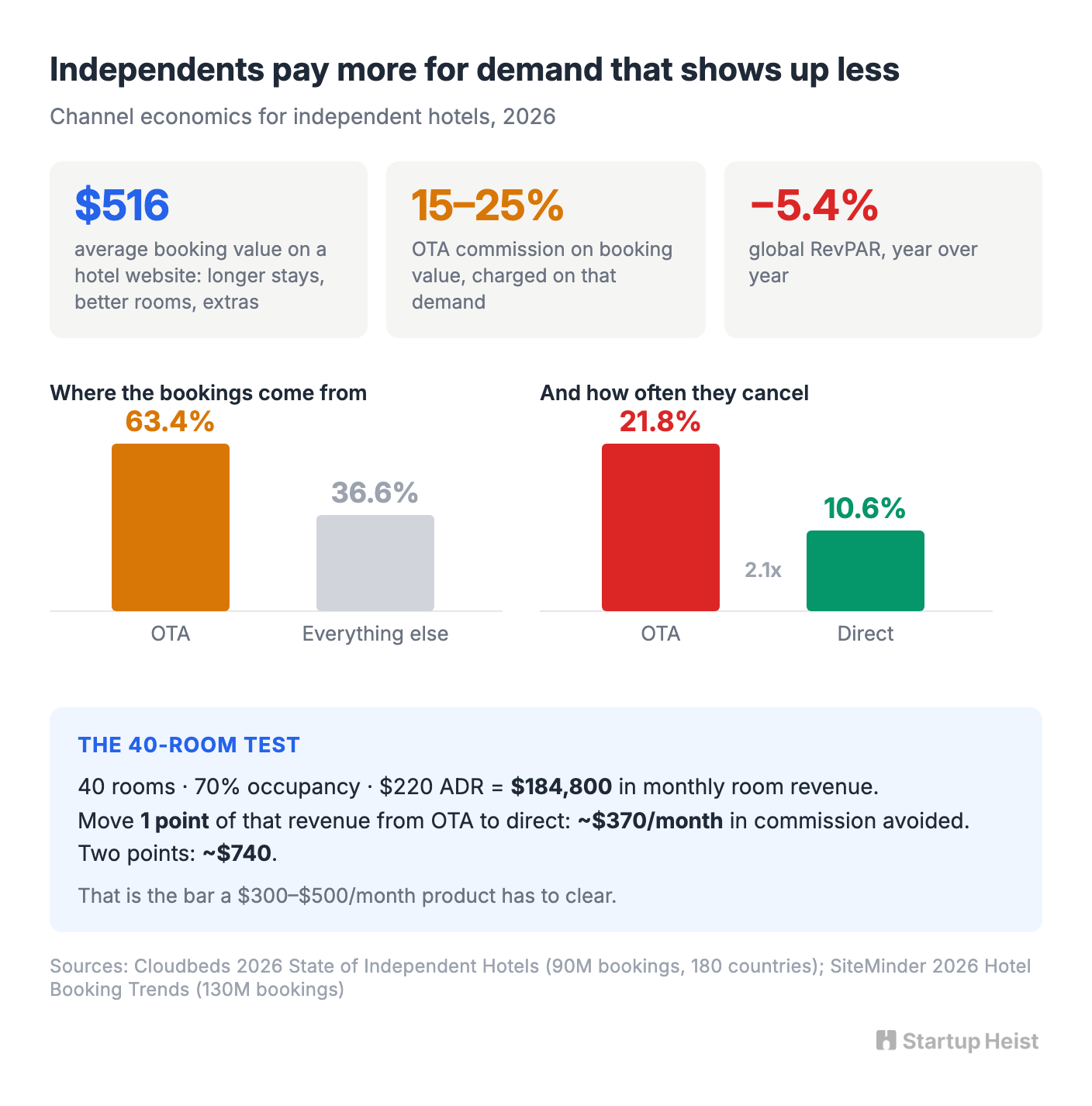
The commission on that demand runs 15% to 25% of booking value, and the bookings are smaller. Across 130 million bookings in its 2026 Hotel Booking Trends report, SiteMinder found hotel websites averaged roughly $516 per booking, far above what the same reservation is worth through an OTA, because direct guests book longer stays, better rooms, and extras.
Run it on a 40-room property at 70% occupancy and a $220 average daily rate. That's roughly $184,800 in monthly room revenue. At 63.4% OTA share and a 20% commission, moving a single percentage point of total room revenue from an OTA to direct avoids about $370 in monthly commission. Two points, about $740.
Direct acquisition has its own costs: payment fees, software, marketing, the occasional metasearch bill. The point of the math is the scale of the bar. A $300 to $500 monthly product doesn't need to restructure the channel mix. It needs to influence a handful of bookings and prove it did, and proving it is the part nobody has solved.
The Product: A Verified Property Record
The product sits between the hotel's existing systems and every surface that needs to describe or sell the property. It isn't a PMS, a booking engine, or a travel marketplace. It's a canonical, continuously updated record of what the hotel sells, who it suits, what its rules actually mean, and how much anyone should trust each answer.
Unlock the Vault.
Join founders who spot opportunities ahead of the crowd. Actionable insights. Zero fluff.
“Intelligent, bold, minus the pretense.”
“Like discovering the cheat codes of the startup world.”
“SH is off-Broadway for founders — weird, sharp, and ahead of the curve.”


