


The Side-Effect Demand Radar
The pharmaceutical industry sees a drug side effect as a safety problem. A consumer-products founder should sometimes see something else: a market forming in public.
When millions of people start taking the same medication, the drug does more than change their bloodwork. It changes their daily life. And they talk about it. They flood Reddit threads, Facebook groups, TikTok comments, and telehealth communities with the same practical questions, over and over: Why am I suddenly exhausted? What helps the nausea? Is anyone else losing hair? How do I get enough protein when I can barely eat? Why am I cold all the time?
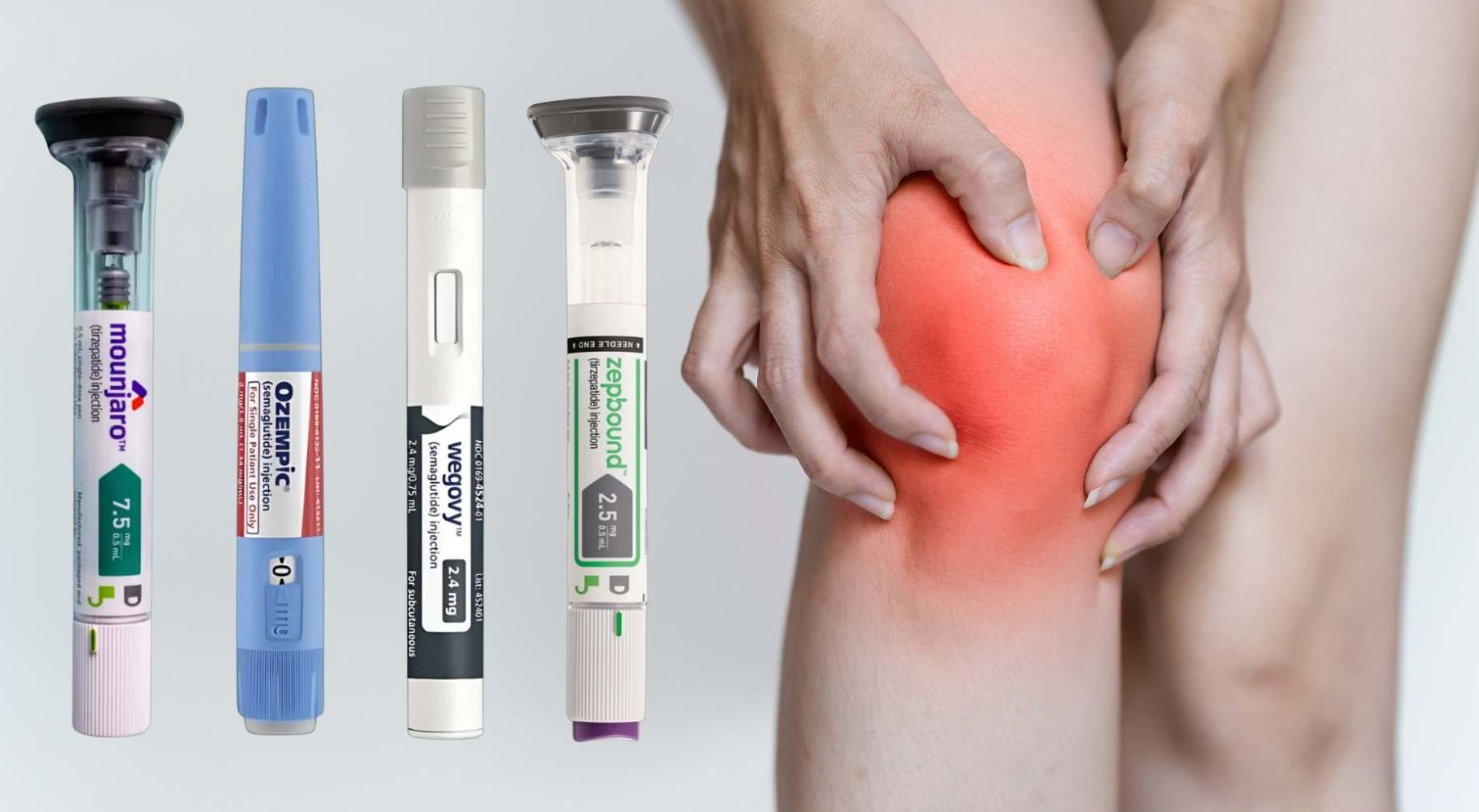
Those threads are messy and anecdotal. They prove nothing about what a drug actually causes. But they carry commercial value that most founders walk right past.
The opportunity is a GLP-1 side-effect demand radar: a social-signal intelligence product that tracks public patient conversations, identifies rising symptom clusters, and turns them into product-development briefs for CPG brands, DTC founders, and telehealth clinics.
It does not tell patients what to take. It does not diagnose anything. It does not pretend to replace clinical research or formal pharmacovigilance. It answers one narrower, more commercially useful question: what are medicated consumers struggling with right now that product builders have not solved yet? That distinction is the entire heist.
Here's the opportunity:
The money: 40 feed subscribers, 30 builder accounts, 5 clinics, and one custom report lands around $38K MRR with fewer than 80 customers. No venture capital required.
Inside:
• Four-tier pricing from $149 feed to $25K reports
• Phased build: manual brief before any software
• Five-dimension cluster scoring model
• Regulatory-friction score to stay lawful
• Founder-led GTM with outreach scripts
The signal hiding in plain sight
In April 2026, researchers published a study in Nature Health that should make any consumer founder sit up. They analyzed 410,198 Reddit posts written between May 2019 and June 2025 that mentioned semaglutide or tirzepatide, the active ingredients behind blockbuster GLP-1 drugs like Ozempic, Wegovy, Mounjaro, and Zepbound.
Among 67,008 users who self-reported taking the medications, 43.5% described at least one side effect. Gastrointestinal symptoms dominated: nausea showed up in nearly 37% of those reports, followed by fatigue, vomiting, constipation, and diarrhea. But the researchers also surfaced complaints the official labels barely mention. Roughly 4% of users reporting side effects described reproductive symptoms, including irregular cycles and abnormal bleeding. Others reported chills and hot flashes, temperature swings that don't appear cleanly in trial data. Roughly one in eight described psychiatric symptoms like anxiety, low mood, or insomnia.
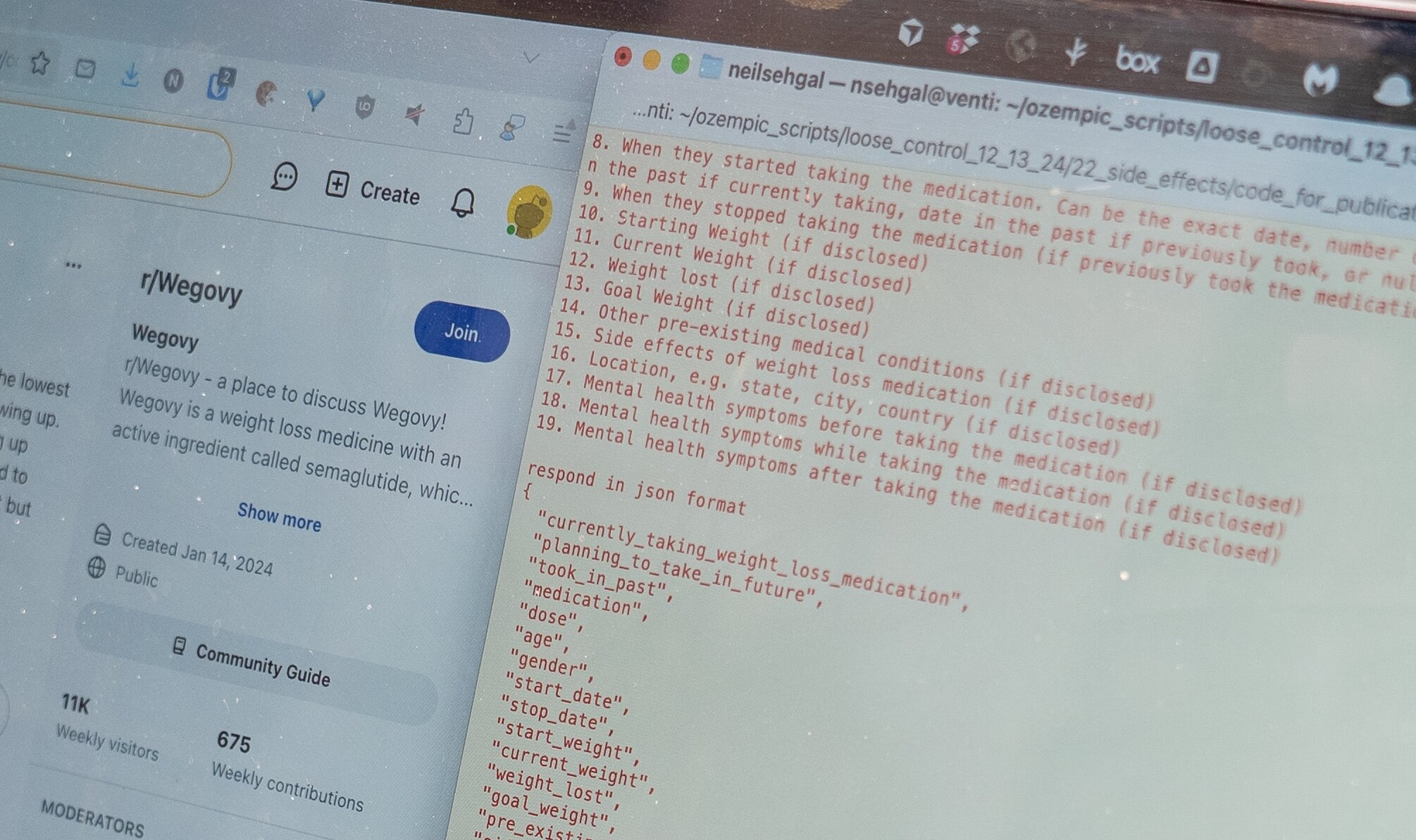
The study framed this as a pharmacovigilance win: social media can flag safety signals that clinical trials miss. True, and incomplete.
Those same posts contain something brands spend millions to obtain: unsolicited, emotionally vivid descriptions of unsolved problems from a fast-growing population with money, motivation, and an urgent desire for relief. Traditional consumer research asks people what they want. Complaint threads show you what they are already trying to fix at 11 p.m. with whatever's in the cabinet.
A founder reading those threads by hand will start seeing the same aftermarket gaps repeat: gut-friendly food and hydration for the nausea crowd, protein formats people can actually keep down, hair and skin support for rapid weight loss, women's-health education for the menstrual changes, clinician-guided programs for the people about to quit. The radar doesn't bless any one of those products. Some complaints are poorly understood. Some fixes need clinical validation. Some categories are far safer to enter than others. But a ranked feed of recurring complaints beats another generic trend report every time.
Why GLP-1 is the perfect wedge
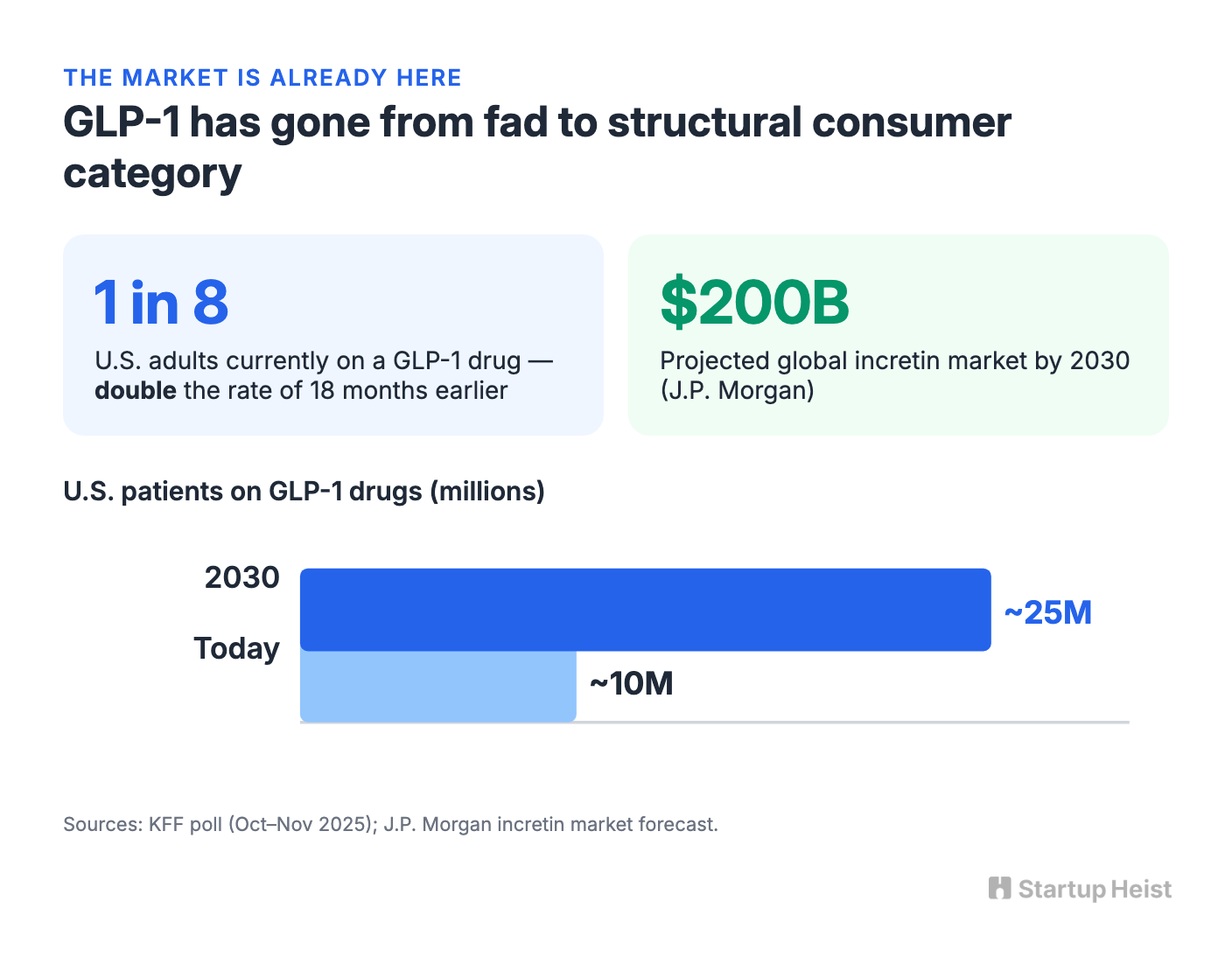
GLP-1 isn't a fringe wellness fad. It's becoming a structural consumer category. A KFF poll fielded in late October and early November 2025 found that one in eight U.S. adults said they were currently taking a GLP-1 drug, double the rate from eighteen months earlier. Women report it more than men. Among adults 50 to 64, it's now better than one in five. J.P. Morgan projects the broader incretin market could hit $200 billion globally by 2030, with roughly 25 million Americans on these drugs by then, up from around 10 million today.
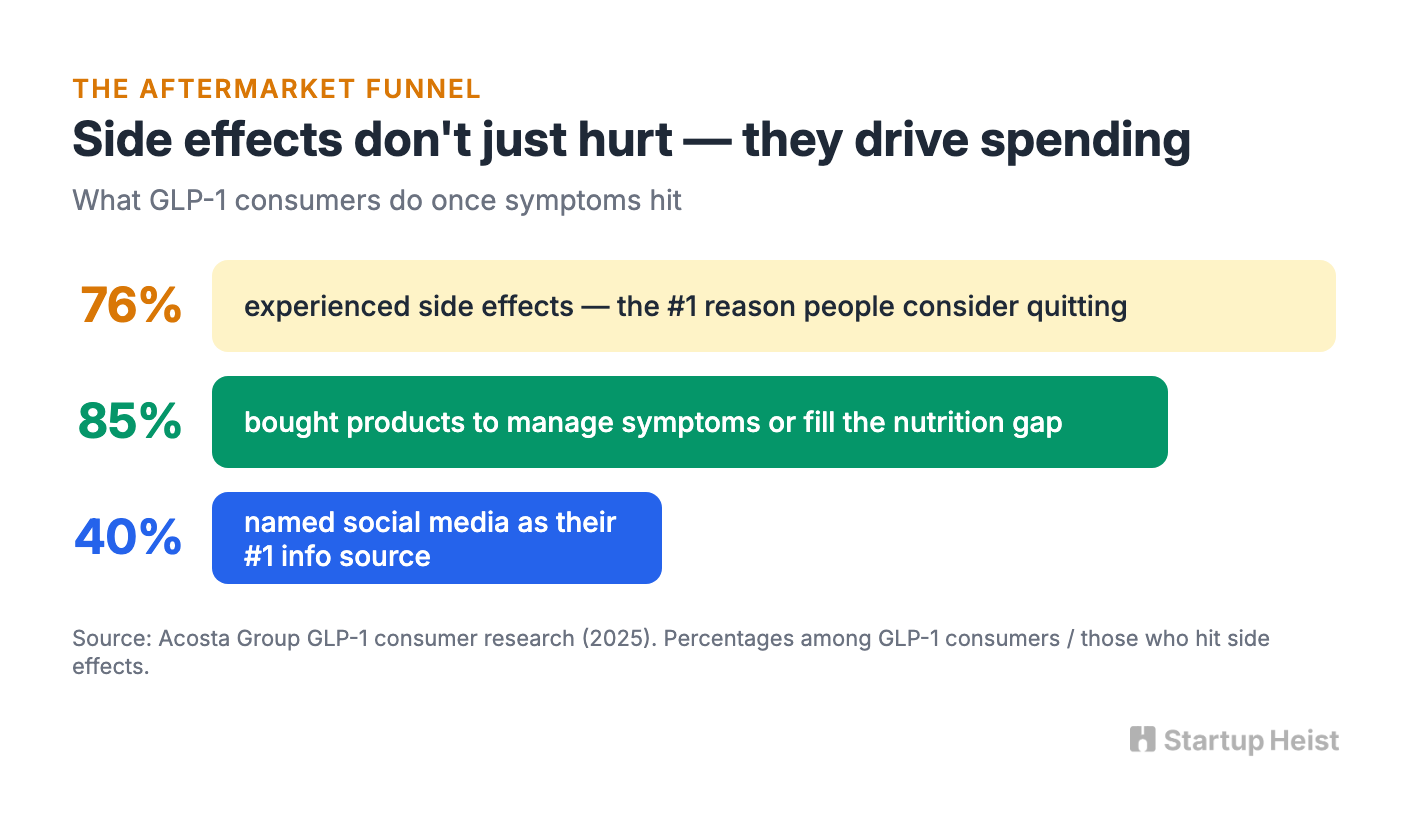
The aftermarket is already forming around that crowd, and the numbers are loud. Acosta Group reported in 2025 that 76% of GLP-1 consumers experienced side effects, the leading reason people consider quitting. Of the people who hit side effects, 85% bought products to manage them or fill the nutrition gap. Around 70% researched products and health questions, and 40% named social media as their primary information source. By 2026, Acosta's follow-up showed GLP-1 use bleeding across the store: produce, yogurt, protein shakes and bars, hydration, gut health, hair care, body care, skincare.
You can watch the shelf fill in real time. Foodgraph, a CPG product-data company, counted 99 products marketed for GLP-1 support, up from 52 in an earlier release, and published a catalog of 50 brands chasing the opportunity. The radar isn't inventing a market. The market exists. What's missing is navigation.
Brands already know GLP-1 consumers want protein, hydration, gut support, and personal care. Broad category knowledge is table stakes now. The edge has moved downstream, to the questions a category report can't answer: Which complaints are accelerating this month? Which are spiking among women, older adults, or people changing dose? Which needs are already saturated, and which are still handled by improvised Reddit advice? Which solutions are credible enough to sell without stepping into regulatory trouble? That's where a specialized signal feed earns its subscription.
Not another social-listening dashboard
The easy version of this is a generic dashboard with sentiment scores and a word cloud. It demos beautifully and dies in three months.
That space is already taken. Brandwatch sells large-scale consumer-intelligence tooling with custom dashboards, AI analysis, and a Reddit partnership that includes full firehose access. A new entrant can't win by scraping the same posts and shipping a cleaner interface. The wedge isn't access to conversations. It's domain-specific interpretation: turning noise into a small number of opinionated, decision-ready calls.
The core product should start as an email report, not a SaaS platform. Each weekly issue does four things.
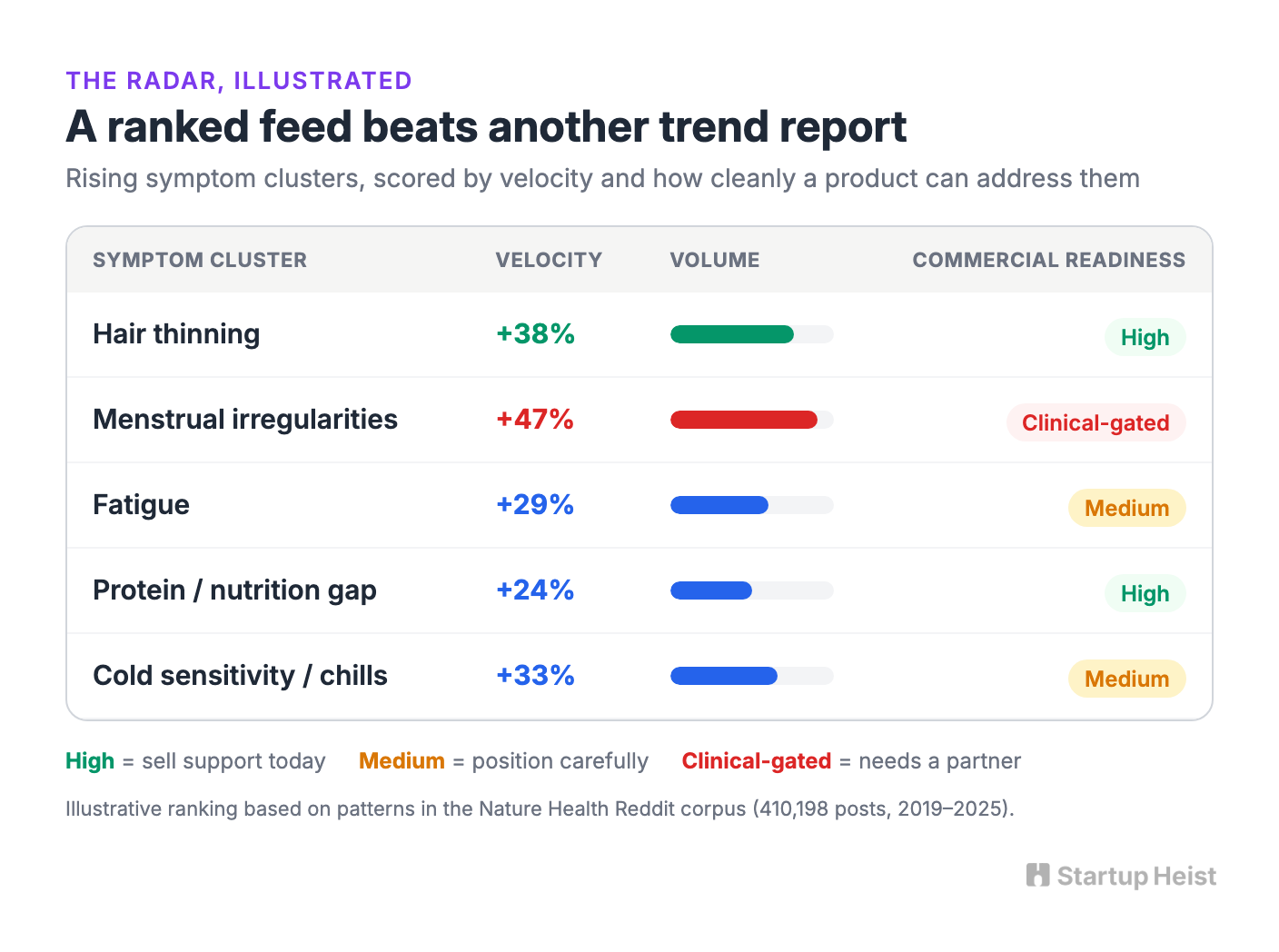
First, it ranks the fastest-rising symptom clusters by volume and velocity, with a confidence rating and a commercial-readiness flag. Hair thinning climbing 38% with high readiness reads very differently than menstrual irregularities climbing 47% that you can't touch without a clinical partner.
Unlock the Vault.
Join founders who spot opportunities ahead of the crowd. Actionable insights. Zero fluff.
“Intelligent, bold, minus the pretense.”
“Like discovering the cheat codes of the startup world.”
“SH is off-Broadway for founders — weird, sharp, and ahead of the curve.”


