


The Fit Passport: A Shopify App That Asks Shoppers Instead of Tracking Them
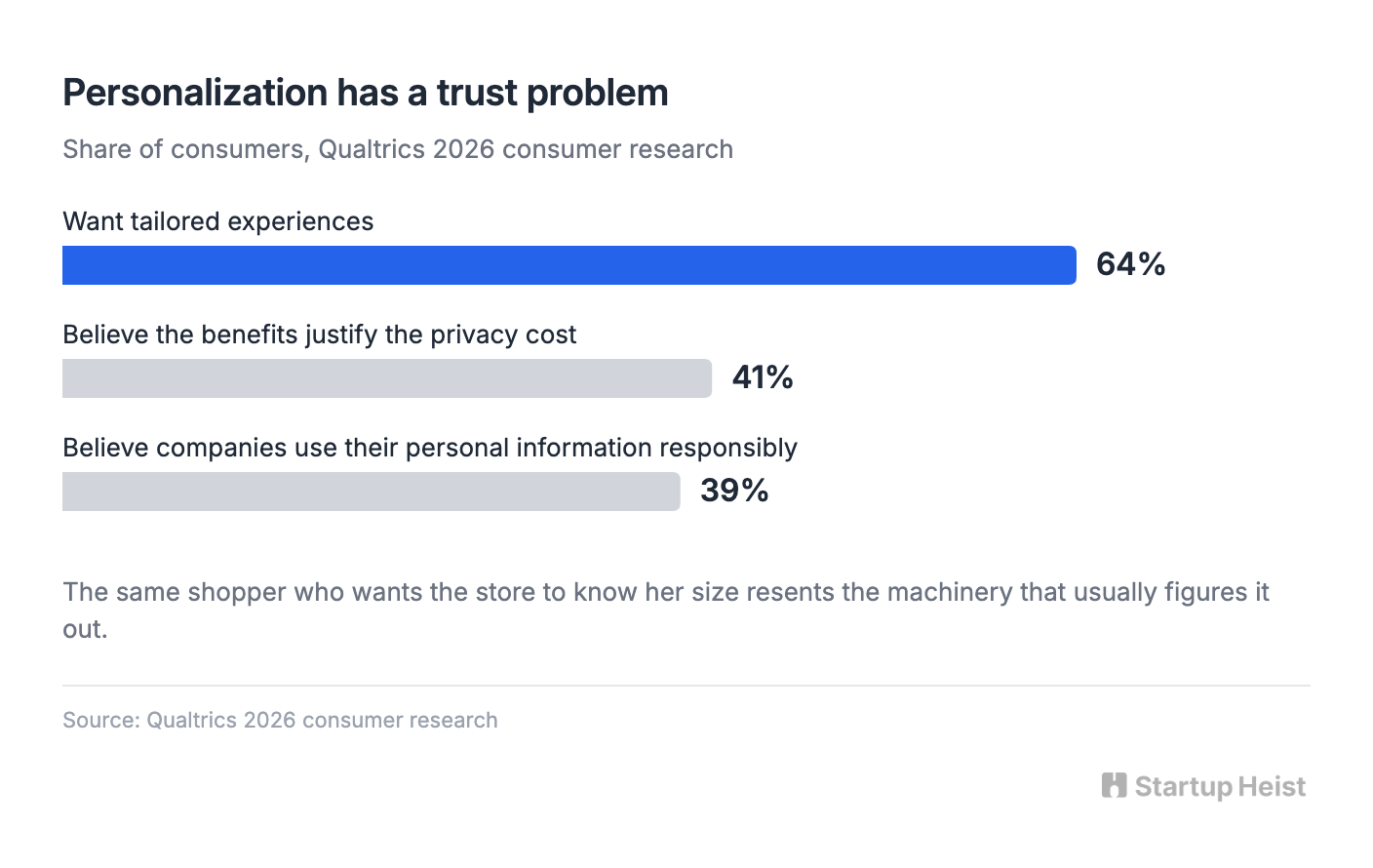
Personalization has a trust problem, and the numbers describe it precisely. Qualtrics' 2026 consumer research found that 64% of consumers want tailored experiences, while only 41% believe the benefits justify the privacy cost, and just 39% believe companies use their personal information responsibly. The same shopper who wants the store to know her size resents the machinery that usually figures it out.
The machinery is where the resentment comes from. The standard ecommerce personalization stack learns about a shopper by accumulating browsing history, advertising identifiers and third-party behavioral data, then infers what she might want. It's expensive, increasingly regulated, and it produces recommendations the shopper can't inspect or correct.
There's a simpler design. Let the shopper tell the store what matters for the purchase in front of her. "I usually wear a medium." "I prefer a relaxed fit." "My waist is 32." Marketers call this zero-party data: information the customer hands over on purpose because it gets her something. Use those inputs alone to make a recommendation, explain why, and let her decide whether the profile survives the session.

The temptation is to build that as a universal personal data wallet, a consumer product that carries preferences to every store on the internet. That version has one of the nastiest cold-start problems in software: consumers won't install a wallet until thousands of stores accept it, and stores won't integrate until millions of consumers carry one. Nobody moves first.
The better entry is merchant-first. Build a Shopify app for one narrow retail vertical that captures explicit shopper preferences, turns them into better purchase decisions, and gives shoppers control over whether those preferences get reused. Start with apparel fit. If that works, the quiz gradually becomes a passport. If enough merchants adopt the same preference vocabulary, the passport becomes an identity-independent preference layer for ecommerce and for the AI shopping agents Shopify is building rails for. That second business could be large, and the only way to reach it runs through the first one.
Here's the short version.
The money: Fifty apparel merchants at $249 a month is roughly $12,500 MRR before implementation fees; 100,000-plus fit-sensitive Shopify stores have no sizing tool installed.
Inside:
• Full MVP scope, deterministic rules first
• Pilot-to-Scale pricing with implementation fees
• The 80/20 holdout test that proves ROI
• Cold email template that offers an experiment
Why apparel is the beachhead
Online retail keeps growing. U.S. ecommerce reached $340.2 billion in the second quarter of 2026, up 12.2% year over year, and now represents 17.1% of retail sales. Shopify gives a solo builder an unusually concentrated way into that market: its merchants generated $378.4 billion of GMV in 2025, more than 14% of U.S. ecommerce, and the second quarter of 2026 alone produced $115.6 billion.
Apparel has something generic personalization software lacks, which is a painful, measurable failure condition. The customer buys the wrong thing and sends it back.
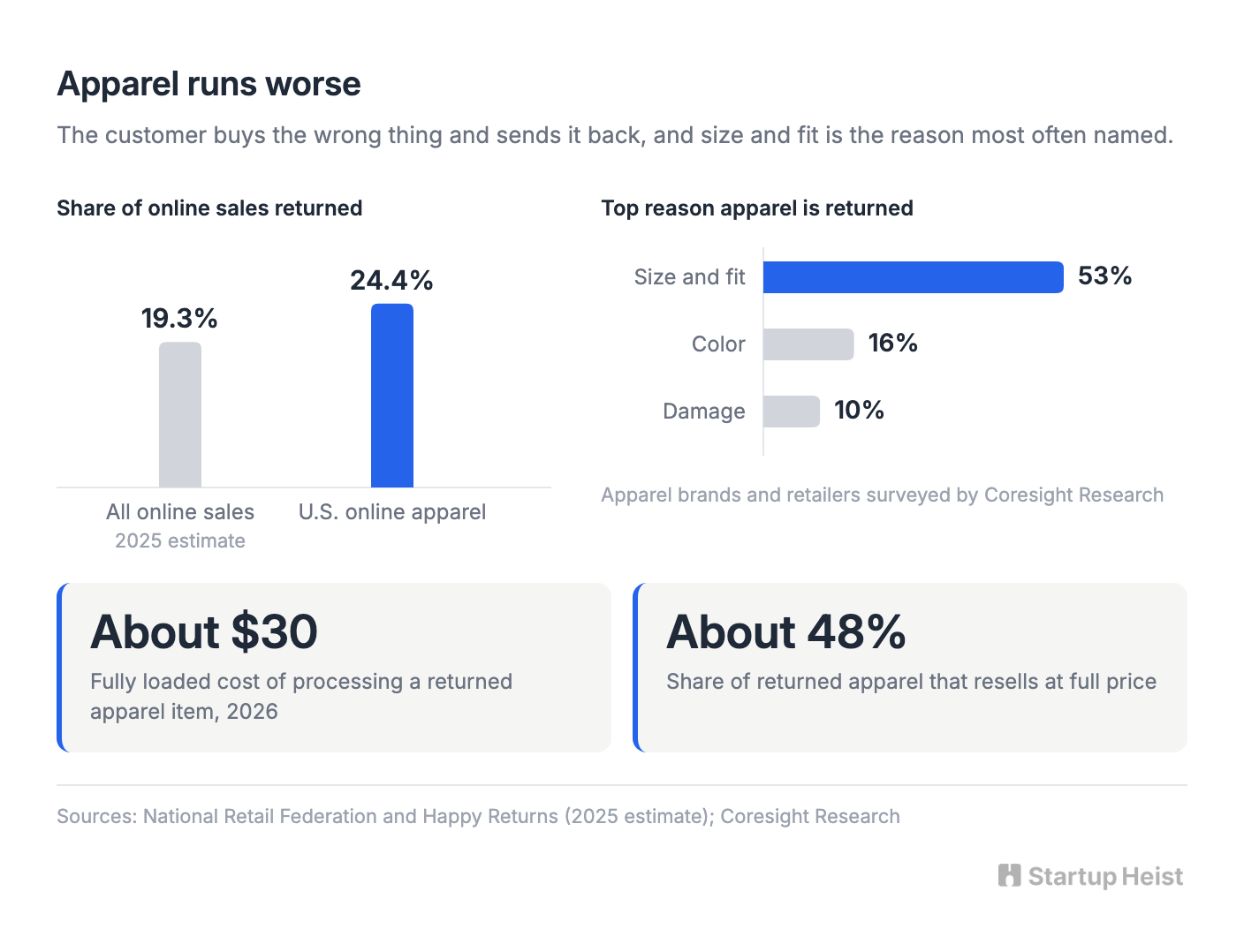
The National Retail Federation and Happy Returns estimated that 19.3% of all online sales would be returned in 2025. Apparel runs worse. Coresight Research put the U.S. online apparel return rate at 24.4%, and when it surveyed apparel brands and retailers about why, 53% named size and fit as the top reason, ahead of color at 16% and damage at 10%. Rithum's 2025 survey of more than 6,000 consumers across five countries found 61% cited poor fit as a main reason for returning items. Every one of those returns costs the merchant real money: the fully loaded cost of processing a returned apparel item runs about $30 in 2026, and only about 48% of returned apparel resells at full price.
So the pitch to a merchant has nothing to do with AI personalization. You're selling help getting more customers into the right product the first time, priced against a return cost the merchant can already see on a spreadsheet.
There's a second reason to prefer apparel over broad personalization. Fit requires a structured vocabulary. A shirt has cut, stretch, silhouette, chest allowance and length. A shopper has usual sizes, a preferred fit, a few measurements and a reference brand that fits well. A useful recommendation translates between the two, and that translation layer can become proprietary in a way a generic quiz never will.
The category looks crowded and is nearly empty
People have tried this before. Easysize's Fit Quiz has been on the Shopify App Store since November 2021, starting at $35 a month plus $0.15 per recommended item added to cart, and promises apparel merchants fewer returns. WAIR charges $125 a month for its first 250 orders and $0.50 per order after. Lyfsize estimates body measurements from two smartphone photos starting at $40 a month, and YouFit does the same from a free tier up. Around them sit the general quiz builders: Octane AI from $50 a month, Presidio's Quiz Kit at $59, and Rebuy, which advertises entry at $25 a month and climbs to several hundred dollars a month with order volume.
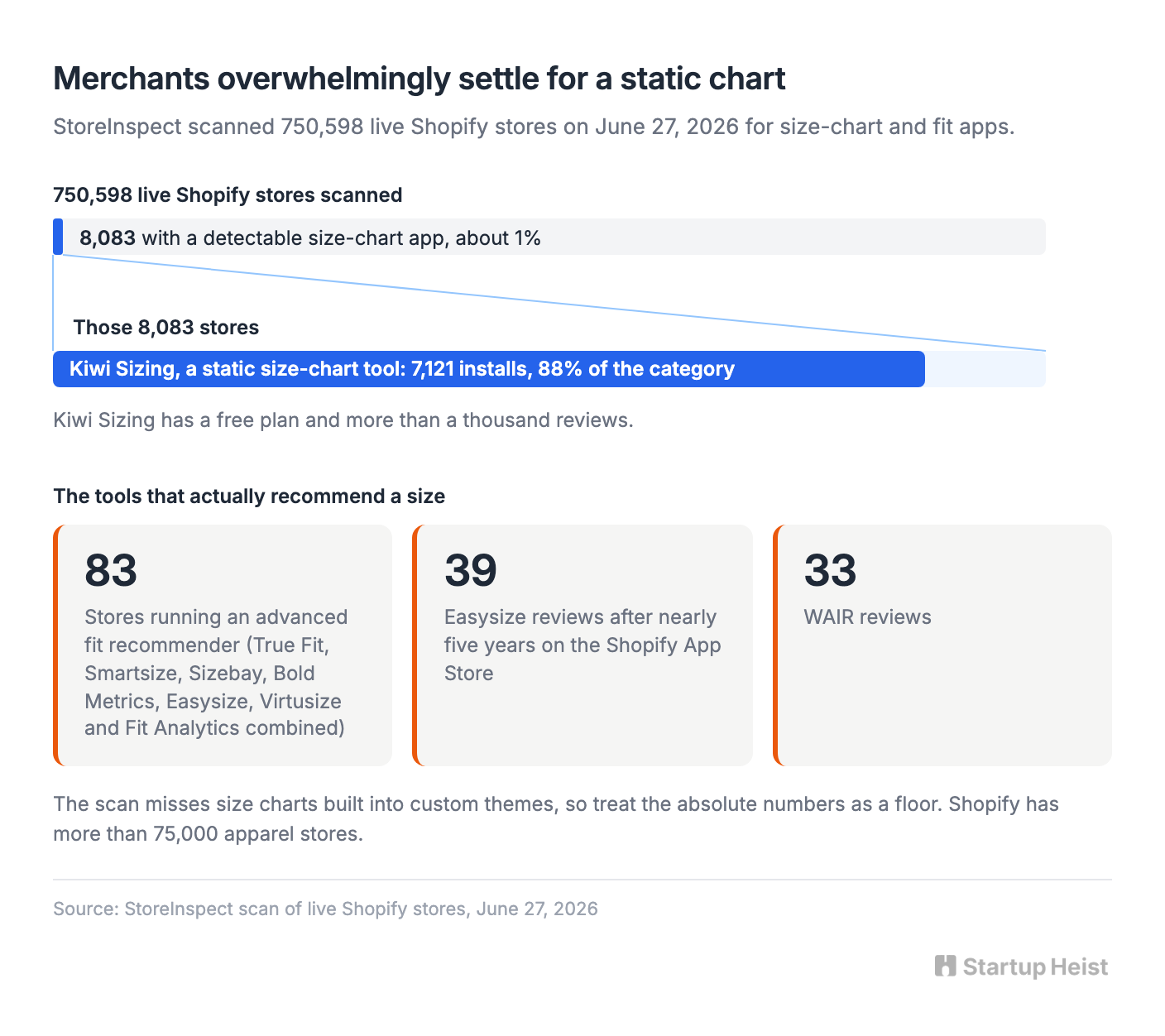
Now look at adoption. StoreInspect scanned 750,598 live Shopify stores on June 27, 2026 and found a detectable size-chart app on 8,083 of them, about 1%. Kiwi Sizing, a static size-chart tool with a free plan and more than a thousand reviews, accounted for 7,121 of those installs, 88% of the category. The advanced fit recommenders (True Fit, Smartsize, Sizebay, Bold Metrics, Easysize, Virtusize and Fit Analytics combined) showed up on 83 stores. Easysize has 39 reviews after nearly five years. WAIR has 33. The scan misses size charts built into custom themes, so treat the absolute numbers as a floor, but the shape is unmistakable: merchants overwhelmingly settle for a static chart, and the tools that actually recommend a size have barely penetrated a platform with more than 75,000 apparel stores.
Two things explain that gap, and both are opportunities. Existing fit tools ask merchants to trust a black box. The recommendation appears, the shopper has no idea why, and the merchant can't verify it did anything for returns. They're also built around what the merchant learns about the shopper, which drags every privacy obligation the merchant already dreads into a widget that was supposed to make life easier.
There's no opening in "Shopify quiz software," and probably not much in "another size recommender." The opening is a different product architecture.
The Fit Passport
Make the shopper's declared preferences a first-class object: visible, explicitly shared, narrowly scoped, revocable and eventually reusable. For apparel, the shopper-facing version looks like this:
Unlock the Vault.
Join founders who spot opportunities ahead of the crowd. Actionable insights. Zero fluff.
“Intelligent, bold, minus the pretense.”
“Like discovering the cheat codes of the startup world.”
“SH is off-Broadway for founders — weird, sharp, and ahead of the curve.”


