


There's a quiet software gap inside the trades, and most founders are looking right past it.
The enterprise side of plumbing, HVAC, electrical, and mechanical service is getting modernized fast. ServiceTitan crossed $1 billion in annualized revenue in fiscal 2026, with full-year revenue of $961 million on 24% growth, gross dollar retention above 95%, and FY2027 guidance of $1.11–$1.12 billion. XOi, the field-service media platform, took $230 million from KKR in February 2025 and used part of it to acquire Specifx, an HVAC equipment-data company that adds roughly 85,000 model families to its dataset. Bluon launched PartsConnect on April 13, 2026, plugging a database of more than 30 million HVAC model numbers across 240-plus OEMs into a parts-sourcing tool that connects technicians to local distributor inventory.

That stack of headlines makes the field service management market sound finished. It isn't.
Here's the opportunity:
The money: 300 small shops at $79/month is roughly $24K MRR. 1,000 shops is $79K MRR. A bootstrapped, founder-led path to a real micro-SaaS.
Inside:
• Boiler and hydronics wedge in cold-weather states
• 6-10 week MVP scope and RAG architecture
• Four-tier pricing built for small shops
• Concierge sales motion and outreach template
Most founders frame the opportunity as "AI for all field service." That market is too broad, too capital-heavy, and already crowded with funded incumbents. The real opening is much narrower:
A mobile micro-SaaS for small plumbing, HVAC, electrical, boiler, and mixed-service shops that turns equipment photos or model numbers into a structured field workflow — identify the unit, retrieve the manual, summarize the relevant pages, draft parts notes, and generate clean invoice language — without forcing the contractor to migrate onto a full operating system.
A field-side productivity tool for sub-20-tech shops that still live in the messy middle: paper manuals, PDF folders crammed onto a desktop, texts to the boss, distributor phone calls, scribbled invoice notes, and technicians trying to remember what they saw on the last job.
That's the heist.
The Market Is Big. The Opening Is Small.
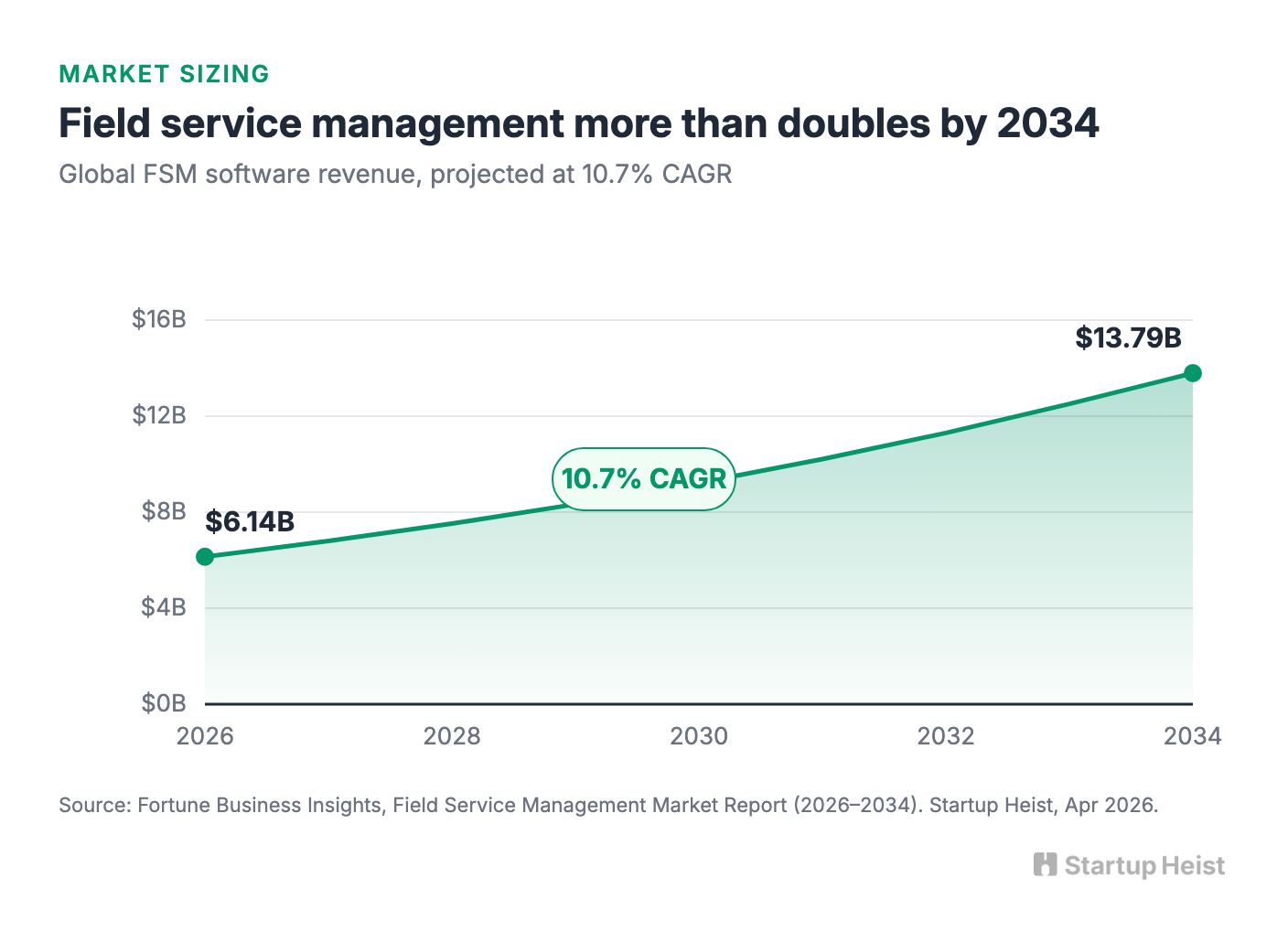
Fortune Business Insights values the global field service management market at $6.14 billion in 2026, growing to $13.79 billion by 2034 at a 10.7% CAGR. Markets don't get that large unless real money is already moving to digitize dispatch, scheduling, invoicing, customer records, inventory, and field operations. Broad markets create broad incumbents, and broad incumbents create gaps underneath them.
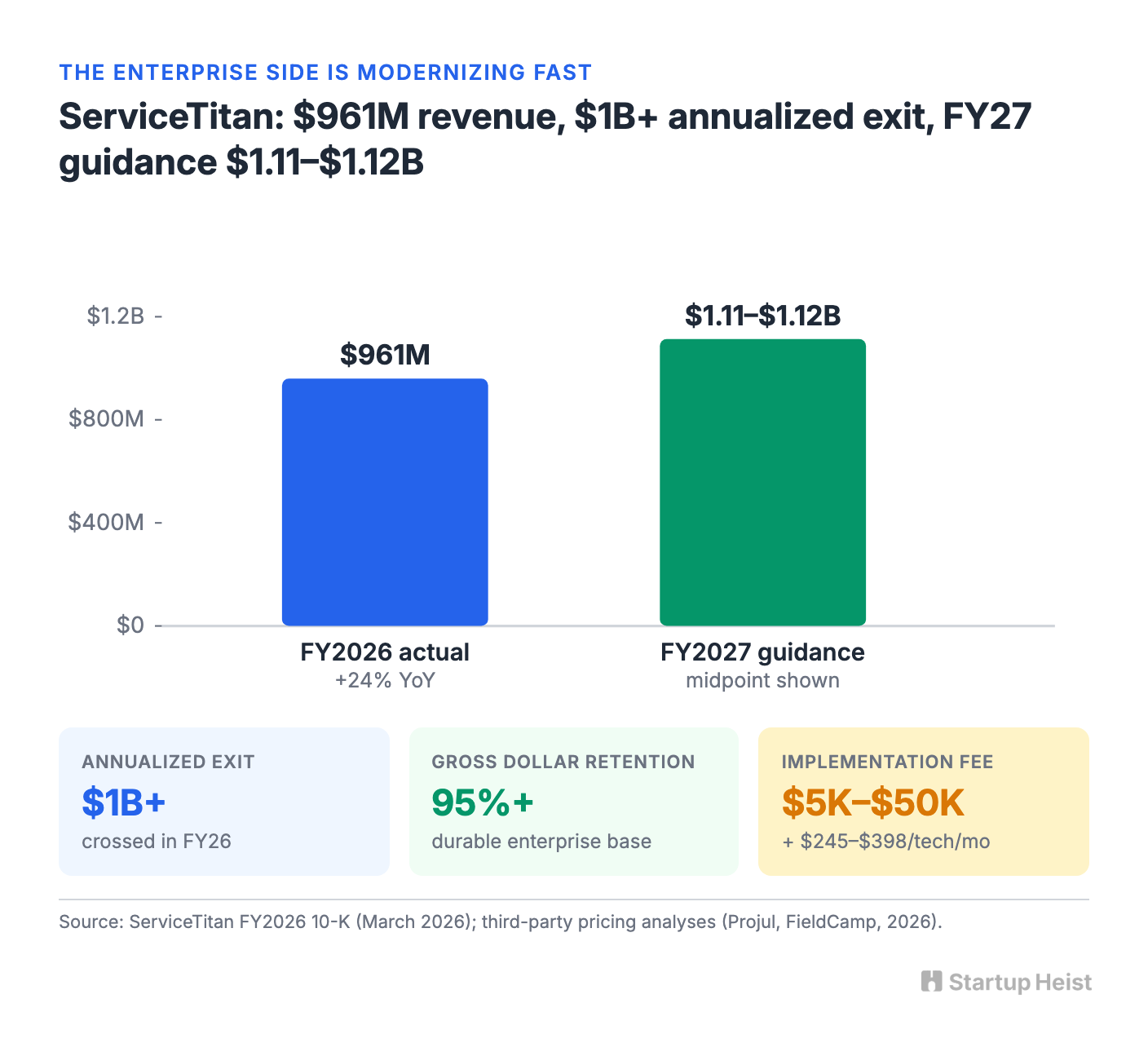
ServiceTitan is built for contractors ready to run their entire business inside a serious software platform: dispatching, scheduling, invoicing, pricebook, reporting, memberships, payroll, mobile estimates. Third-party analyses estimate ServiceTitan at roughly $245–$398 per technician per month, with implementation fees often between $5,000 and $50,000. The U.S. has roughly 104,000 plumbing and HVAC contractor establishments, and about 60,000 employ fewer than five people. A ten-tech shop may genuinely need the whole stack. A two-tech plumbing shop usually wants something simpler: stop the junior tech from texting photos to the owner every time he sees an old water heater.

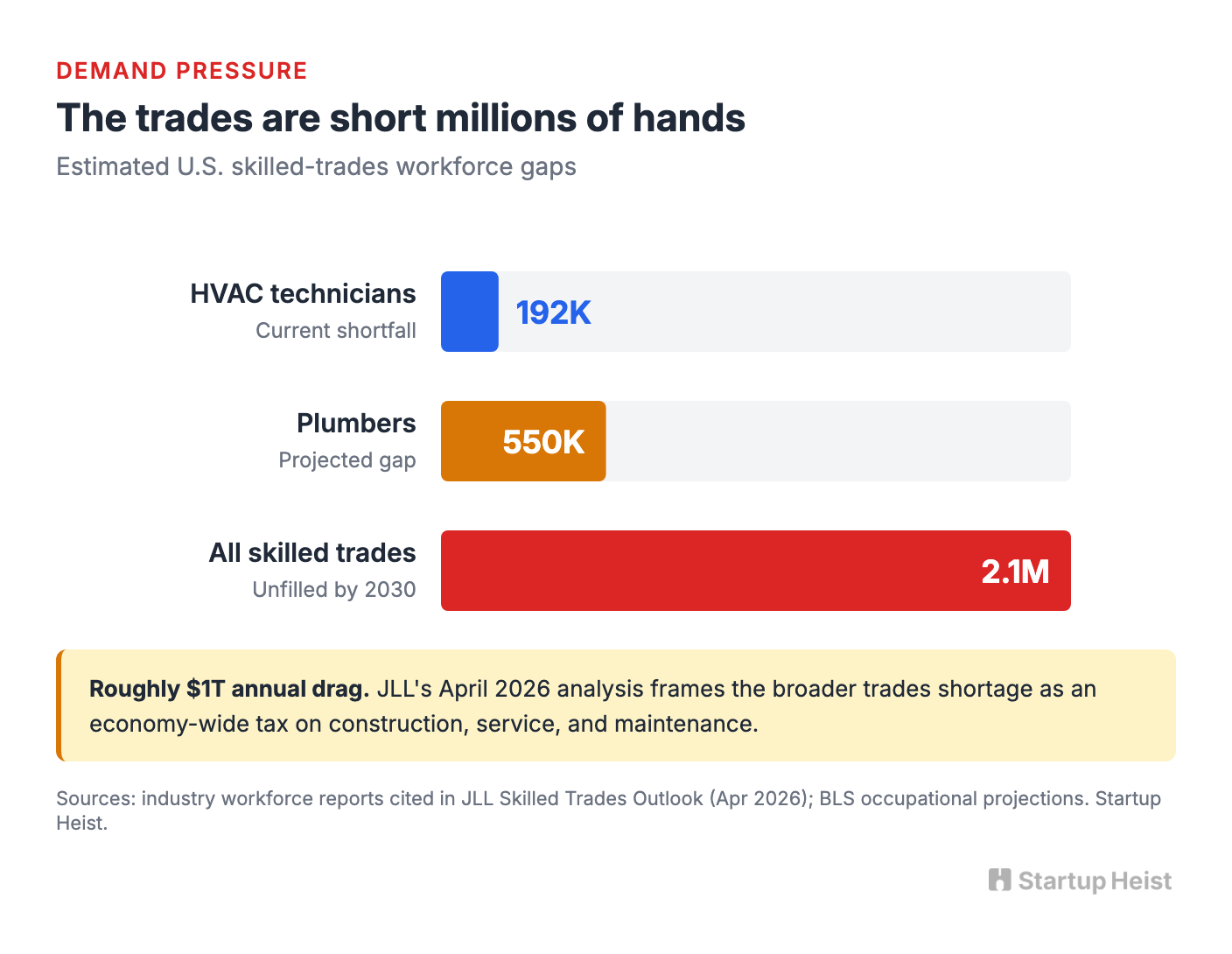
Enterprise platforms sell "run your whole business here." Small trade contractor software buyers want "help me finish this job faster and write the invoice correctly." The timing is also tilting. Gen Z interest in vocational and trade school has roughly doubled over the past several years, and community colleges reported 752,000 undergraduate certificate enrollments in fall 2025, up 28% from 2021. Meanwhile the trades face a structural shortfall: roughly 192,000 missing HVAC technicians and a projected 550,000 plumber gap, with as many as 2.1 million unfilled skilled-trades jobs by 2030. JLL's April 2026 analysis frames the broader trades shortage as a roughly $1 trillion annual economic drag.
A Gen Z apprentice is comfortable with phone scanning, ChatGPT, YouTube diagnostics, and mobile payments. The shop owner still runs dispatch through calls, parts lookup through a distributor counter, and invoice detail through whatever the technician remembers at 5:30 p.m. The opportunity is to sit between the young technician and the old workflow before someone else does.
The Service Call Has Too Many Loose Ends
A routine service call looks simple from the outside. Customer says the boiler isn't heating. Technician arrives. Then the chaos starts.
The unit is old. The label is scratched. The manual is missing. The homeowner doesn't know when it was installed. The previous contractor left no useful notes. The tech takes a photo, searches the model number, lands on a random PDF, scrolls 80 pages on a phone, calls the boss, calls the distributor, writes down a possible part number, finishes the job notes hours later, and the office turns those notes into an invoice the next morning. Every handoff leaks money. Wrong model wastes time. Wrong manual creates confusion. Wrong part causes a callback. Bad invoice notes leave revenue on the table. Poor documentation makes the next service call worse.
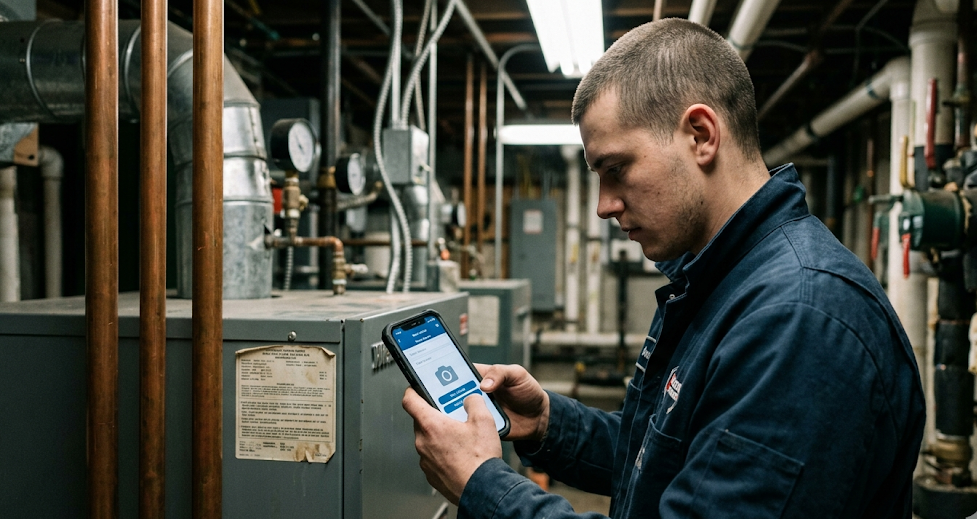
So manual lookup isn't the product. Manual lookup is a feature. The workflow is the product. The winning HVAC manual app for small shops compresses one messy field moment into a structured sequence: capture an equipment photo or model number, normalize the manufacturer and model, retrieve the manual or spec sheet, extract the relevant pages, produce a technician-safe quick-reference summary, draft parts notes, draft invoice notes, save the job record for the shop. Take a picture, leave with better notes. That's a much easier sale than "migrate onto our platform."
Where the Incumbents Leave Room
This isn't an empty market, and pretending otherwise is the fastest way to die. ServiceTitan owns the operating-system position and is layering AI features into its existing customer base aggressively. XOi has the jobsite-intelligence and equipment-metadata lane locked down for large enterprise contractors, with the Specifx acquisition signaling that field equipment data is now a strategic asset. Bluon is the clearest warning shot: PartsConnect is essentially the mature version of one slice of this idea, and it already integrates directly with Housecall Pro — meaning the competitive threat reaches into the FSM stack small HVAC shops already use. In mainstream residential HVAC, Bluon isn't a company to walk into casually.
The takeaway isn't "build Bluon for HVAC." The answer is to go where Bluon isn't yet culturally or operationally dominant: the long tail of mechanical equipment. Boilers and hydronics. Water heaters. Pumps. Commercial kitchen gear. Pool and spa equipment. Generators. Light commercial mechanical rooms. Mixed plumbing/HVAC shops with old installed bases. Small electrical service jobs where diagrams and invoice documentation matter. Regional service niches with messy legacy equipment.
The best opening vertical is probably not HVAC. HVAC has money, but it also has the deepest specialized data competitors. A sharper first wedge is boilers and hydronics for small plumbing and HVAC shops in cold-weather states. The U.S. accounts for 78% of the North American residential boiler market, with the Northeast and Midwest doing the heavy lifting. Boiler installs are old. Model identification matters. Parts can be non-obvious. Homeowners don't know what they own. Manuals are buried on manufacturer sites. Younger techs need help. Older owners have tribal knowledge but poor documentation. The category is adjacent enough to HVAC to matter, but not so cleanly owned by the largest HVAC data platforms. Walk through that door.
The Product: A Field Manual Copilot
The MVP should be brutally focused.
A technician opens the app and creates a job lookup. They can enter a photo of the equipment label, a model number, a serial number, the manufacturer, the equipment category, optional symptoms, and an optional customer or job name.
The app returns:
Unlock the Vault.
Join founders who spot opportunities ahead of the crowd. Actionable insights. Zero fluff.
“Intelligent, bold, minus the pretense.”
“Like discovering the cheat codes of the startup world.”
“SH is off-Broadway for founders — weird, sharp, and ahead of the curve.”


