


The Wedding Dress Code Help Desk
"Cocktail attire" is a solved problem. Retailers merchandise around it, guests can look it up, and everyone arrives dressed roughly correctly.
"Hollywood Western" isn't solved. Neither is "Catskills chic," "Italian summer vacation," or one couple's private reading of "Palm Beach chic."
Those are the instructions wedding guests now receive. Since 2024, wedding media has tracked the same shift: couples abandoning standardized dress codes in favor of location-specific aesthetics, private themes, mandated color palettes, and guest-facing mood boards distributed through the wedding website. Etsy sellers now move "customizable wedding guest dress code mood board" templates as a product category. Zola's 2026 First Look Report, built on responses from more than 11,500 couples and majority Gen Z for the first time, found 73% consider guest dress codes acceptable, with the caveat that demanding a specific color starts to grate.

The wedding press covers this as a fashion story. Spend an hour inside a planner's inbox and it looks more like a support queue.
Every time a couple invents a dress code, they invent a private language. Then a hundred-plus people have to interpret it. Does this dress work. Are boots too literal. Can I wear navy. How formal is this actually. Can I spend $120 instead of $500. Can I wear something I already own. What does "Mediterranean formal" mean for men.
The couple designs the aesthetic once. Somebody then explains it several dozen times, and that somebody is usually the planner. The repetition is the business.
The money: Forty planners sending ten weddings a year at $1,000 each is $33K a month. Full-service planning already averages $5,500, so the line item disappears.
Inside:
• Concierge MVP: setup, guest page, ask button
• Three-tier planner pricing, $750 to $2,000
• Cold email that gets you a free demo brief
• Four compounding moats, plus the weekend upsell
The product itself is unglamorous. The planner uploads the event's mood board, venue, rules, and examples. The guest gets a style guide in plain English, a curated shopping board across budgets, answers to the repetitive questions, and an optional outfit review.
The instinct is to build an AI stylist. The better business is the one that makes a planner's inbox quieter.
The job nobody currently owns
A traditional dress code compresses a large amount of social knowledge into two words. "Black tie" carries a century of convention, and an entire retail and styling industry already knows what to do with it without being briefed.
"Disco garden formal" carries none of that infrastructure. Once a couple creates a private aesthetic, someone has to convert it into operational rules: formality level, permitted and forbidden colors, fabrics, silhouettes, footwear, accessories, weather, venue constraints, how literally to take the theme, and whether the thing already hanging in a guest's closet qualifies.
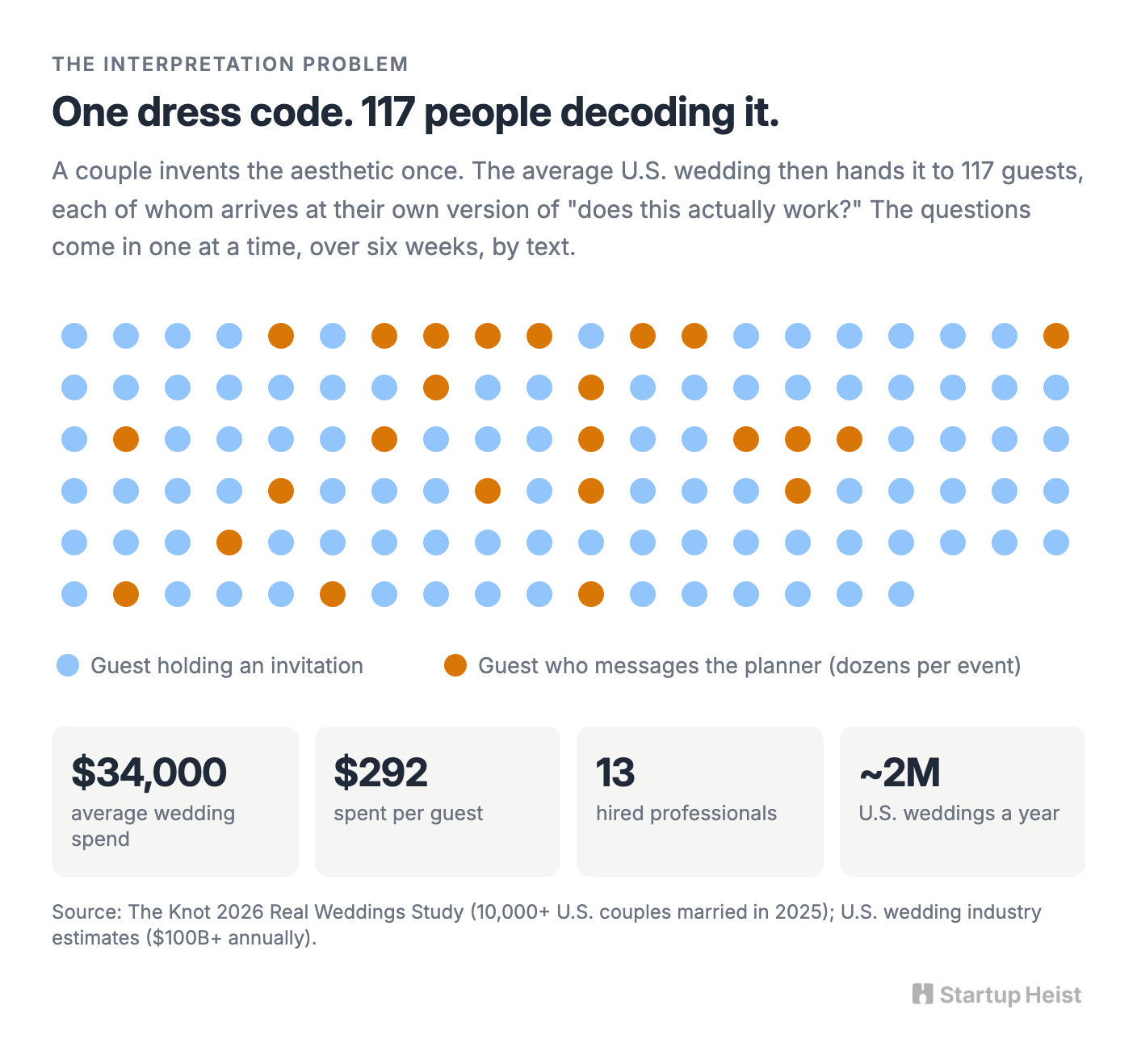
A mood board narrows the range without eliminating the ambiguity. It shows an aesthetic, and what guests actually want is permission. The gap between "here is the vibe" and "yes, that specific navy dress is fine" is where the questions live.
The arithmetic is unforgiving. The Knot's 2026 Real Weddings Study, drawn from more than 10,000 U.S. couples married in 2025, puts the average wedding at 117 guests, $34,000 in total spend, $292 per guest, and 13 hired professionals. Roughly two million American couples married that year inside a wedding industry above $100 billion. One ambiguous instruction sent to 117 people generates dozens of questions, arriving individually, over six weeks, by text.
A $750 service that keeps the planner and the couple out of the wardrobe help desk isn't an absurd line item against a $75,000 destination wedding.
Why the timing works
Weddings got more designed. The Knot's study puts Gen Z at 41% of the surveyed market and describes a decisive move toward personal expression over standard formats. Pinterest remains the dominant inspiration platform and TikTok use has grown roughly 2.5x. When the flowers, the stationery, the venue, and the welcome party all share a visual identity, someone eventually asks why 120 guests are excluded from the system. The answer is a guest mood board, and the support tickets follow.
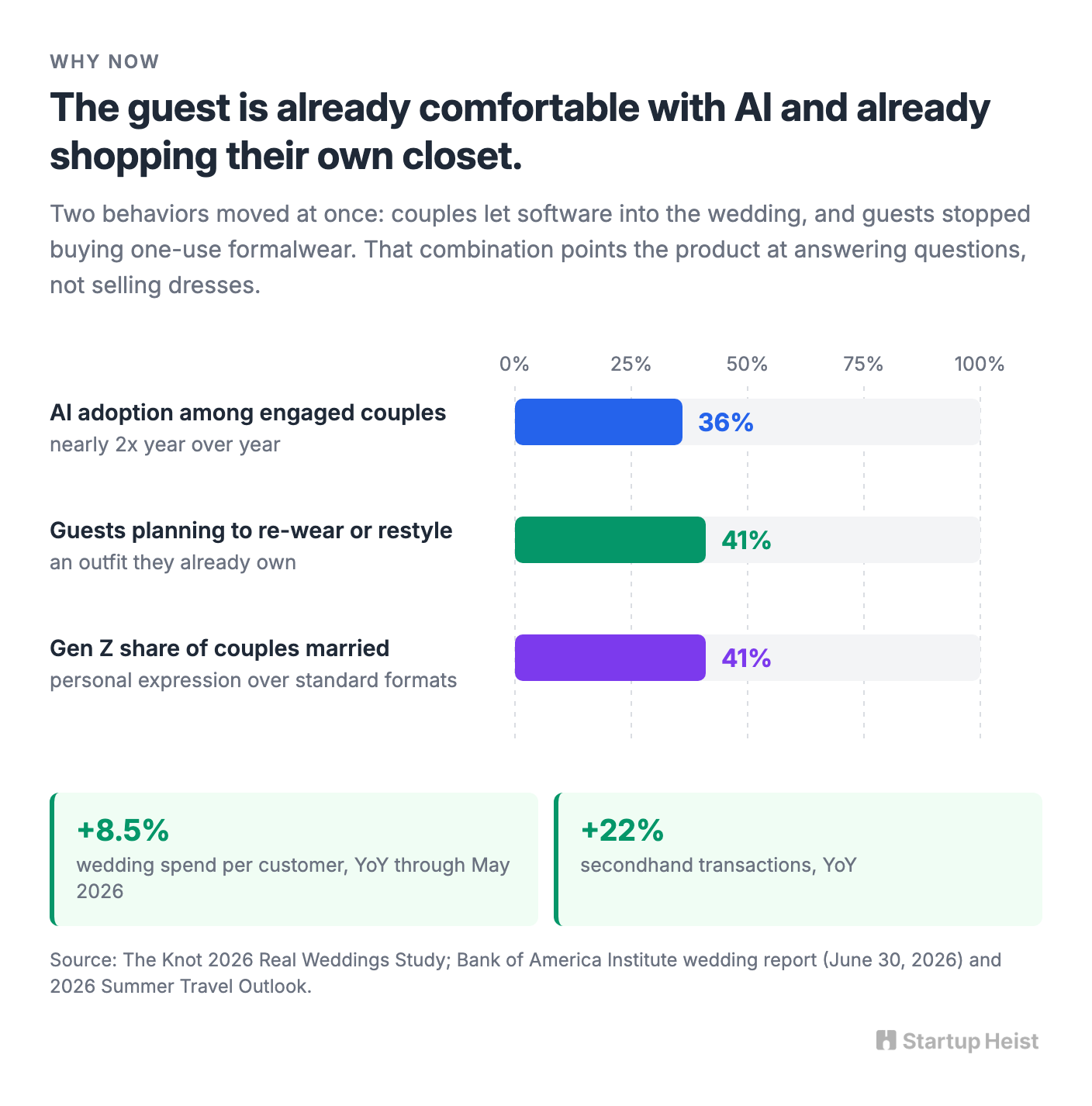
AI is already inside the wedding. Nobody needs convincing that software belongs here. The Knot found AI adoption among engaged couples at 36%, nearly double the prior year, covering etiquette questions, timelines, attire inspiration, and vendor communication. Joy's wedding website product already drafts guest FAQ answers with AI. Comfort with machine-assisted guidance is established, and judgment is still expected from a human, which is exactly why a software-assisted concierge beats an autonomous stylist as a starting model.
Guests are quietly rebelling against one-use formalwear. Bank of America Institute's June 30, 2026 wedding report found wedding-related spending per customer up 8.5% year over year through May 2026. Its formalwear data cuts the other way: the number of households buying formal attire has been trending down, and in the bank's 2026 Summer Travel Outlook, more than 41% of respondents said they plan to re-wear or restyle something they already own for a wedding. Baby Boomers lead on re-wearing. Gen Z is likelier to rent, thrift, or buy secondhand, and the wider market moved with them: secondhand transactions are up 22% year over year, with Gen Z accounting for 41% of sellers.
That last finding is a design constraint. A dress code concierge built as an affiliate shopping machine is pointed at a shrinking behavior. The first question the product asks a guest should be whether something already in their closet works, with rent, thrift, and buy coming after. It's better etiquette, and it aims the product at what guests are actually doing.
Don't build the consumer app
The obvious version of this business is a guest-facing AI stylist: upload a photo, get a verdict.
That lane is occupied. Elara ships an iOS app that scans a guest's existing wardrobe, identifies wedding-ready pieces, offers virtual try-on, and runs an AI stylist chat. Generic closet apps cover the same ground. Competing there means acquiring individual consumers who need you twice a year, at consumer acquisition costs, against a product with a head start.
Flip the customer instead. Sell one planner a control panel and every guest inherits a concierge, so a single sale produces a hundred users and distribution comes built into the transaction.
More importantly, the planner owns the source of truth, which narrows what the AI has to answer. It never has to rule on whether an outfit looks good, which is subjective and unwinnable. It only has to rule on whether an outfit matches the rules for this specific event. A planner writing "no bright white, no stilettos because dinner is on grass, jackets after 6 p.m., Western accessories welcome but no costumes" has produced usable data. Software can work with that.
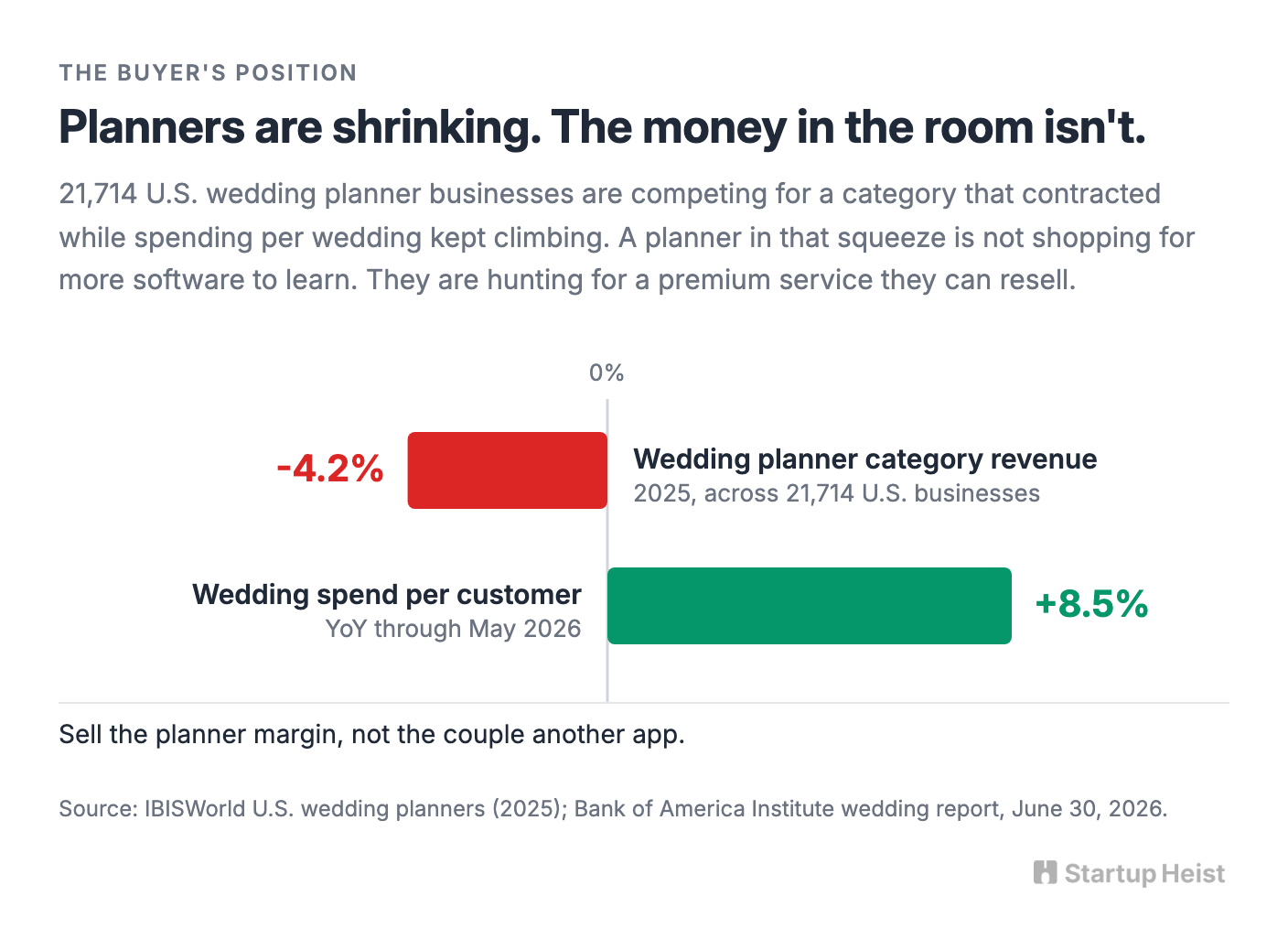
There's a headwind worth naming. IBISWorld counts 21,714 U.S. wedding planner businesses as of 2025, with the category's revenue down 4.2% that year. Bank of America also sees the destination wedding trend cooling slightly as travel costs bite. Planners under margin pressure aren't, on balance, buying more wedding planning software. They're hunting for premium services they can resell, which is the shape this needs to take.
What you actually build
Don't spend six months building Dress Code OS. For the first ten weddings, the software can be largely theater: a polished guest experience sitting on top of a founder-operated workflow across three surfaces.
Unlock the Vault.
Join founders who spot opportunities ahead of the crowd. Actionable insights. Zero fluff.
“Intelligent, bold, minus the pretense.”
“Like discovering the cheat codes of the startup world.”
“SH is off-Broadway for founders — weird, sharp, and ahead of the curve.”


