


The Creator Bundle
Brands want niche influence. They just don't want 30 contracts.
The creator economy has developed a barbell problem. At one end, a small group of stars absorbs an increasing share of brand budgets. At the other, millions of micro-influencers compete for free products and modest sponsorships. Between them sits a large, commercially useful middle: creators with trusted audiences, professional content, and enough reach to influence purchases, without enough individual scale to make buying them operationally convenient.
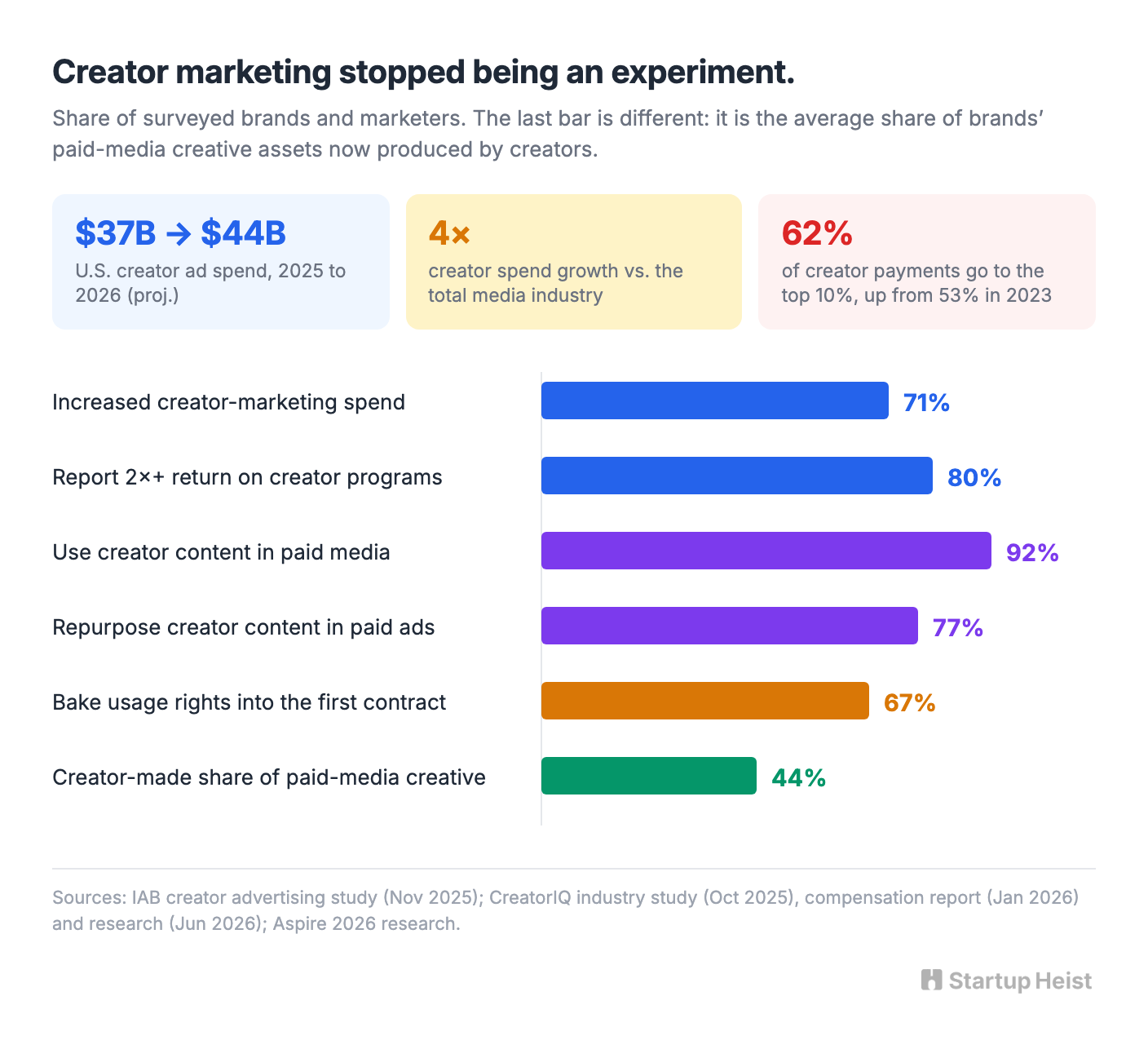
The market itself is booming. The IAB reported in November 2025 that U.S. creator advertising spend would reach an estimated $37 billion in 2025, growing four times faster than the total media industry, with a projection of $44 billion for 2026. Nearly half of creator-ad buyers now consider creators a "must buy," ranking behind only social media and paid search. Yet in the same study, a third of advertisers named finding the right creator as their single biggest obstacle, with measurement, standardization, and operations close behind.
The complaints are the opportunity:
The money: Four campaigns a month at $60,000 each yield $60,000 in monthly contribution margin. U.S. creator ad spend hits an estimated $44 billion in 2026.
Inside:
• Five-layer minimum viable campaign spec
• Pricing that escapes the 10% aggregation trap
• Creator and brand outreach templates
• The 90-day sprint from niche pick to paid pilot
The money is growing even as its distribution deteriorates. CreatorIQ's compensation study, published in January 2026, found that aggregate creator payments rose 59% in 2025, but the top 10% of creators collected 62% of total payments, up from 53% in 2023. The top 1% took 21%, up from 15%. The average campaign payment reached $11,400 while the median creator earned $3,000.
That gap is usually framed as a fairness problem. For a founder, it's an infrastructure problem. Brands don't doubt that mid-tier creators deliver value. What stops them is that purchasing 20 small partnerships means 20 negotiations, 20 contracts, 20 sets of tax information, 20 creative reviews, 20 disclosure checks, 20 rights agreements, 20 invoices, and one miserable spreadsheet attempting to explain what happened. A megastar is expensive but operationally simple.
The heist is to make the middle simple. Build a vertical creator bundling service that packages 15 to 30 vetted creators into one campaign product: one contract, one invoice, one creative process, one rights schedule, one performance report. You're selling brands a finished line item, and the mid-tier creators supplying it cost $200 to $2,500 per post at current market rates, an input price that leaves real room for a packaging margin.
Sell a Line Item, Not a Database
The weak version of this idea is a creator directory. The slightly better version is an influencer marketing marketplace where brands search, filter, message, and negotiate. Both hand the customer more software and more decisions. The strong version removes the decisions.
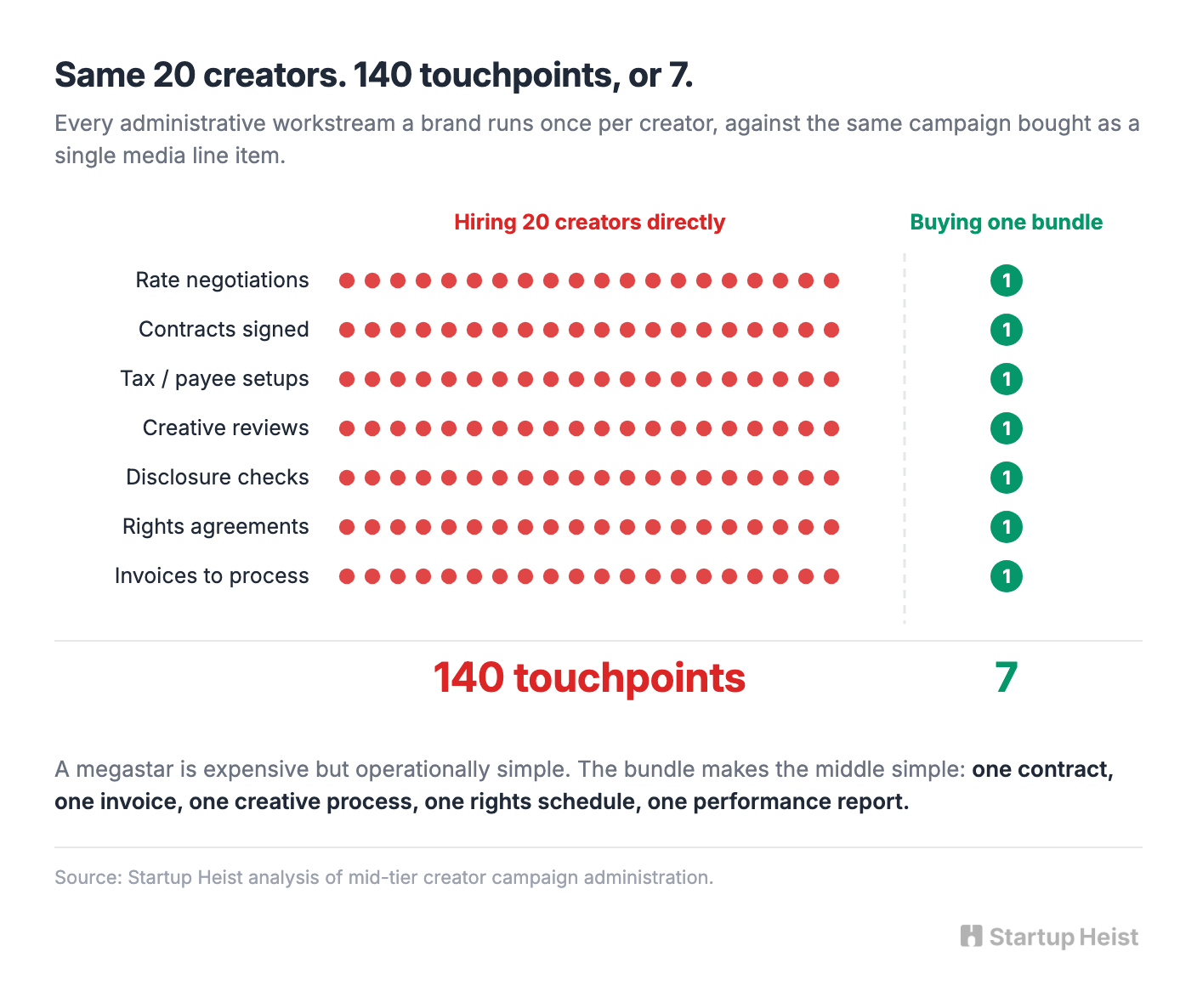
Say a kitchen-appliance brand is launching a home espresso grinder. Its marketing manager could spend six weeks finding coffee creators, checking audience quality, negotiating rates and usage rights, approving scripts, and chasing deliverables. Or she could buy the Home Espresso Creator Flight: 20 vetted coffee creators, 20 short-form videos, 20 organic posts, standardized sponsorship disclosures, six months of defined content usage rights, tracked links, one consolidated report, one contract, one invoice.
The difference is what the customer walks away holding. A marketplace hands the brand a tool and 50,000 people it might hire. A bundle hands it inventory: 20 appropriate creators who already agreed to the deliverables, timing, rights structure, and compensation. The business resembles a specialized media network more than a talent agency, assembling fragmented supply into a standardized media product that includes audience access, content production, campaign administration, rights clearance, compliance, payment handling, and measurement. The brand enters as one vendor and one budget line.
Why This Window Is Open
Creator marketing is moving out of the experimental budget. CreatorIQ's October 2025 industry study found 71% of surveyed organizations increased creator-marketing investment, and nearly two-thirds of them pulled the money directly from paid and digital media budgets. The money moves because the channel delivers: more than 80% of respondents in CreatorIQ's June 2026 research report at least a 2x return on their creator programs.
That reallocation changes what buyers expect. Experimental programs survive on relationships and screenshots. Media budgets can't. Once creator spending competes with paid search and social advertising, buyers start asking media questions: what inventory are we buying, what rights do we receive, what did each asset cost, can the content run as ads, which creators delivered on time, and what should we buy again. The IAB's own measurement work concedes the industry hasn't caught up: creator advertising still lacks the standards, financial rigor, and common currencies that enterprise media planning demands.
Meanwhile the content itself has changed jobs. CreatorIQ reported in June 2026 that creator content now accounts for an average of 44% of brands' paid-media creative assets, with 92% of respondents using creator content in paid media in some capacity. Aspire's 2026 research found 77% of brands repurpose creator content in paid advertising and 67% bake usage rights into the creator's initial contract. A creator campaign is no longer just a collection of sponsored posts; it's simultaneously a content-acquisition program, a licensing transaction, a paid-media input, and a compliance workflow. A vertical bundler packages all four, and the buyers now reallocating media dollars into this channel are actively shopping for someone who can.
One Vertical or Nothing
The word "vertical" is doing most of the work in this thesis. A generic network of 500 unrelated creators is just another marketplace; 30 respected home-espresso creators are a purchasable media property.
Vertical focus compounds in several directions at once. It reduces buyer uncertainty, because the creators are already organized around a coherent commercial audience. It makes campaign briefs reusable: a grinder launch and a subscription-bean campaign share language, context, and production patterns. Creator selection sharpens, because you learn who's good at reviews, demonstrations, comparisons, and paid-media assets. Sales concentrate into a finite list of relevant brands. And benchmarks start to mean something: a click-through rate from a woodworking tutorial shouldn't be compared with a beauty Reel.
The evidence backs niche depth over raw reach. CreatorIQ's 2025–2026 marketing study found brand suitability now outranks follower count as a creator-selection factor: brand fit ranked first among surveyed brands while follower count landed near the bottom. A creator with 35,000 deeply interested woodworkers can be worth more to a tool company than a lifestyle account with ten times the audience.
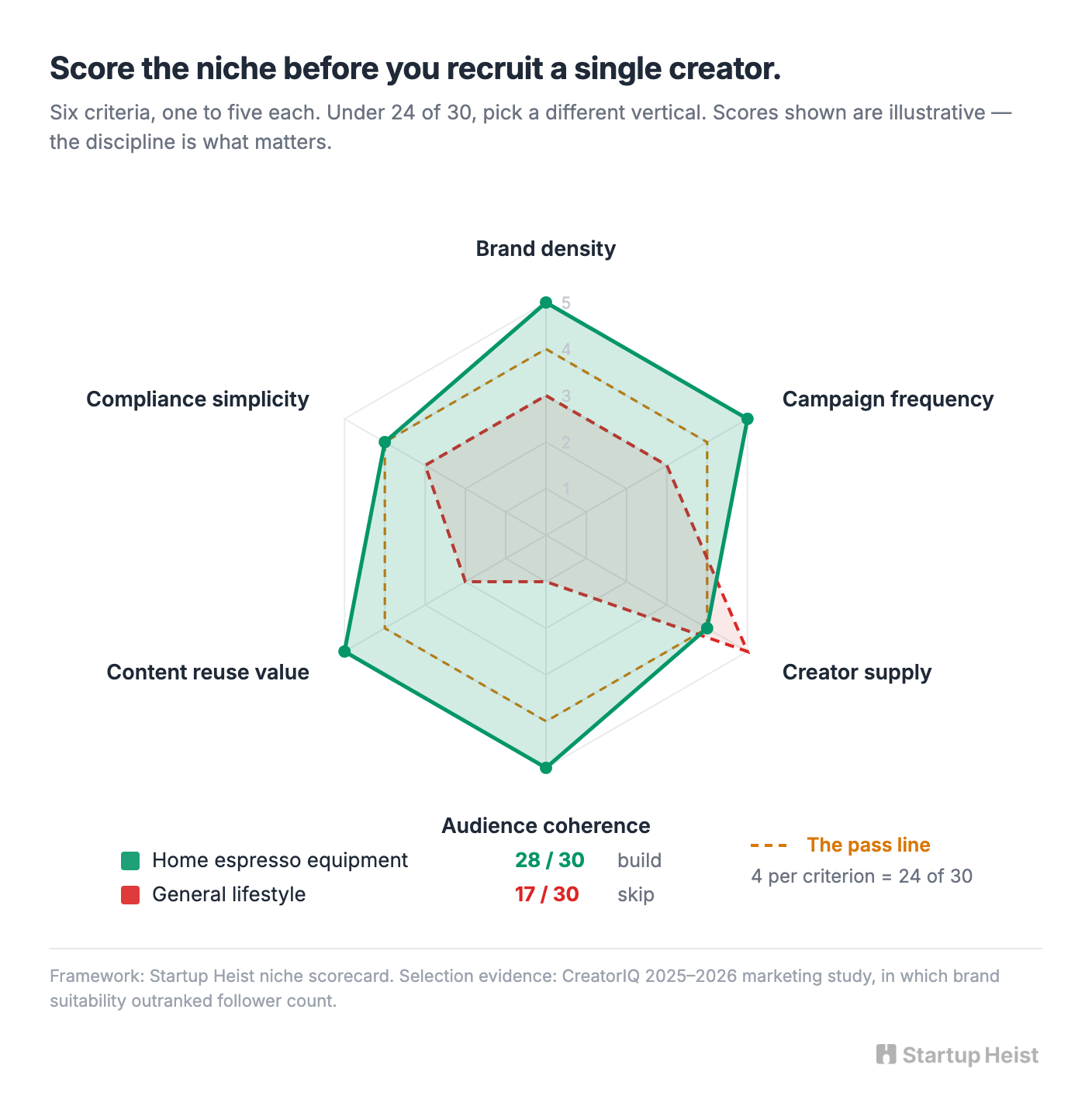
Promising categories share one trait: enthusiast commerce. Home espresso, trail running, woodworking, gardening, cycling, kitchen equipment, camping, specialty food, photography. These audiences buy equipment, upgrades, accessories, and subscriptions, and taste gives niche creators influence beyond their follower counts. Before recruiting anyone, score candidate niches one to five:
| Criterion | Question |
|---|---|
| Brand density | Are there at least 100 plausible buyers? |
| Campaign frequency | Do brands need creator content repeatedly? |
| Creator supply | Can you identify at least 50 credible creators? |
| Audience coherence | Would most creators plausibly fit the same brief? |
| Content reuse value | Can brands turn the assets into ads, emails, and product pages? |
| Compliance simplicity | Can claims be reviewed without regulatory specialists? |
Don't proceed under 24 of 30. The biggest mistake available here is choosing a niche because you like its creators rather than because its brands have budgets.
One structural note before you print business cards. "Creator co-op" is a compelling internal concept and a weak brand-facing product. To a marketing manager, co-op implies committees and complexity, exactly what you're eliminating. There's a legal reason for caution too. The FTC treats naked price-fixing agreements among competitors as generally illegal, and while a January 2025 FTC policy statement shielded certain organizing activities by independent contractors, it explicitly doesn't guarantee protection from private antitrust claims. The clean model is a managed-services company buying services from creators under individual agreements and reselling a bundled campaign. Each creator privately accepts a rate, deliverable, and rights package; you set the campaign price; creators stay free to work elsewhere. Have counsel review the creator agreement, brand agreement, licensing structure, and contractor classification before scaling.
The Minimum Viable Campaign
The first product should be rigid enough to repeat and flexible enough to sell. That takes five layers.
Unlock the Vault.
Join founders who spot opportunities ahead of the crowd. Actionable insights. Zero fluff.
“Intelligent, bold, minus the pretense.”
“Like discovering the cheat codes of the startup world.”
“SH is off-Broadway for founders — weird, sharp, and ahead of the curve.”


