


The Factory Doesn't Need a Grant Writer. It Needs a Capital-Case Compiler.
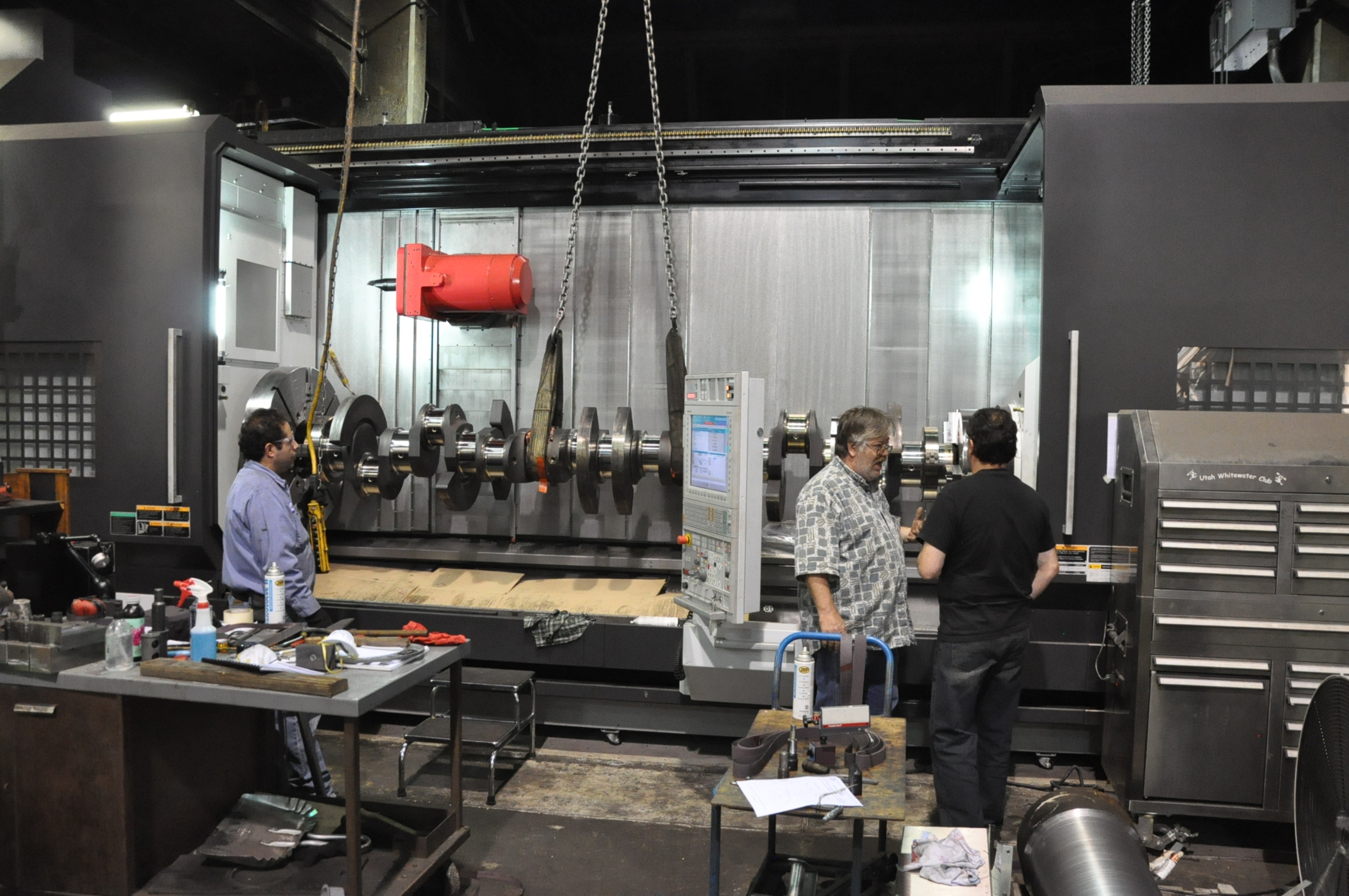
A profitable machine shop wants to buy a $600,000 five-axis mill. The owner can explain why in four minutes standing next to the bottleneck.
The cell runs three shifts. Lead times have stretched from six weeks to fourteen. There's close to a million dollars of customer backlog stacked behind one machine, plus a steady stream of work going out to an outside vendor at a margin the shop could be keeping.
Then the banker asks the only question that matters.
"Show me exactly what changes if we give you the money."
And the answer scatters. The machine quote is in an email. The backlog lives in the ERP. Three years of financials are in QuickBooks. Utilization sits in a spreadsheet the production manager maintains and nobody else opens. The installation schedule came from the dealer over the phone. Labor assumptions live in the owner's head. The customer who has been begging for capacity since spring has never put a forecast in writing.
Every one of those facts is true. None of them are assembled.
That gap is a business. Call it grant writing and you'll build the wrong company. What the shop is missing is capital evidence, and right now the federal government is running a very loud advertisement for it.
On August 6, 2026, the Small Business Administration announced its first-ever Critical Suppliers Prize Competition: up to $20 million in non-dilutive prizes for U.S. small manufacturers that can expand capacity at supply-chain chokepoints. Applicants must already be profitable and generally creditworthy, deploy funds immediately, and show measurable production increases within six months. Focus areas are advanced metals, advanced materials, and energy systems and energetics. Submissions close August 28, 2026 at 11:59 p.m. Eastern.
Read the eligibility list again. Profitable, creditworthy, fast to deploy, and able to show measurable output gains in half a year.
The SBA just published a specification for a product nobody sells.
Here's the opportunity underneath it.
The money: Twenty dossiers a year at $3,500 is $70,000 solo. Add quarterly updates at $1,500 and one operator clears $10K MRR without hiring anybody.
Inside:
• Five-module Capital Readiness Dossier scope
• Offer ladder from $750 audit to $6,500 build
• Partner-led GTM plus the cold email that works
• Kill criteria after 15 to 20 engagements
The prize is a deadline, not a market
Don't size this opportunity off the $20 million.
The SBA expects four to six winners at up to $6 million each. Six customers isn't a business. And the agency estimates a submission takes about three hours to complete, which detonates the lazy version of this startup on contact. You can't charge $5,000 to fill out paperwork the government itself thinks takes an afternoon.
The market is the thing underneath the application: the manufacturing capital cycle, which runs whether or not a prize exists.
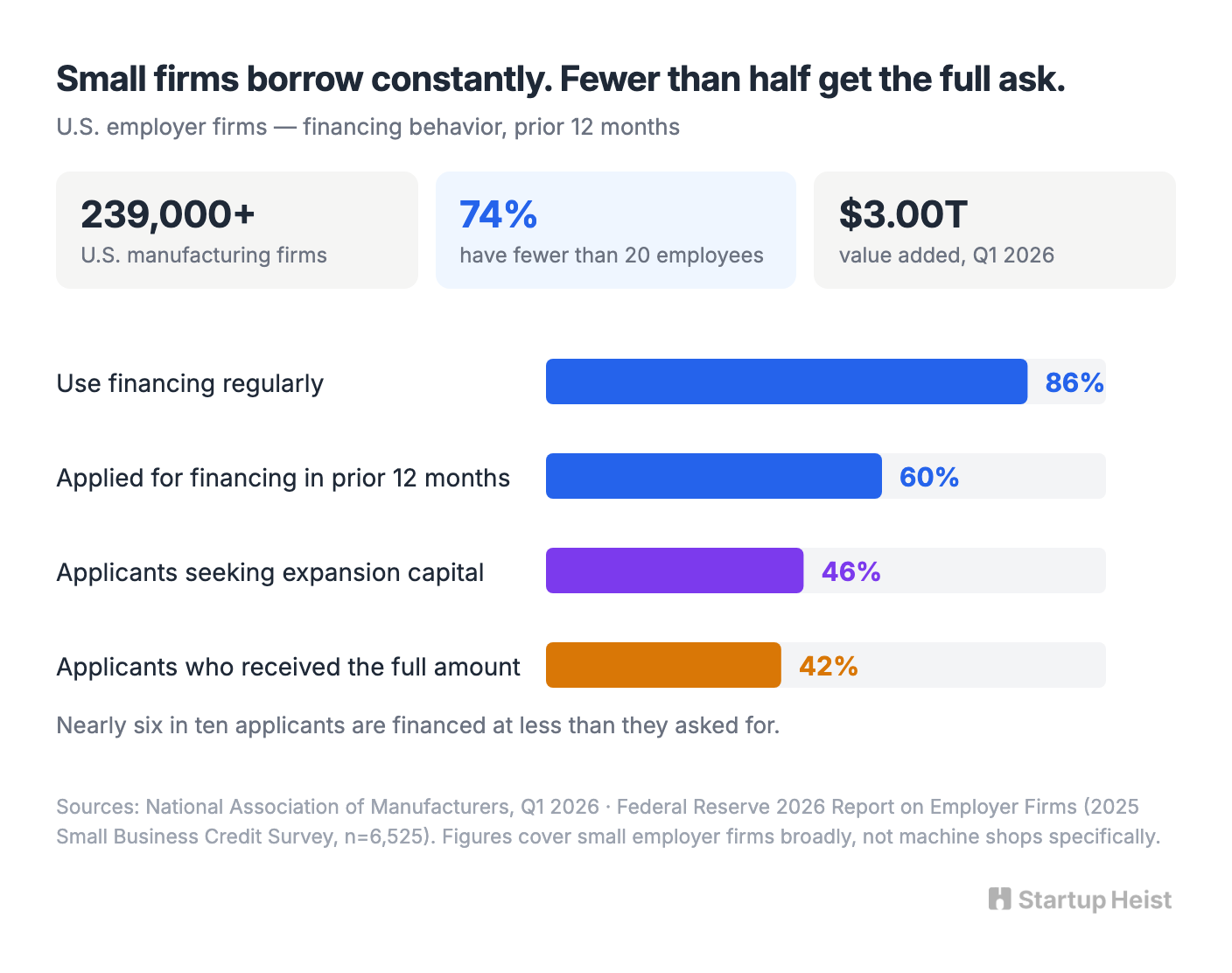
The National Association of Manufacturers counts more than 239,000 manufacturing firms in the United States employing 12.6 million people, generating $3.00 trillion in value added in the first quarter of 2026, or 9.4% of GDP. The number that matters here is smaller and stranger. 74% of those firms have fewer than 20 employees.
That's a customer base too sophisticated for a business-plan template and too small to staff an FP&A team. A 14-person shop buying a $600,000 machine is making the largest financial decision of its decade with a spreadsheet and a phone call.
For these companies, capital events are routine. The Federal Reserve's 2026 Report on Employer Firms, drawn from the 2025 Small Business Credit Survey of 6,525 firms, found that 86% of employer firms use financing regularly and 60% applied for financing in the prior 12 months. Among applicants, 46% were chasing an expansion or a new opportunity, and only 42% received the full amount they asked for. Those figures cover small employers broadly rather than machine shops specifically, so treat them as the weather, not the forecast.
And the weather is unusually favorable. For fiscal year 2026, running October 1, 2025 through September 30, 2026, the SBA cut upfront fees to zero on 7(a) manufacturing loans up to $950,000 and zeroed both the upfront and annual service fees on 504 manufacturing loans. On July 4, 2026, a rule change let qualified borrowers stack 7(a) and 504 for up to $10 million in combined SBA-backed financing, double the prior ceiling and what the agency calls the highest financing level in its history. The SBA also launched MARC, a revolving credit line built specifically for small manufacturers. The first MARC loans went out in December 2025: $3.5 million across four companies.
Tax policy pushes the same direction. The One Big Beautiful Bill Act made 100% bonus depreciation permanent for property placed in service after January 19, 2025, with the Section 179 cap at $2,560,000 for 2026, and created Qualified Production Property for full expensing of production real estate. Cheap capital plus permanent expensing produces a predictable result: the Equipment Leasing and Finance Association projects $129 billion in deal volume through its CapEx Finance Index for 2026, the highest since the survey began in 2006.
Thousands of small manufacturers are about to prove, repeatedly, that a specific machine will produce a specific economic outcome. That proof is almost entirely unproductized.
Your competitor is a CPA and a spreadsheet
The adjacent software is real and it's cheap. Instrumentl sells grant discovery and workflow to nonprofit teams starting around $299 per month on an annual plan. PlanGuru does budgeting, forecasting and scenario analysis for about $99. LivePlan Premium builds up to ten financial scenarios for $40. None of them lose sleep over machine hours.
The real competition is Bob the CPA, Susan the production manager, Excel, and three days of emailing attachments. That combination is pretty good, which is the whole problem. A shop with clean books and a competent accountant won't pay $3,500 for a nicer revenue chart.
Equipment financing also isn't broken. Industry credit approval rates ran about 79.5% as of June 2026, with small-ticket approvals at 80.7%. When a $200,000 machine secures its own loan, the collateral does most of the arguing.
Approval isn't the wedge. The wedge is every capital decision where the machine can't carry the argument by itself: prize and incentive applications, blended capital stacks under the new $10 million ceiling, six- and seven-figure automation projects, an OEM demanding proof you can hold a delivery commitment, and the board meeting where somebody has to defend the number.
In those rooms, forecasting isn't enough. The product has to take operational facts that live outside the financial statements and convert them into an auditable investment thesis.
A generic tool models revenue rising 18%. This product says something closer to:
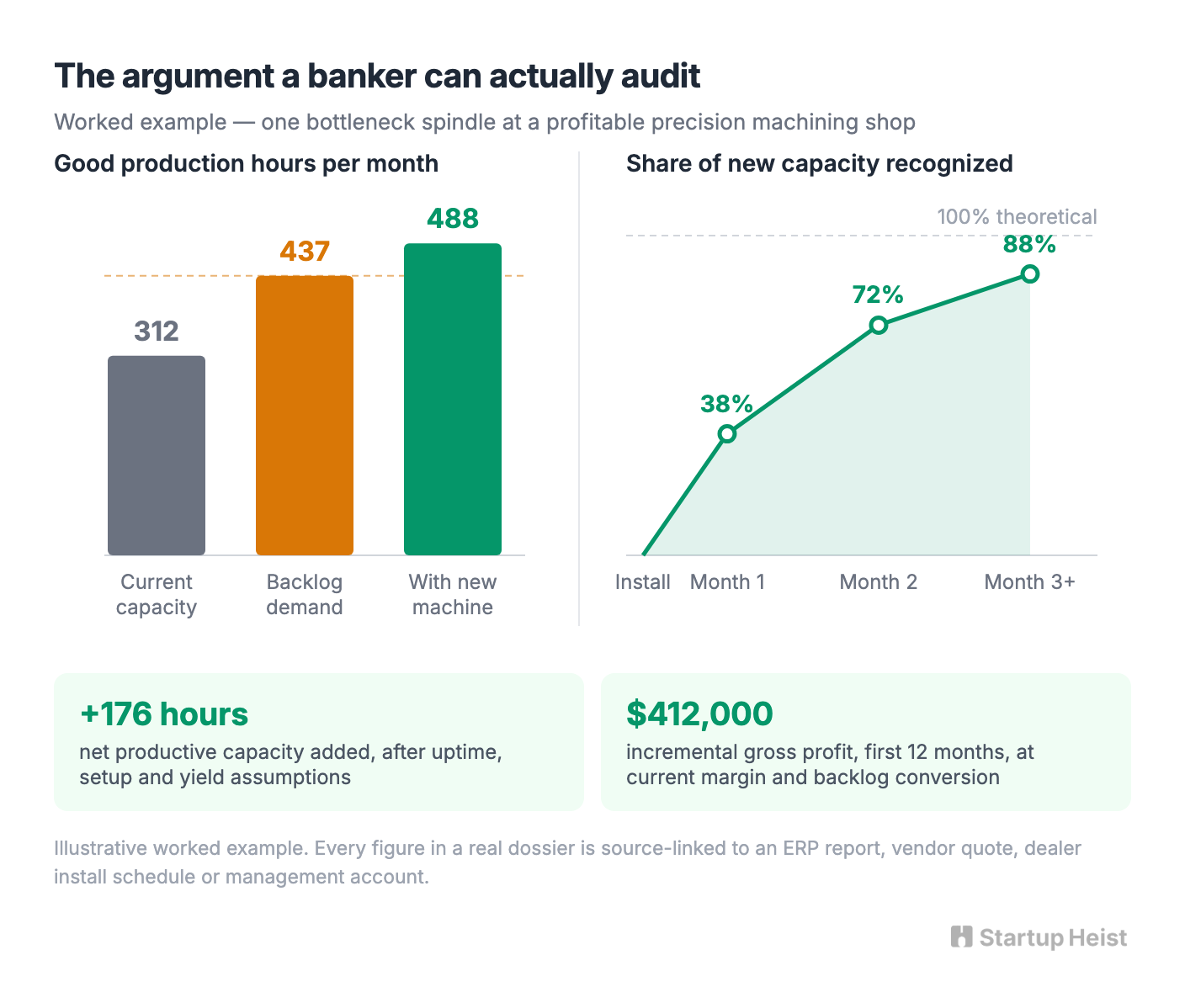
Bottleneck spindle capacity is 312 good production hours per month. Confirmed backlog implies demand for 437. The proposed machine adds 176 net productive hours after uptime, setup and yield assumptions. Installation is scheduled for November 3, training runs two weeks, and customer qualification takes 21 days. The base case therefore recognizes 38% of incremental theoretical capacity in month one, 72% in month two, and 88% thereafter. At current contribution margin and backlog conversion, the investment produces $412,000 of incremental gross profit in the first 12 months.
Then every number in that paragraph is clickable, and behind each one sits a document with a name and a date on it.
That's the product. Building it is mostly a question of who you build it for.
Pick one painfully specific customer
Don't launch this for "manufacturers." The word spans a five-person job shop and a battery-materials plant.
Unlock the Vault.
Join founders who spot opportunities ahead of the crowd. Actionable insights. Zero fluff.
“Intelligent, bold, minus the pretense.”
“Like discovering the cheat codes of the startup world.”
“SH is off-Broadway for founders — weird, sharp, and ahead of the curve.”


