


The Artist Identity Firewall
A $10–$30/month watchdog for indie musicians living through the AI-music spam war
The scary part of AI music is not that a machine can write a passable song. It is that one bad actor can manufacture thousands of tracks, bolt them onto the wrong artist profile, imitate a recognizable voice, recycle someone's lyrics, and ship the whole batch faster than the victim can find the support form.
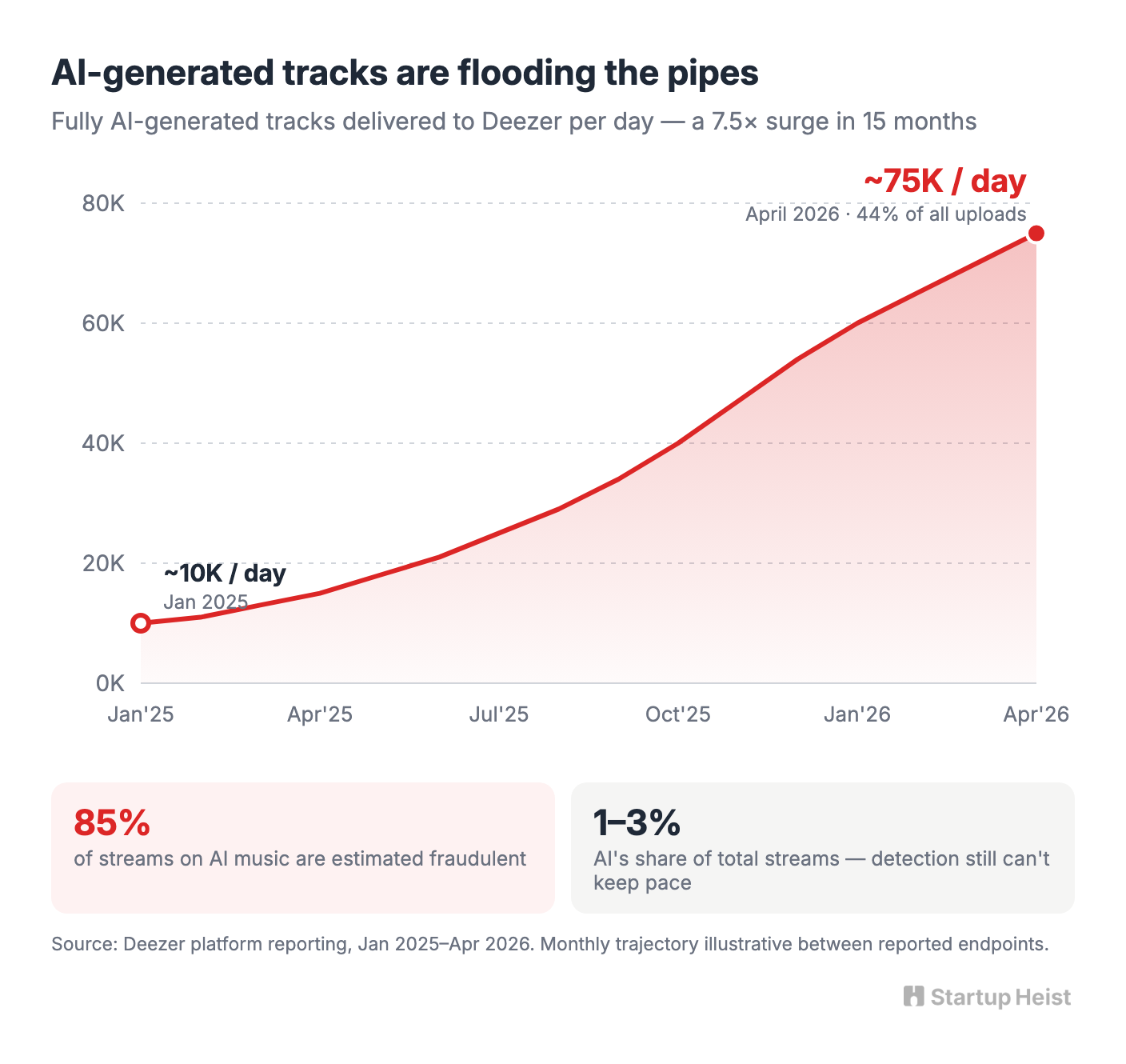
This stopped being hypothetical a while ago. In April 2026, Deezer reported that almost 75,000 fully AI-generated tracks were being delivered to its platform every single day. That is 44% of all new uploads, up from roughly 10,000 a day in January 2025. Deezer also estimates that as much as 85% of streams on AI-generated music are fraudulent, which is why it now demonetizes suspicious AI streams and pulls detected synthetic tracks out of recommendations. The volume is staggering even though AI music is still only 1–3% of total streams. The real problem isn't the raw flood of uploads. It's that detection and fraud can't keep up with it.
Here's the opportunity:
The money: 1,500 solo artists at $14, 500 at $24, and 150 small labels at $89 a month gets you to roughly $46K MRR, about $556K a year.
Inside:
• 90-day MVP: Spotify + YouTube monitoring
• Free rights-readiness tool as lead magnet
• Four-tier pricing from $10 to label plans
• The case-resolution dataset moat
Spotify is moving too. On April 30, 2026, it launched a "Verified by Spotify" badge for profiles that clear its authenticity bar, plus Artist Profile Protection, a beta feature that lets participating artists approve or decline releases before they appear under their names. Spotify's own explanation names the problem directly: incorrect releases show up because of shared names, metadata mistakes, or malicious attempts to attach music to another artist's profile. Those errors corrupt an artist's catalog, streaming stats, Release Radar exposure, and recommendations.
Streaming was built around open distribution. That openness is what let independent musicians release work without a label, and it is also the attack surface. When anyone can push music through a self-service distributor for the price of a sandwich, the fraudster never needs to break into an account. He creates a confusingly similar artist, exploits a metadata collision, submits a fake collaboration, or staples a synthetic release onto a profile that already exists.
The platforms are building a checkpoint. The opportunity is to build the security camera.
The Opportunity
Build a subscription watchdog for indie musicians and small labels.
The product continuously monitors an artist's identity and catalog across Spotify, YouTube, Apple Music, and eventually Deezer. It flags suspicious releases, impersonator profiles, near-identical metadata, unauthorized reuploads, copied audio, and unexpected catalog changes. When it finds something off, it builds an evidence bundle and walks the artist through the correct platform-native response.

Think of it as brand protection for musicians, stripped down for a customer who pays DistroKid or TuneCore roughly $23–$50 a year to distribute music but cannot afford a lawyer, a catalog-protection agency, or an enterprise fraud platform. DistroKid's entry Musician plan runs $24.99 a year; TuneCore's Rising Artist plan starts at $24.99. That is the budget you are designing against. The squeeze is real: TuneCore eliminated its free tier in June 2025, so the floor for distribution keeps rising while protection stays unaffordable.
The promise has to stay narrow and honest. The product should not claim to eradicate AI music, declare every soundalike an infringement, or pose as an automated law firm. The sharper pitch:
Know when your artist identity is being misused. Collect the evidence automatically. File the right report before the damage compounds.
Working names that fit: CatalogWatch, ArtistShield, ProfileGuard.
The Crime Scene
"AI music fraud" hides at least five different problems, and each one demands a different response.
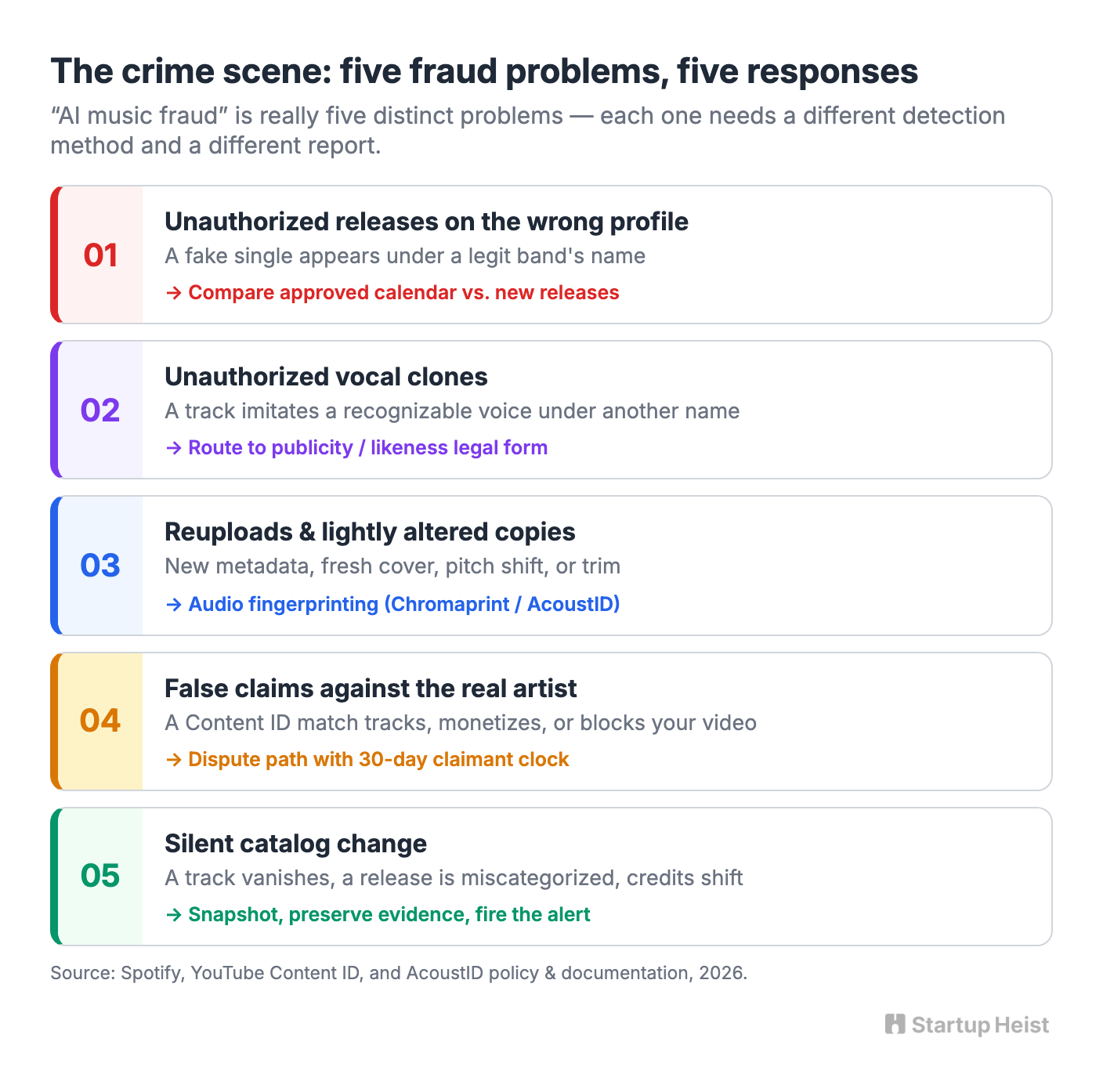
The first is unauthorized releases attached to the wrong profile. A fake single appears under a legitimate band's name, sometimes malicious, sometimes just two artists sharing a name. Either way, fans and recommendation engines see it. This is the best starting point because you can catch it without any audio analysis: compare the customer's approved release calendar against newly discovered releases on the profile, and flag anything unknown.
The second is unauthorized vocal clones. A track lands under a different name but uses a recognizable imitation of the artist's voice. Spotify's policy says it will remove music that impersonates another artist's voice without permission, AI-cloned or not, and routes claims through its legal form under the publicity-or-likeness category. The catch sits in that sentence: the artist still has to notice the clone first.

The third is reuploads and lightly altered copies, where a track gets new metadata, a fresh cover, a pitch shift, or a trim. This is where audio fingerprinting earns its keep. AcoustID runs an open-source identification service built on Chromaprint, with a database of more than 89 million fingerprints. It is excellent at catching copies and close derivatives, but it is not a magic detector for every song that merely resembles an artist.
The fourth runs in reverse: fraudulent claims against the real artist. On YouTube, uploads are scanned against Content ID, and a match can get a video tracked, monetized, or blocked. The creator can dispute, but the claimant then has up to 30 days to respond. The pain is rarely about not knowing an appeal exists. It is about discovering what happened, gathering the links, picking the right path, and moving fast enough to limit the bleeding.
The fifth is silent catalog change. A track vanishes. A release gets miscategorized. A profile is merged. Credits shift. Treat these the way uptime monitors treat downtime: record the change, preserve the evidence, fire the alert.
Why the Platforms Don't Kill the Startup
At first glance Spotify's Artist Profile Protection looks like a death sentence. Spotify is shipping a native fix, so why pay a third party?
Because Spotify is solving one slice of the problem on one platform. Profile Protection can keep certain releases off a Spotify page. It does not watch Apple Music. It does not track YouTube channels, videos, and Content ID events. It builds no cross-platform evidence vault, keeps no case history across an artist's full catalog, and tells no small label which roster artist needs attention today. Apple Music has its own IP dispute form; Deezer has an English-only copyright form that wants descriptions, error messages, and screenshots; YouTube splits video and non-video takedowns into separate legal tracks. Every platform fights its own war with its own paperwork.
The play is not to rebuild Spotify's interface. It is to become the artist's cross-platform incident-response layer. That is the durable wedge, and it is the one nobody else is filling for the little guy.
The Product: Monitor, Preserve, Respond
Do three things exceptionally well.
Monitor. The artist connects a profile and confirms an approved catalog. The system then watches a defined set of signals:
Start with deterministic signals, not a pretend AI oracle. A fake track uploaded directly under the customer's profile is high-confidence. A profile with a near-identical name and copied artwork is high-confidence. A reupload that strongly matches the customer's fingerprint is high-confidence. A track that merely "sounds a little like" the artist is not. That line protects both the customer and you.
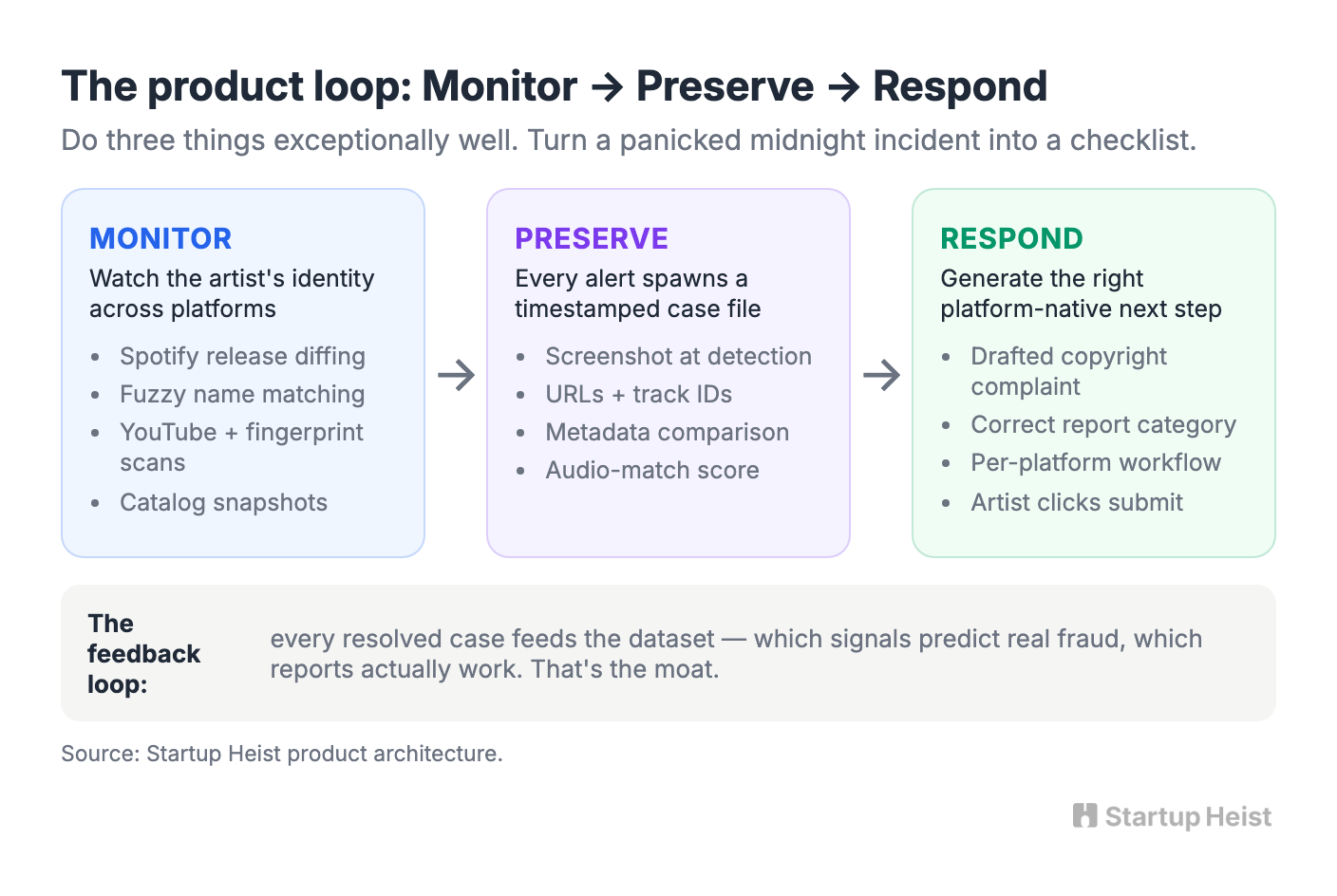
Preserve. Every alert spawns a timestamped case file. The evidence vault stores the platform, URL, profile, release page, and track identifiers; a screenshot at detection time; the detection timestamp and any later changes; a metadata comparison against the approved catalog; an audio-match score where it applies; a claim category (profile mismatch, exact copy, voice clone, copied artwork, copied lyrics, false claim, uncertain); the recommended reporting path; and the case status with prior correspondence.
The vault sounds like a minor feature, but it is the spine. Fraudulent pages change. Uploads disappear. Metadata gets edited. Support teams ask for screenshots. A musician who finds a suspicious release at midnight should not have to reconstruct the chain three weeks later from memory. The archive is also where defensibility quietly accumulates.
Respond. Generate the next step without cosplaying a lawyer. For a copied recording, draft a platform-native copyright complaint. For a Spotify voice clone, route to the legal form and the publicity-or-likeness category. For Apple Music, walk through the official dispute workflow, noting that most disputed content comes from third-party providers Apple may contact directly. For Deezer, assemble an English-language claim packet with the required fields. For YouTube, separate a Content ID dispute from a formal removal request, because they are not the same process. The software earns its fee by turning a panicked incident into a checklist.
| Watch item | Detection method | Why it matters |
|---|---|---|
| New Spotify releases under the artist name | Profile polling and release diffing | Catches fake collaborations and catalog hijacks |
| Similar artist-profile names | Fuzzy name matching and metadata search | Catches impersonator accounts and typo clones |
| New YouTube uploads using titles, name, lyrics, or audio | Search monitoring and fingerprint comparison | Catches unauthorized uploads and misleading videos |
| Missing or changed releases | Catalog snapshots and scheduled comparisons | Surfaces removals, metadata edits, profile mix-ups |
| Apple Music and Deezer conflicts | Search monitoring and catalog comparisons | Extends coverage beyond Spotify |
| Content ID and claim events | Forwarded emails or dashboard integrations | Helps artists respond faster to false claims |
The MVP: Spotify and YouTube First
Do not launch four platforms. Launch two.

Unlock the Vault.
Join founders who spot opportunities ahead of the crowd. Actionable insights. Zero fluff.
“Intelligent, bold, minus the pretense.”
“Like discovering the cheat codes of the startup world.”
“SH is off-Broadway for founders — weird, sharp, and ahead of the curve.”


