


Every Airbnb Host Pushes to Production Blind
The most expensive question in short-term rentals
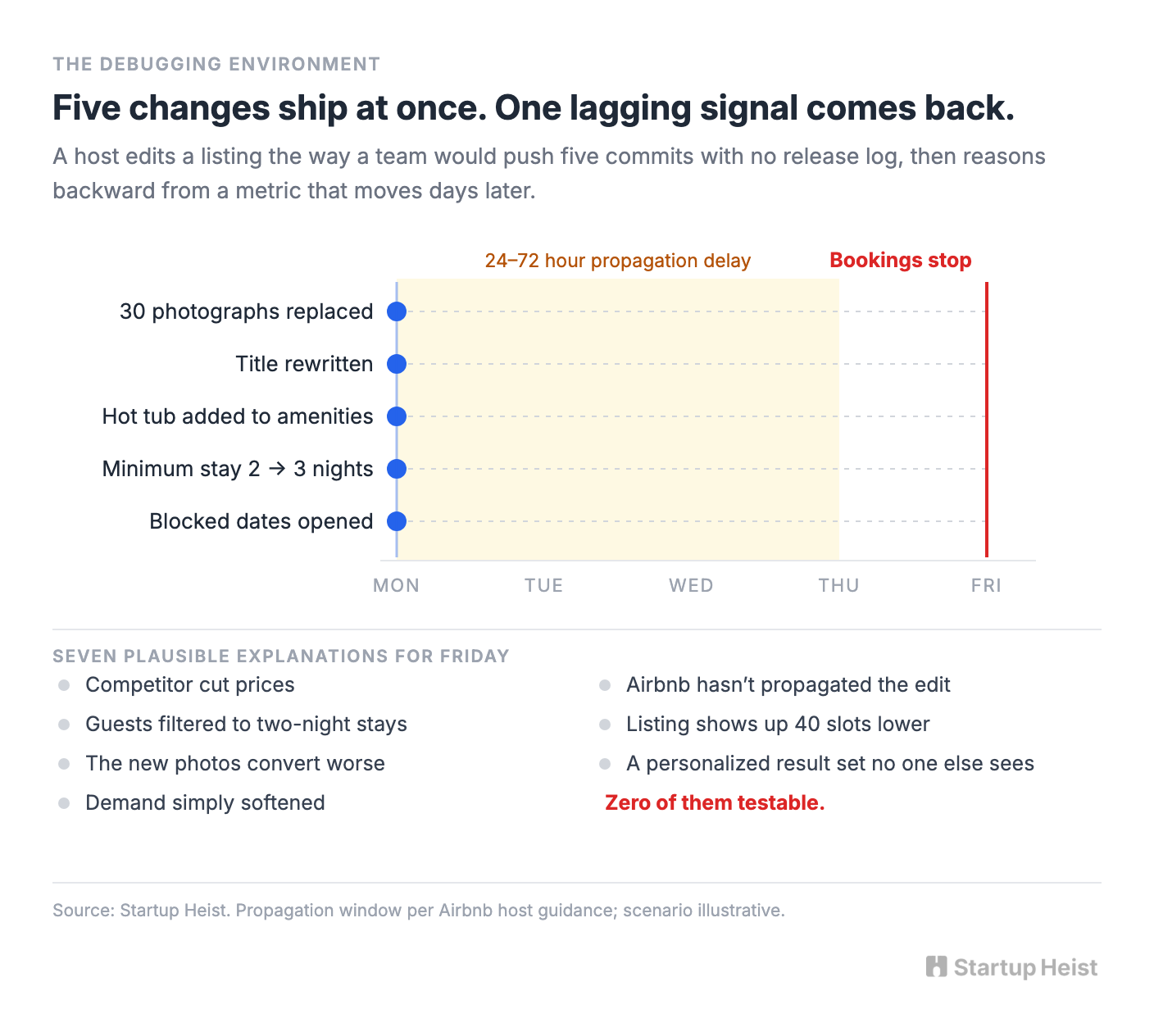
You manage a two-bedroom cabin that normally books six weekends out. On Monday you replace 30 photographs, rewrite the title, add a hot tub to your amenities, raise the minimum stay from two nights to three, and open a handful of previously blocked dates.
By Friday, the bookings stop.
Now answer a question worth a few thousand dollars: what changed?
Maybe nothing changed. Maybe a competitor cut prices. Maybe guests are searching two-night weekends and you just excluded yourself. Maybe the new photos convert worse than the old ones. Maybe Airbnb hasn't fully propagated one of your edits, or your listing still appears and sits forty slots lower. Maybe demand softened. Maybe you're looking at a personalized result set no other guest sees.

Every one of those is plausible, and none of them is testable with what a host has on hand.
So the host does what people do when instrumentation is missing. They invent a story. Usually the story is "Airbnb shadowbanned me," and it carries them into a support queue with no evidence, considerable adrenaline, and a strong chance the real culprit is the three-night minimum they set themselves on Monday.
There's a business in that gap, though probably not the one you'd expect. Here's the shape of it:
The money: 500 one-time reports at $29 plus 375 subscribers lands near $21,700 a month. Boutique agencies already charge $200 to $300 for a single listing audit.
Inside:
• Six-step wizard: baseline to evidence packet
• The five searches to run before you edit
• Three-tier pricing: $29 one-time to $49/month
• The photographer channel nobody is courting
Airbnb tells hosts the truth, and it doesn't help
Airbnb is unusually forthcoming about how its search ranking works. The company says quality, popularity, price, and location all shape placement. Quality folds in photos, ratings, communication history, cancellations, and amenities. Popularity folds in guest behavior like wishlist saves and message volume. Airbnb also states plainly that its algorithm encourages variety within results, so guests see a spread of hosts, characteristics, and prices rather than one universal leaderboard.
Airbnb has even killed the most persistent host superstition directly. Repeatedly tweaking your listing neither helps nor hurts your search ranking. Meaningful changes, like real new photos or an amenity you actually added, can influence performance. Fiddling for the sake of fiddling does nothing.
Hosts largely don't believe it. Forums still recommend touching your listing daily to stay "active," and the most common question in short-term rental communities is still some version of why is my Airbnb listing not showing in search. That's the predictable behavior of people managing a system they can't observe. Airbnb publishes the ranking factors and withholds the only thing that would settle an argument: whether your listing appeared in that search at that moment.
The result is a debugging environment with no logs. A host makes five changes at once, waits, watches a lagging metric like bookings, and tries to reason backward through a personalized, varied, multi-factor result set with a 24 to 72 hour propagation delay baked in.
Software teams solved this problem decades ago and gave it a boring name: release management. You don't push to production without knowing what shipped, when, and what the system looked like before. Airbnb carries more than 8 million active listings from more than 5 million hosts, and nearly every one of those hosts pushes to production with no record of any of it.
Why the obvious version of this business loses
The obvious startup here is an Airbnb rank tracker. Don't build that.
Three companies already do that job at three price points, all answering the same question: where do you rank and how do you rank better? RankBreeze has sold search rank tracking for years across guest counts, open calendar dates, and city searches, starting around $29 a month for three listings, with a dynamic-pricing add-on at $19.99 per listing or 1% of booking revenue. PriceLabs already sits inside the workflow of most professional operators through dynamic pricing at $19.99 per listing per month in the U.S., and sells Listing Optimizer as a $12.99 per-listing add-on that grades listings A through D, keeps a change log with timestamps and score deltas, and refreshes a rank history graph weekly. AutoRank starts around $9 per listing per month on annual commitments with $250 to $500 onboarding fees, aimed squarely at operators running 15 to 500 properties.
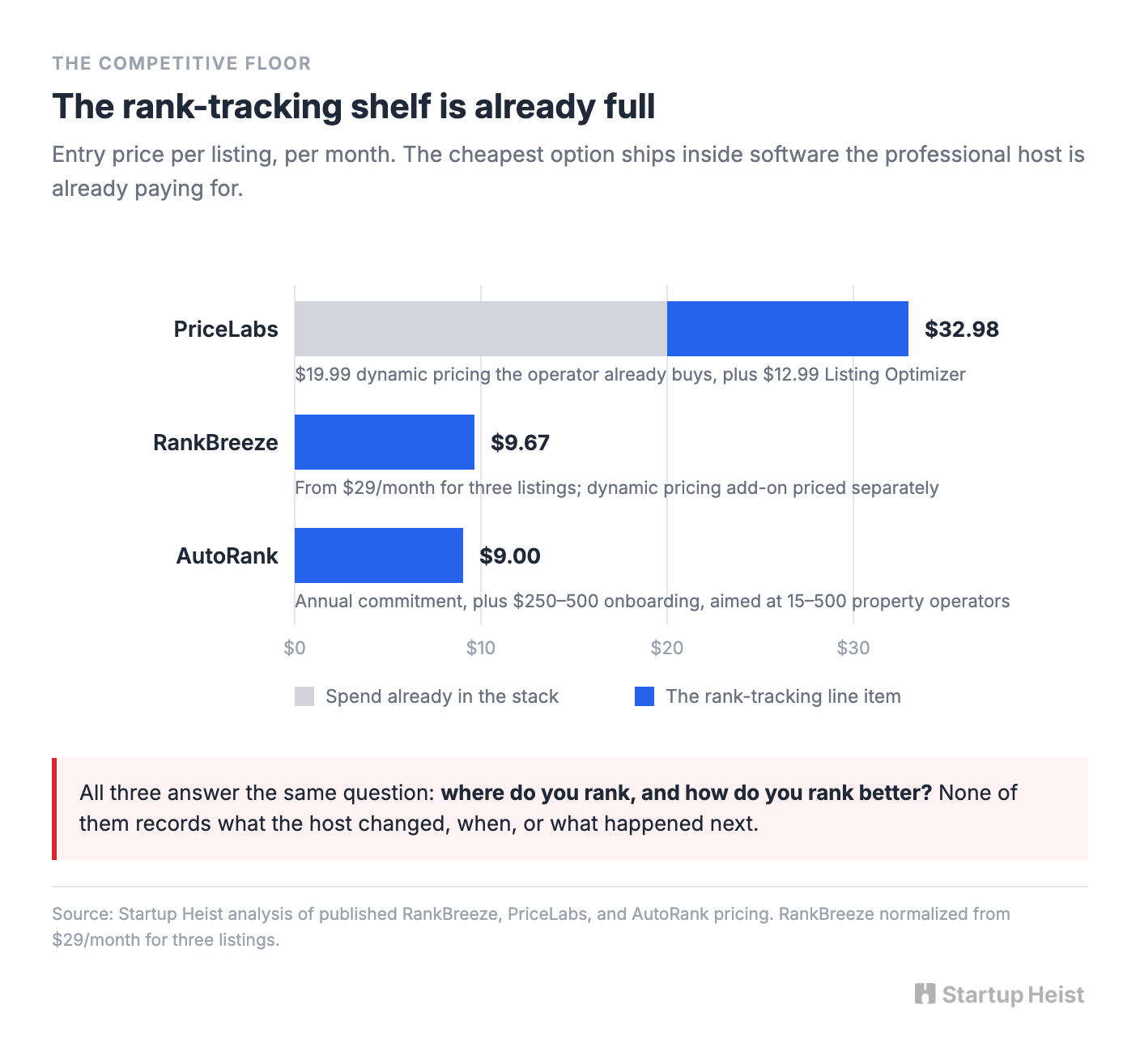
Each of them has more data and better distribution than you will have on launch day, and the cheapest of them is bundled into software the professional host is already paying for. "Airbnb Rank Tracker, But Prettier" is a losing hand.
There's a harder constraint underneath the competitive one. Airbnb's Terms of Service instruct users not to use bots, crawlers, scrapers, or other automated means to access, collect data from, or otherwise interact with the platform. The sexy version of this idea, with thousands of automated searches running continuously and an alarm when a property vanishes, is precisely the version a solo founder should refuse to build. Airbnb enforces with IP blocking, CAPTCHAs, and device fingerprinting, and the penalty isn't a warning email. It's the account.
That constraint does useful work for you. It prices out the version of this product that would otherwise be commoditized within a quarter, and it leaves the honest version standing.
The wedge: own the incident, not the algorithm
Rank trackers answer the question hosts ask when things are calm: where do I rank?
The question that actually costs money arrives later, when money is on fire. What changed immediately before this, what have we actually tested, what explanations have we eliminated, and what evidence do we still have?
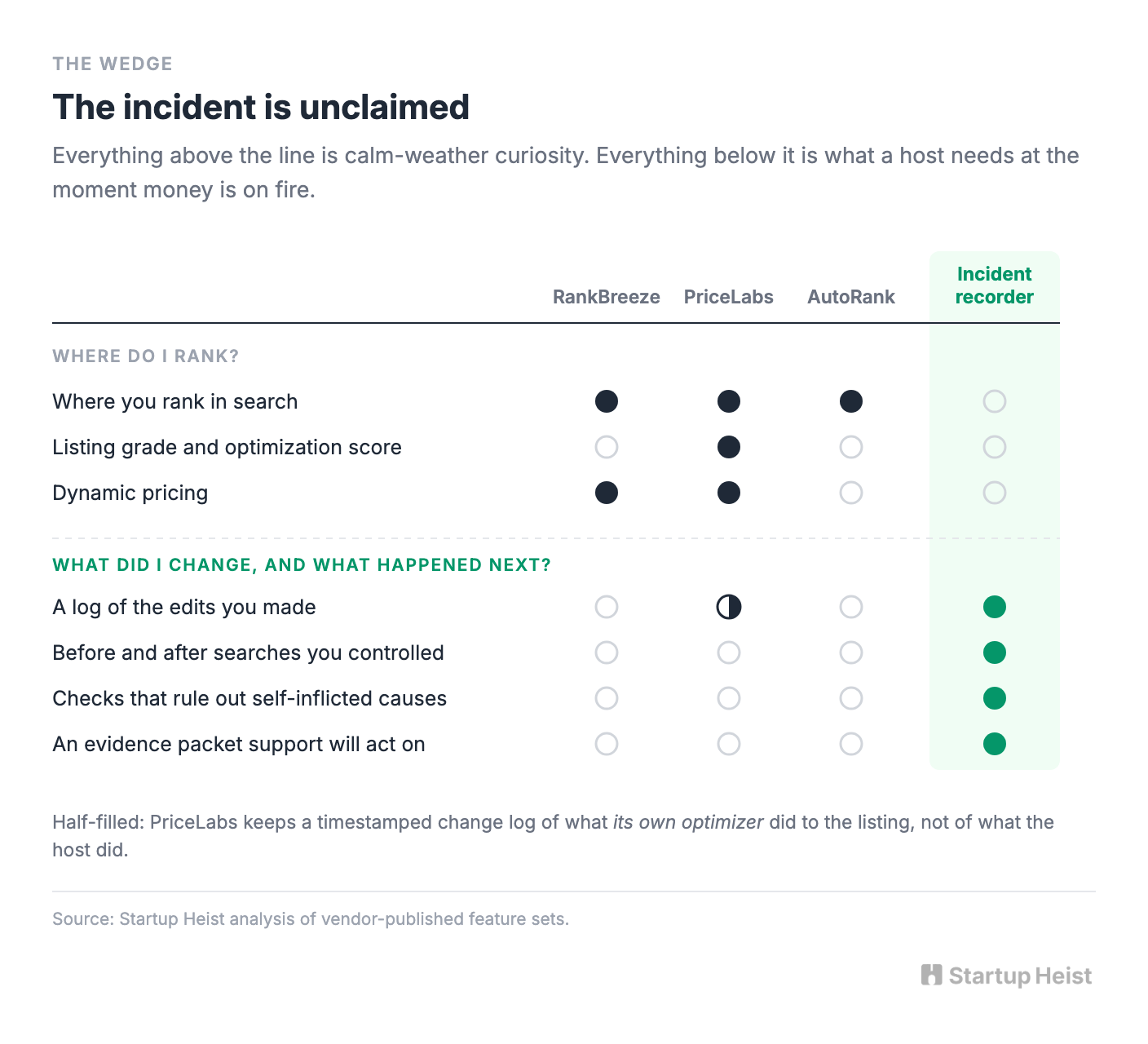
Nobody sells that. PriceLabs' change log records what its own optimizer did to your listing. It doesn't record that you swapped 34 photos on a Thursday afternoon and then watched Saturday bookings die. No rank tracker captures a before-state you defined, under conditions you controlled, that you can hand to a support agent.
The evidence itself has real value, and Airbnb's own community forums show why. The recurring pattern in host threads is a listing that goes missing from search, days or weeks of circular support conversations, and then a fix that lands within hours once the case reaches Airbnb's technical team as a documented report. The bottleneck was never Airbnb's engineering. It was the week spent proving something was actually wrong.
What you're selling is the artifact that gets a host triaged in hours instead of a week.
The product: a visibility incident report
The whole product hangs off one button, and the button is pressed before anything breaks.
"I'm about to change my listing."
Unlock the Vault.
Join founders who spot opportunities ahead of the crowd. Actionable insights. Zero fluff.
“Intelligent, bold, minus the pretense.”
“Like discovering the cheat codes of the startup world.”
“SH is off-Broadway for founders — weird, sharp, and ahead of the curve.”


