


The AI Slop Cleanup Crew
The next AI business is finishing, not generating
On June 9, 2026, Product Hunt sent a newsletter with a blunt headline: "De-slop your design." The featured product, Uiverse Design, is a library of more than 3,500 community-made interface components pitched as an antidote to AI-generated websites that all look suspiciously alike. The newsletter named the problem directly: "Every AI-generated website uses the same card layout, the same serif-and-sans pairing, the same hover state." Same oversized gradients, same generic startup language, same feeling that nobody made a real decision.
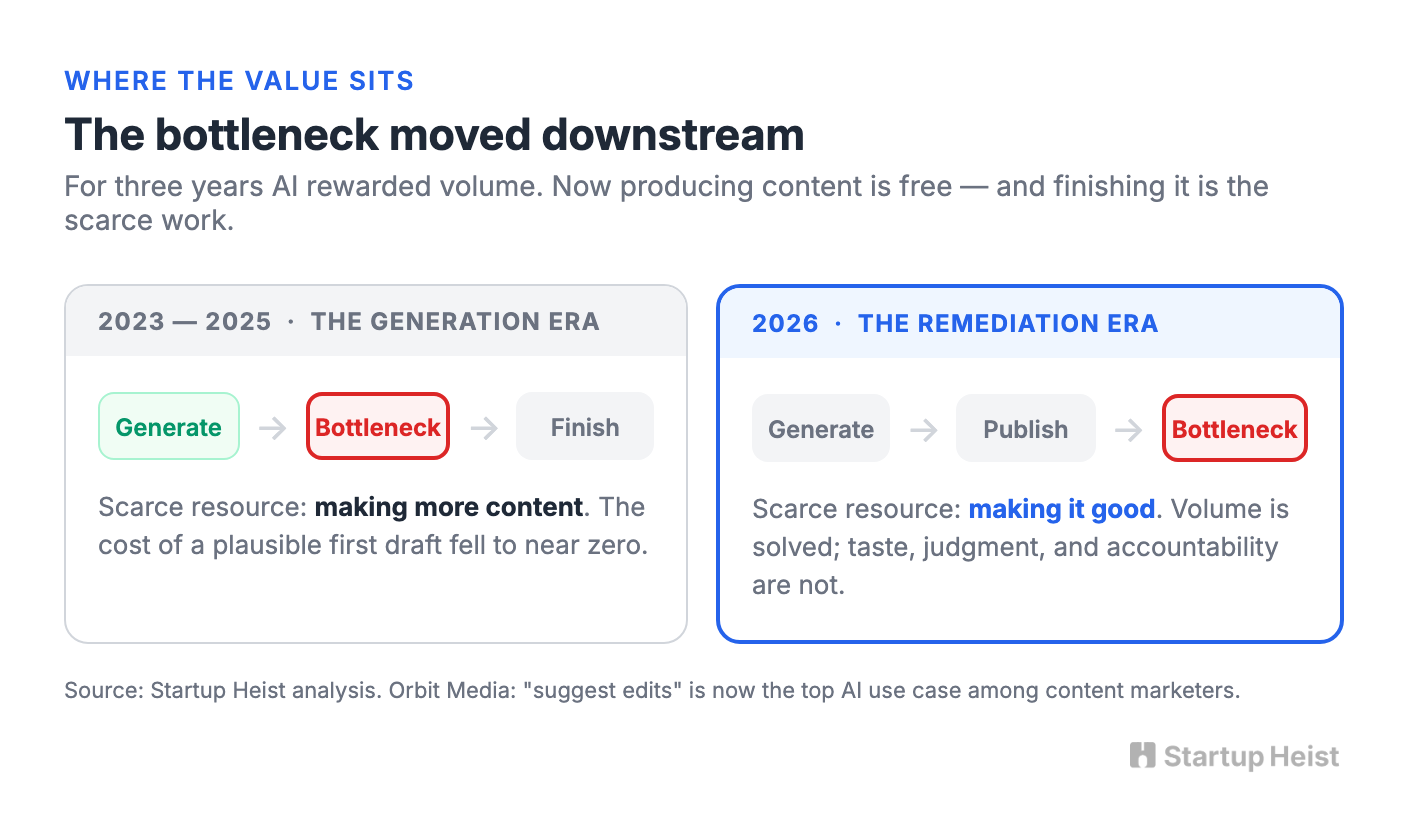
That launch is a small signal of a much larger shift. For three years, the AI economy rewarded volume: generate the landing page, the 40 blog posts, the sales deck, the email sequence. The cost of a plausible first draft collapsed to nearly zero. Now the bottleneck has moved downstream. Producing enough content is no longer the problem. The problem is that too much of it looks, sounds, and feels like it came from the same machine. Merriam-Webster named "slop" its 2025 Word of the Year, defining it as low-quality digital content produced in quantity using AI. The word escaped tech circles because everyone recognizes the experience: content that looks polished from a distance and turns strangely empty the moment you pay attention.
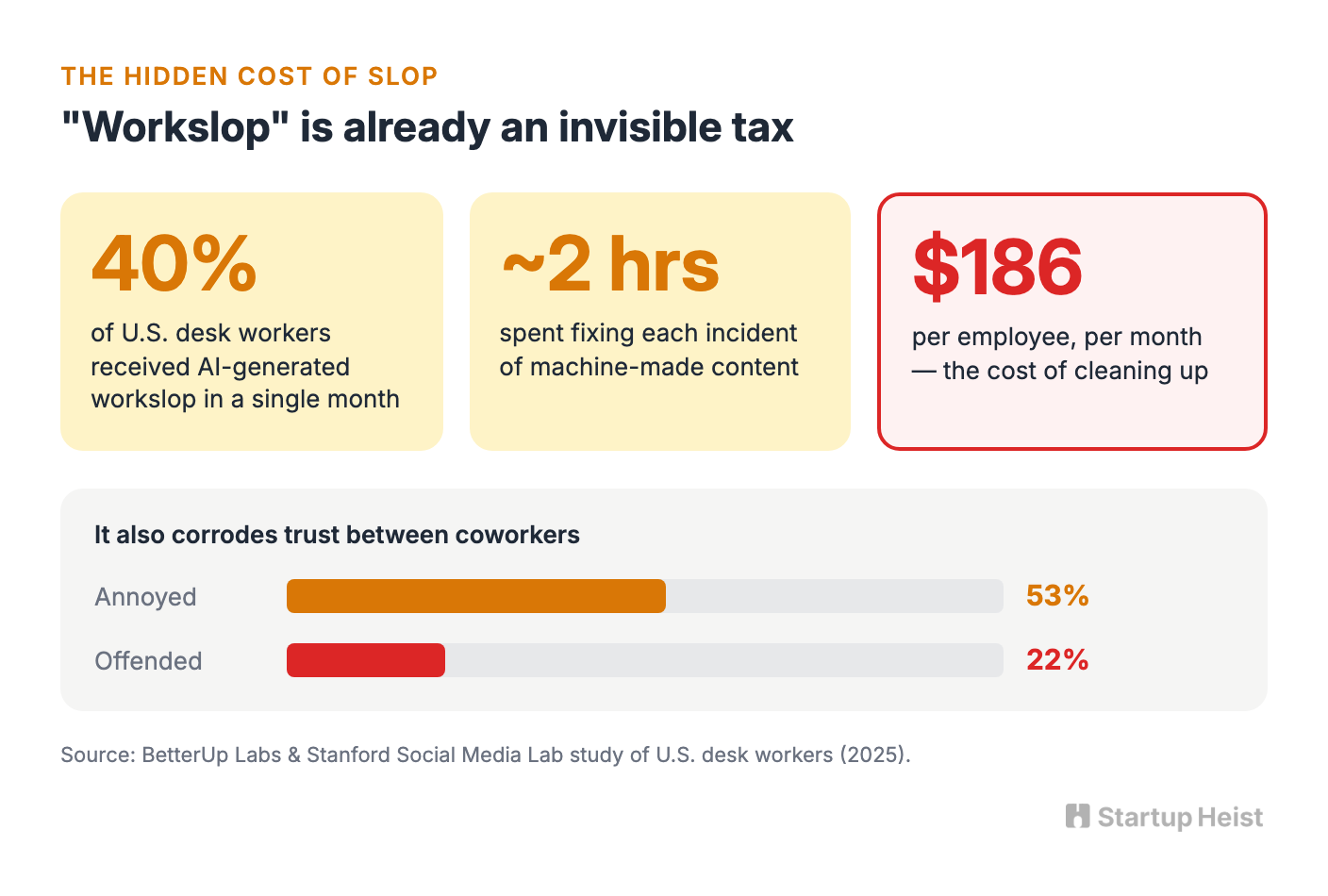
The cleanup economy is already forming. NBC News reported in 2025 that companies are hiring humans to fix clunky AI output, paying freelance writers to rewrite machine-made articles that, as one of them put it, "don't look remotely human at all." The catch is that buyers often pay less for the cleanup than for original work, on the assumption that fixing is easier than writing. Inside companies, researchers from BetterUp Labs and Stanford's Social Media Lab found that 40% of U.S. desk workers received AI-generated "workslop" in a single month, each incident taking about two hours to fix, an invisible tax of roughly $186 per employee per month.
Here's the opportunity: build the finishing trade for the AI construction boom. A productized AI content remediation service that cleans up AI-heavy copy and design for one valuable vertical, at fixed prices, on fixed timelines.
The money: 4 audits, 4 sprints, and 2 retainers a month is $12K MRR solo. A boutique version with a small team and agency partners reaches $30K to $75K.
Inside:
• Three-tier offer: audit, sprint, retainer
• Six-dimension slop scoring rubric
• B2B SaaS wedge and ICP filter
• Cold email that demos the fix
• Vertical pattern library as the moat
The service is not anti-AI. It is what happens after AI becomes normal.
The shift from generation to remediation
AI adoption is not slowing down. Salesforce found 78% of SMB leaders using AI expect it to be a game-changer, and nine in ten say it makes operations more efficient. But the usage pattern is telling. Orbit Media's research shows "suggest edits" is now the most popular AI use case among content marketers. Two-thirds use AI during the writing process; only a small minority let it produce complete articles. The market is learning that AI works well as a junior assistant and poorly as an unsupervised publishing department.
The symptoms are everywhere: generic introductions that take 300 words to say nothing, perfectly structured paragraphs with no memorable opinion, the endless "It's not just X; it's Y," unsupported certainty around technical claims, hero images with the same glossy synthetic lighting, websites that feel assembled rather than designed. Fisher Phillips, a national employment law firm, now advises employers to assign a human owner to every AI-assisted document and train managers to recognize slop: vague conclusions, buzzword stacking, polished paragraphs with no substance.
The incentives are lining up from every direction. Employees need work that does not embarrass them, and the same BetterUp study found workslop carries a social cost: 53% of recipients were annoyed by it and 22% were offended, which means bad AI content quietly erodes trust between coworkers. Marketing leaders need content that does not weaken the brand. Creators need content that does not look mass-produced. Agencies need a quality-control layer before deliverables reach clients. AI created the mess, and AI will help with part of the cleanup, but the final 20% requires human taste, judgment, and accountability. That gap is where the money is.
Platforms are raising the quality floor
On July 15, 2025, YouTube renamed its "repetitious content" monetization policy to the "inauthentic content" policy, clarifying that mass-produced and repetitive material is not eligible for the Partner Program. In January 2026, CEO Neal Mohan addressed "AI slop" directly, writing that YouTube was expanding its spam and clickbait systems to reduce its spread. That same month, YouTube terminated a network of channels that collectively held 4.7 billion lifetime views and 35 million subscribers, all built on mass-produced AI content. Enforcement is no longer theoretical.
Google Search sends the same message. AI-generated content is not prohibited, but generating large numbers of pages without adding value may violate Google's scaled-content-abuse policy, and its guidance for visibility inside AI-powered search features is explicit: create valuable, non-commodity content.
There is a nuance here that matters for anyone building in this space. The winning offer is not "hide the fact that you used AI." It is "make the work good enough that the method stops being the most interesting thing about it." That positioning separates a durable business from a sketchy detector-evasion hustle.
Sell the repaired house, not the wrench
The obvious response to slop is building another software tool. That is probably the wrong move. The AI humanizer category is already crowded and brutally cheap, with free tiers offering hundreds of thousands of words per month and QuillBot bundling unlimited paraphrasing and AI detection for $8.33 a month. A generic rewrite button commands no margin, and prices will keep falling.
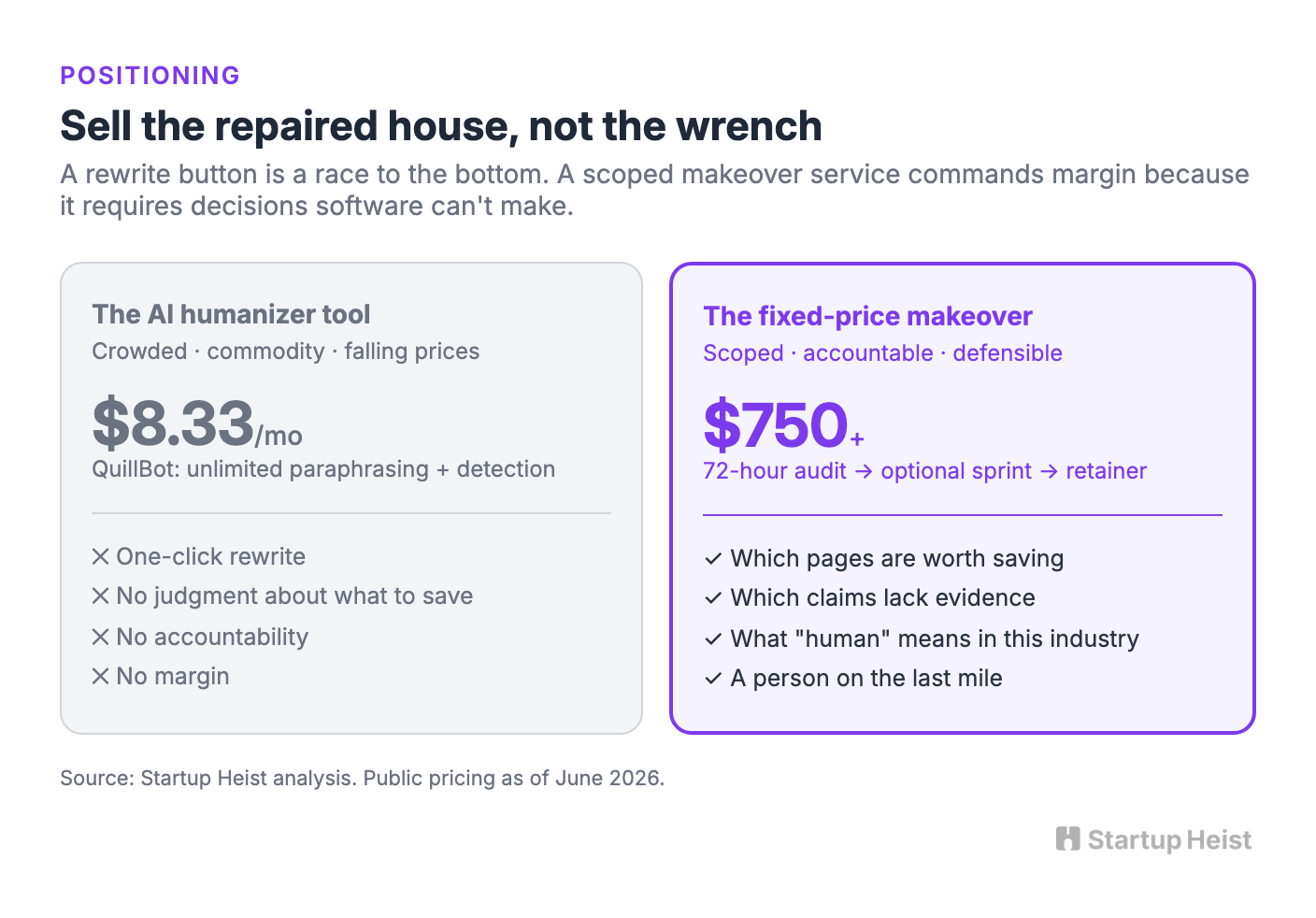
But the tool is not the job. A serious cleanup requires decisions: which pages are worth saving, which claims lack evidence, which parts sound unlike the company, which visuals undermine trust, which assets should be deleted rather than polished, what "human" looks like in this specific industry. A text transformer cannot answer those questions in one click. A generalist agency can, but only after a slow discovery process and a vague proposal.
The gap is a tightly scoped, fixed-price makeover service: a 72-hour audit followed by an optional implementation sprint. The customer is not paying for your prompts. The customer is paying to stop publishing work that feels disposable.
The best first wedge: B2B teams with an AI hangover
Several verticals are viable. YouTube creators have monetization urgency, local services have obvious visual problems, regulated companies need human review. The strongest first wedge is more boring: B2B SaaS companies and professional-services firms with a backlog of AI-assisted marketing content.
Target a narrow profile: 10 to 100 employees, a small or founder-led marketing function, at least 30 published posts or pages with visible signs of AI-assisted production, a product valuable enough that one qualified lead matters, and no appetite for a six-month brand-agency engagement.
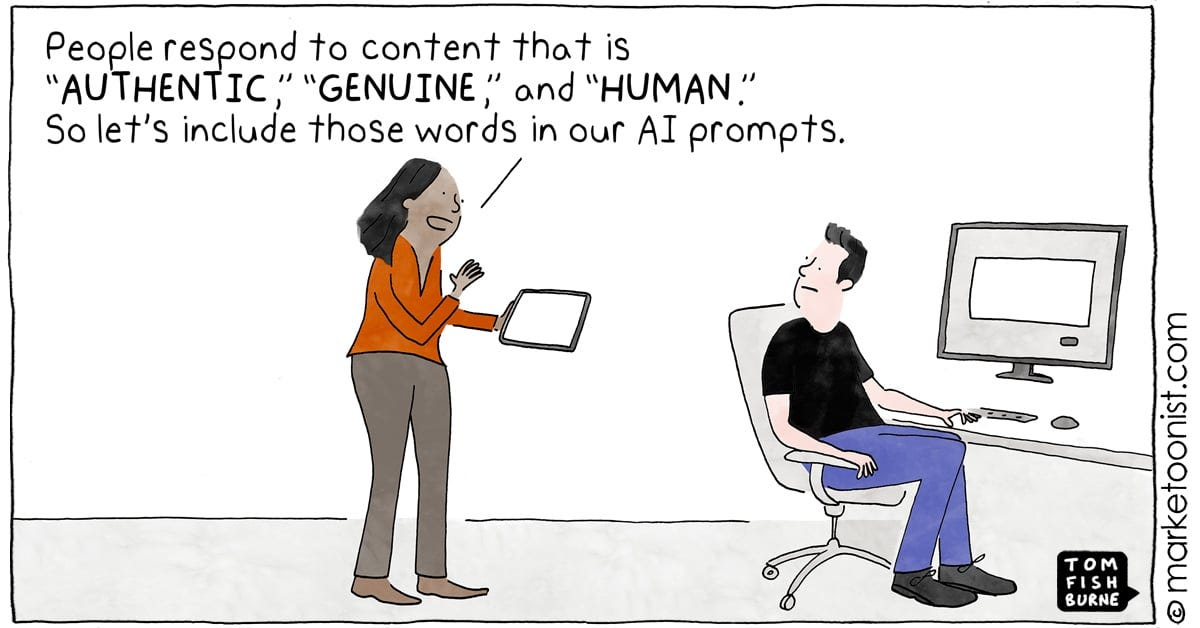
These companies are ideal customers. The problem is visible, so you can inspect the website before sending an email and show a concrete example. The assets are easy to scope: five landing pages or one sales deck is manageable, "fix our entire brand" is not. The business value is legible, because a weak page damages conversion or creates a credibility problem during due diligence, no magical ranking promises needed. The pain repeats, because new content keeps flowing through the same pipeline. And the offer can specialize over time, narrowing from B2B SaaS into cybersecurity, accounting software, or legal tech as your pattern library deepens.
The pitch is one sentence: your team can keep using AI, and we make sure the final result still sounds like your company.
The offer: a 72-hour AI content audit
Start with an audit, not an unlimited cleanup service. The audit creates a bounded first engagement and keeps you from drowning in implementation work before learning which problems clients actually pay for.
Unlock the Vault.
Join founders who spot opportunities ahead of the crowd. Actionable insights. Zero fluff.
“Intelligent, bold, minus the pretense.”
“Like discovering the cheat codes of the startup world.”
“SH is off-Broadway for founders — weird, sharp, and ahead of the curve.”


