


The AI Receptionist Has a Consent Problem. Sell the Test.
A dental practice installs an AI receptionist to catch missed calls and book appointments after hours. The launch goes well. The voice sounds natural, patients book cleanings at 9 p.m., and the agency that set it up moves on to its next client.
Three months later, someone at the office changes the after-hours call forwarding. The recorded disclosure that used to play before the AI picked up is no longer on that route. The receptionist keeps working and appointments keep landing on the calendar, so nobody realizes callers now reach the AI without hearing the notice until someone dials the number and listens.

Installing an AI phone agent and verifying how it behaves six months later are two separate jobs. The first is crowded with vendors and agencies. The second is operational work that almost nobody owns, and that gap is where the business sits. Here's the opportunity:
The money: Five agencies with 10 locations each at $79 per location monthly is $3,950 MRR, before $750 audit fees. Fifteen agencies at 20 locations reaches $23,700.
Inside:
• The six-route test matrix for dental phones
• Three-phase MVP: audit, monitoring, gate
• Pricing ladder from $750 audits to $99/month
• 90-day GTM, outreach email, kill criteria
The business is a specialized service that audits AI receptionist call flows, checks that the intended disclosure and consent steps actually fire, and keeps testing as configurations change. Sell it to the dental-focused AI agencies and managed IT providers who run these deployments, not to individual dentists. Start with a paid technical audit, automate the repeatable tests, and convert the audit into a per-location monitoring subscription. Build a call-routing consent gate only when a customer's existing tools can't do the job.
The shape is a service-assisted micro-SaaS. It won't become a billion-dollar compliance platform, but an operator who becomes the independent testing layer for a handful of agencies can still build a very profitable small company.
The Gap Between Buying AI and Operating It
The United States has 135,665 dental practice establishments, according to the American Dental Association's reading of 2023 Census data. In an ADA survey published in mid-2026, 43.3% of responding dentists said they use AI for at least one practice task, and another 26.4% said they plan to. About 10.1% use it for reception or front-desk check-in. Those figures measure dental AI adoption broadly rather than AI phone agents specifically, but the direction is clear. On the supply side, Retell AI lists voice-agent pricing of $0.07 to $0.31 per minute, and research firm Sacra estimates Retell hit $80 million in annualized revenue in August 2026, up from roughly $45 million at the end of 2025. Businesses are paying real money to let software answer the phone.
That software is rarely one product. A modern AI phone workflow can chain a carrier, call routing, speech recognition, a language model, text-to-speech, a scheduling integration, and sometimes a separate analytics vendor, each on its own settings and contract terms. The clinic owner doesn't know the architecture. The agency knows the technology better than the law. The AI platform supplies features while assigning the legal duties to its customer.
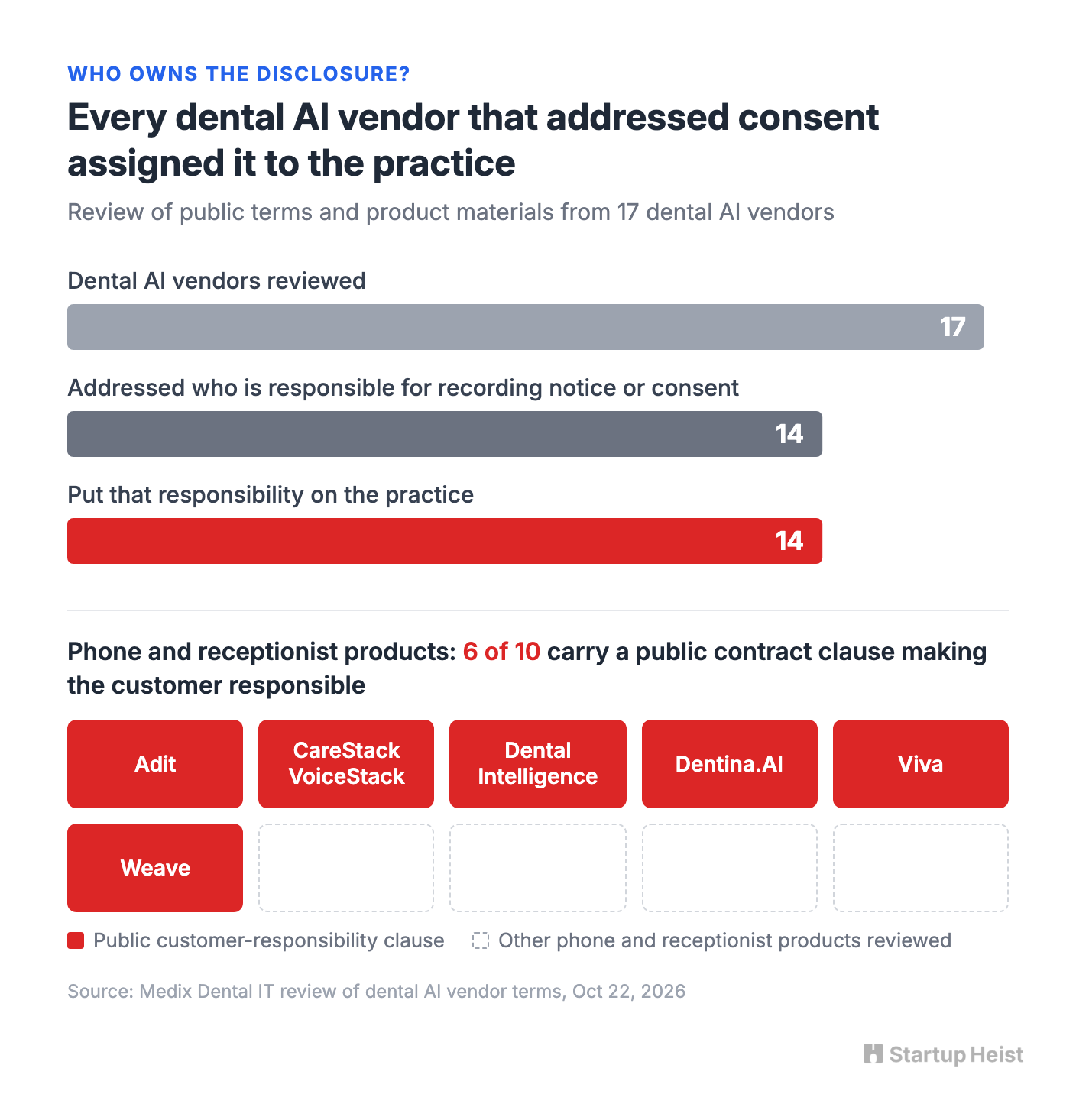
On October 22, 2026, Medix Dental IT published a review of public terms and product materials from 17 dental AI vendors. Fourteen addressed who is responsible for call recording notice or consent, and all fourteen put it on the practice. Of the ten phone and receptionist products reviewed, six (Adit, CareStack's VoiceStack, Dental Intelligence, Dentina.AI, Viva, and Weave) carry a public contract clause making the customer responsible. Native disclosure tools exist, though the details vary. VoiceStack plays a disclosure "if required." Mango Voice has the practice record its own notice clip. Weave support will set up a recorded notice on inbound calls when the practice asks. Whether that feature is switched on, on every route, after every change, falls to somebody else, and right now nobody is paid to check.
Why the Legal Environment Makes This Worth Testing
California's Invasion of Privacy Act, known as CIPA, restricts certain interception and recording of communications. Under Penal Code Section 637.2, statutory damages run up to $5,000 per violation, or three times actual damages if that's greater. The number gets attention and is easy to overread. A remedy on the books doesn't make every AI-processed call a $5,000 liability.
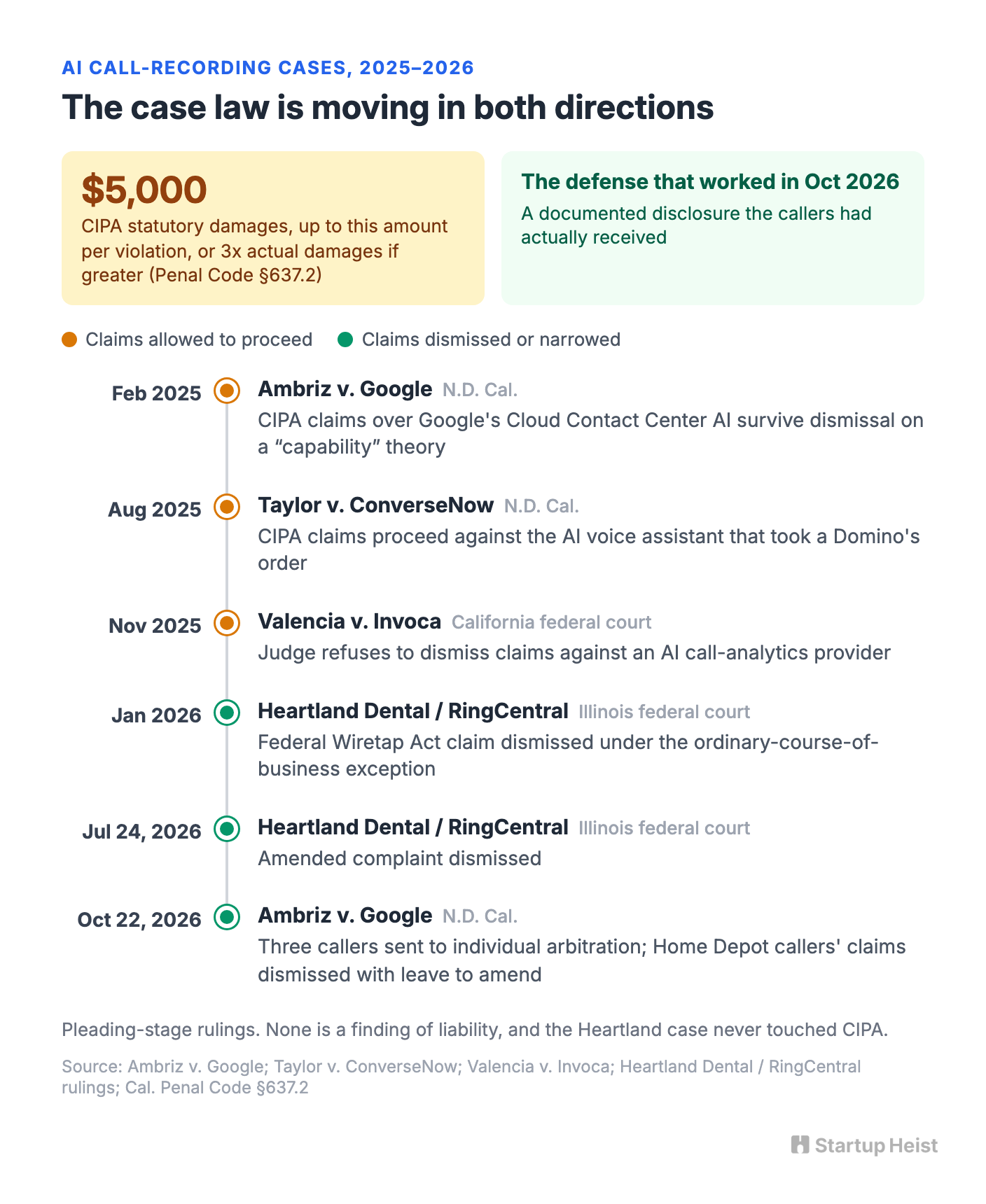
The case law is moving in both directions. In Taylor v. ConverseNow (August 2025), a Northern District of California judge let CIPA claims proceed against the AI voice assistant that took a caller's Domino's order, reasoning that a vendor using caller data to improve its own AI can be treated as a third-party eavesdropper. In Ambriz v. Google (February 2025), the same district allowed CIPA claims over Google's Cloud Contact Center AI to survive dismissal under a similar "capability" theory. In Valencia v. Invoca (November 2025), a California federal judge refused to dismiss claims against an AI call-analytics provider. These are rulings at the dismissal stage, with no finding of liability in any of them, but together they show a vendor's data rights can turn it into a third party on the call.
The dental case cut the other way. A patient sued Heartland Dental and RingCentral over AI tools that allegedly intercepted and analyzed calls to a Heartland-supported practice. An Illinois federal court dismissed the federal Wiretap Act claim in January 2026 under the ordinary-course-of-business exception, then dismissed the amended complaint on July 24, 2026. That case never touched CIPA, and it immunizes nobody else.
Then, on October 22, 2026, the Google case turned. The court sent three callers to individual arbitration and dismissed the Home Depot callers' claims with leave to amend. Two of them had agreed to a privacy statement disclosing that recordings could go to service providers, and none could plead that Google intended to listen without consent. It's another pleading-stage ruling, but the defense that worked was a documented disclosure the callers had actually received.
Roughly a dozen states require every party's consent to record, including California, Florida, Illinois, Pennsylvania, and Washington, and area codes say little about where a caller is actually sitting. An agency running multi-state deployments needs one legally reviewed policy and proof each clinic follows it. A testing company can't promise a notice makes every call lawful, but it can prove the approved disclosure played and the phone behaved as designed, and agencies will pay for that proof.
The Product: Call-Routing Assurance
Call it CallProof: independent AI receptionist testing for dental agencies. The pitch fits in one sentence. We test your clients' AI phone workflows before launch and keep testing them afterward, so you know the moment disclosures, consent paths, transfers, or fallback routes stop behaving as configured.
Unlock the Vault.
Join founders who spot opportunities ahead of the crowd. Actionable insights. Zero fluff.
“Intelligent, bold, minus the pretense.”
“Like discovering the cheat codes of the startup world.”
“SH is off-Broadway for founders — weird, sharp, and ahead of the curve.”


