


The AI Mystery Shopper for Restaurants
A diner used to type "Italian restaurant near me" and pick from a list.
Now more of them type something closer to a brief: romantic Italian place near Rittenhouse Square, under $100 for two, good gluten-free options, table Saturday at 7.
The machine answering that request doesn't hand back ten links. It returns three restaurants, mentions which one has a patio, summarizes what people say about the pasta, and points at a reservation.
Somewhere in that neighborhood sits a restaurant with a great patio and a real gluten-free menu that didn't make the cut. The owner will never find out. There is no impressions report for a conversation that happened inside ChatGPT.
That blind spot is where the money is, and the obvious way to attack it is already a commodity. Dashboards that count AI mentions exist, and they start at $29 a month. The real opening is to become the restaurant industry's AI mystery shopper: run the questions diners actually ask, document what the machines get wrong, trace each bad answer back to the specific record that produced it, repair the record, and come back to confirm it held.
It's traditional mystery shopping, except the shopper is a chatbot and the thing under inspection is the restaurant's digital reality.
Here's what that business looks like.
The money: Thirty monitoring clients at $325 a month is $9,750 MRR, and four cleanup sprints on top puts a solo operator near $220K a year.
Inside:
• The 15-prompt test set for any location
• Two-week MVP build, six components
• Three-tier pricing from $500 to $3,000
• The agency wholesale channel at $1,200/mo
The behavior moved before the operators did
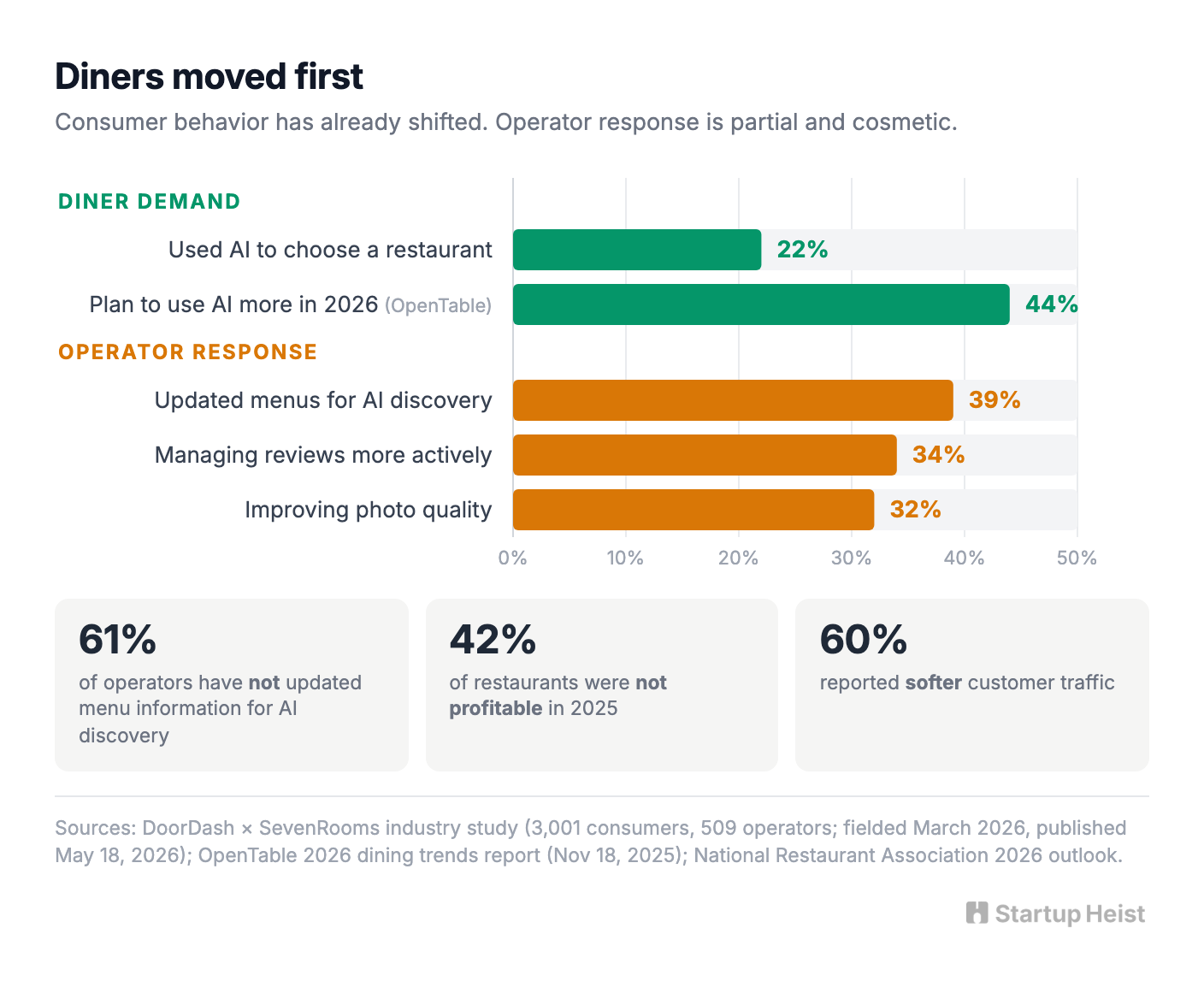
DoorDash and SevenRooms ran their first joint industry study in March 2026, surveying 3,001 U.S. consumers and 509 restaurant operators. Published on May 18, 2026, it found that 22% of consumers have already used an AI tool like ChatGPT or Gemini to help choose a restaurant. Operators are moving, but slowly and at the edges: 39% have updated their menu information with AI discovery in mind, 34% are managing reviews more actively, 32% are improving photo quality.
OpenTable's 2026 dining trends report, released November 18, 2025, points the same direction: 44% of Americans said they planned to use AI more often for restaurant discovery and reservations in 2026. The questions OpenTable sees through its own AI concierge aren't "best restaurant near me." They're whether a place is kid-friendly, what the best dish is, whether dogs are allowed.
The keyword is no longer the unit of competition in restaurant search. What matters now is whether a restaurant is correctly understood across a few dozen attributes: romantic, kid-friendly, patio, private dining, gluten-free, open late, good for groups, near the theater, quick lunch, dog-friendly, available Saturday at seven.
Those attributes live in a half-dozen systems that routinely disagree. The website says dinner starts at five, Google says four-thirty. Yelp knows about the patio, OpenTable doesn't. The delivery app has this week's menu, the restaurant's own site still hosts a PDF from last spring.
Now put a language model on top of that mess and ask it to make a decision for a hungry stranger.
Meanwhile the operators have no spare attention. The National Restaurant Association projects $1.55 trillion in industry sales for 2026, a 4.8% nominal increase that's roughly 1.3% real growth after inflation. Forty-two percent of operators reported their restaurant wasn't profitable in 2025. Sixty percent reported softer customer traffic. Nobody in that group is auditing their own AI representation.
What the machines are actually reading
In October 2025, Yext analyzed 6.8 million citations across ChatGPT, Gemini, and Perplexity. Eighty-six percent of them came from sources the brand already controls: websites and listings, not Reddit threads or forum chatter. Once location context and query intent were applied, Reddit-style platforms accounted for about 2%.
Zoom into foodservice specifically and Yext's breakdown of 2.2 million citations reads like a work order:
- 41.6% from third-party listings: Yelp, Google Business Profile, DoorDash
- 39.8% from first-party websites
- ~13% from reviews and social
- ~6% from news, forums, and government sources
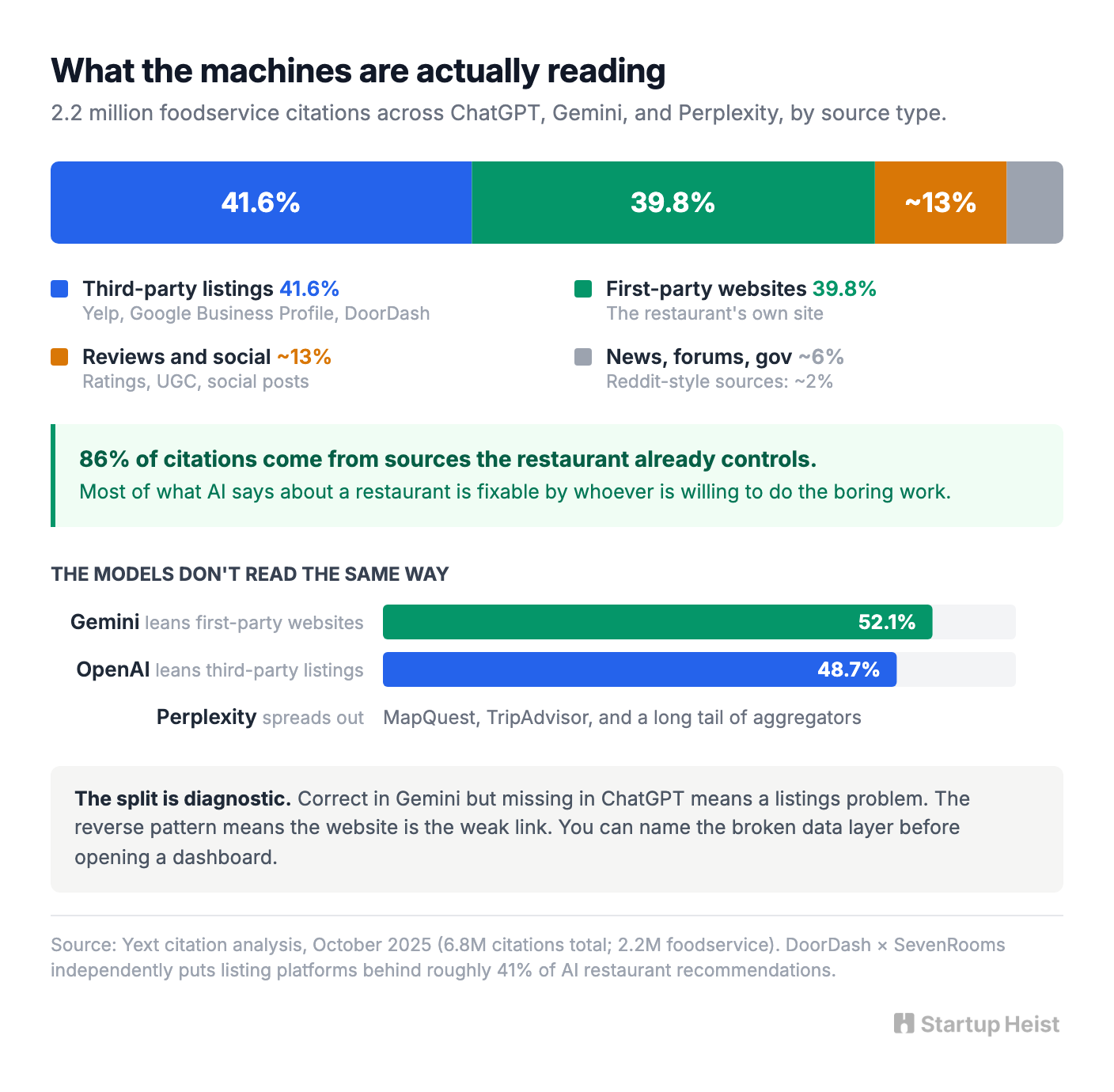
DoorDash's own study arrives at the same number from a different direction: roughly 41% of AI restaurant recommendations come from listing platforms.
The models also split by temperament. Gemini leans on first-party websites (52.1%), OpenAI leans on listings (48.7%), and Perplexity spreads itself across sources like MapQuest and TripAdvisor.
That split is diagnostic. A restaurant that shows up correctly in Gemini and vanishes in ChatGPT has a listings problem; the reverse pattern means the website is the weak link. You can tell an owner which data layer is broken from the shape of the failure, before opening a single dashboard.
Eighty-six percent controllable means most of what AI says about a restaurant is fixable by someone willing to do the work. Nobody's doing it because the work is boring, spread across a dozen logins, and requires judgment about which facts matter.
Why the obvious version of this business is already gone
Sell "we track whether ChatGPT mentions your restaurant" and you have walked into a price war you will lose.
Otterly.AI starts at $29 a month. Scrunch charges $250 for its Core plan and $500 for the agency tier. SE Ranking sells AI search tracking as an $89 add-on. Generic AI visibility monitoring, what the SEO world now files under answer engine optimization, is a commodity and getting cheaper.
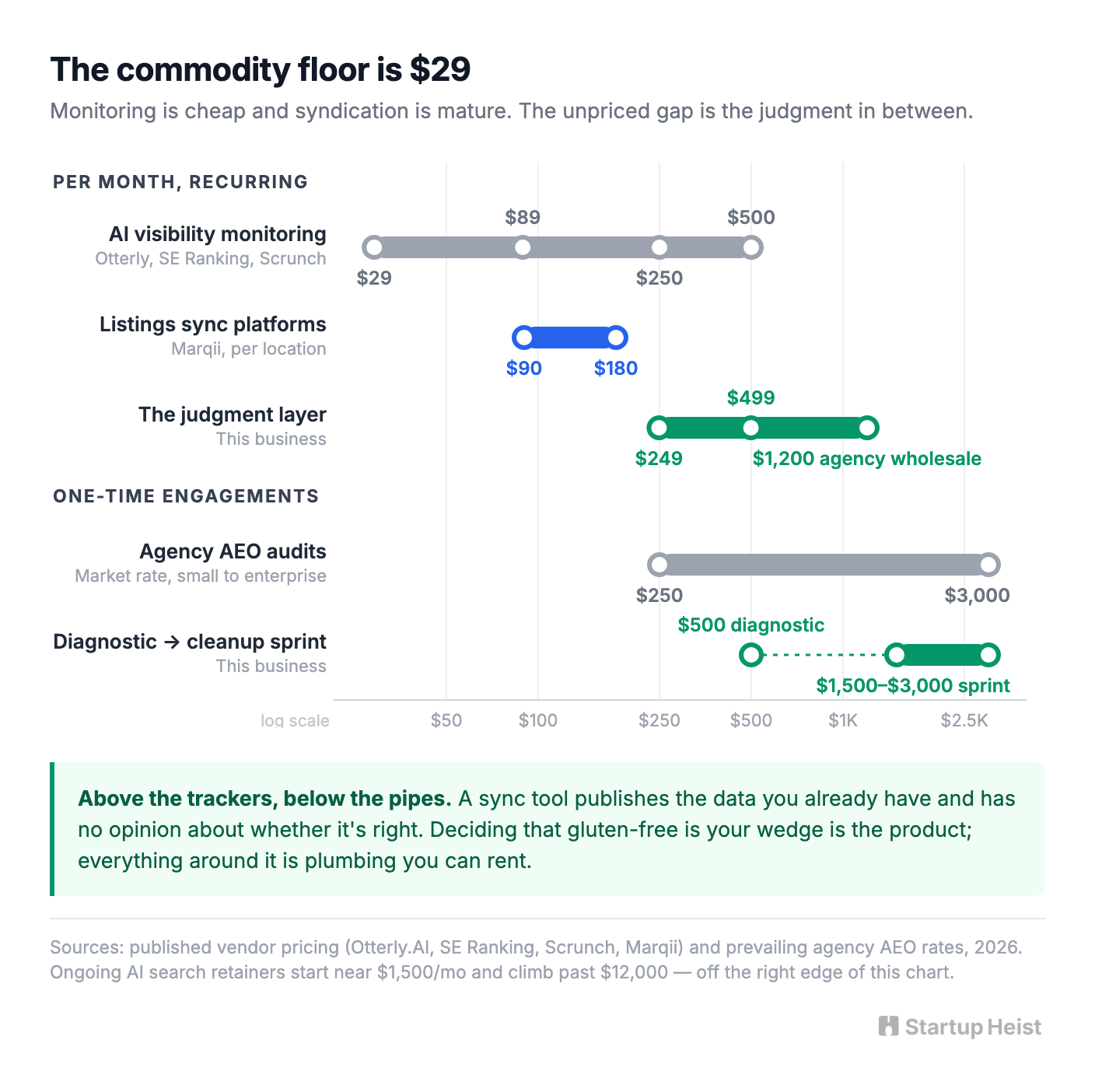
The repair side is more crowded than it first looks. Marqii is a restaurant-native listings platform charging roughly $90 to $180 per location per month. It pushes hours, menus, and business details to 70-plus listing sites, syncs menus straight from the POS, serves 15,000-plus restaurants, and shipped an MCP server in mid-2026 so operators can query their listing data from inside an AI assistant. At the enterprise end, Olo Sync distributes restaurant data to 50-plus publishers and reports that brands using it average more than 15,000 annual referrals per location.
Both ends of the pipe are solved: monitoring is cheap, syndication is mature. What nobody sells is the judgment in between.
A sync tool pushes the data you already have. It has no opinion about whether that data is right. It won't tell you your menu is a scanned image no model can parse, that the reservation link on your location page 302-redirects into a dead OpenTable widget, or that "private dining" is the attribute actually worth fighting for at this address. Marqii will happily publish "gluten-free" to seventy sites. Deciding that gluten-free is your wedge is not something it does.
That decision is the product, and everything around it is plumbing you can rent.
Three ways a restaurant goes missing
Every finding you produce will fall into one of three buckets, and sorting them this way is what turns a pile of chatbot screenshots into an invoice.
Unlock the Vault.
Join founders who spot opportunities ahead of the crowd. Actionable insights. Zero fluff.
“Intelligent, bold, minus the pretense.”
“Like discovering the cheat codes of the startup world.”
“SH is off-Broadway for founders — weird, sharp, and ahead of the curve.”


