


Launch Shield: The Next Hacker News Hug of Death Might Not Come From Humans
AI crawlers and monitoring bots are turning small product launches into infrastructure stress tests. A lightweight edge utility can protect indie founders' applications, keep their products readable to machines, and prove exactly how much wasted work it prevented.
Indie developer Sammy Straus launched a feed reader, sprinklz.io, on Hacker News and collected a hundred or so upvotes, a modest showing by any standard. The site started slowing down right after the post, then got worse several days later.
When Straus dug into the NGINX logs, the finding was blunt: nearly half of the traffic came from a single client, a service that repeatedly polls websites for changes and summarizes them into an AI-generated newsletter. Other traffic came from self-identified crawlers run by Anthropic, OpenAI, and Google, plus vulnerability scanners probing paths the app never had. Because sprinklz is a single-page application, the logs revealed one more detail: a majority of the requests never ran the JavaScript needed to render the page. Those clients were hitting the server without ever behaving like users.

Straus blocked the worst offender, rewrote robots.txt to discourage most AI crawlers, added rate limits, and spent weeks on performance work. The write-up of the episode reached the Hacker News front page in October 2026 with more than 350 points.
The business case sits in the comment thread. One engineer pointed out that even sixty requests a minute is trivial for a 2015 laptop sitting in a closet. Straus called the traffic a wake-up call more than the root cause, since it exposed parts of the application that needed to get faster. Another commenter described a crawler that still hits one of their domains a million times a day even though every route returns an error.
Both camps have a point. AI bot traffic is cheap to serve in principle, and most small applications end up serving it expensively anyway, which is where the opportunity opens.
The money: In one scenario, 30 Launch Passes at $79, 5 assisted setups at $249, and 100 subscribers at $15 add up to $5,115 a month, with $1,500 of it recurring.
Inside:
• MVP spec with route safety and rollback
• Launch Pass pricing before subscriptions
• Diagnostic-first outreach email template
• 30-day plan with go/pivot/kill gates
The Problem: Your Application Works Hard for Visitors Who Will Never Sign Up
The classic hug of death was flattering. Thousands of real people clicked through, the server buckled, and the founder bought more capacity.
The new version is quieter and lasts longer. A product appears on Hacker News, Product Hunt, or Reddit. Search crawlers, AI training bots, research agents, change monitors, and vulnerability scanners find the URL and keep coming back. Each one hits the homepage, the pricing page, the docs, and any public endpoint it can find. If those pages run database queries or server-side rendering on every request, backend load climbs while signups stay flat.
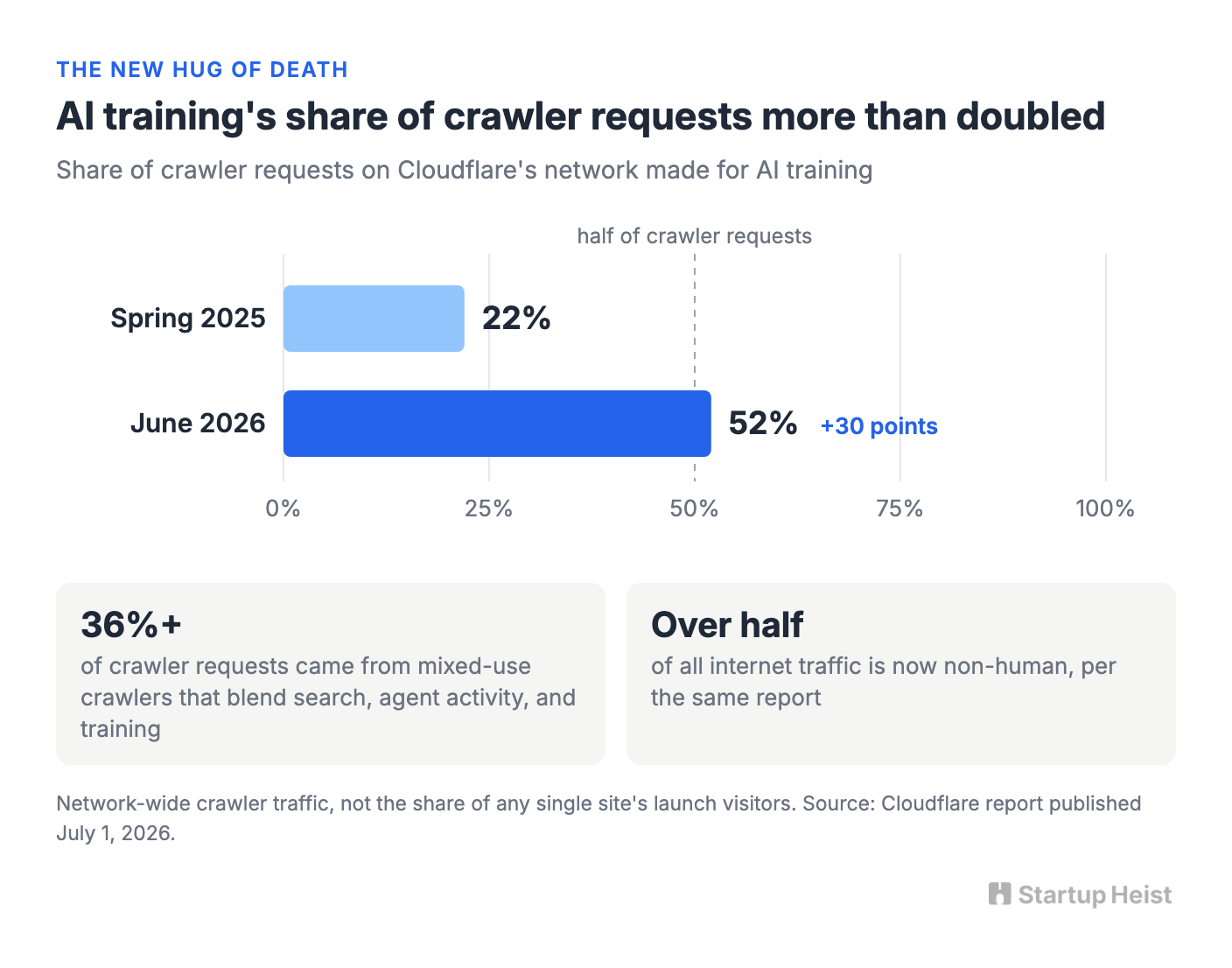
In a report published July 1, 2026, Cloudflare said 52% of the crawler requests on its network were for AI training as of June 2026, up from 22% in spring 2025, with mixed-use crawlers that blend search, agent activity, and training making up more than 36%. The same report says more than half of all internet traffic is now non-human. These figures describe crawler traffic across Cloudflare's network; they don't mean half of your launch visitors are bots. At the extreme end, Read the Docs reported in July 2024 that a single crawler had downloaded 73 TB of zipped HTML in one month, May 2024, costing it more than $5,000 in bandwidth.
For a small SaaS founder, whether a visitor is human matters less than whether it needs your application server at all. Take three requests for the same landing page: a prospect reading about the product, an AI agent extracting the price, and a change monitor on its twentieth visit of the morning. All three want the same public facts, and none of them needs your database to regenerate those facts from scratch. Stopping unnecessary computation is more valuable, and far easier, than identifying every bot.
The Product: A Cheap Front Door for Expensive Applications
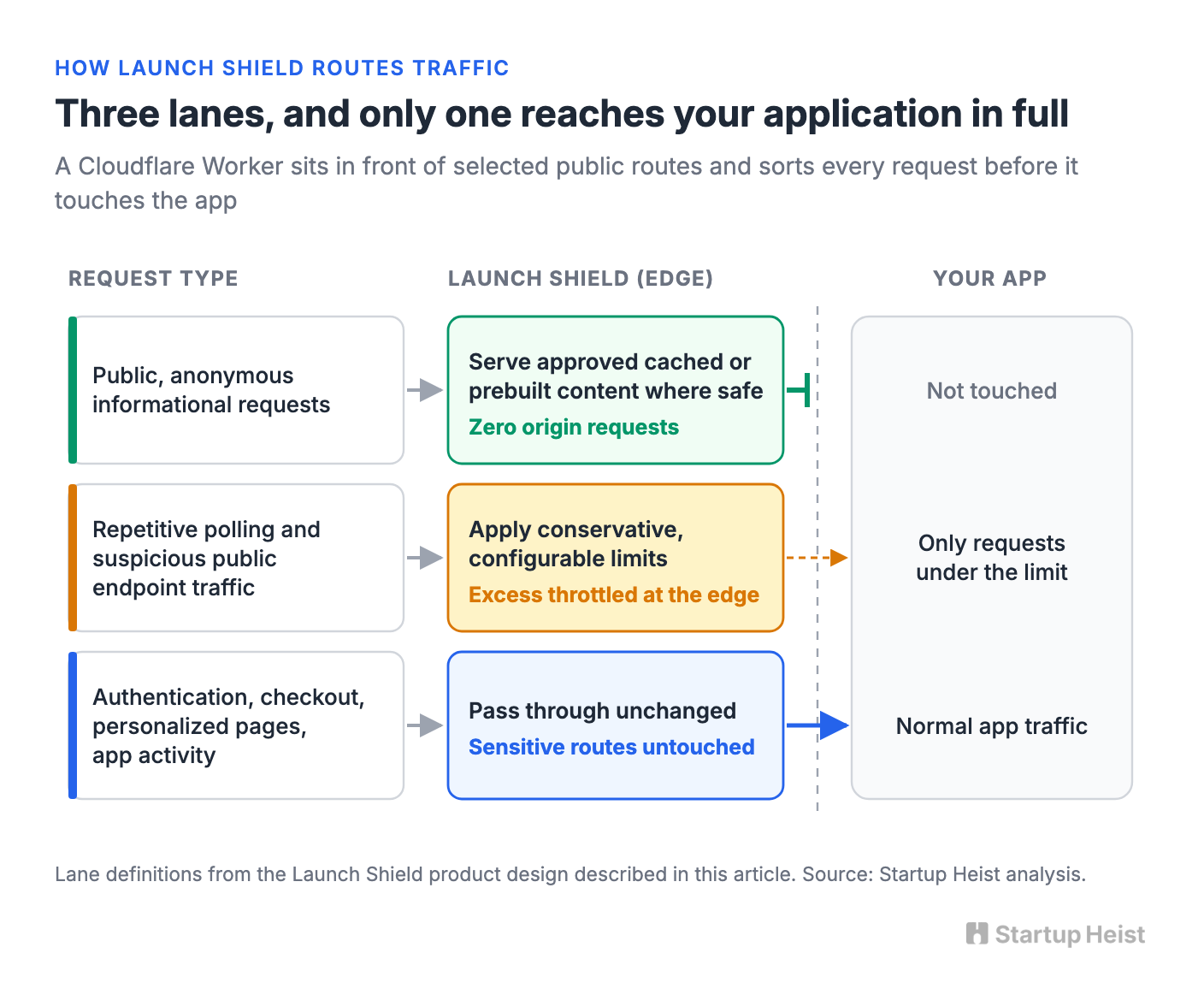
Call it Launch Shield. A founder running a SaaS app on a small VPS or a metered platform installs it before launch day. It deploys a Cloudflare Worker in front of selected public routes, generates a static product brief, and starts watching traffic. Every request falls into one of three lanes.
| Request type | Launch Shield behavior |
|---|---|
| Public, anonymous informational requests | Serve approved cached or prebuilt content where safe |
| Repetitive polling and suspicious public endpoint traffic | Apply conservative, configurable limits |
| Authentication, checkout, personalized pages, app activity | Pass through unchanged |
The core feature is a dependable way to answer suitable requests without touching the application. A homepage that takes several server operations to render can be served from a prebuilt copy at the edge with zero origin requests. A public endpoint that returns the same data all day can be explicitly cached, while dynamic and sensitive routes stay untouched.
Launch Shield also publishes a short, machine-readable product brief for automated clients: what the product does and for whom, core features, current pricing including any free plan, who is behind it, a canonical URL with optional tracking links, and a last-updated date. The founder approves every word, the brief is public, and its facts match the website. A Markdown version is easier for text-oriented agents to parse. It carries no hidden instructions, invented endorsements, or claims hidden from human visitors.
The brief has to be genuinely prebuilt. Redirecting bots to a dynamically generated Markdown page just moves the expensive work to a different URL. A static brief served from Cloudflare's edge never wakes the application, so repetitive informational traffic stops competing with real users for capacity, and machines get an accurate description of the product without rendering a JavaScript-heavy interface.
That second effect might eventually produce referrals, though it should be treated as a hypothesis. A newsletter bot can summarize your brief, drop your link, or ignore you entirely, and no middleware controls what a third party publishes. Sell the product on the work it avoids.
The Competition: Cloudflare Already Gives Away Most of the Parts
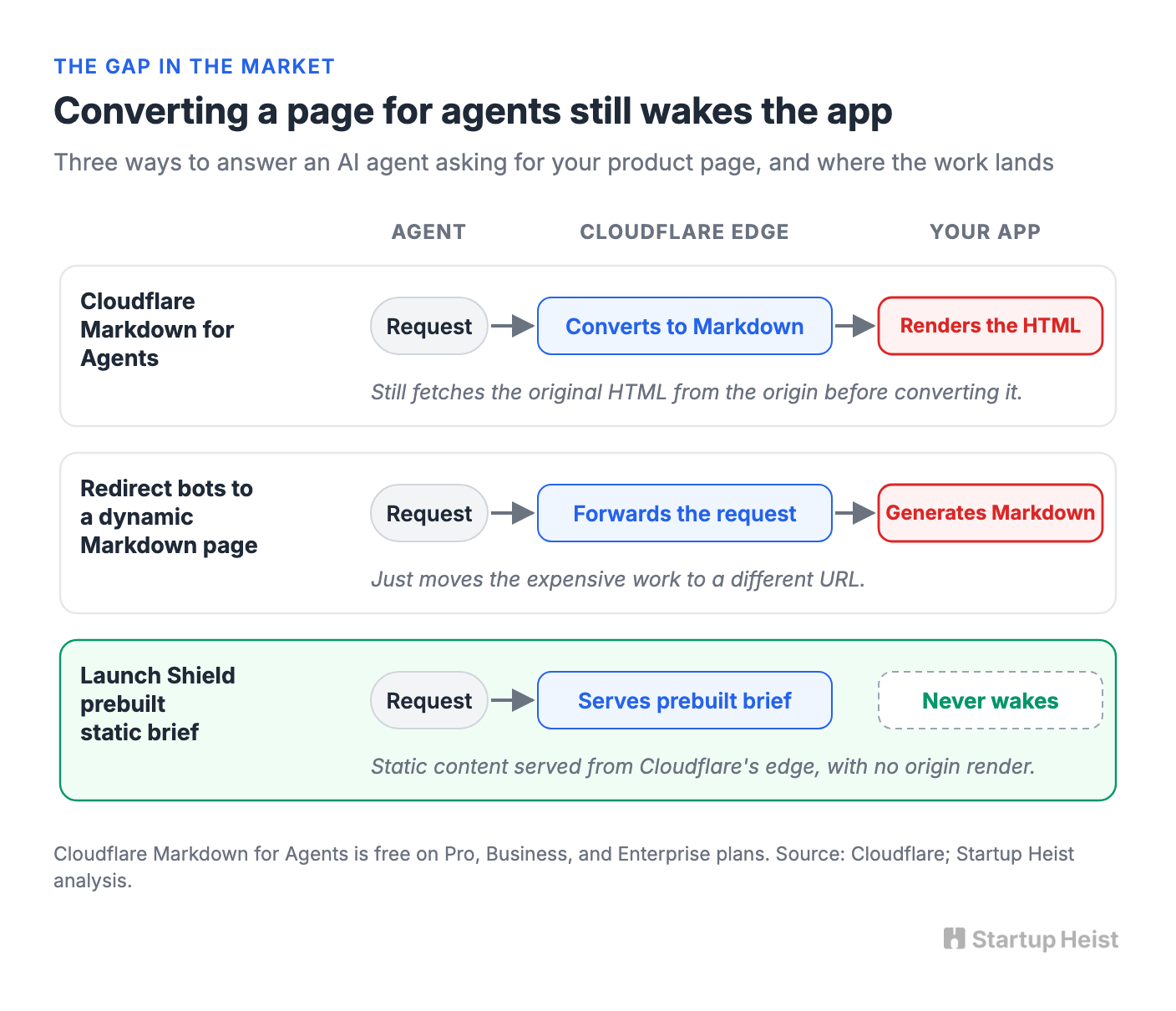
The infrastructure giants got to bot control first. Cloudflare's AI Crawl Control runs on every plan, with crawler analytics, allow and block rules, and robots.txt compliance tracking; its Pay Per Crawl option, still in private beta, lets publishers charge crawlers per request. Its Markdown for Agents feature converts HTML to Markdown for any client that asks for it, free on Pro, Business, and Enterprise plans. That feature still fetches the original HTML from the origin before converting it, so the application does the work anyway. TollBit sells content licensing to publishers. Known Agents identifies and manages bots with a free tier capped at 100,000 events a month and a Startup plan at $29 a month. Open-source tools like Anubis make every visitor solve a proof-of-work puzzle before the page loads. And any competent developer can write NGINX rules, CDN cache rules, and rate limits.
Unlock the Vault.
Join founders who spot opportunities ahead of the crowd. Actionable insights. Zero fluff.
“Intelligent, bold, minus the pretense.”
“Like discovering the cheat codes of the startup world.”
“SH is off-Broadway for founders — weird, sharp, and ahead of the curve.”


