


The Funeral Ends. The Bureaucracy Begins.
For most of the last century, a funeral home sold a bundle. Preparation, viewing, ceremony, transportation, casket, burial. One transaction, one invoice, and an afternoon that ended with the family driving home.
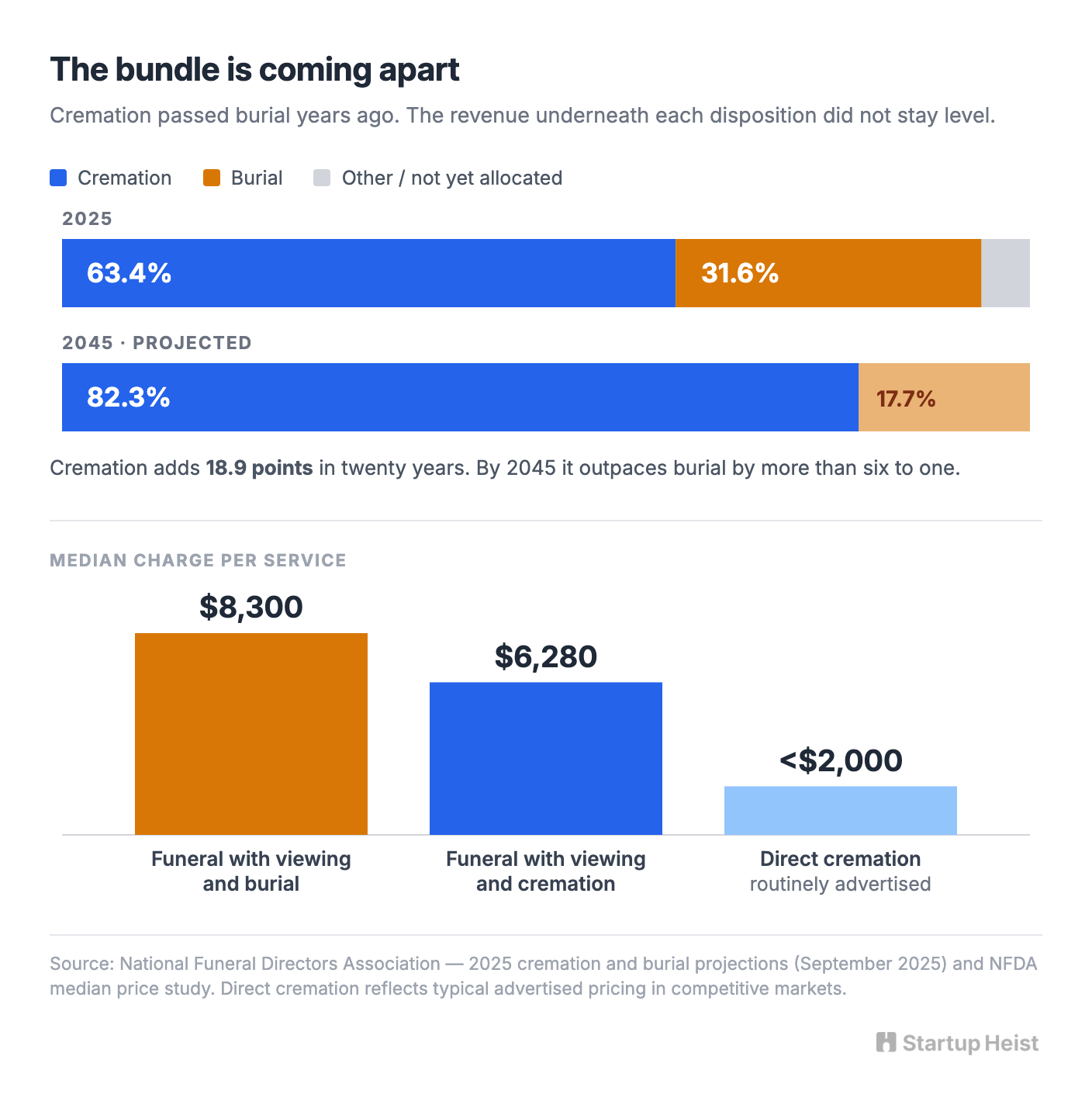
That bundle is coming apart. In September 2025, the National Funeral Directors Association projected that 63.4% of American dispositions in 2025 would be cremations, against 31.6% burials. By 2045 the association expects cremation to reach 82.3%, outpacing burial by more than six to one. The revenue gap underneath that shift is wide. NFDA's most recent price study puts the median funeral with viewing and burial at $8,300 and the identical service with cremation at $6,280. Direct cremation, where there is no service at all, is routinely advertised under $2,000 in competitive markets.

None of this means funeral homes are dying. There are about 15,400 of them in the United States, roughly three-quarters family- or privately owned, and the CDC's provisional count recorded 3,094,593 American deaths in 2025. The customers keep arriving.
What changed is where the work sits. A family now spends fewer hours inside the building and buys fewer physical goods. The moment they leave, somebody still has to close out an entire human life: bank accounts, utilities, cell plans, streaming subscriptions, life insurance, credit files, Social Security, pensions, the mail, the house, the car title, the gym membership, the Facebook page, and a dozen agencies that each want a certified death certificate mailed to a different address.
None of that work got smaller when the funeral did. It simply stopped being anybody's job.
That unclaimed work is the opening.
The money: Ten partner homes at 10% attachment and $700 a case is roughly $140,000 a year. Fifty homes puts you near $700,000.
Inside:
• Two-tier pricing at $599 and $999
• The unit economics behind a $599 case
• A 90-day pilot plan and the cold email
• Kill criteria for the first 50 cases
500 Hours, and Nobody Sends a Bill
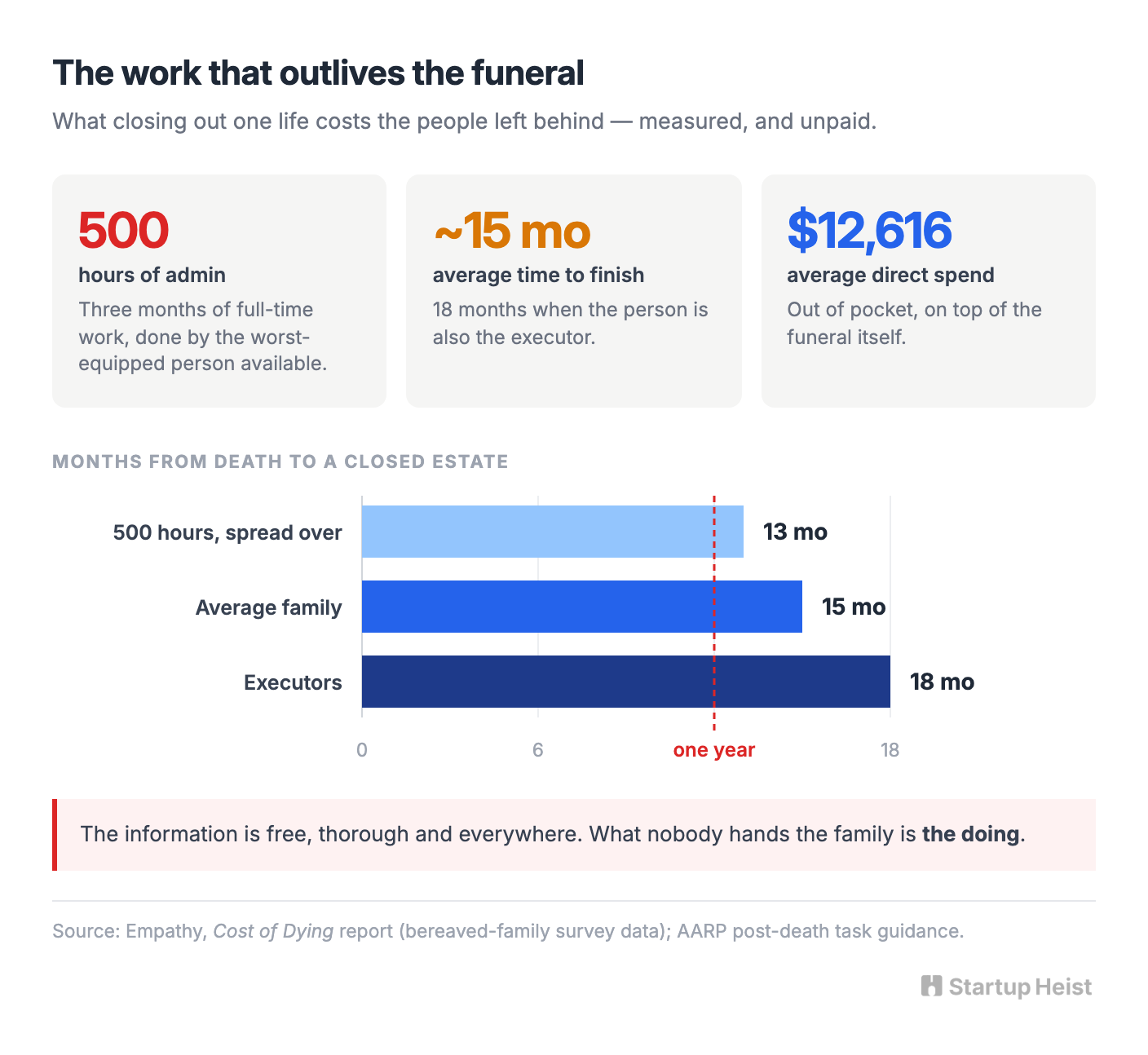
Empathy, the best-funded company in estate settlement, has spent years measuring what closing out a life actually costs the people left behind. One of its findings should govern every decision you make here: the work consumes as much as 500 hours spread across 13 months. Its annual Cost of Dying report, built on survey data from bereaved families, separately puts the average time to finish at about 15 months, and 18 months for executors. Average direct spend runs $12,616.
Five hundred hours is three months of full-time work, performed by someone in the worst emotional condition of their life, while they're also back at their own job.
AARP's guide to the process runs to dozens of tasks and warns families it can take years. It tells them to secure the property, order ten or more death certificates, identify the executor, deal with incoming bills, cancel digital services, notify insurers and banks, freeze credit against identity theft, and work through government agencies one at a time. Every one of those institutions has its own form, its own proof requirements, a phone tree, and a bereavement department that closes at 4 p.m. Eastern.
None of that information is hidden. It's free, thorough, and everywhere. What nobody hands the family is the doing.
The Channel Is Already Full of Clipboards
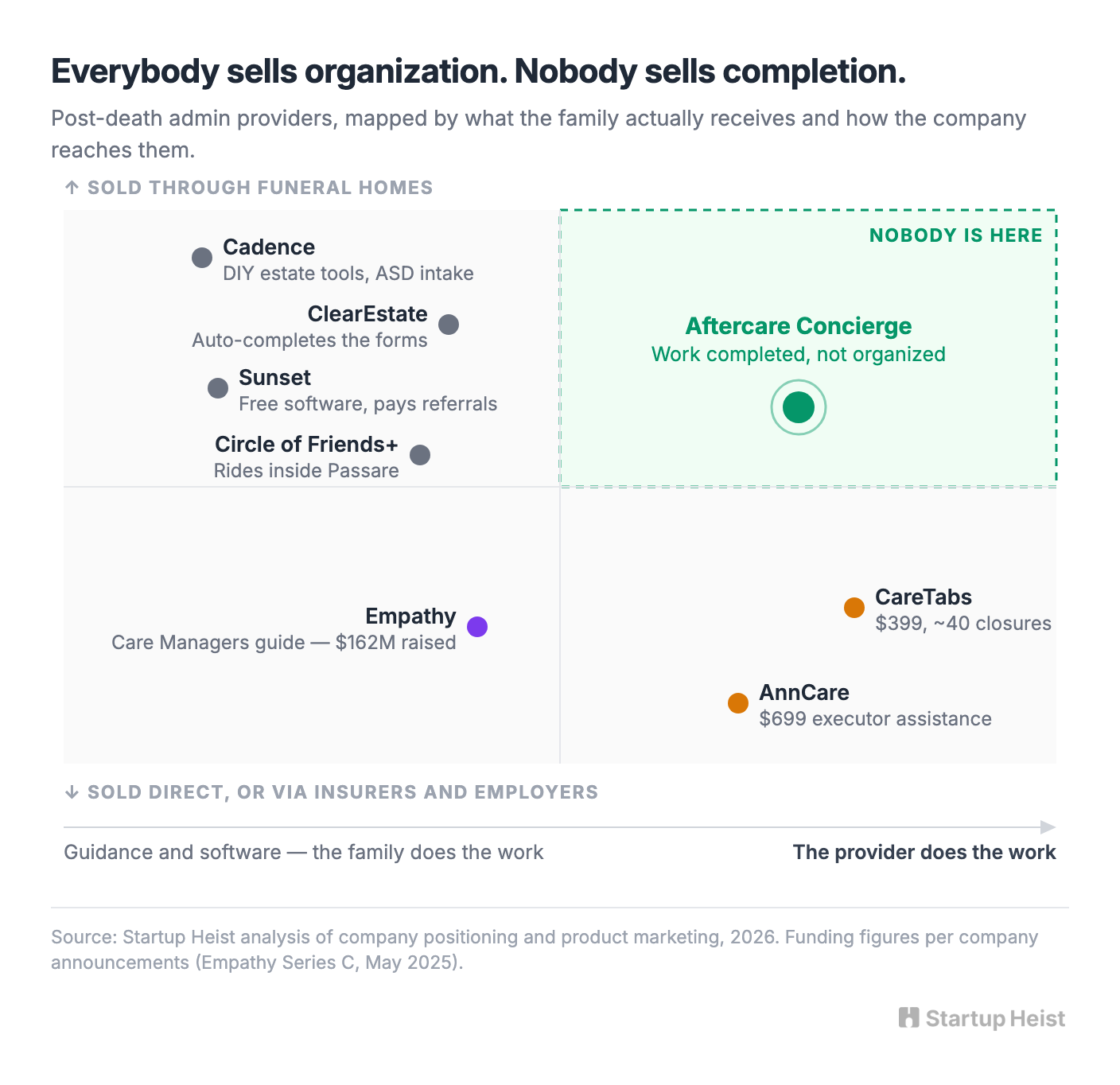
The usual writeup of this opportunity assumes funeral homes have never been pitched an aftercare product. They've been pitched constantly, and the deathcare channel is crowded. Empathy is the heavyweight. It pairs software with human Care Managers who help with accounts, benefits, funeral logistics and probate navigation, and after a $72 million Series C in May 2025 it has raised $162 million total. Its distribution runs through insurers, banks and employers rather than funeral homes, and it now reaches close to 50 million policyholders. Below it sits a layer of companies aimed squarely at funeral directors: Cadence sells estate tools, identity protection and executor guidance to funeral homes and integrated with the answering service ASD so intake data flows straight into its system; ClearEstate pitches funeral homes an aftercare portal that auto-completes the fifty-plus forms an estate requires and lets the director watch progress; Circle of Friends+ rides inside Passare, the case-management platform used by more than 2,600 funeral homes; and Sunset, a Y Combinator company, gives families its estate software free, monetizes by holding and earning interest on estate funds, and already pays funeral directors a commission for the introduction. At the consumer end, AnnCare charges a flat $699 for executor assistance and CareTabs advertises $399 for roughly forty institutional notifications and closures with unlimited follow-through.
Now look at what all of them actually promise. Cadence's own marketing says it "empowers families to do it themselves," and while its positioning is broadening, the mechanism isn't: on January 20, 2026 it launched Estate Guard, which surfaces active financial and digital accounts tied to the deceased using verified institutional data, which is still automation rather than a person doing the work. ClearEstate automates the forms so the executor can file them. Empathy assigns a Care Manager who guides. The channel is thick with funeral home aftercare software that makes those 500 hours more organized, and almost nothing in it takes the hours away. That's a narrower opening than "funeral homes need new revenue," and a more honest one. The market isn't empty. It's crowded with better clipboards, and nobody in it is offering to take the clipboard away.
Start Where the Lawyers Aren't
This business becomes dangerous the instant you describe yourself as an estate administrator. An executor or court-appointed administrator carries real fiduciary and tax exposure. The IRS treats the deceased person's final return and the estate's return as separate filings, and most institutions won't disclose anything or permit any action until someone produces formal authority.
So don't try to replace the executor, the probate attorney, the CPA or the fiduciary. Sit underneath all four.
Unlock the Vault.
Join founders who spot opportunities ahead of the crowd. Actionable insights. Zero fluff.
“Intelligent, bold, minus the pretense.”
“Like discovering the cheat codes of the startup world.”
“SH is off-Broadway for founders — weird, sharp, and ahead of the curve.”


