


PartOut: Turn the Dead-Phone Pile Into Inventory
A broken smartphone asks a repair shop an expensive question, and it isn't the one the customer is asking. Whether the phone can be fixed is usually obvious within a minute. What takes real judgment is figuring out the most profitable thing to do with it.
An independent shop that takes in a damaged iPhone has at least five moves available: repair it and resell it, sell it damaged, ship it to a wholesaler, keep it as a donor, or strip the display and cameras, scrap the housing, and wholesale the carcass. The right answer depends on the exact model and storage tier, which components still pass, how long removal takes, what's already on the shelf, what a replacement part costs from a supplier this week, and what comparable parts actually clear for.
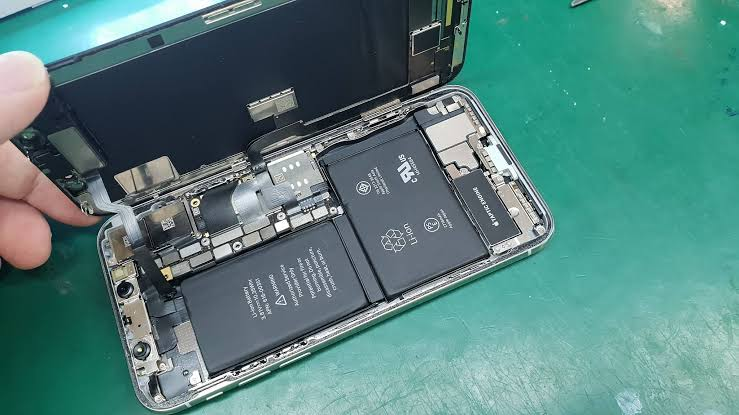
Shops make that call today with experience, a few marketplace searches, and whatever the lead technician remembers about the bins behind the counter. That worked when a dead phone was mostly junk. It works far less well now that a dead phone is a portfolio of components, each with its own price, sell-through rate, and removal cost.
Nobody has turned that call into software, which is the opportunity:
The money: Fifty shops at $90 a month is $4,500 MRR; 250 is $22,500, and RepairDesk's $79 to $99 per store proves shops already pay for this category.
Inside:
• MVP scope: seven modules, no computer vision
• Dead Bin Audit: the service that opens doors
• Harvest or buy: the real margin engine
• The 90-day pilot and seven metrics to track
Build PartOut, a disposition engine and donor-parts ledger for independent phone-repair shops. It takes a damaged device, records what still works, and calculates the expected economics of four choices: repair it, sell it whole, wholesale it, or harvest specific components. If the shop harvests, PartOut turns the recovered parts into serialized, labeled inventory with a chain of custody back to the donor.
This is decision software for the graveyard behind the repair counter. It deliberately skips several flashier things it could have been, and each restraint has a reason.
Why the pile got interesting
The repair market itself isn't exploding, and that matters for how you pitch this. IBISWorld puts U.S. cell-phone repair at about $4.2 billion in 2025, growing 1.3% that year. This is a mature, fragmented service trade. The economics inside it, though, are moving fast, because several forces are hitting the back room at the same time.
The used smartphone market has become a real parallel supply chain. Counterpoint Research valued the global pre-owned smartphone market at $83 billion in 2025, about 19% of all smartphone sales value, with Apple holding 58% of refurbished sales. IDC forecasts used-smartphone shipments growing 5.8% in 2026 while new-device shipments shrink. Trade-in programs returned $1.43 billion to U.S. consumers in the second quarter of 2026 alone, up 7% year over year; the average iPhone traded in was 4.03 years old, and average iPhone trade-in values rose 11% from the prior quarter. Those devices, and the refurbished iPhones they become, are exactly the inventory that lands on an independent shop's bench.
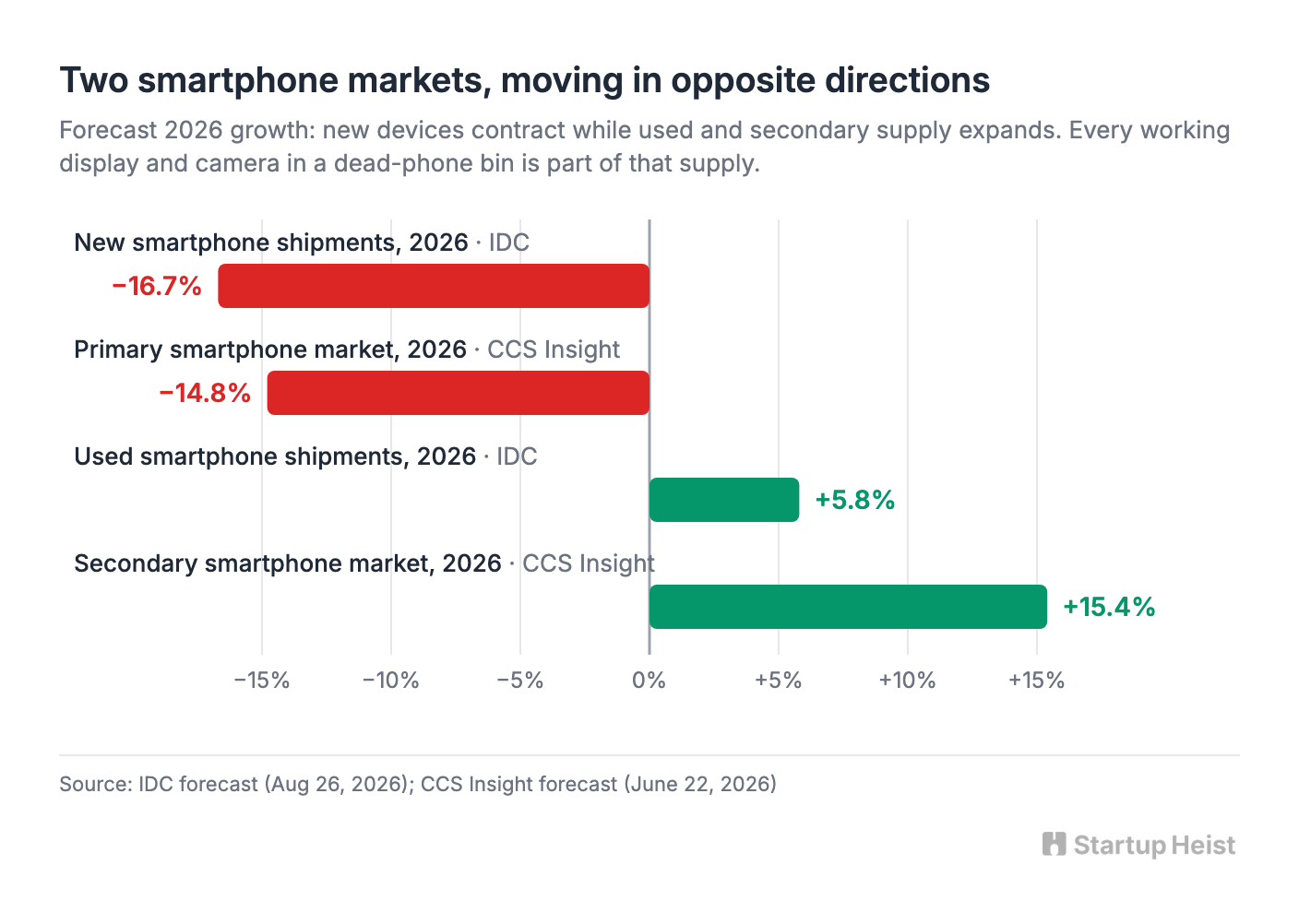
Component scarcity, meanwhile, is acute in a way the industry hasn't seen. On August 26, 2026, IDC cut its forecast for worldwide smartphone shipments to a 16.7% decline in 2026, the steepest contraction on record, with the average selling price jumping 27.6% to $581. The driver is memory: NAND and DRAM costs are up more than 300% year over year, and IDC expects them to keep rising until at least 2028. On September 16, 2026, Reuters reported that smaller phone makers expect the shortage to last through 2027, with Fairphone's chief executive putting memory at almost 60% of the bill of materials on a $400 handset. Shops shouldn't start desoldering RAM over this. What matters is that the option value sitting inside existing devices is rising. CCS Insight forecast on June 22, 2026 that the secondary smartphone market would grow 15.4% in 2026 while the primary market fell 14.8%, and warned that refurbished prices would climb because supply depends on trade-ins and buybacks. Every functioning display and camera module in a shop's dead-phone bin is part of that supply.
Right-to-repair law has shifted the ground too. California's Right to Repair Act took effect July 1, 2024, requiring manufacturers to provide owners and repair shops with documentation, parts, and tools, with seven years of support for products wholesaling at $100 or more. New York's Digital Fair Repair Act has been in force since December 28, 2023. Oregon banned parts pairing for devices sold after January 1, 2025, and Colorado's ban took effect January 1, 2026. Enforcement is live as well: on September 3, 2026, Acme Revival filed the first lawsuits under Colorado's law, against Toast, Owl Labs, and Blackmagic Design. Apple itself announced on April 11, 2024 that used genuine parts would be supported in repairs, and shipped Repair Assistant in iOS 18 that September to calibrate them. More devices in secondary channels, more legitimate ways to repair them, more reason to squeeze every dollar from each unit. The pile of damaged phones in the back room has quietly become the most under-managed asset in the building.
The heist
The first version of the product can be almost embarrassingly simple.
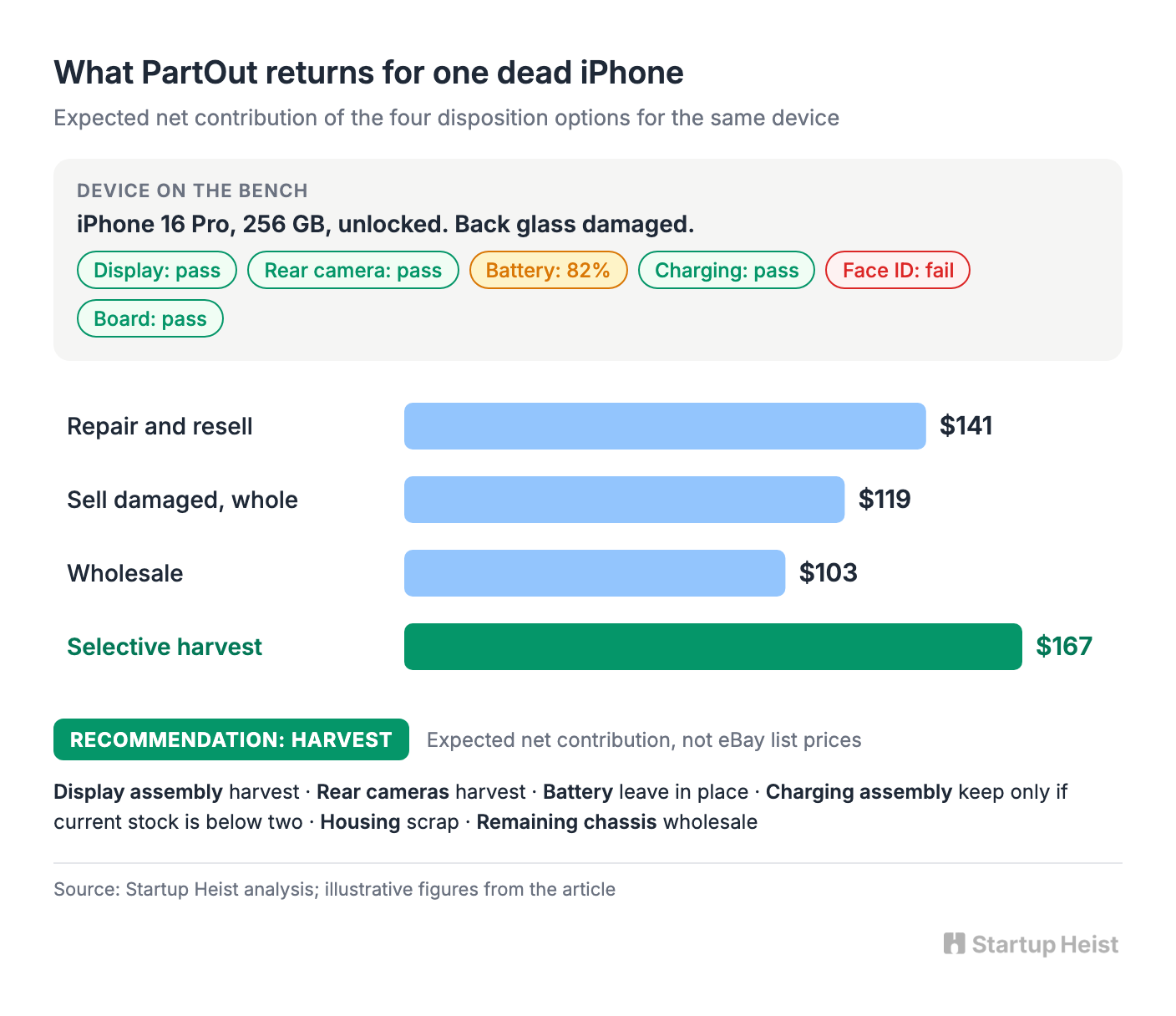
A technician opens PartOut and scans or searches for the device on the bench, enters the model, storage, and lock status, and runs a fast pass/fail on each component:
iPhone 16 Pro, 256 GB, unlocked. Back glass damaged. Display: pass. Rear camera: pass. Battery: 82%. Charging: pass. Face ID: fail. Board: pass.
PartOut returns a table:
| Option | Expected net contribution |
|---|---|
| Repair and resell | $141 |
| Sell damaged, whole | $119 |
| Wholesale | $103 |
| Selective harvest | $167 |
Recommendation: HARVEST. Then, underneath: display assembly, harvest. Rear cameras, harvest. Battery, leave in place. Charging assembly, keep only if current stock is below two. Housing, scrap. Remaining chassis, wholesale.
The number that makes this software rather than a price guide is the one it refuses to show. "The parts add up to $240 on eBay" is close to meaningless. What matters is expected net recovery: expected sale proceeds multiplied by the probability of a sale, minus removal labor, testing time, marketplace fees, a warranty and return reserve, storage cost, and depreciation while the part sits.
Run that math and the ranking changes. A $60 component that sells 30% of the time within six months is worse inventory than a $35 component that turns every two weeks. A camera module that's physically fine but came out of an Activation-Locked donor is worth close to zero for an iPhone repair, because Apple's Repair Assistant will refuse to calibrate it. PartOut knows that before the technician picks up the heat gun.
The secret is disposition, not appraisal
Phone repair shop software already exists, and it's good. RepairDesk, one of the strongest incumbents, starts at $99 per store per month, or $79 on annual billing, for point of sale, repair tickets, inventory, and device buyback and trade-in, and says more than 3,000 shops use it. RepairQ covers buy, sell, trade, and repair for multi-location operators with serialized device tracking. At the enterprise end, NSYS Group and Phonecheck sell automated diagnostics and IMEI-based inventory to refurbishers and wholesalers processing thousands of units a month.
Attacking any of them head-on with "RepairDesk, except newer" would be a brutal business. PartOut should instead be the decision layer that sits beside the system of record. RepairDesk knows the shop owns this iPhone. PartOut answers what the shop should do with it, and eventually whether a specific camera should go into today's repair, be saved for a higher-value job, or be replaced by a $31 aftermarket part.
That second question turns out to be the bigger business, but you only earn the right to ask it after solving the messiest problem in the shop, which has nothing to do with the calculator.
Start with the messiest thing in the shop
The wedge is donor-inventory cleanup, and you sell it before you sell any math.
Walk into a repair shop and ask how many dead phones are in the back. The answer might be 40. It might be 400. Then ask whether anyone knows exactly which usable parts are inside them. The pause that follows is the sales pitch.
Unlock the Vault.
Join founders who spot opportunities ahead of the crowd. Actionable insights. Zero fluff.
“Intelligent, bold, minus the pretense.”
“Like discovering the cheat codes of the startup world.”
“SH is off-Broadway for founders — weird, sharp, and ahead of the curve.”


