


The Markup Isn't on the Dirt. It's on the Bag Size.
There's a seductive version of this business. Buy a commodity by the pallet, put it in a beautiful bag, rename it "Premium Aroid Aeration Media," and charge ten times what it cost you.
That version will get you killed. The ingredients are public, the recipes are all over Reddit, and any competitor who reads your label can undercut you by Tuesday.
The better business starts one layer up, where what you're selling is the answer to a question a specific person is asking at a specific moment, with a $300 plant sitting on their kitchen counter and its roots exposed:
What exactly do I repot this in so I don't kill it?
The opportunity is a narrow direct-to-consumer brand built around clean, screened, situation-specific root-zone kits for valuable indoor plants. You start with Monstera and philodendron repotting, then expand into wholesale and adjacent plant niches.
The short version:
The money: 445 orders a month at a $45 average order is $20,000 in revenue and roughly $5,000 in monthly operating contribution for one operator.
Inside:
• Six-week plan from sourcing to fifty kits
• Unit economics and the freight trap
• Label claims that trigger EPA rules
• Wholesale pitch and three durable moats
Nobody should mistake this for passive income, and there's no venture-scale platform buried in a sack of pumice. What you get is a compact consumer brand with an unusually clean wedge. The wedge only works if you know where the arbitrage actually lives, and it isn't the price tag.
Pack size is where the arbitrage lives
BuildASoil sells horticultural pumice in a 7-quart bag for $31. The same company sells the same pumice in a 1-cubic-foot bag, roughly 25 dry quarts, for the same $31. Bonsai Jack sells 1/4-inch pine bark fines in a 2-dry-quart bag for around $17. Orchid-grade Douglas fir bark sells for $40 to $65 a 2-cubic-foot box, which lands close to a dollar a quart.
The same ingredient costs somewhere between $1.20 and $8.66 per quart depending entirely on how much of it you buy at once.
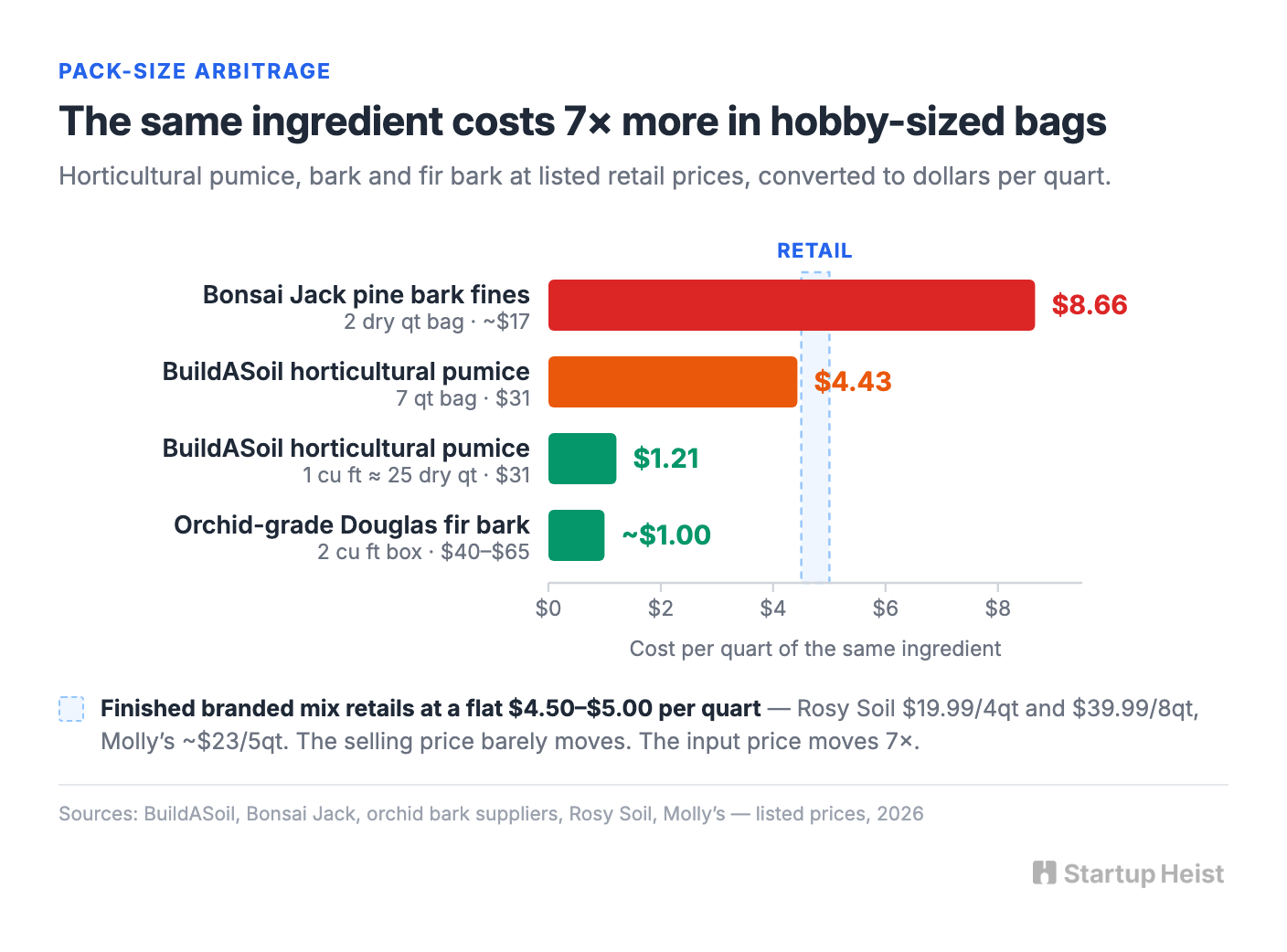
Finished product prices barely move by comparison. Rosy Soil's aroid mix is $19.99 for 4 quarts and $39.99 for 8, a flat $5 a quart. Molly's Aroid Mix runs about $23 for 5 dry quarts, roughly $4.60. Branded chunky aroid mix clusters tightly between $4.50 and $5.00 per quart across every channel.
A collector who wants to build their own 4-quart batch has to buy pumice, bark, coco chips, charcoal and perlite. At hobbyist pack sizes that's $50 to $80 in ingredients, producing about ten quarts and a closet full of half-used bags they'll still be stepping over in eighteen months.
Buying the finished kit is cheaper than doing it yourself, which is the part almost nobody says out loud.
You're buying at cubic-foot economics, selling at quart economics, and absorbing the storage problem on the customer's behalf. Everything else in this business is an argument about who gets to keep that spread.
The customers exist and they're already spending
USDA's 2024 Census of Horticultural Specialties recorded $931.6 million in U.S. sales of foliage plants for indoor or patio use, up 34.7 percent from 2019. The whole horticultural-specialties sector booked $18.3 billion.
Above that broad base sits a rare plant collector tier that has gotten genuinely strange. Palmstreet, the live-shopping app where rare houseplants get auctioned on stream, passed $100 million in rare plant sales in 2025 and crossed three million orders. A four-inch, two-leaf pink-variegated Alocasia infernalis sold on the platform for $10,000 in late August 2025. By late September a variegated Anthurium luxurians had gone for $26,000. Anthurium alone accounts for roughly 16 percent of Palmstreet's plant volume; Hoya and philodendron together clear 23 percent.
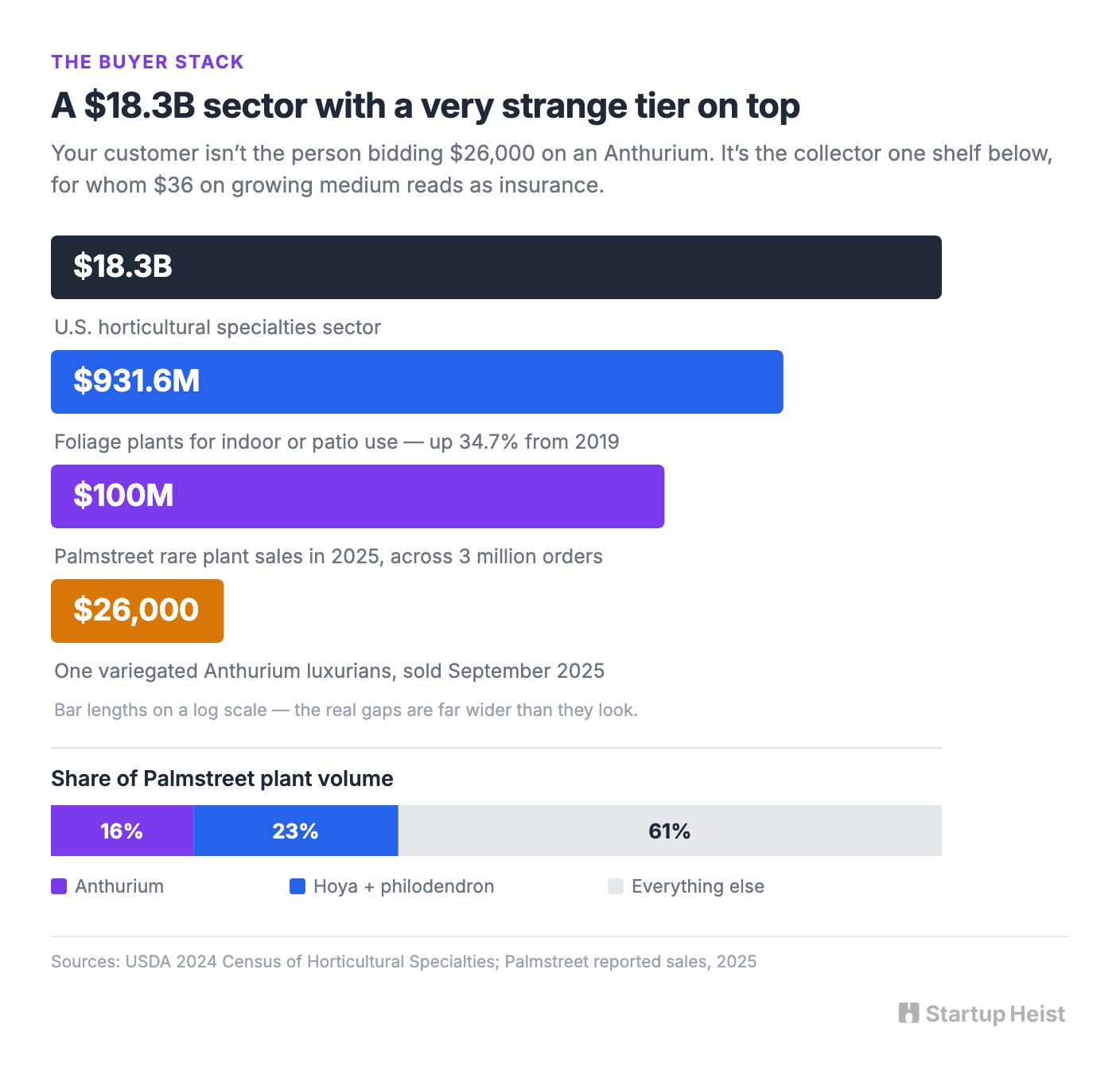
None of that requires you to sell to the people bidding $26,000 on an Anthurium. Your customer is the houseplant collector whose shelves hold enough $50, $100 and $300 plants that $36 on the growing medium reads as insurance rather than an expense.
Right now those people are choosing between a bag with no ingredient disclosure and a Reddit thread with eleven conflicting recipes.
Everyone found the $30 bag, and almost nobody owns the decision
Plenty of operators have already discovered you can sell dirt for $30. Rosy Soil sits on Lowe's and Home Depot shelves. Molly's, Gardenera and DUSPRO all compete on Amazon, where the broader potting soil niche moves roughly $810,000 a month and grew about 25 percent year over year.
What they have in common is that they sell a bag and stop. The buying decision that produces the sale happens somewhere else entirely, in a forum thread or a comment section or a panicked search at 11pm, and none of them are there for it.
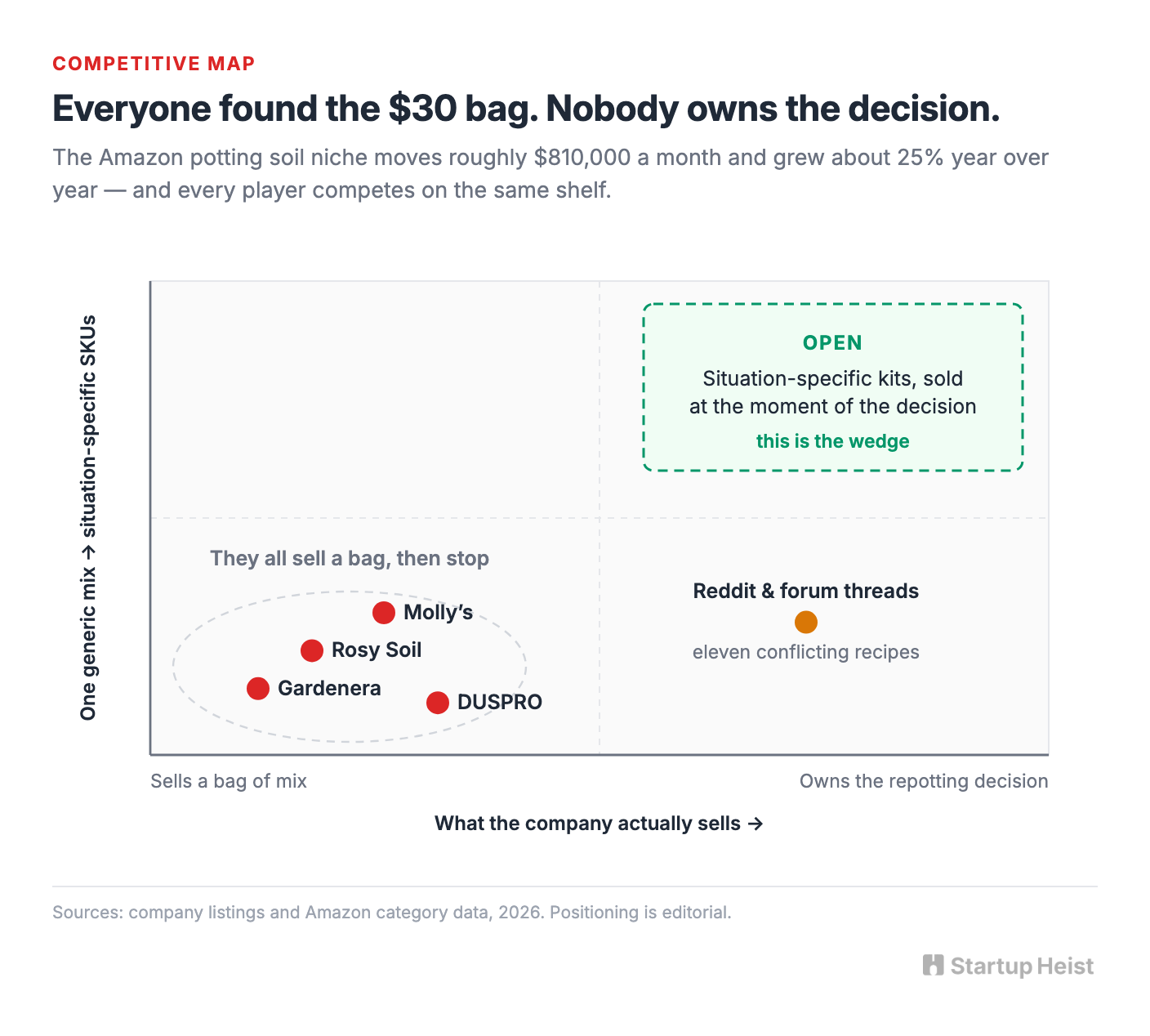
Spend an afternoon in those threads. Someone posts a photo of a root ball and asks whether their mix is too wet. Someone else says three plants turned to mush and wants to know what to switch to. A chronic over-waterer has cycled through five ingredients and reports being overwhelmed. The questions repeat with enough regularity that the answers have become folk knowledge, contradictory and unsourced.
Launching another generic "chunky aroid soil" SKU drops you into a comparison table against all of them with no reason for anyone to pick you. Segment by problem instead, and the comparison table stops applying.
So the first product should read as a Monstera and Philodendron Root Rescue Kit, built for someone who just bought a plant, is pulling it out of dense nursery media, and is genuinely afraid of getting it wrong.
The framing changes what goes in the box, what you can legally say on it, and who will sell it for you.
What actually goes in the box
Five components, none of them exotic.
Unlock the Vault.
Join founders who spot opportunities ahead of the crowd. Actionable insights. Zero fluff.
“Intelligent, bold, minus the pretense.”
“Like discovering the cheat codes of the startup world.”
“SH is off-Broadway for founders — weird, sharp, and ahead of the curve.”


