


Don't Build AI Search. Build the Shopping List.
A customer walks into a good hobby shop holding a phone. On the screen: a squad of sci-fi infantry in weathered olive armor, snow packed around the bases. "I want mine to look like this."
A competent employee doesn't point at the paint wall. They ask questions. How many models? Already primed? Brush or airbrush? Done this before? Do you want the exact look or close enough? What do you already own?
Then they walk the aisles and build a pile. Primer. Three or four base colors. A metallic. A wash. A highlight. Texture paste, snow, varnish, maybe a brush. Along the way they prevent mistakes. That glue is wrong for resin. That paint needs a lighter primer underneath. You don't need the 60ml bottle for twelve models. We're out of that color, this one's close enough.
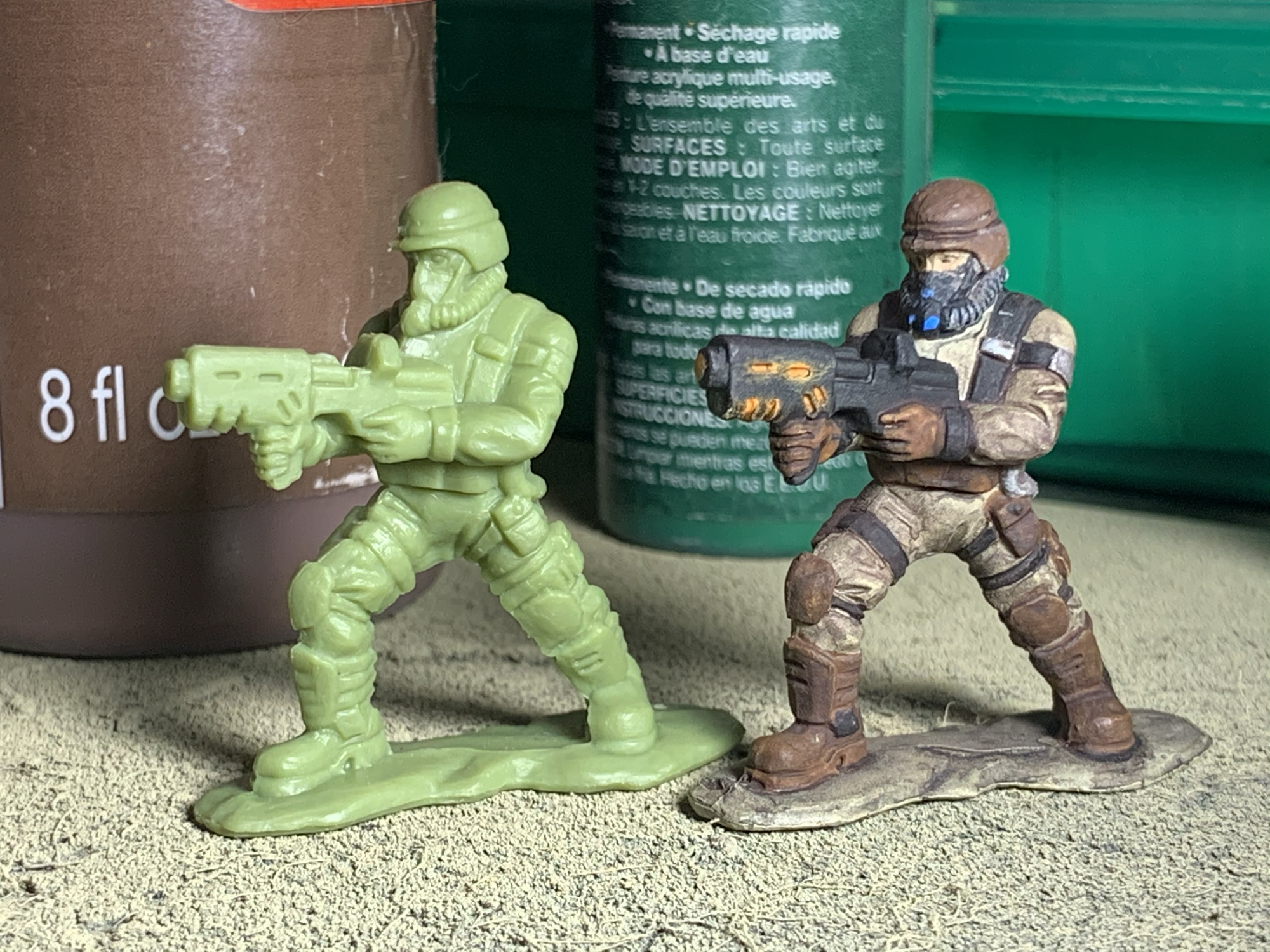
The shopper buys the entire project.
Almost no ecommerce store can do this. The catalog is organized around products while the customer is thinking about an outcome, and the money sits in that gap.
The play is a merchant-specific project-kit builder: a Shopify app that turns a shopper's goal or reference photo into an editable bill of materials, checks every proposed item against deterministic category rules, substitutes against live inventory, and drops the whole project into the cart in one click. It isn't a chatbot, a semantic search bar, or a "customers also bought" carousel. It's the digital version of the employee who can answer the most commercially valuable question in specialty retail: what do I need to finish this?
Here's the opportunity:
The money: 25 merchants at $299 a month is $7,500 MRR, plus a $750 onboarding fee each. Michaels' assistant users converted at over double the site-search rate.
Inside:
• Why miniature painting is the wedge vertical
• The four-layer AI-proposes, rules-verify build
• Pricing ladder from $149 pilot to $1,500/month
• 90-day plan plus the cold outreach email
The Behavior Is Already Public
Michaels rolled out an AI shopping assistant called Ask Mike in May 2026 and formally announced it on July 21, 2026. It runs on Google Cloud's Gemini Enterprise, and Michaels says it went from concept to production in six weeks.
Shipping AI is unremarkable in 2026. What matters is what customers typed into it.
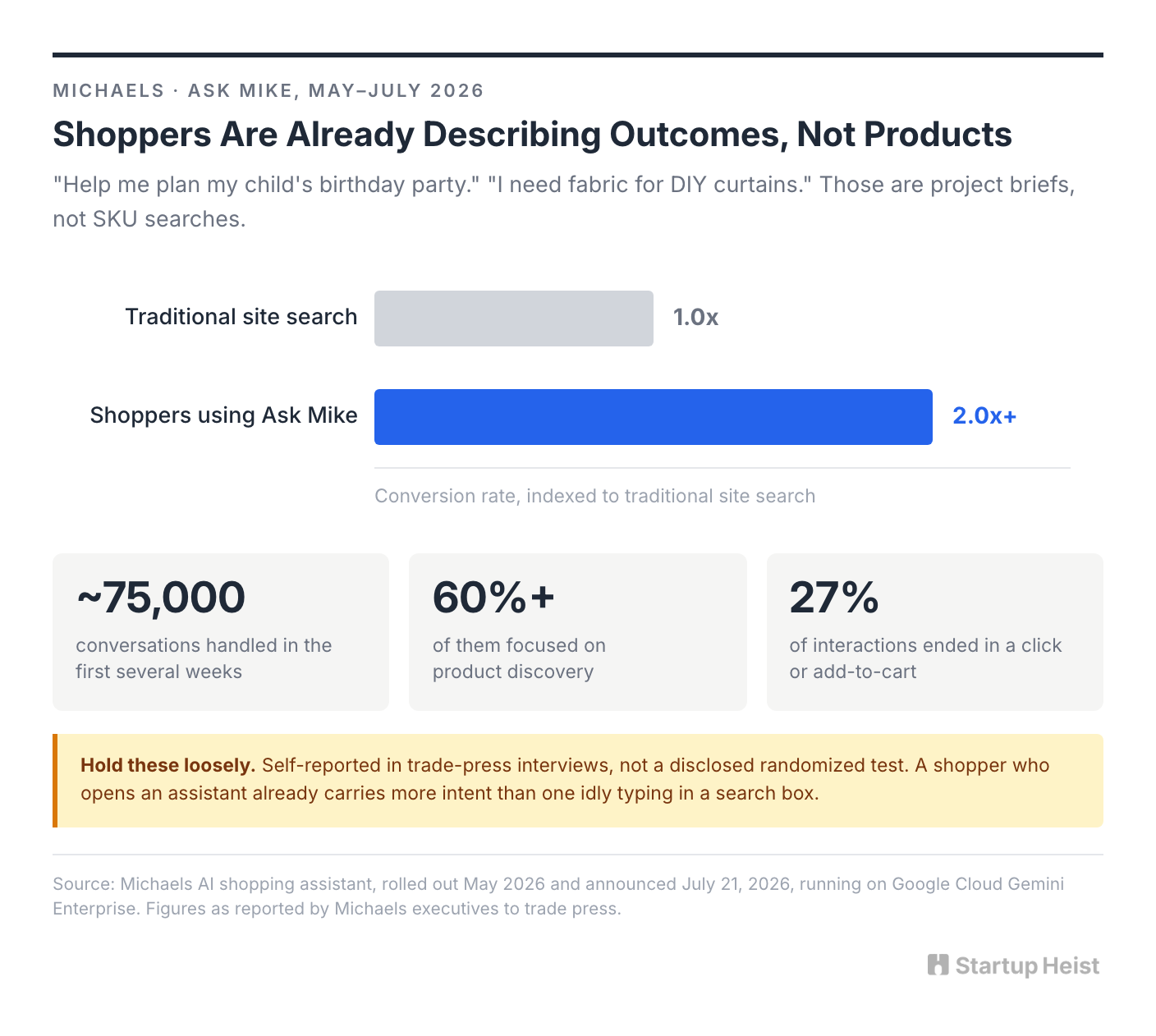
Ask Mike handled nearly 75,000 conversations in its first several weeks, more than 60% of them focused on product discovery. Michaels highlighted prompts like "help me plan my child's birthday party" and "I need fabric for DIY curtains." Those aren't SKU searches with extra words attached. Shoppers were describing the outcome they wanted and letting the assistant work backward. Michaels also reported that shoppers who used Ask Mike converted at more than double the rate of shoppers using traditional site search, and that 27% of assistant interactions ended in a product click or an add-to-cart.
Hold those numbers loosely. They come from executive interviews with the trade press rather than a disclosed randomized test, and a shopper motivated enough to open an assistant already carries more intent than someone idly typing in a search box. Michaels hasn't published traffic splits, incremental margin, or controlled lift. You don't need to believe "AI doubled conversion" for the signal to matter: customers are now willing to describe a project instead of a product, at scale, unprompted.
Specialty Retail Is Secretly a Bill-of-Materials Business
A quilting store isn't really in the fabric business, any more than a miniature store is in the paint business or a leatherworking store is in the hides-and-punches business. Each one sells the components required to produce a finished thing. Their catalogs are parts warehouses with storefronts attached.
These are real businesses, not novelty markets. Mintel's 2026 research found that 73% of American adults had done a craft project in the previous year. On the miniatures side, Games Workshop closed its financial year on May 31, 2026 with record revenue of £659.7 million, up from £617.5 million, and pre-tax profit of £275.7 million. Hobbyists spend, repeatedly, on multi-item purchases.
Every one of those purchases starts with a question the storefront cannot answer.
The Wrong Heist: Cloning Ask Mike
The obvious idea is "AI search for Shopify." Skip it. That land was already given away.
Shopify's own Search & Discovery app is free, and semantic search inside it is available to any store on a Shopify plan or above with fewer than 200,000 products. Guided selling is mature and cheap: RevenueHunt's Product Quiz Maker, a Built for Shopify app rated 4.9 across 432 reviews, runs $39 a month for 500 responses and $199 for 2,500. Bundling is worse than cheap, because Shopify's own bundles product is free. The conversational commerce slot is just as crowded, with Rep AI, Manifest AI, Tidio, Gobot and Shopify's own Inbox assistant all selling some version of the chat box.
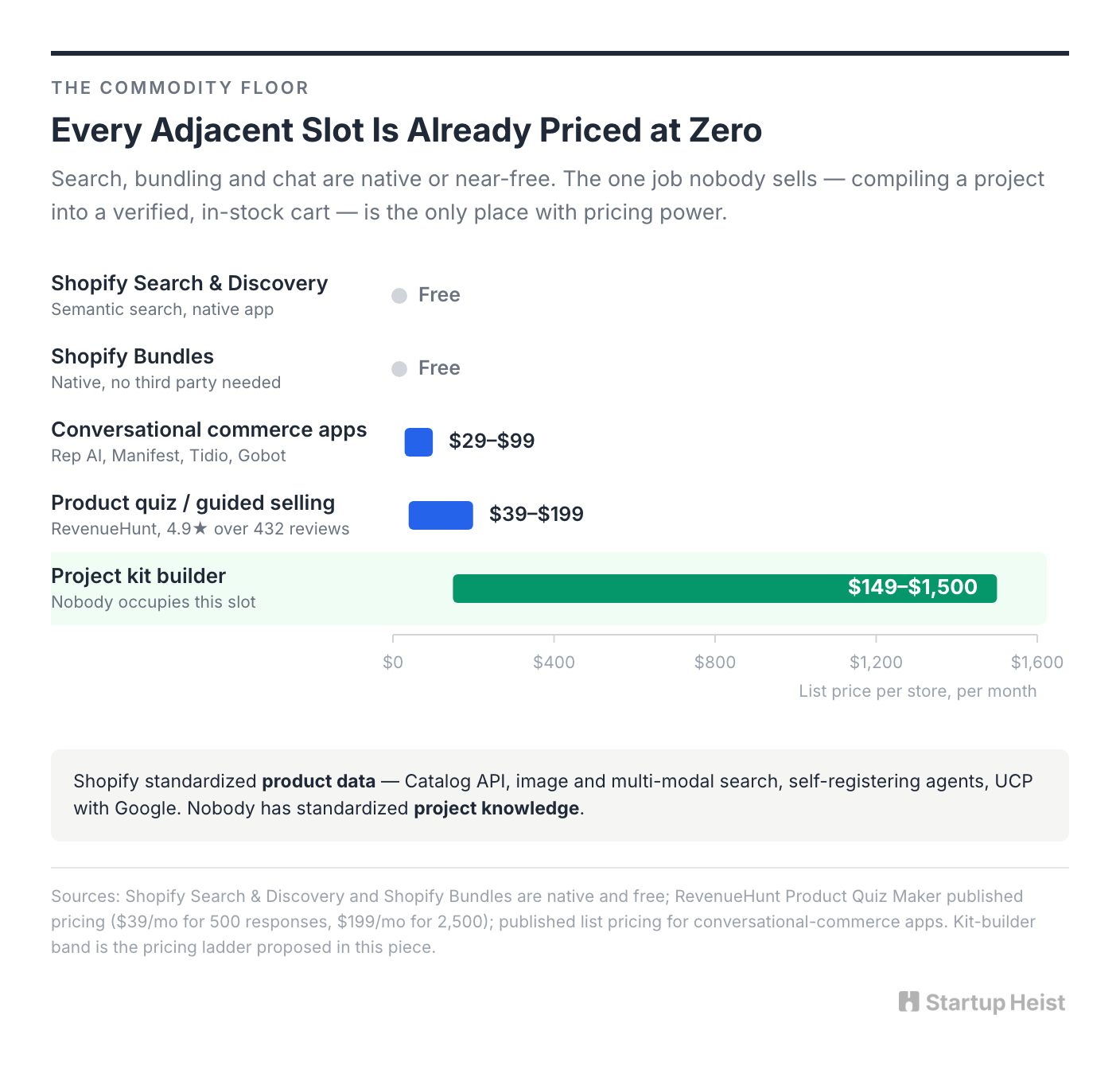
Then Shopify raised the floor again. In the Spring '26 Edition, published June 17, 2026, it shipped the Catalog API, which turns its product catalog into queryable infrastructure for AI agents, standardized across millions of merchants with real-time pricing and inventory. It added image and multi-modal search to that API, removed the approval gate so any developer can self-register an agent, and co-developed the Universal Commerce Protocol with Google to cover discovery through checkout. Shopify's own claim: AI searches powered by Shopify Catalog convert at twice the rate of those built on scraped data.
So if your pitch is "we put a chat box on your store and AI recommends products," you have no pricing power. A competent developer reproduces the demo in a weekend, Shopify reproduces the feature in an Edition, and the model vendor already owns the intelligence.
None of that infrastructure knows that a resin model needs a different adhesive than a plastic one, or that translucent contrast-style paint over a very dark primer destroys the effect the shopper is asking for, or that twelve miniatures don't justify the large bottle. The Shopify apps carrying "bill of materials" in the name, Assemblified and Craftybase among them, are backend manufacturing tools built for the merchant's own stockroom. Nothing customer-facing occupies the slot. Shopify standardized product data. Nobody has standardized project knowledge, and that's the gap worth stealing.
The Heist: Build a Project Compiler
Think of the product as a compiler. A compiler takes a high-level instruction and turns it into something a machine can actually execute.
This app takes "I want to make this" and compiles it into these specific variants, in these quantities, from this merchant's live inventory. The pipeline runs: intent, constraints, project specification, required components, compatible SKUs, quantities, substitutions, cart. Everyone else is building prompt, LLM, product links.
A shopper uploads that photo of weathered olive armor and snowy bases. The app doesn't immediately spit out ten products. It asks five questions: how many models, are they primed, brush or airbrush, what's your experience level, and do you want the simplest kit or the closest visual match.
Now it has enough constraints to build something real.
Required: a light or neutral primer, an olive base, a dark wash, a lighter olive for highlights, a gunmetal, a dark neutral, a snow texture, a matte varnish.
Optional: weathering pigment, a fine detail brush, basing tufts, mixing medium.
Estimated project total: $74.
The shopper removes the brush because they already own one. One color is out of stock, so the system swaps in a pre-approved alternative rather than guessing. Then one button: add 9 items to cart.
That button is the entire product, and everything hard about it sits underneath.
Why Miniature Painting Wins the First Slot
Several verticals have this same shape, but they're not equally good places to start.
Unlock the Vault.
Join founders who spot opportunities ahead of the crowd. Actionable insights. Zero fluff.
“Intelligent, bold, minus the pretense.”
“Like discovering the cheat codes of the startup world.”
“SH is off-Broadway for founders — weird, sharp, and ahead of the curve.”


