


The Matcha Heist: Don't Build a Matcha Brand. Build the Drop Machine.
Matcha has escaped the cup.
For a decade the commercial thesis was simple: Americans were drinking more of it. Now matcha has become an aesthetic language. Green, creamy, ritualistic, slightly premium, wellness-coded without making a single medical claim, and relentlessly photogenic. It's a color palette and a mood before it's a beverage.
The beverage numbers are real. The U.S. at-home matcha market grew from roughly $130 million in 2023 to an estimated $200 million in 2025, according to Jade Leaf Matcha data cited by Forbes in June 2026, with a projected doubling by 2030. Demand has been strong enough to strain supply at the source: a shortage of tencha, the shade-grown leaf that becomes ceremonial matcha, began in late 2024, and Japanese wholesale prices have more than doubled since 2023, with Kyoto auction prices up as much as 170 to 265% in 2024 to 2025 alone.
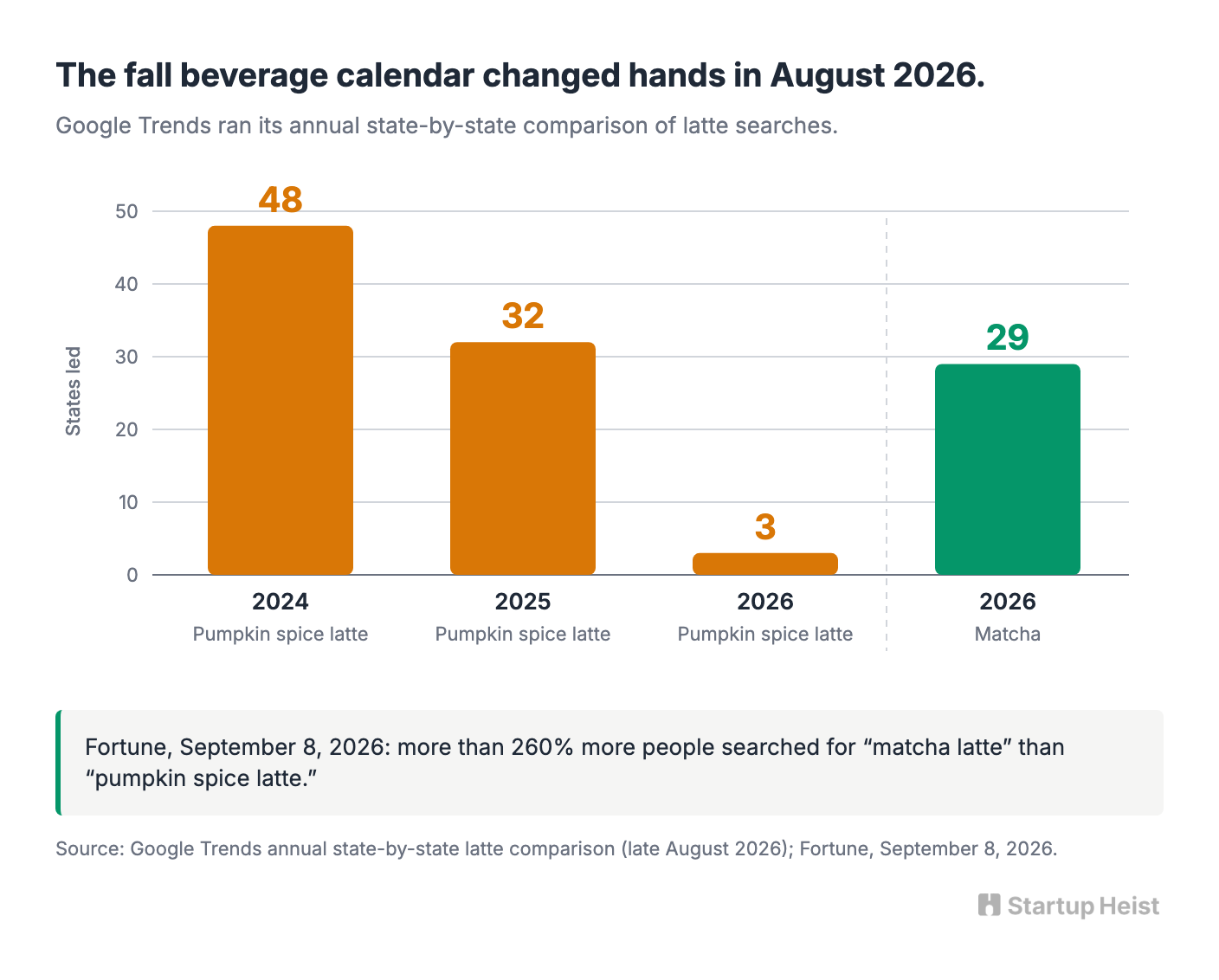
The more telling signal arrived in late August 2026. Google Trends ran its annual state-by-state comparison of latte searches. Pumpkin spice latte, the flavor that invented modern seasonal beverage marketing, led in three states. In 2025 it led in 32. In 2024 it led in 48. Matcha led in 29. Fortune reported on September 8, 2026 that more than 260% more people searched for "matcha latte" than "pumpkin spice latte," and that McDonald's had swapped pumpkin spice for caramel apple pie as its sole fall coffee flavor for the first time in over a decade.
The fall beverage calendar changed hands in August 2026. That's the kind of cultural moment consumer founders spend years waiting for, and most of them are about to waste it.
Here's the version of this worth a month of your time.
The money: A $56 giftable bundle at 300 orders a month is roughly $17,000 in revenue; Ceremonia's $38 guava mist sold out at Sephora in a week.
Inside:
• Three-concept test before you buy inventory
• One-bottle MVP with zero-MOQ private label
• $19 CAC ceiling worked back from margin
• MoCRA checklist for sub-$1M cosmetic brands
The obvious product already exists
The temptation is to put the word MATCHA on a face wash, buy some TikTok ads, and wait for Google to deliver customers. That window closed while you were reading the trend piece.
Tatcha launched a $40 Matcha Foam Cleanse on June 15, 2026, on top of its existing Matcha Cleanse. KraveBeauty sells a $16 Matcha Hemp Hydrating Cleanser backed by clinical testing. Le Monde Gourmand sells a $28 Thé Matcha eau de parfum. Phlur's Matcha Milk hair and body mist sits on Sephora shelves with a Berry Cream companion. Etsy returns hundreds of matcha perfumes and over a thousand matcha candles, many from sellers with thousands of reviews. And the literal matcha fragrance shelf filled up in 2026: Zara's Sweet Matcha Day, Armaf's Matcha Magix, and Gulf Orchid's $29.99 Matcha Latte all arrived between January and September 2026.
Every obvious matcha SKU already has a landlord, so forget owning matcha.
The smarter heist treats matcha as the first input into a rapid sensory-product launch system: spot an emerging food or beverage aesthetic, translate it into a visually distinctive private-label fragrance or body-care concept, validate the concept before buying inventory, launch a tiny compliant run, and either scale the winner or kill it. The first drop could be Matcha & Ube, or Strawberry Matcha, or Matcha Milk Tea. The asset you're building is the machine that knows what goes in the next bottle.
Keep that distinction straight, because this is a viable small consumer business and potentially a very good cash-flow business. It isn't a venture-scale monopoly, and pretending otherwise will make you order 1,000 units of the wrong thing. The opportunity fits a narrow, low-inventory sensory product or giftable ritual far better than a sprawling "matcha lifestyle" line.
Why fragrance is the door, and skincare is the wall
You could launch a cleanser, and you shouldn't.
Facial skincare drags an unknown brand into a trust competition against companies with years of reviews, formulation credibility, and clinical positioning. KraveBeauty markets its matcha cleanser with an independent clinical study. Tatcha has Sephora distribution and a decade of authority. Nicer typography won't close that gap.
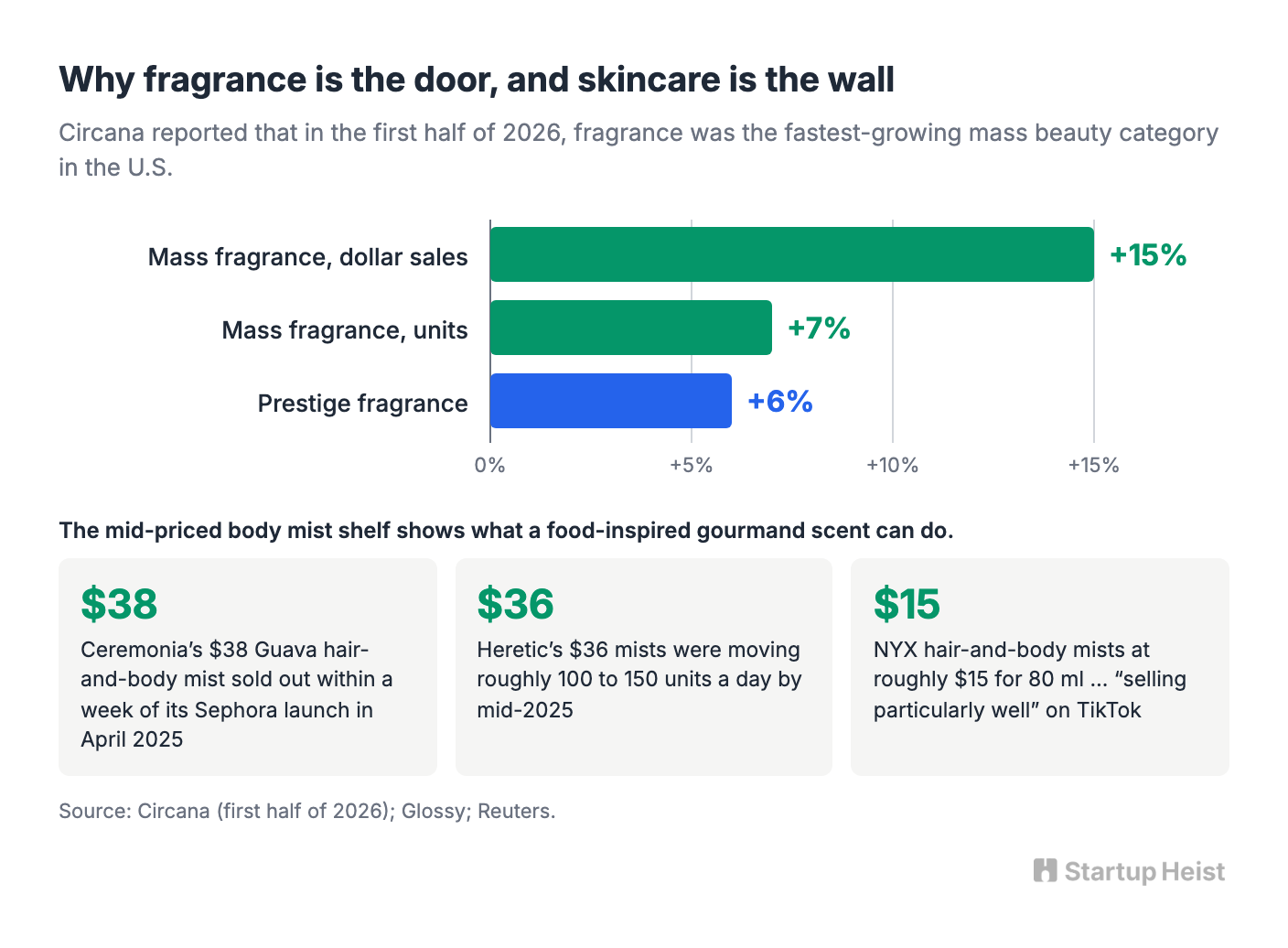
Fragrance plays by different rules. A hair-and-body mist doesn't have to convince anyone it will fix their acne or repair their barrier. Its job is sensory: smell good, look desirable on a shelf or a feed. The claims stay boring, which keeps regulatory exposure low, which keeps the whole experiment cheap. And the category has wind at its back. Circana reported that in the first half of 2026, fragrance was the fastest-growing mass beauty category in the U.S., with dollar sales up 15% and units up 7%, while prestige fragrance grew 6%. L'Oréal read the same data: in late June 2026 it launched NYX hair-and-body mists at roughly $15 for 80 ml, an explicit play for Gen Z demand that its consumer products chief told Reuters was "selling particularly well" on TikTok, priced to undercut Sol de Janeiro and Phlur.
The mid-priced body mist shelf shows what a food-inspired gourmand scent can do. Ceremonia's $38 Guava hair-and-body mist sold out within a week of its Sephora launch in April 2025, according to Glossy. Heretic's $36 mists were moving roughly 100 to 150 units a day by mid-2025. Matcha itself is already crossing that bridge: Phlur's Matcha Milk runs bergamot and black tea on top, matcha, macadamia milk, and vanilla in the heart, musk and amber at the base, and customers describe it as a sweet, creamy latte. It sells the feeling of the drink, and it contains no tea.
Beverage founders would kill for that last detail. While every café and canned-latte brand fights over a doubled tencha price and a real supply shortage, your input cost is a fragrance accord and a bottle. You get the cultural moment with none of the commodity exposure. Nobody buying a mist cares about your matcha grade. They care whether the bottle captures the moment.
Sell the ritual
Say the first drop is called Matcha & Ube After Hours.
The name describes a scent, and it makes no ingredient claim. If the mist doesn't contain matcha extract or purple yam, never imply that it does. What the name promises is a scent story: earthy green tea, steamed milk, vanilla, toasted sweetness, perhaps a nutty or faintly floral edge.
The packaging carries the contrast, muted ceremonial green against dusty violet. The content shows two liquids and two color worlds colliding. The product copy describes scent and says nothing about detoxification, antioxidants, or "superfood skincare."
What you're selling is a smellable version of the café order that keeps showing up on someone's feed, and that's a different pitch from another matcha beauty product. Ube has been climbing the same TikTok dessert ladder matcha climbed, and strawberry matcha lattes have been a fixture of café menus and short-form video for two summers. The pairings are already in the culture; you're bottling them.
The framing also gives you somewhere to go after matcha. Strawberry Matcha becomes a drop. Hojicha Cream another. Black Sesame Vanilla, Yuzu Milk, Pandan Coconut, Brown Sugar Oat. Most of those don't deserve products. Your business model exists to find out which ones do, cheaply.
Test three concepts before you own a single bottle
The usual sequence runs backward: pick a manufacturer, browse 150 stock formulas, fall in love with one, design packaging, order 500 units, and only then ask whether anyone wants it.
Unlock the Vault.
Join founders who spot opportunities ahead of the crowd. Actionable insights. Zero fluff.
“Intelligent, bold, minus the pretense.”
“Like discovering the cheat codes of the startup world.”
“SH is off-Broadway for founders — weird, sharp, and ahead of the curve.”


