


USPS built the physical rail for safer local commerce. The play is to own the transaction layer on top of it.
A vintage seller lists the same jacket on Facebook Marketplace, OfferUp, and Instagram. Within an hour, three buyers message: "Is this available?" "Can you hold it until Friday?" "Where can we meet?" The seller answers the same questions three times, negotiates the same price, and agrees to meet one buyer outside a Target at 7 p.m. The buyer shows up twenty minutes late, or never shows at all.
Discovery worked fine; three buyers turned up within the hour. Everything after "I'll take it" is the handoff, and the last fifty feet of a local sale still run on text messages, parking lots, and hope.
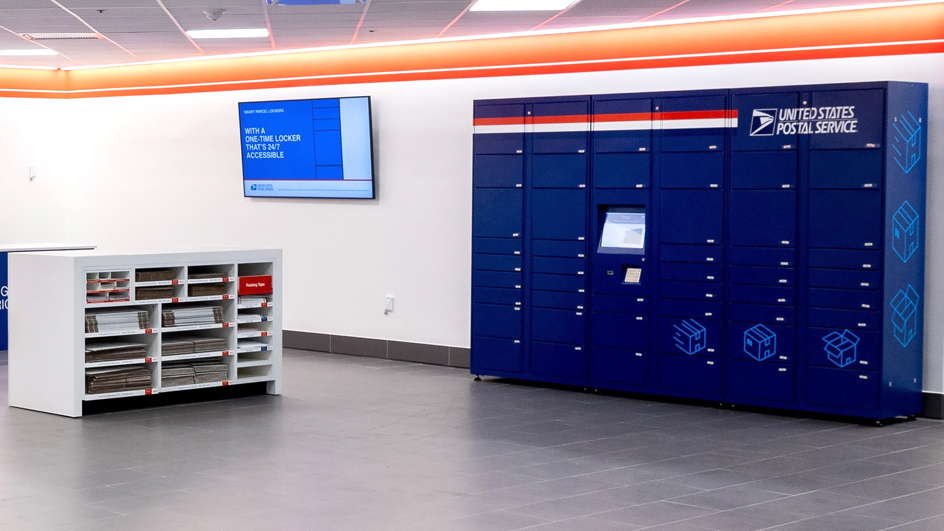
On July 15, 2026, USPS launched Local XChange, a service that lets local buyers and sellers exchange merchandise through USPS Smart Lockers without ever meeting. The seller books through Click-N-Ship, pays $5.51, deposits the packaged item in a locker, and USPS emails the buyer a pickup QR code. The buyer scans it and takes the box home.
USPS has quietly created new physical infrastructure for local commerce without any of the software needed to operate it at volume. That gap is the heist. The opportunity is a lightweight transaction, commitment, and proof layer for high-frequency local sellers, one that works across Facebook Marketplace, OfferUp, Craigslist, Instagram DMs, campus resale boards, and repeat customers who order by text. Call it HandoffOS: the operating system for completing parcel-sized local sales after buyer and seller have already found each other.
Here's the brief:
The money: 100 sellers at $49 is about $4,900 MRR; 500 sellers at $59 blended clears $350K ARR. Resellers already pay $29 to $99 monthly for reseller software.
Inside:
• Seven-component MVP, no escrow required
• 30-day concierge-to-paid build plan
• Three-phase payments path that dodges FinCEN
• Kill criteria and the dispute trap to avoid
USPS solved the hardest physical problem
Local commerce has always had an awkward final mile. Marketplaces are good at helping buyers discover nearby inventory and bad at helping two strangers safely exchange it. Every traditional option is compromised: reveal your home address, coordinate a meetup at a police-station safe exchange zone and eat the no-shows, leave the item on a porch and hope payment arrives, or ship it and absorb postage and platform fees.
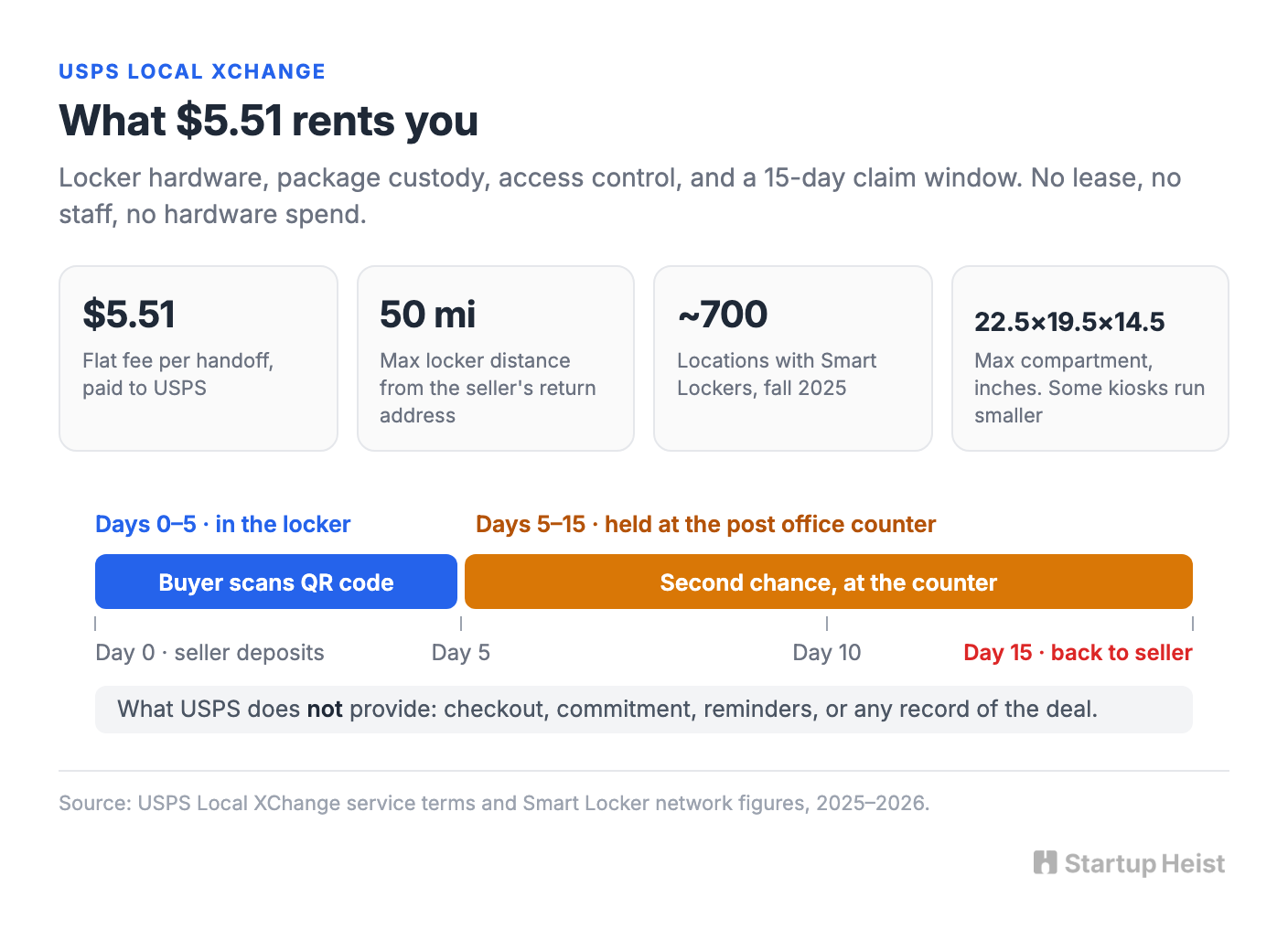
Local XChange is a credible fifth option. The seller picks an eligible Smart Locker within 50 miles of their return address. Items must fit a compartment no larger than 22.5 by 19.5 by 14.5 inches, and some locations run smaller. The buyer gets five days to retrieve the package; unclaimed items move to the post office counter for ten more days before returning to the seller on day 15. USPS reported roughly 700 locations with Smart Lockers as of fall 2025, with more coming as it modernizes retail lobbies. The network isn't universal, but it's dense enough for focused city launches.
Look at what USPS is subsidizing here: physical locations, locker hardware, package custody, access control, QR-code delivery, return handling, and a brand every American already trusts with packages. A startup renting this physical layer pays $5.51 per transaction, no leases, no hardware, no staff. Starting positions don't get much better than that. The catch is what USPS left out.
The missing layer begins before the locker
USPS's own instructions reveal the opening. Before using Local XChange, the seller and buyer are expected to have completed the transaction, including payment. The seller separately collects the buyer's name and email, agrees on a locker, enters everything into Click-N-Ship, packages the item, and manages the buyer relationship end to end. USPS handles the custody event and nothing commercial around it.
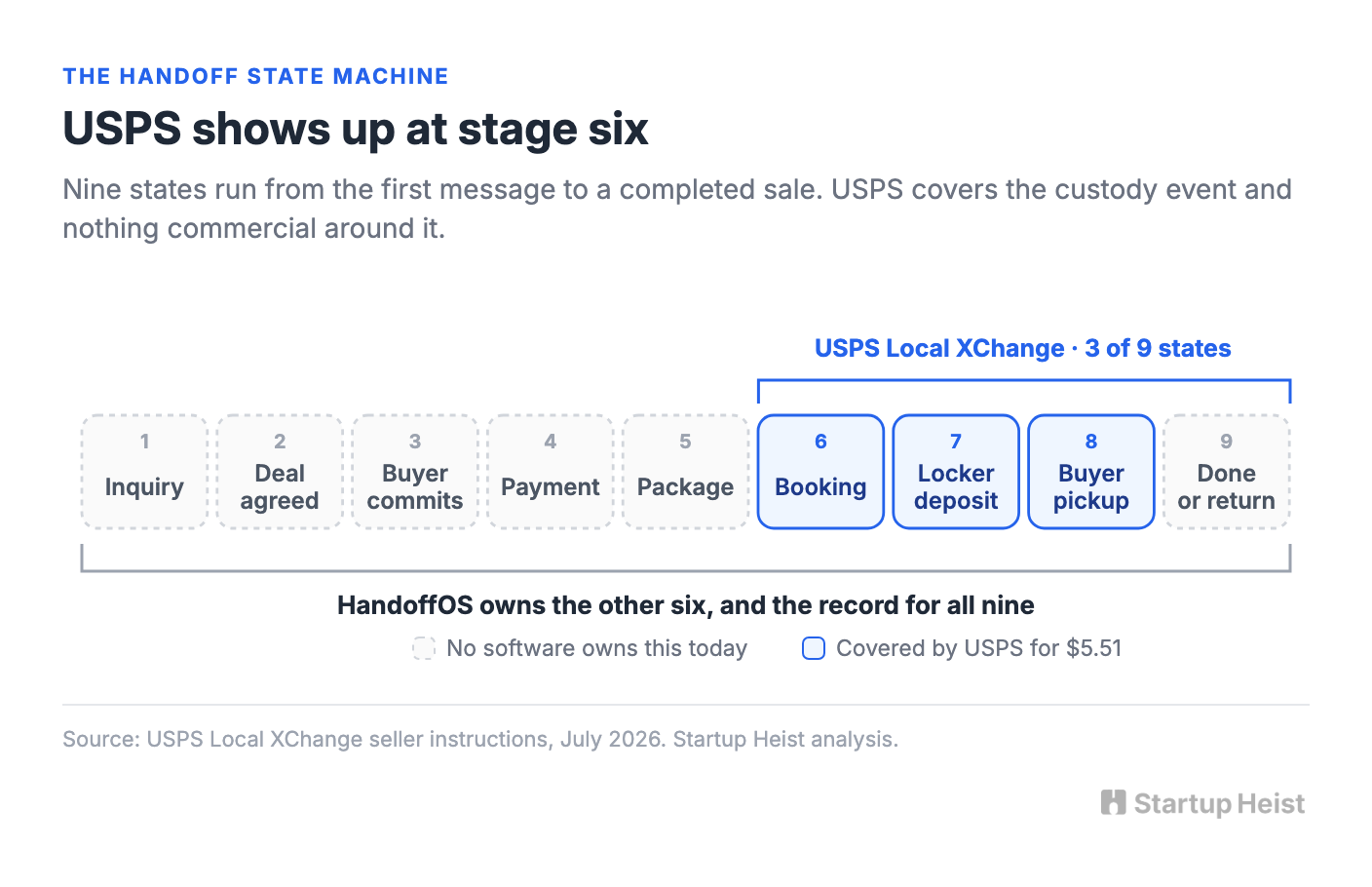
A casual seller clearing out a closet barely notices. Someone processing 50 local transactions a month lives inside that gap. USPS provides no buyer checkout or reservation page, no commitment deposit, no condition acknowledgment, no pickup reminders, no cross-marketplace tracking, and no record of anything: serial numbers, deposit photos, dispute documentation, or a unified history of buyers, no-shows, and completed handoffs.
The locker is one event in a longer state machine: inquiry, agreement, buyer commitment, payment, packaging, booking, deposit, pickup, completion or return. USPS enters near the end of that sequence. HandoffOS should own everything around it.
Don't build another marketplace
The obvious mistake is to look at Facebook Marketplace's scale and decide to build a better local marketplace. Facebook, OfferUp, Craigslist, Instagram, and eBay already own consumer attention. Buyers won't recreate their profiles inside a smaller inventory pool, and the opportunity exists precisely because discovery is fragmented. Professional sellers go where the buyers are, which means their deals arrive through several incompatible surfaces at once.
HandoffOS should be the link a seller sends after typing "Yes, it's available. Use this page to reserve it and choose the locker." That's a much smaller product than another marketplace, and a much better business.
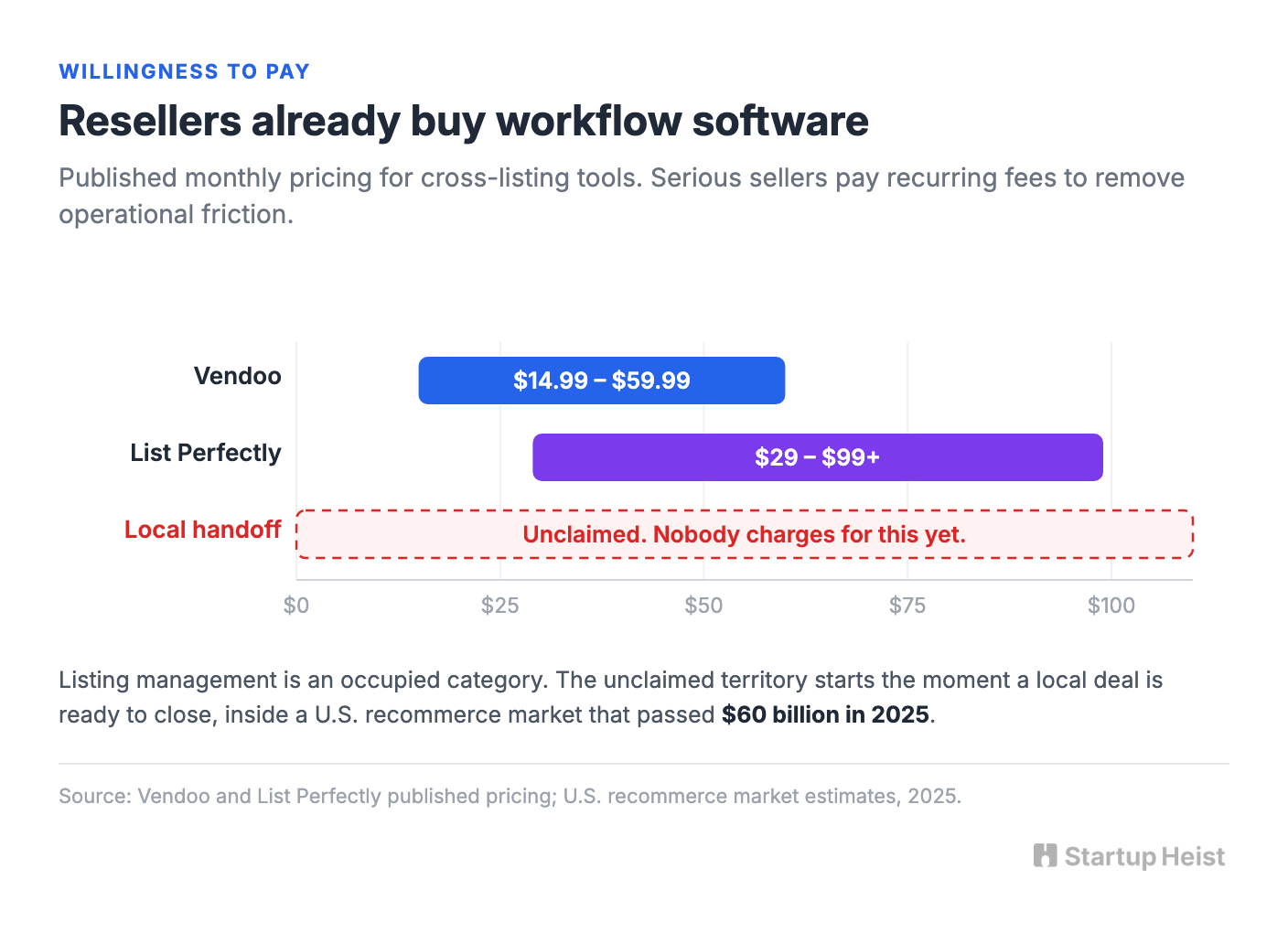
The reseller software market has already proven the willingness to pay. Cross-listing platforms like Vendoo and List Perfectly built real businesses helping sellers post inventory across eBay, Poshmark, Mercari, Facebook, and Etsy, detect sales, and delist everywhere else. List Perfectly charges $29 to $99+ per month; Vendoo runs $14.99 to $59.99. Serious resellers pay recurring software fees to remove operational friction, and listing management is an occupied category. The unclaimed territory starts at the exact moment a local deal is ready to close.
The sellers who feel this pain weekly
Someone unloading a sofa every three years will tolerate an awkward meetup and will never pay $49 a month for transaction software. The initial customer completes at least 20 local transactions a month, lists across multiple channels, sells items worth $50 or more, handles parcel-sized merchandise, and has either eaten enough no-shows or worried enough about strangers at the front door to want a process.
Four categories fit best. Sneakers and collectibles: compact, valuable, sold across several channels, with serial numbers and authenticity claims that make evidence capture genuinely useful. Vintage apparel: professional sellers moving inventory through social media, pop-ups, and DMs, with bundles that easily justify the fee. Refurbished electronics: phones, consoles, and laptops carry both safety and proof concerns, and sellers can document serials and condition before deposit. Estate-sale and campus operators: high-volume miscellaneous inventory and move-out surges where buyers prefer an institutional pickup point over a stranger's apartment.
The wrong categories are $15 lamps and couches. A $5.51 fee dies on low-value clutter, and the locker dimensions exclude the furniture economy entirely.
The timing signal extends beyond USPS. OfferUp killed nationwide shipping for new listings on September 23, 2025 and told users it was refocusing entirely on making local transactions simpler, safer, and more rewarding. Local exchange is a distinct behavior with its own economics, and the industry is reorganizing around it inside a U.S. recommerce market that passed roughly $60 billion in 2025, a year in which 93% of Americans bought something secondhand. eBay already proved the mechanic: its local-pickup flow gives buyers a QR code and six-digit confirmation code, and the seller's scan creates proof of handoff inside eBay's system. But eBay's solution only works on eBay. Nobody has built verified, organized handoff across all the fragmented channels where local deals actually happen.
The first product: buyer commitment plus proof
The MVP shouldn't promise escrow, fraud protection, or authenticity guarantees. It should promise something narrower: turn an informal local sale into a documented, trackable handoff. Seven components.
Unlock the Vault.
Join founders who spot opportunities ahead of the crowd. Actionable insights. Zero fluff.
“Intelligent, bold, minus the pretense.”
“Like discovering the cheat codes of the startup world.”
“SH is off-Broadway for founders — weird, sharp, and ahead of the curve.”


