


New Jersey Turned Every Bike Shop Receipt Into a Legal Document
The business is making one newly regulated retail transaction boring, repeatable, and hard to get wrong.
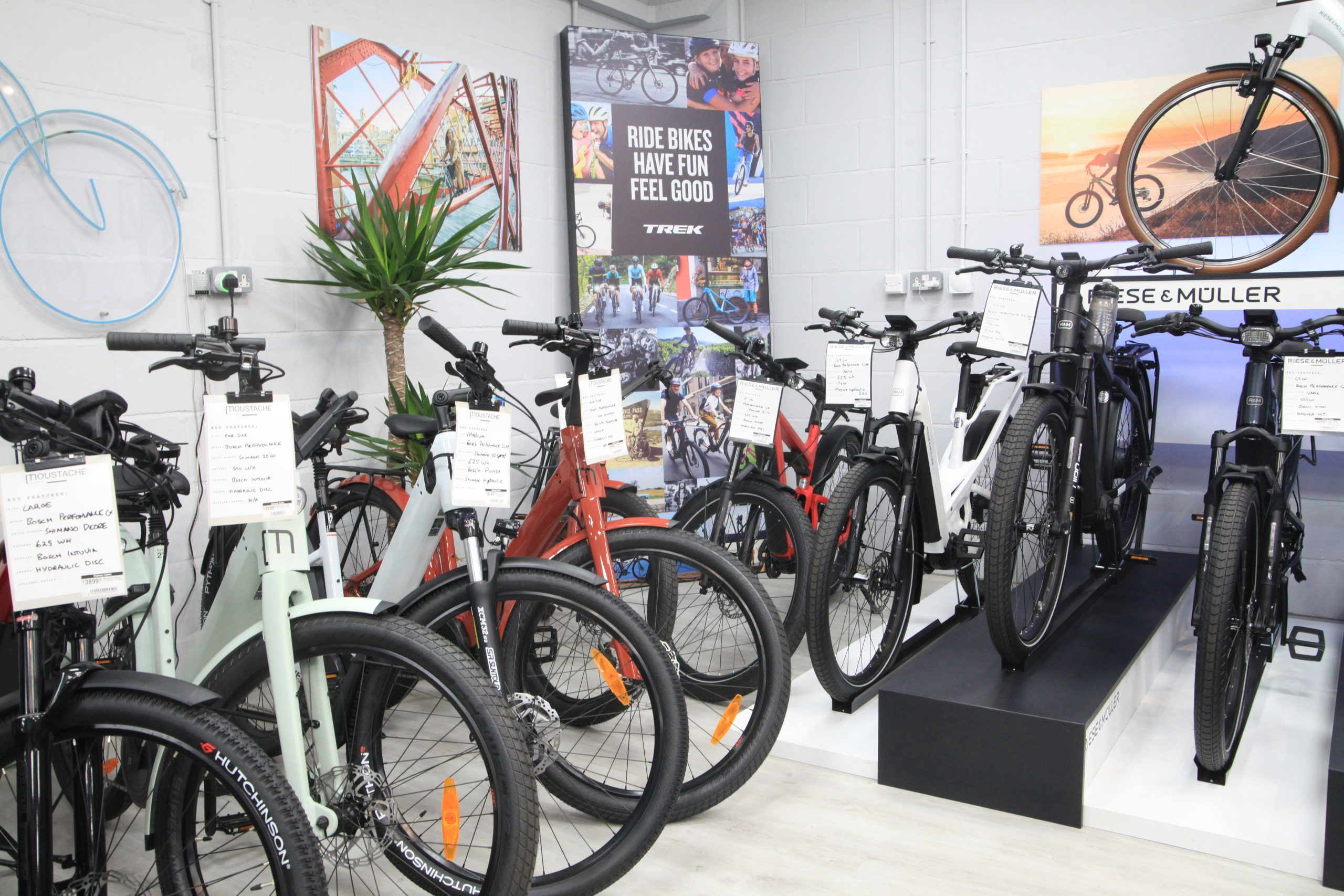
A customer walks into a bike shop in Montclair and buys a $3,000 e-bike.
In 2024 that checkout took four minutes. Ring it up, write the serial on the receipt, explain the battery, sell a helmet, wave goodbye.
Today the same transaction produces a queue of questions the employee has no script for. Which category is this bike? Do I need insurance? Can my sixteen-year-old ride it? What do I bring to the MVC? Does my receipt count as proof of ownership? Where is the serial number, exactly?
New Jersey manufactured that moment on January 19, 2026, when Governor Phil Murphy signed S4834 into law as P.L. 2025, c.285. The law scrapped the federal three-class e-bike framework the state had adopted in 2019 and pulled electric bicycles under the motor vehicle apparatus, with registration, licensing, and in some cases insurance. The six-month grace period expired on July 19, 2026, and the Motor Vehicle Commission opened its first e-bike appointments on June 26, 2026.
Buried in the statute is a sentence written for builders: all sellers of e-bikes shall make the applicable registration forms available to individuals purchasing them. That language is in the law itself, and the MVC repeats it on its e-bike page.
So New Jersey has inserted a government-document handoff into the checkout counter of businesses whose software was built to sell bicycles, and gave them nothing to do it with. The gap between that obligation and the point-of-sale systems running those shops is the business.
The money: A hundred New Jersey dealers at $39 a month is about $4K MRR, and the packet engine resells into every other regulated-product disclosure that follows a sale.
Inside:
• Nine-capability v1 a solo dev ships in a month
• Three-tier pricing against the POS incumbents
• Cold email plus five discovery questions
• The kill criterion and the feature to refuse
The form is the product spec
Coverage of the New Jersey e-bike law describes the burden in the abstract. The form itself hands you a spec.
Form BA-49EB is titled the Low Speed Electric Bicycle and Motorized Bicycle Ownership and Registration Form. It opens with a warning in bold: Please write clearly or your application will be rejected. It requires an appointment booked in advance through the state's TeleGov portal. And it asks for the following about the bike:
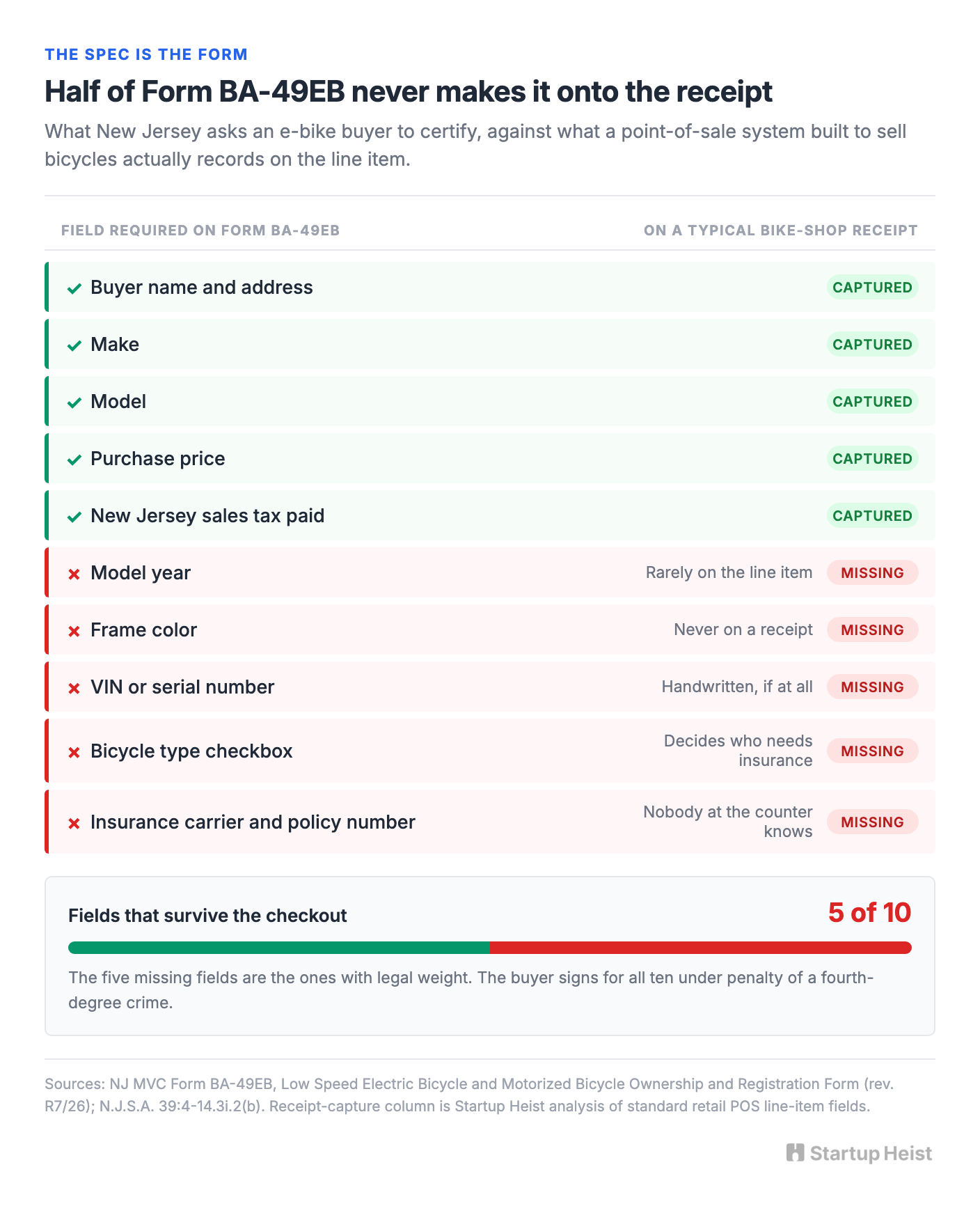
Vehicle Identification Number or serial number. A checkbox declaring the bicycle type. Year. Make. Model. Color. Insurance company name and policy number, if the bike falls into the category that requires coverage.
The middle of the form is an ownership affidavit. The buyer checks one of two boxes: either a bill of sale or receipt is attached as proof of ownership, or no formal proof exists and the buyer is submitting a written ownership statement instead. Then a second pair of boxes: either New Jersey sales tax was paid on the purchase, or it wasn't, in which case the buyer writes in the purchase price.
The signature block is the part worth reading twice. The buyer certifies, under N.J.S.A. 39:4-14.3i.2(b), that submitting a false bill of sale, a false receipt of purchase, or any other false proof of ownership is a crime of the fourth degree.
Which means the document a shop hands a customer at checkout is now the attachment on a sworn state affidavit with criminal penalties behind it. The shop isn't the one signing, but it is the one producing the paper, and most point-of-sale systems in bicycle retail were never designed to record a serial number, a frame color, and a regulatory classification on the same line item.
There's one more field, tucked into the MVC-use-only box at the bottom: Agency Assigned VIN. The state built a fallback for bikes that arrive with no findable serial number, which suggests that happens often enough to plan for.
The form has already been revised once. The current version is stamped R7/26, meaning July 2026, six months after the law passed. Anyone building here should assume the goalposts move.
The classification checkbox is the whole game
New Jersey created three categories, and the boundaries between them run through product specs no customer has ever thought about.
A low-speed electric bicycle has pedal assist only, no throttle, and cuts out at 20 mph. It must be registered. No insurance required.
A motorized bicycle has a throttle or assists past 20 mph, topping out at 28. It must be registered, and it requires insurance.
An electric motorized bicycle, meaning 750 watts or more with a throttle and assist past 28 mph, is treated as a motorcycle.
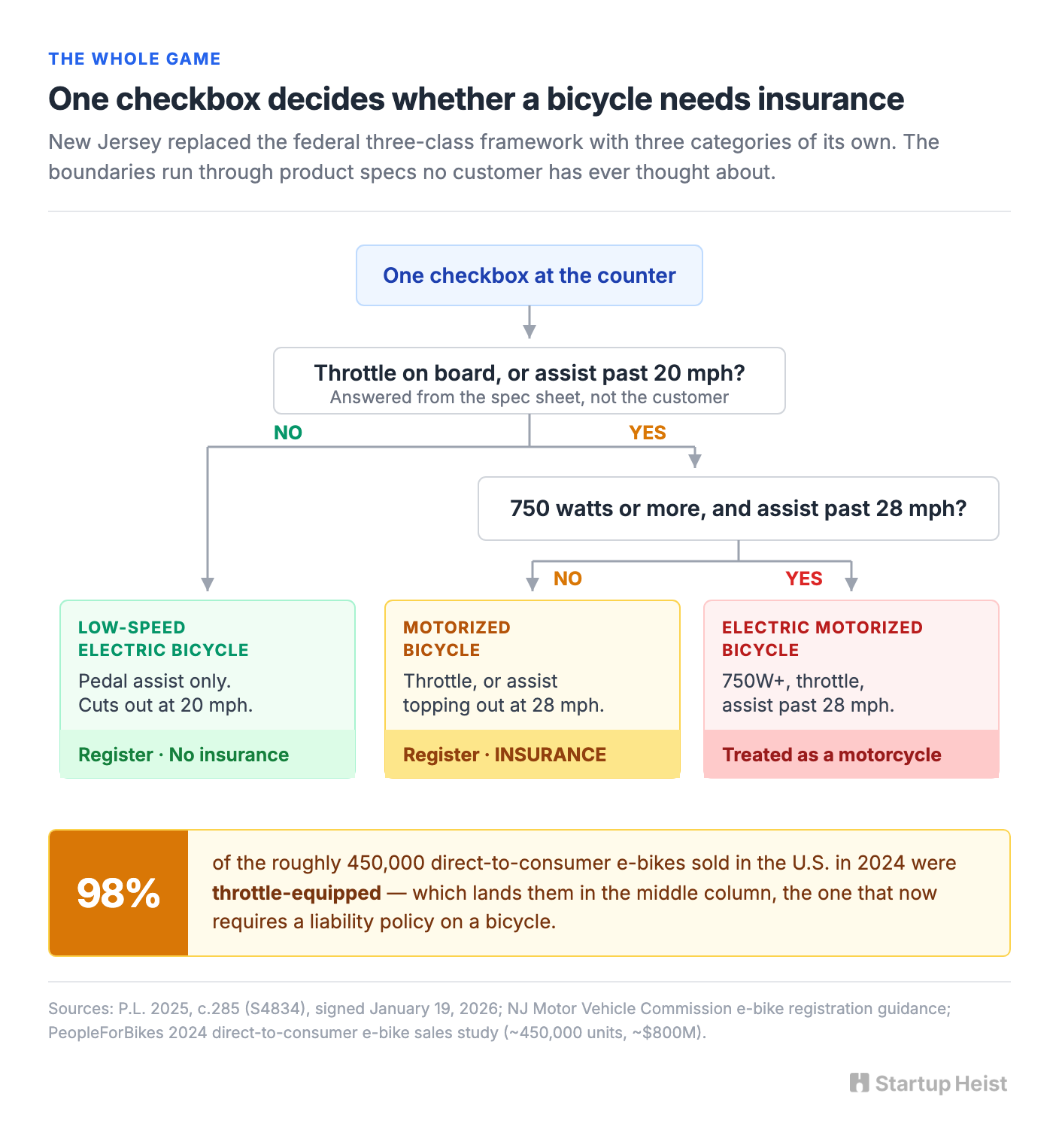
One checkbox on BA-49EB separates a customer who registers for free from a customer who now needs a liability policy on a bicycle. PeopleForBikes measured direct-to-consumer e-bike sales in 2024 and found roughly 450,000 units worth about $800 million that conventional retail data had missed entirely, effectively doubling the visible U.S. market. Of those, 98% were throttle-equipped.
A throttle puts a bike in the motorized bicycle category, and that category requires insurance.
The employee holding the spec sheet is the one who knows which box applies. The customer signing the affidavit is the one carrying the legal risk of getting it wrong. That mismatch is where a product lives.
The honest problem: the market is shrinking
The law is damaging the businesses you'd be selling to. Reporting from New Jersey dealers on August 14, 2026 describes e-bike sales collapsing: one shop down 90%, another down 63%, a range of others reporting 20% to 60% declines. Shops have laid off staff, shut down rental operations, and warned they may not survive the year. Customers walked away believing e-bikes had been banned outright. Others said they'd just buy online and ignore the whole thing.
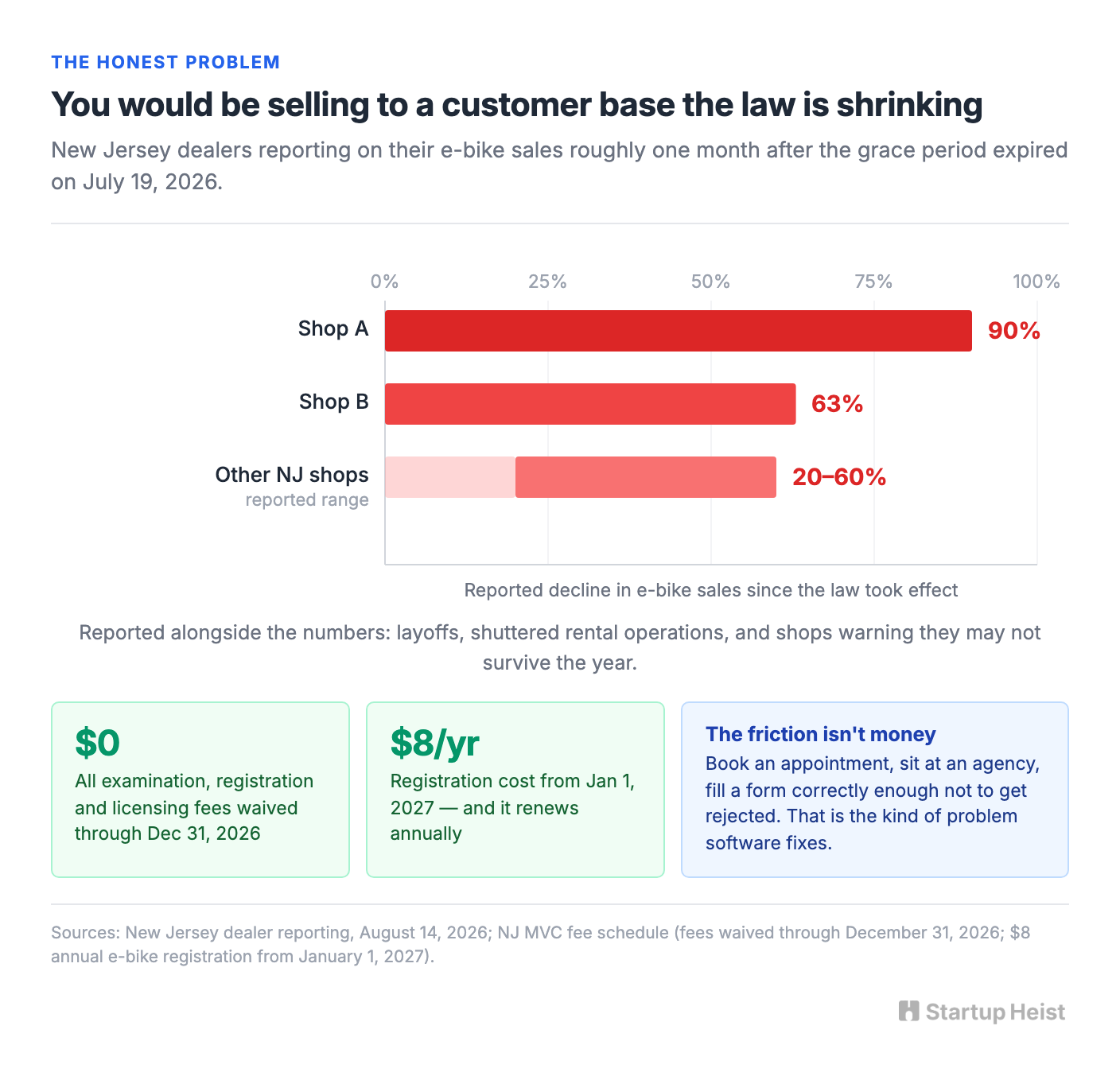
Money isn't the friction. All examination, registration, and licensing fees are waived through December 31, 2026, and e-bike registration costs $8 a year starting January 1, 2027. Compliance that cheap means the objection is entirely about hassle: book an appointment, sit at an agency, fill a form correctly enough not to get rejected, walk out with two plate stickers to affix to the front fork. That's the kind of problem software fixes. And an annual fee means annual renewal, so every registered e-bike in New Jersey becomes a recurring paperwork event rather than a one-time chore.
The law may also not survive in its current form. PeopleForBikes is working with the Sherrill administration on a follow-up bill to refocus regulation on the high-speed e-motos that caused the political problem and roll back requirements on conventional e-bikes. The New Jersey Bike & Walk Coalition is organizing against the statute statewide.
So the setup is a shrinking customer base, an unstable regulation, and free government forms as your primary competitor. The reason to build anyway has almost nothing to do with New Jersey.
The wedge: a packet, not a platform
Call it E-Bike Sale Passport.
Unlock the Vault.
Join founders who spot opportunities ahead of the crowd. Actionable insights. Zero fluff.
“Intelligent, bold, minus the pretense.”
“Like discovering the cheat codes of the startup world.”
“SH is off-Broadway for founders — weird, sharp, and ahead of the curve.”


