


CupCanvas: Turn the Cup Into a Local Media Channel
The next loyalty program for an independent coffee shop might not look like a loyalty program at all.
It might look like a frog in an Eagles jersey, or a hand-drawn Chinatown street scene, or a limited illustration from the tattoo artist two doors down. Six designs released over six Saturdays, regulars trying to collect the set, and the shop sticks one on your drink.
That's the opportunity behind CupCanvas:
The money: 64 shops at $79 a month is $5,000 MRR before launch fees of $750 to $1,500 each. Dutch Bros built a monthly sticker ritual that sells out in two hours.
Inside:
• The $240 printer and the label physics
• Square OAuth workflow, no partnership needed
• Six-rung metric ladder ending in incrementality
• Launch Drop pricing and the outreach email
The word that matters here is drop. Printing a picture onto a label is easy. Turning that picture into a repeatable local marketing mechanic, with artist collaboration, scarcity, customer capture, POS attribution, repeat-visit tracking and merchandising, is the business. The naive version of this idea is a novelty; the version worth building is a small piece of local-commerce infrastructure.
Approach it as micro-SaaS plus a productized campaign service rather than a venture-backed creator marketplace. A few hundred locations is a respectable bootstrapped software company. If the behavioral data eventually proves that local drops lift visit frequency, there's a bigger platform underneath, but that second story has to be earned. Steal the simple one first.
The behavior is already here
China offers the clearest view of what happens when the disposable cup becomes media. In November 2025, Heytea relaunched its DIY Hi-Sticker feature, moving from fixed templates to a free-creation sandbox where customers draw their own cup label in the app. The feeds on Xiaohongshu and Douyin promptly filled with idol portraits, anime characters, inside jokes, boyfriend stickers and pet drawings. Dao Insights put the strategy plainly: rather than competing on the next flavor, Heytea was treating the cup as micro-media. You don't just buy a drink, you make a moment, and once that moment is printed and photographed it leaves the store and enters the algorithm. In Dao's framing, Heytea wasn't chasing virality so much as outsourcing it.
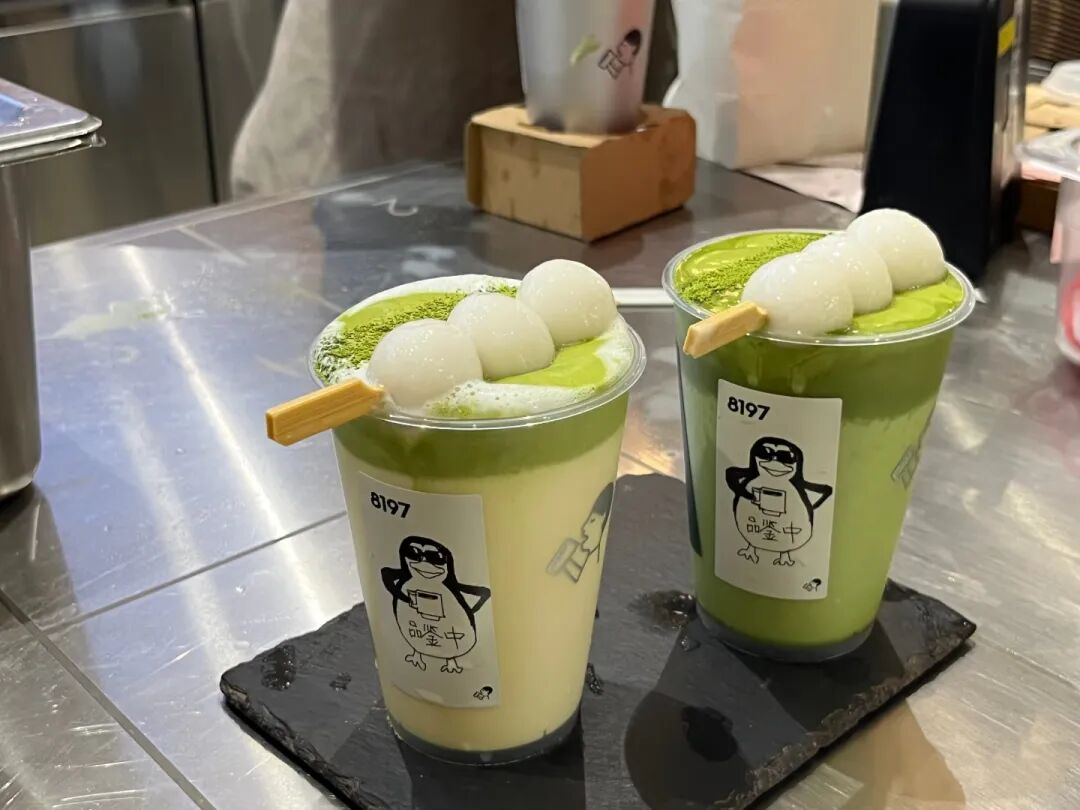
The United States arrived at the same place from the opposite direction. Dutch Bros, at 1,225 shops as of its August 5, 2026 earnings release, gives customers a limited sticker with any drink purchase on the first Wednesday of every month, while supplies last. Popular designs can sell out within two hours. The chain keeps a public Sticker Hub of past releases, has expanded into location- and state-specific drops, and its stickers get resold on eBay. That's a ritual, and it sits next to a loyalty program that runs through roughly 73% of transactions.
Rituals create something discounts can't: anticipation. Nobody tells a friend to come Wednesday because the latte is 40 cents cheaper. They might say the new sticker drops Wednesday. That shift, from transaction incentive to identity object, is the whole idea. Independent cafés and boba shops understand the appeal. What they lack is the design bench, the campaign calendar and the operational machinery to run it every month, and that machinery is what CupCanvas packages.
Why beverage shops are the right territory
You want three conditions: frequent transactions, a product that travels through the world visibly, and customers who care about aesthetics, identity and place. Coffee and boba check all three.
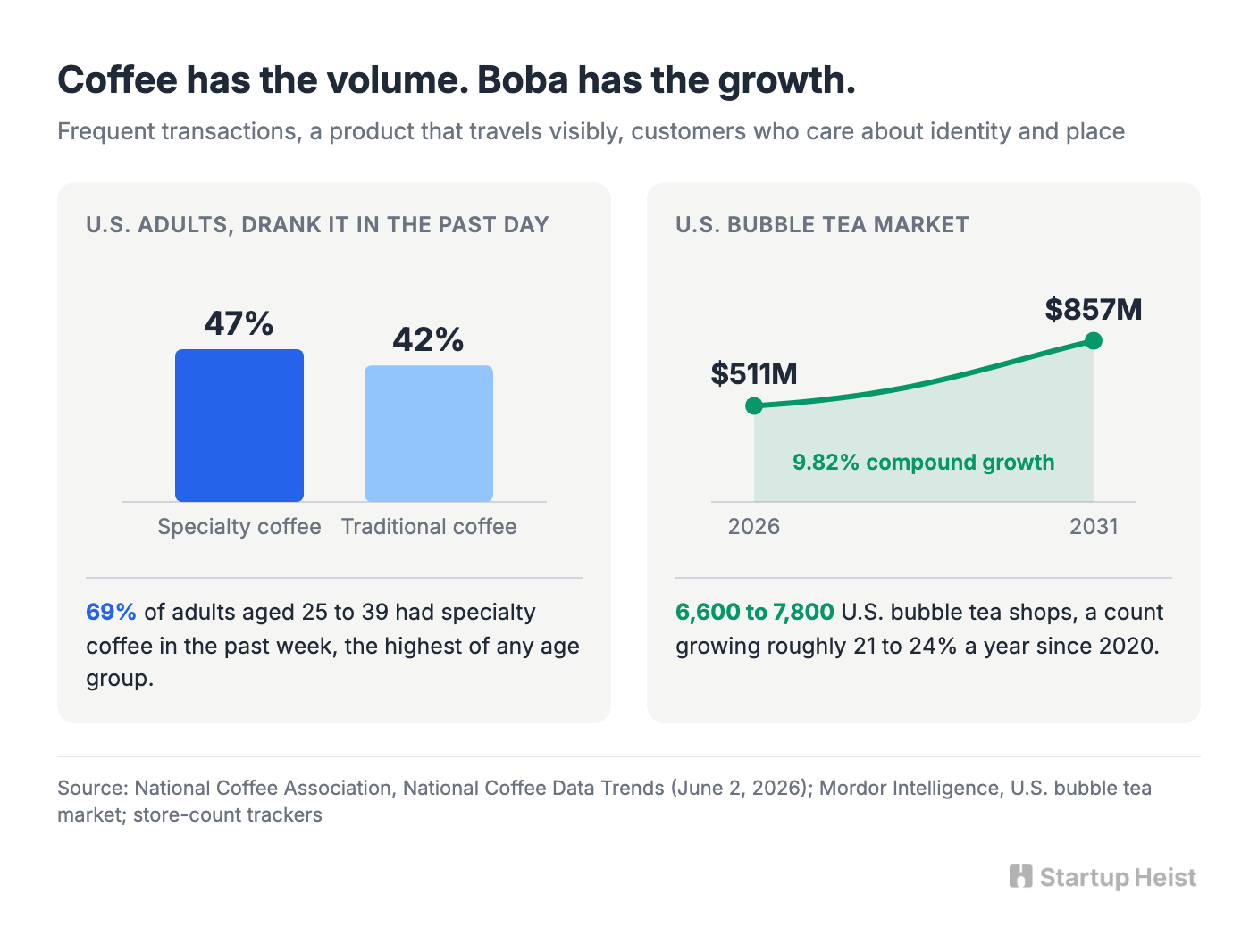
The National Coffee Association's 2026 National Coffee Data Trends report, released June 2, 2026, found that 47% of U.S. adults had specialty coffee in the past day, ahead of traditional coffee at 42%. Among adults aged 25 to 39, 69% had specialty coffee in the past week, the highest of any age group. Boba is smaller but faster. Mordor Intelligence puts the U.S. bubble tea market at $511 million in 2026, growing to $857 million by 2031, a 9.82% compound rate, with foodservice holding 57% of the channel in 2025. Store-count trackers put U.S. bubble tea shops somewhere between 6,600 and 7,800 depending on methodology, and the count has grown roughly 21 to 24% a year since 2020. Independent coffee shops number in the tens of thousands.
None of this is an argument that America needs more beverages. The problem for a neighborhood shop is that the next taro milk tea or strawberry matcha is trivially easy for the shop down the street to copy, and local identity isn't. A monthly illustration from a known neighborhood artist, or a drop tied to a university rivalry, a street festival or a local meme, can't be duplicated cleanly once the shop has built the relationships around it. The drink is the delivery mechanism; what you're really selling merchants is programmable cultural relevance.
The layer Square won't build
Square is the correct first ecosystem and also the trap. Its U.S. Square Plus plan runs $49 per location per month and bundles loyalty and marketing, including promotions tied to specific items, holidays and slow periods. Square can already run a loyalty campaign, email a customer list and put a QR code on a receipt. Pitch any of those and you're selling a feature Square gives away.
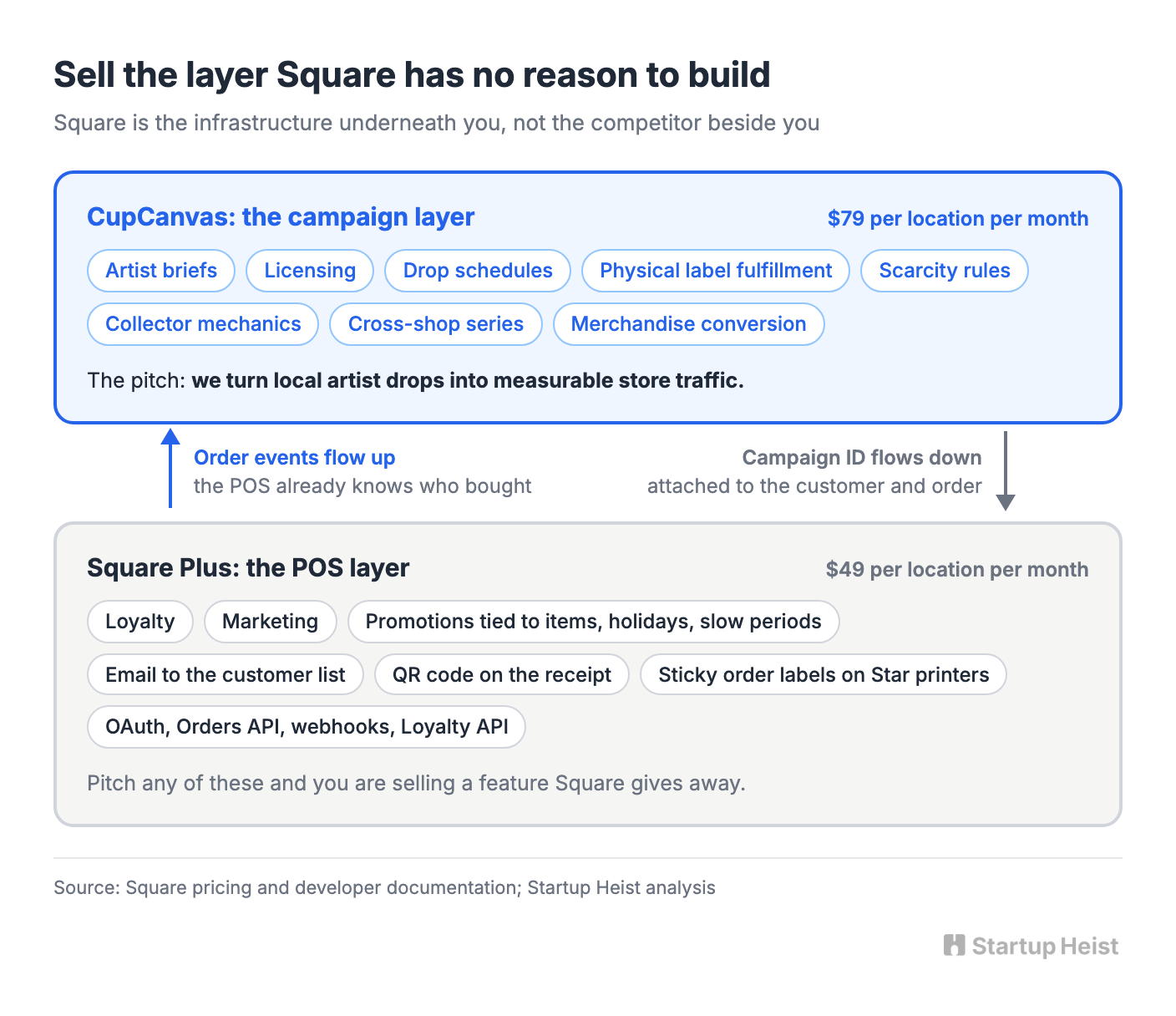
Pitch this instead: we turn local artist drops into measurable store traffic. Square becomes the infrastructure underneath you rather than the competitor beside you. CupCanvas owns the parts Square has no reason to specialize in: artist briefs, licensing, drop schedules, physical label fulfillment, scarcity rules, collector mechanics, cross-shop series and merchandise conversion. The POS already knows who bought; CupCanvas supplies the reason to come back.
The timing works for a quieter reason too. Walk into a boba shop running Square and watch the counter. Square POS supports sticky order labels on Star thermal printers, and many shops already print one per drink with the customer's name and sweetness level, which the barista sticks on the cup. The physical habit CupCanvas needs is already installed. All you're changing is what the label says.
Don't build the fun version first
The tempting demo goes like this: customer orders, receives an iPad, draws whatever they want, the software prints it, the barista applies it, everybody smiles. It would make a great TikTok and a lousy MVP. At 8:12 on a Monday morning, no coffee shop wants six customers at the register composing self-portraits. Open creation also drags you into copyright disputes, offensive content moderation, celebrity likenesses, children's images and trademark claims on day one. Heytea's own feeds show where open canvases go: anime, idols and memes the beverage company doesn't own.
So resist the coolest feature. CupCanvas v1 has no public drawing tool. The shop loads six approved designs, the customer picks number four, and the label prints. Operationally boring is exactly what you want.
What the first product does
Think of CupCanvas as Mailchimp campaigns for physical cups. Each campaign has:
Unlock the Vault.
Join founders who spot opportunities ahead of the crowd. Actionable insights. Zero fluff.
“Intelligent, bold, minus the pretense.”
“Like discovering the cheat codes of the startup world.”
“SH is off-Broadway for founders — weird, sharp, and ahead of the curve.”


