


The $129 Box That Turns a Fridge Shelf Into a Medicine Cabinet
Sub-Zero & Wolf sells refrigerators that start around £5,000. Between 2024 and 2026, demand for its smallest units rose tenfold, and the buyers aren't stocking wine. They're storing skincare actives, probiotics, peptides, and injectable weight-loss drugs. On Gumtree, where the average mini fridge sells for £45, searches for them climbed 85% between January and June 2026. Design magazines now call the result a "supplement fridge" and cover it as a category, the way they once covered wine coolers.
The obvious move is to sell the appliance. Find a thermoelectric cooler on Alibaba for $25, give it a matte finish and a name like Peptide Pod, and move it on TikTok for $149. Plenty of people are already trying. It's the wrong product, for reasons that have nothing to do with taste and everything to do with what happens when you put an electrical appliance into forty thousand homes and imply it protects prescription medication.
The better business is smaller, cheaper to start, and sits one layer down. Build the medication system that lives inside the refrigerator people already own. What you're actually selling is control over a $300-a-month medical ritual that currently consists of hiding an expensive prescription behind the yogurt.
Here's the opportunity:
The money: Two thousand units a month at $129 is $258K in monthly revenue at 56% to 71% product margin. Ten million Americans are already injecting.
Inside:
• Four-tier pricing from $69 to $199
• Full COGS breakdown and the CAC ceiling
• 90-day build plan, prototype to 500 units
• Clinic wholesale pitch plus two email scripts
The installed base got big enough to sell picks and shovels
Accessories become viable when three conditions land at once: the installed base is large, the product is part of a recurring routine, and the thing being protected costs enough that a $100 accessory reads as cheap insurance. GLP-1s cleared all three by the start of 2026.
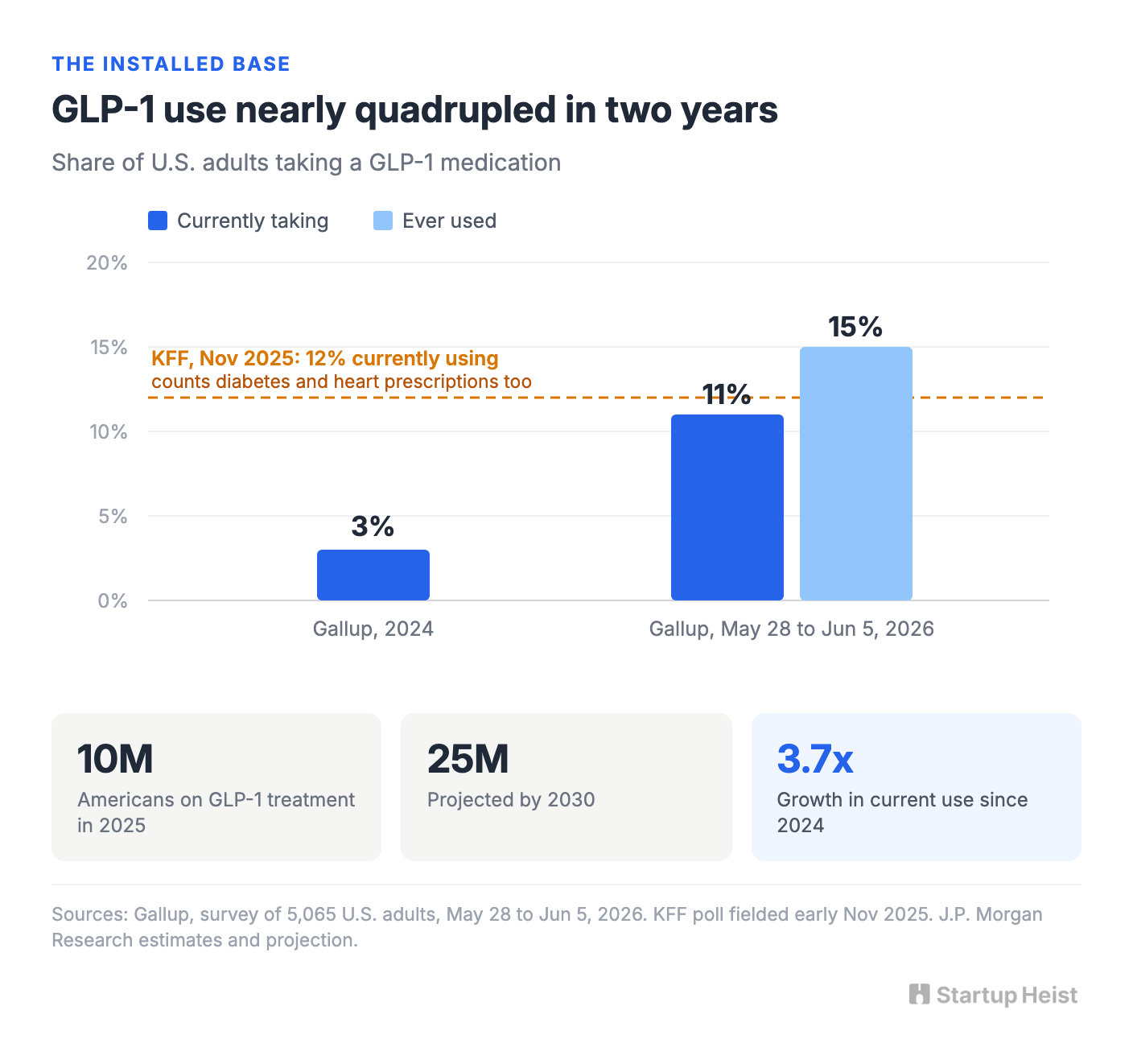
Gallup, surveying 5,065 U.S. adults between May 28 and June 5, 2026, found 11% currently taking a GLP-1 for weight loss, up from 3% in 2024. Fifteen percent have used one at some point. KFF, which counts diabetes and cardiovascular prescriptions too, put current use at 12% and lifetime use at 18% in a poll fielded in the first days of November 2025. J.P. Morgan's research desk estimates roughly 10 million Americans were on GLP-1 treatment in 2025 and projects about 25 million by 2030.
Price is falling in a way that widens the base further. In March 2026, Lilly put the Zepbound KwikPen on self-pay pricing at major pharmacies nationwide, starting at $299 a month and running to $449 depending on dose. Hims lists injectable Wegovy at $299 and Zepbound at $399, before the $149 monthly membership that sits on top. The drug that was a status symbol in 2023 is now a line item roughly the size of a car payment, which means the people buying it are increasingly ordinary households with roommates, kids, and one shared refrigerator.
Why the mini fridge is the wrong first product
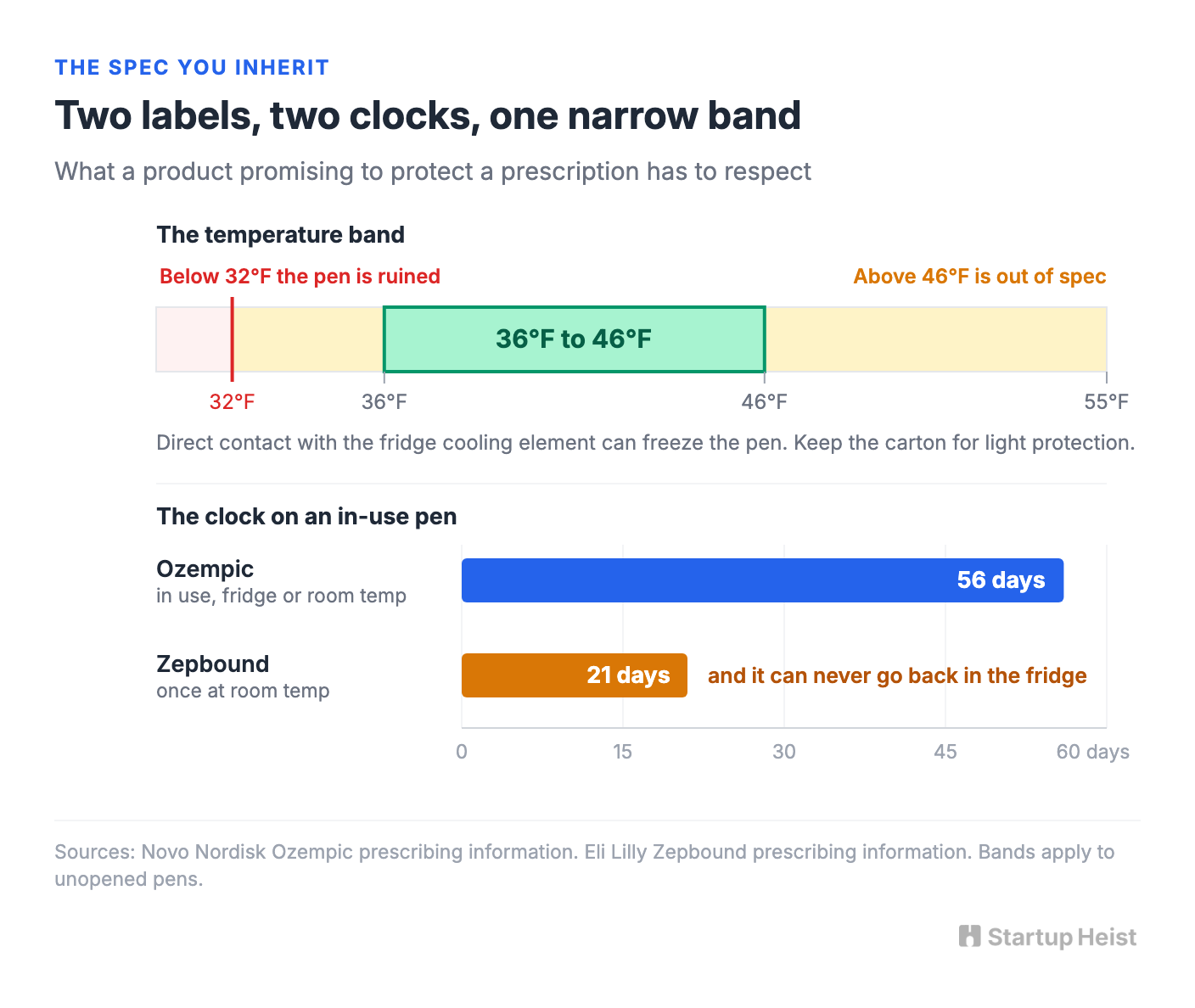
Injectable medication storage carries consequences that chilling eye cream does not. Novo Nordisk specifies that unused Ozempic pens sit between 36°F and 46°F, never frozen, kept away from the refrigerator's cooling element because direct contact there can freeze the pen. Once in use, a pen holds for 56 days refrigerated or at room temperature. Lilly specifies the same 36°F to 46°F band for Zepbound and adds two constraints most users never read: keep the product in its original carton to protect it from light, and once you move a pen to room temperature it has 21 days and cannot go back in the fridge.
A typical beauty fridge doesn't reliably hold that band. Thermoelectric units cool relative to ambient temperature rather than holding a set point, so a cooler that behaves beautifully in a 68°F bedroom drifts in an 80°F one. Purpose-built medical refrigeration solves this with microprocessor control, forced-air circulation, high and low alarms, door alarms, temperature logging, and NSF/ANSI 456 certification holding within ±0.5°C. That's a different machine, built by companies with a compliance department.
Manufacture the refrigerator and you inherit the refrigeration problem along with the claims problem, since anything advertised as protecting a prescription invites scrutiny of that promise. Shipping an electrical appliance at scale also carries a product-liability profile that a plastic organizer never touches. A consumer medication refrigerator can work. It should be your third product, funded by the first two.
The layer nobody owns
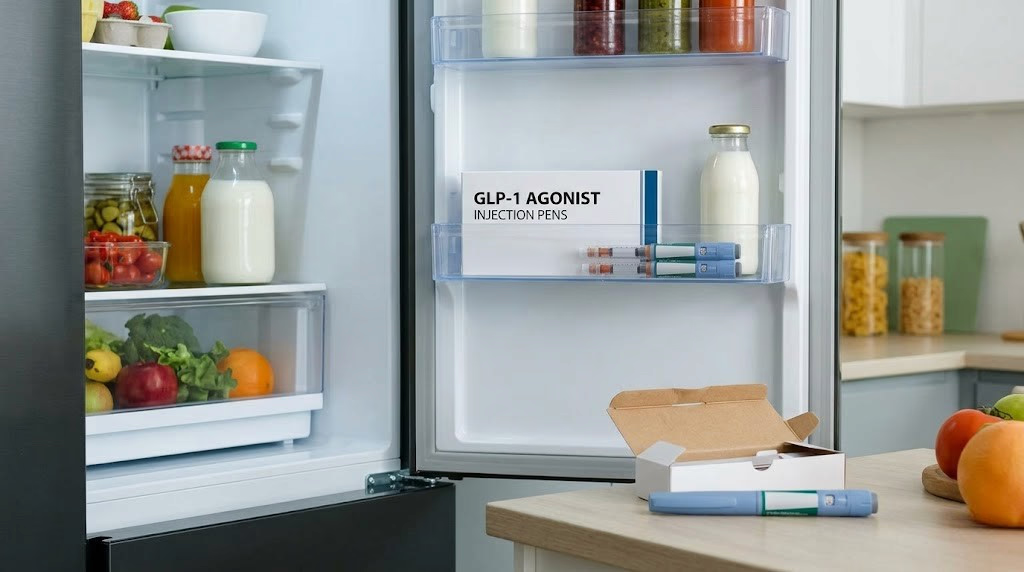
Watch what happens when someone brings home four Zepbound pens. The manufacturer supplies the medication and the appliance maker supplies the shelf. Nobody supplies anything in between. So the carton ends up wedged between the milk and the leftovers, visible to everyone who opens the door, reachable by children, movable by anyone, and occasionally thrown out by a helpful spouse doing a fridge purge. The cardboard gets damp. Alcohol wipes and spare needles live in a bathroom drawer two rooms away. Nobody knows what temperature that shelf actually holds.
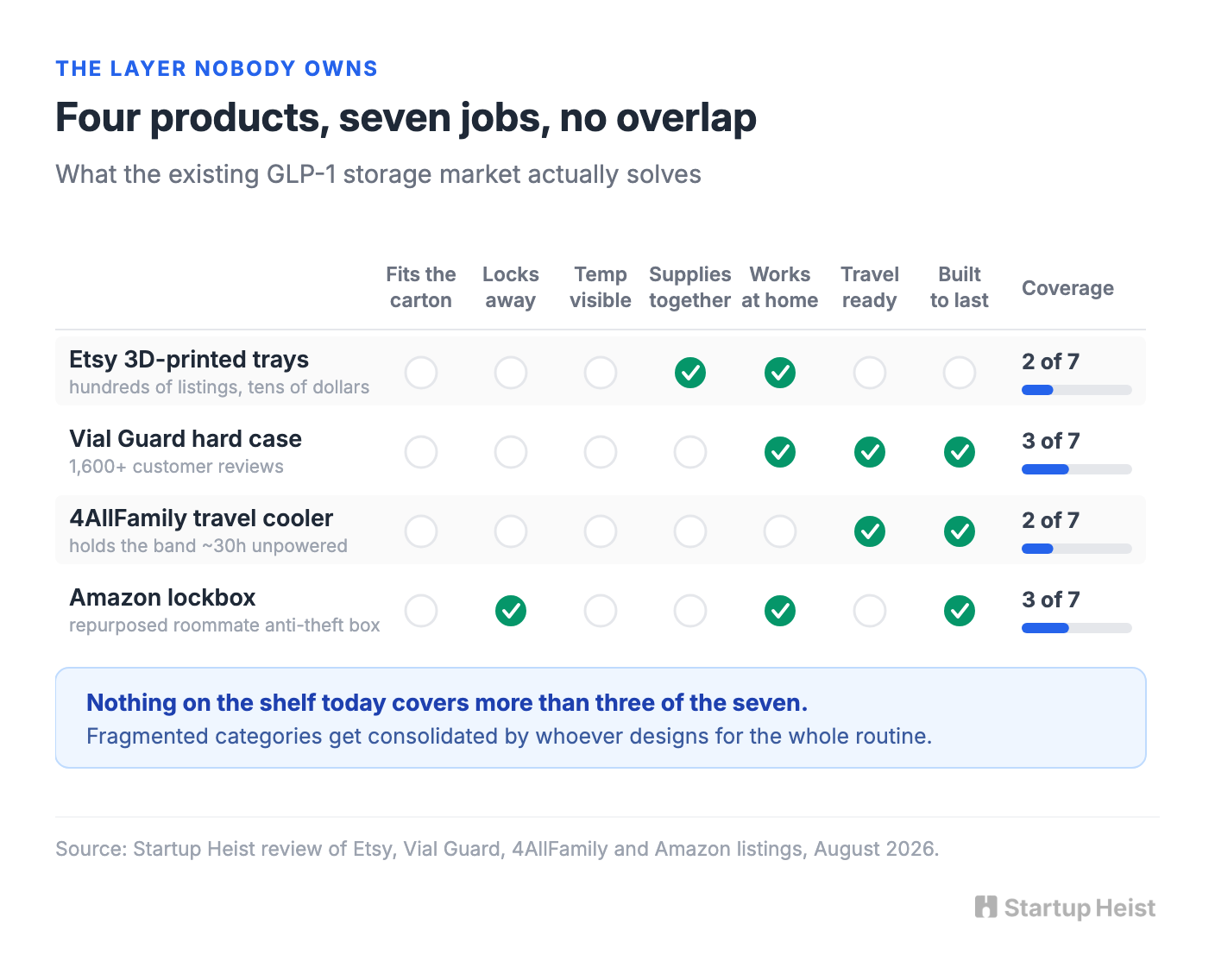
People are already solving this on their own, badly, and paying for it. Etsy carries hundreds of listings for GLP-1 pen holders, vial racks, fridge organizers, and stacking injection trays, most 3D-printed and priced in the tens of dollars. Vial Guard has built a real business on hard-shell vial cases and accumulated more than 1,600 customer reviews. 4AllFamily sells a line of medical travel coolers rated to hold the 36°F to 46°F band for roughly 30 hours unpowered and around 50 hours on USB. Amazon's generic combination-lock fridge box, originally a roommate anti-theft product, gets repurposed for medication constantly.
Every one of those is a single-purpose object solving one slice of the problem. The travel cooler doesn't help at home, the vial case doesn't lock, the lockbox has no temperature visibility and won't fit a carton, and the Etsy tray falls apart in eighteen months. This category is fragmented, and fragmented categories get consolidated by whoever designs for the whole routine.
What the customer wants is for the refrigerator they already own to behave like a private medicine cabinet.
The product
Call it a refrigerated medication station rather than a GLP-1 cooler. The naming matters for the same reason the engineering restraint does: this brand needs to outlive the specific drug that created it.
Unlock the Vault.
Join founders who spot opportunities ahead of the crowd. Actionable insights. Zero fluff.
“Intelligent, bold, minus the pretense.”
“Like discovering the cheat codes of the startup world.”
“SH is off-Broadway for founders — weird, sharp, and ahead of the curve.”


